The morning I decided to say goodbye to my kitchen cabinets, it wasn’t a grand renovation moment. It was a quiet Tuesday, the kind where the kettle whistles a bit too sharply and the light coming through the window reveals everything you’ve been pretending not to see. There they were: swollen doors, edges puckered from years of steam, tiny shadows at the baseboards that I knew—without wanting to know—meant mould. When I opened the most-used door, it sighed on wonky hinges, smelling faintly of damp particleboard and old cumin. I realised, suddenly and completely, that my kitchen had become a museum of compromises.
The Day the Cabinets Lost the Argument
It wasn’t always this way. Once, those cabinets were glossy and new, their fake-wood grain gleaming under the hardware-store pendant light. I remember running my fingers across the smooth laminate, pleased at the bargain I’d snatched up. No one mentioned that particleboard swells like a sponge, or that the thin plastic veneer would peel away like sunburnt skin in a few short years. No one talked about condensation trapped behind closed doors, or the slow, unseen creep of mould where moisture and darkness make secret deals.
You don’t notice it at first. A warped corner here, a sticky hinge there. A plate that feels inexplicably clammy when you pull it out. Then, one day, you slide a mixing bowl from the back of the cabinet and your hand comes away with a faint, stubborn smell—earthy, sour, vaguely fungal. You clean, of course. You scrub. You buy expensive mould sprays that smell harsher than the mould itself. But the truth sits there, behind every effort: the problem isn’t cleanliness. It’s the cabinets.
That morning, I leaned against the counter and let my eyes trace the outlines of every swollen edge and crooked line. It felt a bit like realising a relationship had run its course. These cabinets had seen late-night toast, nervous first-date dinners, and celebratory cakes. They’d done their job. But they were tired, and so was I. The idea had been creeping in for months, whispered by magazine spreads and the occasional bold friend: what if you just… didn’t have cabinets?
Open, Airy, and Surprisingly Practical: The Rise of Cabinet-Free Kitchens
At first, the concept sounded like a stylist’s fantasy—lovely for a photo shoot, unrealistic for a real kitchen where people burn toast and store half-empty bags of lentils. No upper cabinets? Where would the mismatched mugs go? Where would you hide the ugly plastic containers? It felt a bit like contemplating life without a closet, just everything out in the open.
But the idea also carried a quiet seduction: walls free from bulky boxes, light stretching from one end of the room to the other, everything you use within easy sight and reach. More importantly, it promised something my swollen cabinets could not: air. Ventilation. The simple, old-fashioned magic of things being able to dry properly because they weren’t sealed away in a humid little tomb.
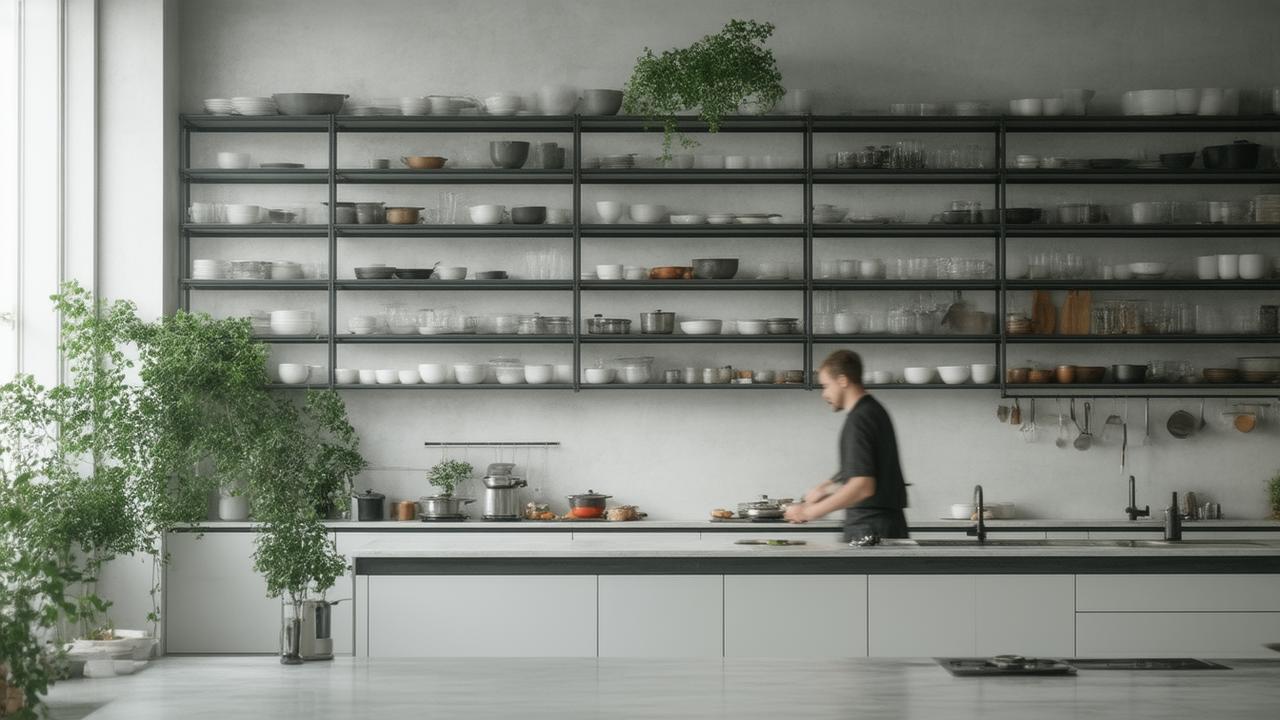
As I started looking into it, I realised this wasn’t a passing trend dreamt up on social media. The cabinet-free, or minimal-cabinet, kitchen is part of a broader movement toward simpler, more breathable homes—spaces that don’t just look good on camera, but actually feel good to live in. Instead of long lines of sealed cupboards, people are embracing open shelves, wall-mounted rails, freestanding pantry units, and sturdy, moisture-resistant worktables you can actually clean under. The kind of setup your great-grandparents might recognise, dressed up for the present day.
The Quiet Charm of Things You Can Actually See
There’s something deeply disarming about walking into a kitchen where the plates are right there on a shelf, the cooking tools hanging in easy reach, the jars of grains catching the light like a row of tiny landscapes. It turns cooking into more of a conversation with your space. You see what you have; you remember to use it. You stop buying your fifth bag of rice because the first four aren’t hiding in a dark corner.
Of course, there’s a catch: you have to let go of the idea that everything “messy” must be hidden. The new trend doesn’t pretend you’re not living a full, occasionally cluttered life. Instead, it asks a different question: what if you owned fewer, better things and gave them room to breathe?
The Cheaper New Trend: Shelves, Rails, and Freestanding Pieces
The shift away from traditional cabinetry is, at its heart, a structural rebellion. For decades, modern kitchens have been built on a simple formula: plasterboard walls + fixed cabinets screwed into studs + laminate or MDF doors + all your belongings boxed into compartments. It looks tidy—until moisture, weight, and time start to wage their quiet war.
The new wave is refreshingly straightforward. Instead of full runs of fixed cabinets, people are piecing together kitchens like a set of well-chosen tools. A sturdy, steel or solid-wood shelving unit where the heavy pots live. A simple rail with hooks for spatulas and sieves. A single, well-sealed pantry cupboard for the things that truly need darkness. A compact, freestanding island that offers drawers without the complexity of custom cabinetry. And above all: open air around, behind, and beneath things.
It’s not just a visual change—it’s a different relationship to moisture. No more deep cavities where steam from the stove creeps up and gets trapped. No more enclosed, unventilated corners where a dribble from the sink quietly seeps into flimsy chipboard. When everything is out in the open, it tends to stay dry. And dry, in a kitchen, is everything.
Materials That Don’t Sulk in Steam
The real heroes of this cabinet-light movement are the materials themselves. Instead of particleboard hearts with paper-thin skins, the trend leans into what can actually withstand a life of splashes, spills, and steam.
Think powder-coated steel shelving units that shrug off humidity. Solid hardwood boards, properly sealed, whose occasional scratch adds character rather than inviting disintegration. Stainless steel prep tables like the ones you see in restaurant kitchens—industrial, wipeable, impossible to bully with a wet dishcloth. And for walls, tile or limewash finishes that can be wiped or breathe without peeling.
This doesn’t mean you need to turn your home into a commercial kitchen. It means choosing a few hard-wearing, moisture-friendly elements and building the rest of your space around them. A single steel rack above the counter might hold your everyday plates and glasses. A reclaimed timber shelf, oil-finished rather than lacquered, can cradle your jars of dried fruit and grains. Each piece is simpler—and often far cheaper—than a full wall of made-to-measure cabinets.
| Option | Approx. Cost (per linear metre) | Moisture & Mould Resistance |
|---|---|---|
| Standard MDF/laminate cabinets | Medium–High (includes doors, hinges, fitting) | Low – prone to swelling, peeling, hidden mould |
| Open solid-wood shelf + brackets | Low–Medium (depends on wood type) | Medium – good if sealed and well ventilated |
| Powder-coated steel shelving unit | Low (off-the-shelf, no fitting fees) | High – very resistant to warping and mould |
| Stainless steel prep table/island | Medium | Very High – built for commercial moisture levels |
Designing a Kitchen That Breathes (and Still Looks Beautiful)
There’s a worry that seeps into people’s voices when they first imagine a no-cabinet kitchen: “Won’t it look messy?” It’s a fair question, especially if your mental picture is a jumble of cereal boxes and stained plastic bowls piled in the open. But the trick isn’t perfection—it’s intention.
Start with what you reach for every day. The plates you actually use, the three favourite mugs, the spices you genuinely cook with. Those belong in the most visible, accessible places: on a sturdy shelf, on a rail, in a shallow open crate beside the stove. Everything else can be demoted to a closed pantry or a lower drawer in a freestanding unit. You’re not banning doors entirely; you’re using them sparingly, where they matter most.
Colour and texture do a lot of heavy lifting in cabinet-free spaces. A pale wall with just two wooden shelves can feel serene rather than sparse. A single, bold rail of black steel with neatly hung tools can read as intentional décor. A cluster of glass jars—lentils, oats, flour—becomes both storage and display, with the added bonus that you can see when you’re running low.
Light, Sound, and the Pleasure of Less Bulk
Something subtle happens when you strip upper cabinets from a kitchen: the room exhales. Light reaches corners it hasn’t touched in years. Sounds change—the soft clink of plates on an open shelf is oddly satisfying, more honest than the muffled thunk of a cabinet door. You start to notice the way steam from a boiling pot curls freely upward rather than gathering in the shadows of a cupboard over the stove.
There’s a psychological lightness, too. Without the opaque boxes overhead, it becomes harder to stash things you don’t need. Clutter has nowhere to hide, which sounds scary until you realise it nudges you, gently, toward owning less—and loving what you keep more.
The Anti-Mould Kitchen: Airflow as Design Principle
Mould thrives in a particular kind of silence: still air, trapped moisture, hidden surfaces. Traditional cabinets are perfect for that. Steam seeps in around imperfect seals, minor leaks go unnoticed, and dust mingles with damp on the invisible backs and undersides of boxes fixed tight against the wall. By the time you notice, it’s often widespread.
A cabinet-light kitchen flips the script by letting air become part of the design. Gaps beneath freestanding units let you actually mop under them. Space behind open shelving invites circulation instead of stagnation. Even simple choices—like not letting shelving run all the way to the ceiling—give hot air a place to rise and move.
➡️ No one wants a living-dining room anymore : French households are switching to this far more sociable trend
➡️ Hairstyles after 60: forget old-fashioned looks, as professional hairstylists say this haircut is the most youthful
➡️ If your dog gives you its paw, it’s not to play or say hello : animal experts explain the reasons
➡️ Starlink Unveils Mobile Satellite Internet: No Setup, No New Phone Needed
➡️ Pour half a glass of this common kitchen liquid—no vinegar or baking soda—to clear a slow drain automatically
➡️ A Popular Hair Washing Habit Gradually Weakens Hair After Midlife
➡️ How many showers per week are truly optimal for healthy aging? Experts challenge conventional wisdom
In such a space, mould has fewer secrets. A damp patch stands out against open wall. A spill under a steel rack can be wiped in seconds, not left to fester behind toe-kicks and end panels. You may still have the occasional drip or splash—this is a kitchen, after all—but you can see it, reach it, and fix it before it becomes a quiet disaster.
Cleaning That Feels Less Like Battle, More Like Ritual
Ironically, a more open kitchen is often easier to keep clean, precisely because nothing is hidden. The flat underside of a shelf collects a thin film of dust, visible enough that you run a cloth over it as routinely as you rinse your mug. The legs of a freestanding table gather the inevitable crumbs, but you can see them. Five minutes with a broom, and it’s done.
Compare that with the contortions of trying to clean behind built-in cabinets or under a row of kickboards. The battle against unseen grime is exhausting. By contrast, the new trend leans into visibility: if you can see the mess, you can deal with it long before it becomes a problem. Less drama, fewer harsh chemicals, more straightforward care.
Where the Old Cabinets Go (and What Comes Next)
The day I finally unscrewed my first cabinet from the wall, the room fell strangely quiet. Particleboard dust floated in the slanted morning light. Behind the box was the ghost of a kitchen past: unpainted patches, old screw holes, a faint watermark from some ancient leak. It felt raw, a little shocking. But also honest. I patched, I sanded, I painted. Then I mounted two simple wooden shelves and rolled a steel rack into the corner where three swollen cupboards used to stand.
Gradually, the kitchen reshaped itself. The heavy things—the cast iron pots, the bulky mixer—claimed the lower open shelves of a freestanding unit. Everyday plates lined up in the open, their familiar chips suddenly part of the décor. My favourite spices migrated to a single, reachable rail. The rest—spares, rarely used gadgets, the good china—moved into a single, tall cupboard away from the sink, where moisture was less of a threat.
It wasn’t instant perfection. There were weeks when the arrangement felt off, when a shelf seemed a few centimetres too high or a jar needed a new home. But the flexibility was the point. Nothing was glued into place, no massive run of cabinets dictating where everything must live forever. The kitchen and I were in conversation again, adjusting, refining, finding the balance between beauty, function, and air.
Now, when the kettle whistles and the morning light spills across the room, I see no swollen doors, no warped edges, no secret shadows along the baseboards. Just open shelves, breathing walls, and the quiet, unshowy confidence of materials that don’t mind a little steam. The kitchen feels less like a fitted product and more like a living space—one that grows, changes, and stays dry.
Goodbye, kitchen cabinets. Not goodbye to storage, or to order, or to the comfort of a well-loved mug in its familiar place. Just goodbye to swollen doors, mouldy corners, and the myth that everything has to be boxed in to be beautiful. The new trend isn’t just cheaper, or tougher, or easier to clean. It’s a reminder that sometimes, the best thing you can give a room is the simplest gift of all: room to breathe.
FAQ
Won’t an open, cabinet-free kitchen look cluttered?
It can, if you try to keep everything you own on display. The key is to curate what lives out in the open—everyday plates, frequently used tools, staple ingredients—and store rarely used items in a single closed pantry or freestanding cupboard. Intention, not perfection, keeps the space feeling calm.
Is this really cheaper than installing traditional cabinets?
In most cases, yes. Off-the-shelf shelving, rails, and freestanding units are often far less expensive than custom or semi-custom cabinetry, especially once you factor in fitting costs. You can also build the kitchen gradually, buying one solid piece at a time instead of committing to a full run of cabinets at once.
How do I keep dust off items stored on open shelves?
Everyday dishes and glasses tend not to gather much dust because they’re used and washed frequently. For items that sit longer, a quick wipe as part of routine cleaning is usually enough. Proper ventilation helps, too, reducing the sticky dust that forms in poorly ventilated spaces.
What materials are best if I want to avoid warping and mould?
Look for powder-coated steel, stainless steel, and well-sealed solid wood. Avoid raw particleboard and cheaply laminated MDF in areas exposed to steam or splashes. Good wall finishes—like tile or breathable paints—and proper caulking around sinks also make a big difference.
Do I have to get rid of all my cabinets to follow this trend?
Not at all. Many people keep a few lower cabinets or a single pantry while removing upper cabinets to open up the space. You can also mix: one closed unit for truly messy items, open shelves and rails for everything else. The aim isn’t to follow a rule; it’s to create a kitchen that works, breathes, and lasts.





