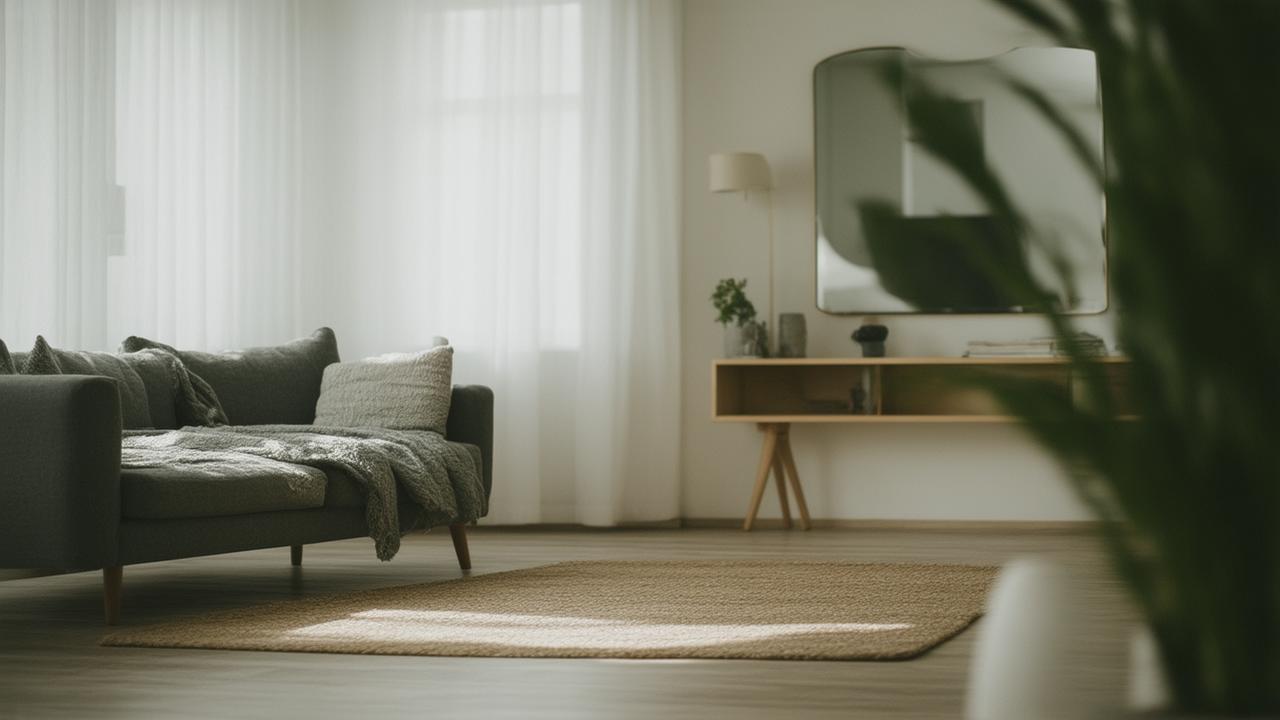
There’s a moment, just after you step into a room, when your eyes haven’t quite decided what story they’re being told. Is this space cramped or generous, calm or cluttered, shrinking in around you or quietly expanding? Standing in a small living room, that first impression can feel unforgiving—low ceilings, close walls, a sofa that suddenly looks way too big for its own good. But decorators have a favorite trick, almost like a visual sleight of hand, that changes the story instantly. It doesn’t require knocking down walls or moving house. It’s about how you guide the eye—how you teach a small space to pretend it’s large, airy, and inviting.
The Subtle Magic of a Single Move
Imagine walking into a tiny city apartment, the kind where the living room is basically the front door, dining room, and Netflix corner all in one. Yet as you step inside, it doesn’t feel cramped. Instead, your gaze travels across the room, gliding along a soft, continuous line of color and light. Nothing stops your eye; nothing chops the room in half. The walls seem to lean away, the ceiling feels taller, and the whole space somehow breathes.
This is the illusion decorators love most: extending sightlines with one unified move. Their favorite trick is deceptively simple—use consistency to stretch the room. One color story, one large rug, one main focal point, one sweep of curtains, one quiet rhythm instead of many small, loud interruptions. When the room feels like a single, calm thought instead of a noisy debate, it grows.
The eye is lazy in the best way. It wants the easiest, smoothest path. If you give it a continuous visual route—a rug that anchors the furniture, curtains that climb higher than the window, walls that melt into the trim, furniture legs you can see under—it tells your brain: This is open, spacious, uncluttered. The room itself hasn’t changed by a single square inch. Your perception has.
The Power of One: The Rug That Unites Everything
If decorators had to choose one item that changes the feel of a small living room most dramatically, many would point to the rug. Not a tiny, apologetic one that floats sadly in front of the sofa, but a generous rug that reaches under the main furniture, gathering them into one visual island.
Picture a small living room with a too-small rug—one that just fits under the coffee table. Each piece of furniture sits alone, like strangers at a bus stop. The sofa here, the chairs there, the side table trying to make friends with the wall. Your eye hops from one object to the next, never finding a home base. The room feels busy, bitty, and somehow smaller than it is.
Now picture the same room with a larger rug that stretches wider, its edges reaching near the front legs of the sofa and chairs. Suddenly, they’re all in conversation. They belong to the same zone. Your eyes find the rug first, then slide outward, following its edges to the walls. The space feels cohesive, as if it has intention and shape instead of just…furniture scattered on a floor.
That’s the essence of the decorator’s favorite illusion: one big gesture instead of many tiny ones. One wide rug, not three little mats. One primary color carrying through walls and textiles, not six clashing shades. One main seating arrangement, not a random scattering of chairs. Where the eye sees unity, the brain sees spaciousness.
The Rule Most People Get Backwards
In small spaces, people instinctively go small: small sofa, small coffee table, small rug. It feels logical—like you’re being careful not to overwhelm the room. But visually, the result is often the opposite: everything looks miniature and the space feels even tinier.
Decorators, however, lean into a counterintuitive truth: a few larger, well-chosen pieces can make a space look bigger than many small ones. A generous rug that grounds the furniture. A substantial coffee table with open legs. A single, striking piece of art instead of a cluttered gallery wall. These bigger gestures create calm, and calm reads as spacious.
Stretching the Room With Color and Light
Walk into a living room where the walls are one color, the trim another, the ceiling a third, and the furniture a wild mix of patterns and hues. Even if the pieces are lovely, your eye is constantly stopping and starting. Every color change is like a comma, a pause in the sentence of the room. And in a small space, too many pauses make the sentence feel choppy.
Now imagine that same room softened by a more restrained palette. The walls and trim are close in tone, so edges blur gently instead of shouting for attention. The sofa and rug echo each other’s colors, not perfectly matched but related, like cousins. The curtains blend with the walls instead of slicing a harsh vertical line at either side of the window. Instead of seeing ten colors, your eye sees two or three in varying shades, flowing from surface to surface.
This is another version of the decorator’s illusion: color continuity. When walls, curtains, and large furniture exist in the same quiet color story, your eye doesn’t stop at every edge. It drifts, floats, glides. Width and height seem to expand because you’re no longer counting boundaries—you’re reading the room as a whole, not as a collection of parts.
The Ceiling Trick That Changes Everything
There’s a small move that decorators often make in low or modest-height rooms: they hang curtains higher than the window. Mounted closer to the ceiling line, with panels that kiss or lightly pool on the floor, curtains become tall vertical ribbons that pull your gaze upward. Suddenly, your perception of the room’s height shifts. The windows seem grander, the walls taller, and the room instantly more stately.
This works with paint, too. Extending the wall color onto the ceiling, or choosing a slightly lighter version for overhead, can erase that sharp line where wall meets ceiling and make the room feel like one airy envelope instead of a box with a lid slapped on top. Again, the space hasn’t changed—only the story your senses are being told.
Less Legs on the Ground, More Air in the Room
Furniture doesn’t just take up space; it affects how we perceive the air around it. Heavy, skirted sofas that sit flush with the floor can make a compact living room feel weighed down, as if the furniture is blocking both light and line of sight. In contrast, a sofa or chair on slender, visible legs lets light slip underneath and around it. You read not just the object, but the air beneath and behind it—and that air counts as visual space.
Decorators often choose a few streamlined, raised pieces for small living rooms: a sofa on tapered legs, an open coffee table where you can see the rug underneath, maybe a floating media console or wall-mounted shelves instead of a bulky cabinet. The more floor you can see, the more room your brain thinks you have.
It’s a simple question to ask yourself before bringing any piece into a small room: Will this show me more floor and wall, or hide it? If it hides, it shrinks. If it reveals, it expands.
Editing Instead of Shrinking
There’s another mental trap: trying to solve a tight room by adding more small storage—little cabinets, narrow bookcases, tiny side tables with drawers. Each piece might seem practical, but together they nibble away visual openness. Decorators know that one long, low console can store as much as two tiny cabinets, while also giving the room a single, calming horizontal line and an extra stretch of visible wall above.
Open space is not wasted. It’s the negative space that makes the positive shine. In a small living room, editing down to a handful of pieces that truly serve you—and then giving them breathing room—does more for spaciousness than any number of space-saving gadgets.
Directing the Eye: Focal Points and Flow
Every room has a first sentence—a place your eyes land immediately. Maybe it’s a fireplace, a window, a piece of art, or simply the sofa. Decorators use that first sentence to set the tone and stretch the room in the direction they want.
In a small living room, they might emphasize a view by keeping the window area clean and hanging simple, full-length curtains that frame the glass without clutter. The eye is invited outward, beyond the room, to sky and trees and rooftops. The interior walls become just one part of a larger visual field.
➡️ A legendary rock band announces its retirement after 50 years, leaving behind the hit everyone knows
➡️ A new kitchen device is poised to replace the microwave for good and experts say it’s far more efficient tested
➡️ A bay leaf under the pillow : the small night routine I once mocked, until it changed my sleep
➡️ Bad news a 135 fine will apply to gardeners using rainwater without authorization starting January 18
➡️ Birdwatchers say this one winter fruit keeps robins loyal to your garden
➡️ A basic household product washed down the pipes restored perfect flow leaving repair workers stunned
➡️ Boiling rosemary is the best home tip I learned from my grandmother: it transforms the atmosphere of your home
If there’s no view to lean on, a single, oversized art piece or a large mirror becomes the anchor. Mirrors, when placed thoughtfully, bounce light and suggest depth. A mirror opposite a window can make the room feel as if it has another opening, another source of light. One big mirror is usually better than three tiny ones. Remember the rule of one strong gesture.
Flow is the other quiet hero. When pathways are clear—nothing blocking the route from door to seating, no sharp corners jutting into walkways—the room feels more generous. You experience its length and width with your body, not just your eyes. A simple walk across the room without sidestepping furniture adds to that sense of ease and openness.
A Small-Space Snapshot
Consider a small living room that feels surprisingly large:
- A generously sized rug stretches wide, with all major pieces touching it.
- The walls and curtains share a soft, related color, blurring edges.
- The sofa and chairs sit on slender legs, showing off patches of floor beneath.
- One large artwork anchors the main wall; the rest of the decor is edited and quiet.
- A single, long console below the TV replaces three separate little storage units.
No walls moved. No ceiling raised. Just a handful of intentional, unified moves that teach the eye to see breadth instead of boundaries.
Quick Reference: Small Moves, Big Illusions
Here’s a compact look at how decorators translate this illusion into everyday choices:
| Design Choice | Small-Space Version | Why It Feels Bigger |
|---|---|---|
| Rug size | One large rug under front legs of furniture | Unifies the seating area into a single zone |
| Color palette | 2–3 related tones repeated across room | Reduces visual “noise” and distractions |
| Curtains | Mounted high, reaching floor, close to wall color | Draws eyes up and softens window edges |
| Furniture legs | Raised, visible legs, fewer bulky bases | Reveals more floor, adding visual air |
| Focal point | One strong focal (art, mirror, view) | Gives eyes a clear path and reduces clutter |
Bringing the Trick Home
Stand in your own living room for a moment. Let your eyes wander the way a guest’s would. Where do they stop abruptly? Which pieces shout the loudest? How many little objects compete for attention instead of one or two strong, calm gestures?
Try this sequence, room by room, in any small space—living room, bedroom, even a narrow entryway:
- Choose the “one big move”: a larger rug, a unified wall-and-trim color, or higher-hung curtains.
- Edit: remove one small piece of furniture that blocks flow or hides floor space.
- Soften the palette: repeat one main color on at least three large surfaces.
- Establish a single focal point and let everything else turn down the volume a little.
- Notice how your body feels in the room now—how your breathing and posture subtly change.
In the end, the decorator’s favorite trick isn’t about a specific product or brand. It’s about understanding how gently our senses can be persuaded. A small room doesn’t need to apologize for its size. With a few intentional, unified choices, it can stand a little taller, breathe a little deeper, and quietly convince everyone who enters that it’s bigger than it really is.
FAQ
What is the single most effective way to make a small living room feel larger?
Using a larger area rug that anchors all your main seating pieces is often the most dramatic change. It instantly unifies the room and makes it feel intentional and expansive instead of fragmented.
Do dark colors always make a small room feel smaller?
Not always. Dark colors can feel cozy rather than cramped if used consistently and with good lighting. The key is to avoid high contrast and visual clutter; a deep, unified palette can still feel spacious if edges are softened and the room is well lit.
How high should I hang curtains in a small space?
Whenever possible, hang curtains close to the ceiling or a few inches below the ceiling line, and let them reach the floor. This vertical line draws the eye upward and makes walls appear taller.
Is it better to have multiple small pieces of furniture or a few large ones?
A few larger, streamlined pieces usually feel more spacious than many small items. Too many small pieces create visual busyness and interrupt sightlines, making a room feel cluttered and tight.
Can mirrors really make a small room look bigger?
Yes, when used thoughtfully. A single, well-placed mirror—especially opposite a window or in a position that reflects light and open space—adds depth and brightness, creating the impression of a larger room.





