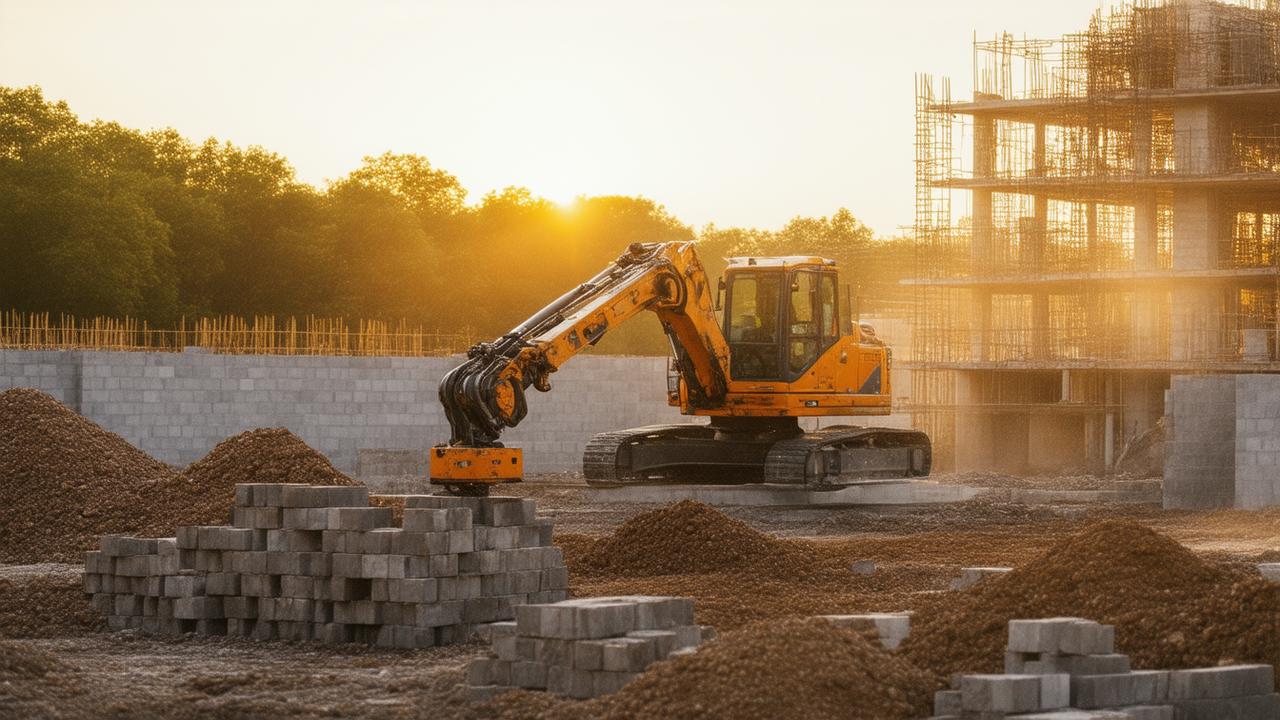
The first thing you notice is the sound. Not the whine of a saw or the heavy thud of hammer on nail, but a smooth, rhythmic hum, like an oversized 3D printer exhaling. In the pale light of early morning, a mechanical arm glides along a rail, tracing invisible lines into the air, then lowering to lay down a thick ribbon of concrete. There are no clouds of dust, no shouting, no rush of workers scrambling over scaffolding. Just one robot, moving with almost eerie calm, slowly sketching a home into existence on an empty patch of land. By this time tomorrow, that patch will be a fully built, 200 square meter house.
The Day a House Appeared Overnight
Imagine walking past a vacant lot on your way home from work, then returning the next day to see a finished, solid home standing where there was nothing before. Walls up. Rooms defined. Doorways formed. The roof frame ready. It sounds like a time-lapse video brought to life—and yet this is no special effect. Around the world, full-sized homes are now being built in less than 24 hours by giant robotic systems we’ve come to know as construction 3D printers.
On this particular site, the ground smells faintly of wet earth and new concrete. The air is cool, but the machine moves as though immune to weather, emotions, even the idea of fatigue. Its steel joints and hoses flex gently as it extrudes layer upon layer of a thick, fast-setting concrete mix, building up the walls in smooth, deliberate passes. Each layer is only a few centimeters high, but the house rises quickly—like a loaf of bread lifting in slow motion.
This 200 m² home is roughly the size of a generous family house: open-plan living area, a couple of bathrooms, three or four bedrooms, maybe even a studio or office space. Traditionally, such a house might take months: surveying, foundations, framing, bricklaying, endless weather delays, delivery of materials, scheduling conflicts, and human exhaustion. Here, the shell of the building—the structural walls and the main form—is done in about a day. No coffee breaks. No overtime pay. No delays because it rained overnight.
In a world where housing prices feel like they’re being pulled upward by invisible strings, this sight—a robot calmly building a home in 24 hours—feels almost radical. It’s not just a technological curiosity. It’s a direct, physical challenge to the idea that a home must be slow, expensive, and complicated to create.
The Robot That Draws in Concrete
How It Actually Builds a House
People often picture a humanoid robot with a hard hat, but the reality is more elegant and strange. The “robot” is more like an oversized CNC machine or a gantry crane: a frame or set of arms that moves with precision over a prepared foundation. It follows a digital blueprint—a 3D model of the house—turning lines of code into layers of material.
Instead of ink or plastic, this printer uses a specialized concrete mix. It’s pumped through a hose into a nozzle at the end of the robotic arm. As the arm moves, it lays down continuous beads of this concrete, tracing the shape of walls, curves, and structural elements. The material is engineered to set quickly enough that the next layer can be added almost immediately, but not so fast that it clogs the system.
A typical build starts just after sunrise. The foundation slab is already there, poured the traditional way or with other prefab methods earlier. The robot is positioned, calibrated, and fed its digital instructions. Then, quietly, it begins: first the outer walls, then interior partitions, thickening areas where support is needed, leaving spaces for doors, windows, and utilities. As the day unfolds, the house seems to grow from the ground like a strange gray coral reef, each layer fusing seamlessly to the previous one.
There’s a mesmerizing precision to it. The corners are clean. The curves—if the architect has chosen them—are smooth and organic, something that’s normally expensive and difficult to achieve with conventional methods. No bricks to stack. No wooden formwork to dismantle. No piles of off-cuts lying around. The robot prints exactly what is needed, where it’s needed.
What Still Needs Human Hands
Of course, the robot doesn’t do everything. Electricians still need to wire the home. Plumbers still install pipes, fixtures, and fittings. Roofers come in to complete the top structure if it isn’t also pre-fabricated. Windows must be inserted; doors must be hung. But this is where the timeline becomes interesting.
Instead of months of structural work, much of the house’s “skeleton” appears in a single day. That means the remainder of the build can be scheduled with far more certainty. Tradespeople can know, down to the hour, when their part begins. Weather has less time to interfere. The longest, most labor-intensive stage—raising walls—is now the fastest.
Speed, Cost, and the Housing Squeeze
Why 24 Hours Matters
A single 200 m² house built in 24 hours is an impressive engineering feat. But the real breakthrough is what that speed means when scaled. Picture a row of 10 such homes, printed one after another. Or a small community taking shape not across years, but months.
In many cities, the housing crisis is no longer an abstract phrase. It’s the sound of rent increases sliding into your inbox each year. It’s the feeling of cramped apartments shared by too many people. It’s families living in temporary shelters, or cars, or on couches. It’s younger generations quietly lowering their expectations from “own a home one day” to “maybe find somewhere that doesn’t eat half my income.”
Traditional construction is slow and increasingly expensive. Skilled labor is in short supply, materials costs have surged, and regulations—while often necessary for safety—add time. Against this backdrop, the idea of printing a home in 24 hours is more than flashy tech; it’s a potential tool for shifting the entire equation.
Faster builds mean less labor cost, fewer delays, and an ability to respond quickly to urgent needs—after natural disasters, for refugee housing, or in rapidly growing urban areas. Combine that with designs that use less material and generate less waste, and the price of a basic, safe home could drop to a level that actually feels reachable for more people.
Numbers That Tell the Story
While specific figures vary by project and country, comparisons between traditional and robot-printed homes usually highlight gains in time, waste reduction, and labor use. A simplified example might look like this:
| Factor | Traditional Build (200 m²) | Robot-Printed Build (200 m²) |
|---|---|---|
| Time for Structural Walls | Several weeks to months | Under 24 hours |
| On-Site Labor Needed | Large crew, multiple trades | Small team supervising robot |
| Material Waste | High (off-cuts, surplus) | Low (printed to design) |
| Design Flexibility | Curves and custom forms expensive | Organic shapes and curves easier |
Even rough comparisons like this make something clear: automation doesn’t just shave off a bit of time. It reshapes where the time and cost lie in the entire process.
Concrete, Carbon, and Careful Optimism
The Environmental Question
Housing crises and climate crises often collide in uncomfortable ways. We need more homes, quickly. We also need to drastically reduce emissions and resource use. Concrete, unfortunately, is one of the most carbon-intensive materials we rely on. So when we hear about houses being printed from concrete, a fair question emerges: are we just speeding up the wrong kind of building?
The answer is complicated, but not hopeless. Robotic construction can reduce waste dramatically, because it uses only as much material as the design calls for—no more stacks of broken bricks or landfill-bound timber. Designs can be optimized by software to use less material while maintaining strength. Some projects are already experimenting with low-carbon mixes, recycled aggregates, and binders that reduce the footprint of each printed layer.
There’s also an architectural advantage: when you’re no longer limited by straight lines and standard brick sizes, you can design walls that curve, hollow out, or thicken strategically to insulate better, capture shade, or integrate natural ventilation. That means houses that stay cooler or warmer as needed, requiring less energy to run.
Printed homes aren’t a magic green bullet. But they may offer a platform where smarter design, thriftier use of resources, and new materials can all meet more easily than in traditional construction.
Jobs, Craft, and the Human Touch
What Happens to Builders?
Whenever a robot steps into a human-dominated field, the fear is immediate and understandable: whose job does this replace? If a machine can lay down a house in 24 hours, what happens to the bricklayers, carpenters, and laborers who once did that work?
The reality unfolding on many early projects is more nuanced than simple replacement. Robots are excellent at repetitive, precise tasks. They don’t get tired or injured from lifting heavy materials. They can work in extreme conditions. But they are not good at everything.
Construction sites with 3D printing robots still need people—just in different roles. Operators oversee the machines and troubleshoot. Technicians maintain and repair the equipment. Designers and architects learn to think in layers and contours, translating human needs into printable forms. Skilled trades remain essential for finishing work, infrastructure, and all the small adaptations that real-life building throws up.
Some of the most physically punishing work may disappear, replaced by more technical and supervisory roles. That shift isn’t painless. It demands retraining, new education programs, and a cultural adjustment in how we think about “building” as a profession. But it also opens a path for safer, more sustainable careers in the sector.
And then there’s something harder to quantify: the preservation of craft. There will always be a place for hand-built timber homes, for carefully laid stone walls, for the intimate art of renovation and restoration. Robotic homes don’t erase that—they simply occupy a different part of the spectrum, where speed, scale, and affordability are urgent priorities.
➡️ “I didn’t expect one decision to save me $750 in just three months”
➡️ Psychology says people who grew up without air conditioning developed these 7 mental resilience traits that are nearly impossible to build today
➡️ Heated dispute over effortless patio cleaning: the ‘miracle’ method for blackened slabs that some call genius and others call irresponsible
➡️ This forgotten feature in your car improves visibility during bad weather
➡️ Food experts explain why this cooking shortcut often backfires
➡️ The simple reason some rooms echo more than others
➡️ The exact reason your phone battery drains faster at night even when you are not using it
From Prototype to Policy
Barriers Beyond the Building Site
Technologically, the idea of a 24-hour, 200 m² printed home is no longer science fiction. It has been done, repeatedly, in various countries. But technology is only one piece of the puzzle.
Local building codes often weren’t written with extruded concrete walls in mind. Inspectors must learn how to assess these new structures. Insurance companies need data and standards. Financing models must adapt to homes that can appear in a day but may not fit conventional checklists.
Then there’s public perception. Homes are emotional structures. We attach identity, safety, and belonging to them. Some people may resist the notion of living in a house that a robot printed, fearing it’s somehow less “real” or less durable than one built by hand.
Over time, these barriers can shift. It wasn’t so long ago that prefabricated homes or modular buildings were dismissed as temporary or low status, yet many are now admired for their efficiency and clean design. As more robot-printed homes stand the test of time—weathering storms, hosting families, quietly lasting decades—trust will grow.
Policy, too, can help or hinder. Cities wrestling with spiraling housing costs may choose to create fast-track approval processes for validated robotic construction methods. Governments seeking to reduce homelessness or rebuild after disasters might fund pilot communities of printed homes. Or they might not, leaving the technology to inch forward in isolated showcases rather than becoming a mainstream tool.
A Different Kind of Dawn in the Neighborhood
As evening falls on that construction site, the robot’s work is almost done. The walls stand tall and smooth, their layered texture catching the low light like the grain of a fingerprint. You can walk through the open spaces now—down a hallway that didn’t exist this morning, into a room that still smells faintly of fresh concrete but already feels like it could carry the weight of a life. A couch here. A bed over there. A child’s drawing taped to a wall that, just hours ago, was only a file on a computer.
It’s tempting to romanticize this moment as a simple triumph of innovation: machine as savior, crisis as solved. It isn’t that simple. The housing crisis is tangled with inequality, land policy, wages, speculation, and decades of planning decisions. A robot arm can’t untangle all of that.
But it can do something quietly profound: it can make the physical act of creating shelter faster, cheaper, and more flexible than it has ever been. It can give architects new freedom to design spaces that respond to both human need and planetary limits. It can help communities rebuild in days instead of months. It can turn empty lots into livable homes in the span of a single day.
As the machine powers down and the site falls silent, the house remains: a full-sized, tangible promise that our built world doesn’t have to stay the way it is. Tomorrow, someone will step through that doorway not as a visitor to a technological demo, but as a resident. They may still worry about bills, about work, about the future. But at least they will have four walls—printed in swift, precise layers—to call their own.
FAQ
Is a 3D-printed concrete home really safe and durable?
Yes, when properly engineered and certified, printed concrete homes can match or exceed the strength of traditionally built masonry structures. The key lies in structural design, material quality, and adherence to local building codes. Early examples have shown strong performance in harsh weather and load tests.
Does the robot really build the entire house in 24 hours?
The robot typically prints the structural walls and main envelope of a 200 m² home in under 24 hours. Additional work—such as roofing, wiring, plumbing, windows, and interior finishes—still takes days or weeks. The breakthrough is in how quickly and reliably the main structure can be created.
Are these homes actually cheaper than traditional houses?
Costs vary by region and project, but many pilot projects report significant savings in labor and construction time, along with reduced material waste. As the technology scales and regulations adapt, total costs are expected to become increasingly competitive with, and often lower than, conventional building.
Can 3D-printed homes help in disaster or refugee situations?
Yes. The speed and repeatability of robotic construction make it well-suited for emergency housing, post-disaster reconstruction, and refugee camps. Entire clusters of safe, durable shelters can be printed rapidly, provided foundations, materials, and logistics are in place.
Will 3D printing replace all other types of construction?
Unlikely. Instead, it will become one important tool among many. For some projects—affordable housing, small communities, standardized units—it may be ideal. For others—complex high-rises, heritage restorations, or highly bespoke architecture—traditional and hybrid methods will remain essential.
Can people customize the design of a printed home?
Absolutely. Because the house is built from a digital model, it’s relatively easy to adjust layouts, add curves, or integrate built-in features. Over time, we’re likely to see libraries of adaptable designs that can be tailored to different climates, cultures, and personal preferences.
What about the environmental impact of using concrete?
Concrete has a significant carbon footprint, but robotic construction can reduce overall impact by minimizing waste and enabling material-efficient designs. Researchers are also developing lower-carbon mixes and alternative binders. The environmental balance will depend on how quickly these innovations are adopted and combined with efficient home operation.





