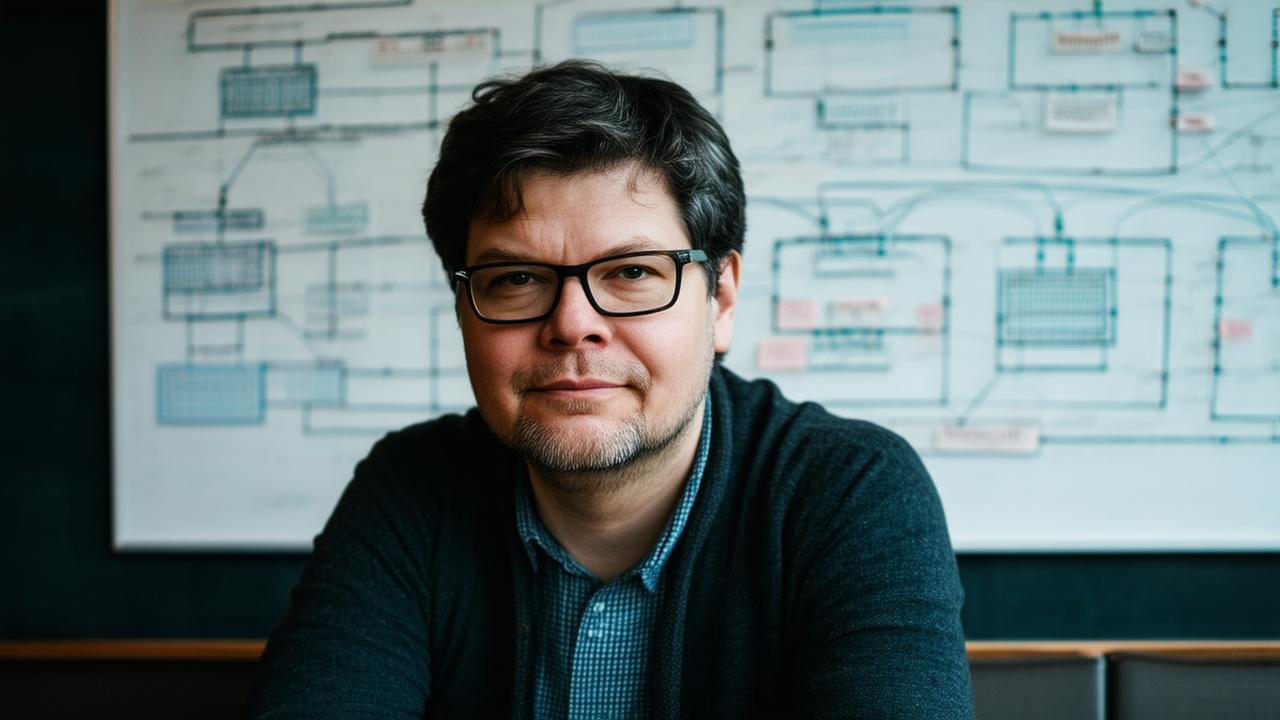
The man who helped teach machines to see doesn’t look like a movie version of a mad scientist. On an ordinary weekday in New York City, Yann LeCun can be found crossing Washington Square Park in a worn jacket, grey curls framing a thoughtful face, coffee in hand, walking to his office at NYU. Pigeons scatter in front of him; students, half-awake and headphone-wrapped, barely glance up. Yet inside this quiet, almost unremarkable routine, something extraordinary is happening. This is one of the people who changed what intelligence means—who helped invent the very techniques that make your phone recognise your face, your car perceive a pedestrian, and your computer “understand” images and words. The story of Yann LeCun is not just about one scientist; it’s about how curiosity, stubbornness, and a stubborn belief in an unfashionable idea reshaped artificial intelligence.
The French Kid Who Didn’t Follow the Script
Before the awards and the corporate titles, before Meta and NYU and global stages, there was simply a boy in France who liked to tinker. LeCun grew up in a suburb south of Paris, the sort of landscape where apartment blocks share space with small cafes and train tracks streak like veins across the city’s edge. He broke things to understand them—radios, electronic kits, any gadget that hummed or glowed. His curiosity wasn’t tidy; it was messy and physical, the urge to open the case and poke around inside.
In school, he gravitated toward maths and physics, drawn to the particular satisfaction of equations that clicked into place like puzzle pieces. But it was the arrival of early computers and the promise of “thinking machines” that hooked him for good. In the 1980s, when the term “artificial intelligence” still sounded like science fiction to most people, LeCun found himself captivated by a radical idea: What if, instead of programming a machine with strict rules, you could build systems that learned, like a brain?
France at that time had its own distinct research culture, steeped in rigorous theory and a sometimes-snobbish suspicion of impractical dreams. Neural networks—the notion of building computer systems inspired by the way neurons connect in the brain—were dismissed by many as a dead end. But LeCun was drawn to them, fascinated by the possibility that intelligence could emerge not from hand-crafted logic but from data and adaptation.
The Unfashionable Dream of Neural Networks
It’s easy now, in an era of AI everywhere, to forget how fringe neural networks once were. Through the late 1980s and into the 1990s, the field had a reputation problem. Funding agencies looked elsewhere. Industry, for the most part, didn’t care. The dominant view was that symbolic AI—logic, rules, clearly defined steps—was the serious way to build thinking machines. Neural networks were a curiosity, an academic cul-de-sac.
LeCun did not agree. At AT&T Bell Labs in New Jersey, which felt like a scientific playground for misfits and visionaries, he started building what would later be seen as one of the foundations of modern AI: convolutional neural networks. They were inspired, loosely, by the way the visual cortex processes what we see. The architecture sounded abstract: layers of artificial “neurons” that scan images in small patches, gradually learning increasingly complex features. But the result, when it worked, was viscerally simple. You could show a machine an image, and it could learn to recognise what was in it.
There is something cinematic about the test case that made LeCun’s early work real: handwritten digits on bank checks. To a human, reading them is effortless. To a machine, those twisted, scribbled 3s and 8s are a chaos of lines. But LeCun’s system learned to identify these digits with uncanny accuracy. It wasn’t magic; it was grind. Feeding data, tuning parameters, waiting for early hardware to chug through calculations. Yet the result was transformative: image recognition by learning, not by rules.
Even so, recognition was muted. The world did not reorganise itself around neural networks in 1990. The hardware was too slow, the datasets too small, and the wider AI community largely unconvinced. LeCun’s work found use in specialised systems, but the grand vision of learning machines remained, for most people, a quaint exaggeration. He kept at it anyway, refining, building, publishing. Sometimes, revolution looks like someone stubbornly doing the same “unfashionable” thing, year after year, convinced the rest of the world will eventually understand.
From Cult Idea to Global Breakthrough
The story truly begins to tilt in the 2000s, when a trio of researchers—Yann LeCun, Geoffrey Hinton, and Yoshua Bengio—started to look less like heretics and more like prophets. They were united by a belief that “deep learning” (neural networks with many layers) could solve hard problems if given enough data and computational power. For years, they had each worked in their own corners, facing the same skepticism, writing papers that landed with soft thuds rather than storms.
Then the world changed—not theoretically, but physically. Graphics Processing Units (GPUs), originally designed to render the sharp curves of game characters and movie explosions, turned out to be astonishingly good at training neural networks. At the same time, data exploded: photos, videos, text, sensor streams. The combination of power and data was like dry tinder meeting a spark.
Deep learning began to crush long-standing benchmarks. On computer vision tasks, performance graphs that had inched upward for years suddenly took a vertical jump. Speech recognition, once clumsy and brittle, started to sound almost natural. LeCun’s early work on convolutional neural networks wasn’t obscure anymore; it was the backbone of this breakthrough. The architecture he had championed became the standard method for teaching machines to see.
By the mid-2010s, the growing momentum was impossible to ignore. In 2018, LeCun, Hinton, and Bengio shared the Turing Award, often called the “Nobel Prize of computing,” for their contributions to deep learning. For the three of them, it was not just an honor; it was a vindication. The unfashionable dream of their youth had become the foundation of modern AI.
Yann LeCun at Meta: Building the Next Brains
Titles are funny things. Today, Yann LeCun is the Chief AI Scientist at Meta, a role that sounds like it belongs in a cyberpunk novel. Beyond the label, it means he is one of the key voices shaping how a tech giant thinks about intelligence—how it builds systems that recommend posts, filter harmful content, and, increasingly, understand the world.
Walk into Meta’s AI labs and you won’t find sentient robots or glowing sci-fi chambers. What you find are clusters of humming machines, fans whirring, racks of specialised hardware stacked like industrial bookshelves, and people—dozens, then hundreds of people—staring at matrices of numbers and colourful plots. This is the factory floor of modern AI: models trained on oceans of data, guided and prodded by humans who debate architectures, loss functions, and whether a particular system is actually “learning” anything meaningful.
LeCun’s focus, however, isn’t just on making existing systems bigger or faster. He’s increasingly preoccupied with a deeper question: What are we missing? Modern AI systems are powerful but brittle. They can generate rich language and recognise images with astounding accuracy, yet fail in simple, often laughable ways. They do not “understand” in the human sense. Show them something wildly outside their training data, and their confidence can become a liability.
LeCun has been vocal about a concept he calls “world models”—internal representations that allow machines not just to react to data, but to predict, imagine, and reason about the physical and social world. In conversations and talks, he often paints a picture: a future AI that can learn like a child, watching and interacting with its environment, forming expectations, becoming surprised when things don’t go as predicted. A system, in other words, that has a kind of common sense.
The Everyday Impact of His Ideas
It might feel distant, this talk of world models and deep architectures, but the fingerprints of LeCun’s work are all around you. When your phone unlocks by reading your face, or an app neatly sorts your photos by “beach,” “mountain,” or “dog,” the techniques at play trace back directly to the convolutional networks he helped pioneer. When autonomous cars detect lanes and pedestrians, when social networks automatically flag certain types of harmful imagery, the same lineage is at work.
To ground this in everyday experience, consider a quiet, simple interaction: you upload a photo of an old family recipe card. The image is uneven, the ink faded. An AI model sharpens the text, recognises the handwriting, and transcribes the words. In that moment, you are not thinking about Bell Labs in the 1990s or GPUs in the 2010s. But the chain runs through those decades and through one French researcher who insisted that machines could learn to see.
| Aspect of Daily Life | How LeCun’s Work Shows Up |
|---|---|
| Smartphone cameras | Automatic scene detection, face unlock, photo categorisation using convolutional neural networks. |
| Social media feeds | Image understanding for recommendations, content filtering, and visual search. |
| Online shopping | Visual product search and automated tagging of items in photos. |
| Transportation | Perception systems in driver-assistance and autonomous vehicles. |
| Security & verification | Document scanning, handwriting recognition, and identity verification. |
Debates, Doubts and a Different Vision of AI
To put someone at the centre of a technological shift this large is to place them in the middle of controversy as well. LeCun is not shy about saying what he thinks, especially on how AI should be built and governed. While some researchers lean heavily into fears of runaway superintelligence, he often pushes back, arguing that the real and present challenges—bias, misuse, concentration of power—deserve more attention than speculative doomsday scenarios.
He believes that intelligence, even in machines, is not a mysterious spark but an engineering problem—complex, yes, but ultimately understandable. This attitude colours how he talks about the future. Instead of a singular moment when AI “wakes up,” he sees a long, iterative process: better sensors, richer models, gradual progress toward systems that learn more like animals and humans do, with fewer labels, more autonomy, and—eventually—a form of common sense.
➡️ Eclipse of the century will plunge millions into six minutes of darkness scientists divided over health risks and religious groups prepare for chaos
➡️ Half a glass and a toilet bowl like new: smart ways to restore old sanitary ware
➡️ Many people don’t realize it, but sweet potatoes and regular potatoes aren’t closely related at all “here’s why”
➡️ 9 things you should still be doing at 70 if you want people to one day say, “I hope I’m like that when I’m older”
➡️ A rare giant bluefin tuna is measured and confirmed by marine biologists using peer-reviewed protocols
➡️ A state pension cut is now approved with a monthly reduction of 140 pounds starting in February
➡️ A simple pantry powder rubbed on car plastics restores a deep factory sheen that even surprises seasoned mechanics
In interviews and online exchanges, he sometimes sounds less like a corporate executive and more like that kid prying open a radio. There is still wonder in his voice when he describes what might be possible: machines that can learn from video the way an infant watches the world, systems that can plan and reason through complex tasks without being spoon-fed every example. This is not the cold, metallic future of dystopian imagination; it is a messy, experimental workshop, wires everywhere, ideas half-built and humming.
A French Accent in a Global Conversation
Despite decades in North America, LeCun’s French accent remains distinct, a reminder that AI is not a purely Silicon Valley phenomenon. His intellectual roots stretch through European traditions of mathematics and physics, through French research institutions that once saw neural networks as a sideshow. When he speaks to students in Paris or Montreal or New York, he personifies the idea that scientific revolutions often cross borders quietly, carried inside people who simply refuse to give up.
He also represents a particular kind of scientist-engineer hybrid: comfortable debating theory, but happiest when a system actually works, when a set of weights and connections does something in the real world. That duality—abstract and concrete, visionary and practical—is part of why his influence extends beyond any single paper or algorithm. It lives in the culture of how modern AI research is done: experiment-driven, data-hungry, impatient with brittle hand-crafted rules.
The Future He’s Trying to Build
So where does someone like Yann LeCun go from here, in a world already profoundly shaped by the ideas he fought for? He is still at the whiteboard, still publishing, still arguing online, still mentoring young researchers who will write the next chapters of AI. His attention is increasingly trained on that elusive next step: making AI systems not only powerful, but truly robust—curious, adaptive, able to form internal models of the world.
Imagine, for a moment, an AI assistant that doesn’t just parrot patterns from data, but actually understands that if a glass tips off a table, it will shatter; that if you move a chair, you can clear a path; that if someone sounds anxious in a message, they might need a slower, gentler response. These are the everyday miracles of human intelligence that we almost never think about. For LeCun, they are the frontier.
It is tempting to say that Yann LeCun “invented” artificial intelligence, but that would be wrong in the simplest sense: AI is the work of thousands of people over decades. And yet, in another sense, it is hard to imagine today’s AI world without him. His insistence that machines could learn from data, his dogged commitment to neural networks when they were unfashionable, his role in shaping deep learning into a practical, world-changing technology—these things have bent the arc of the field.
Some revolutions announce themselves with explosions. Others arrive the way LeCun walks across campus in the morning: quietly, steadily, over many years. Somewhere between Paris and New Jersey, between theory and practice, between skepticism and conviction, a Frenchman helped teach machines to see—and now, perhaps, to understand. The rest of us are still catching up to what that means.
Frequently Asked Questions
Who is Yann LeCun?
Yann LeCun is a French computer scientist known as one of the pioneers of deep learning. He helped develop convolutional neural networks, which are at the core of modern computer vision systems, and currently serves as Chief AI Scientist at Meta while also being a professor at New York University.
What is Yann LeCun best known for?
He is best known for inventing and popularising convolutional neural networks, a type of neural network particularly good at understanding images. His work laid the foundation for technologies like facial recognition, image classification, and many other visual AI applications.
Did Yann LeCun really “invent” artificial intelligence?
No single person invented artificial intelligence. AI is the result of contributions from many researchers over decades. However, LeCun played a central role in creating and advancing deep learning methods that power much of today’s AI, especially in computer vision.
Why did his work on neural networks take so long to be recognised?
When LeCun first worked on neural networks, computers were slower, data was scarce, and many AI researchers believed other methods were more promising. It wasn’t until more data and powerful hardware (like GPUs) became available that deep learning could show its full potential—and his ideas suddenly became central.
How does Yann LeCun see the future of AI?
He envisions AI systems that build internal “world models,” allowing them to understand, predict, and reason about the world more like humans and animals do. Rather than focusing on apocalyptic scenarios, he emphasises practical progress toward machines with common sense, better learning abilities, and more robust behaviour.





