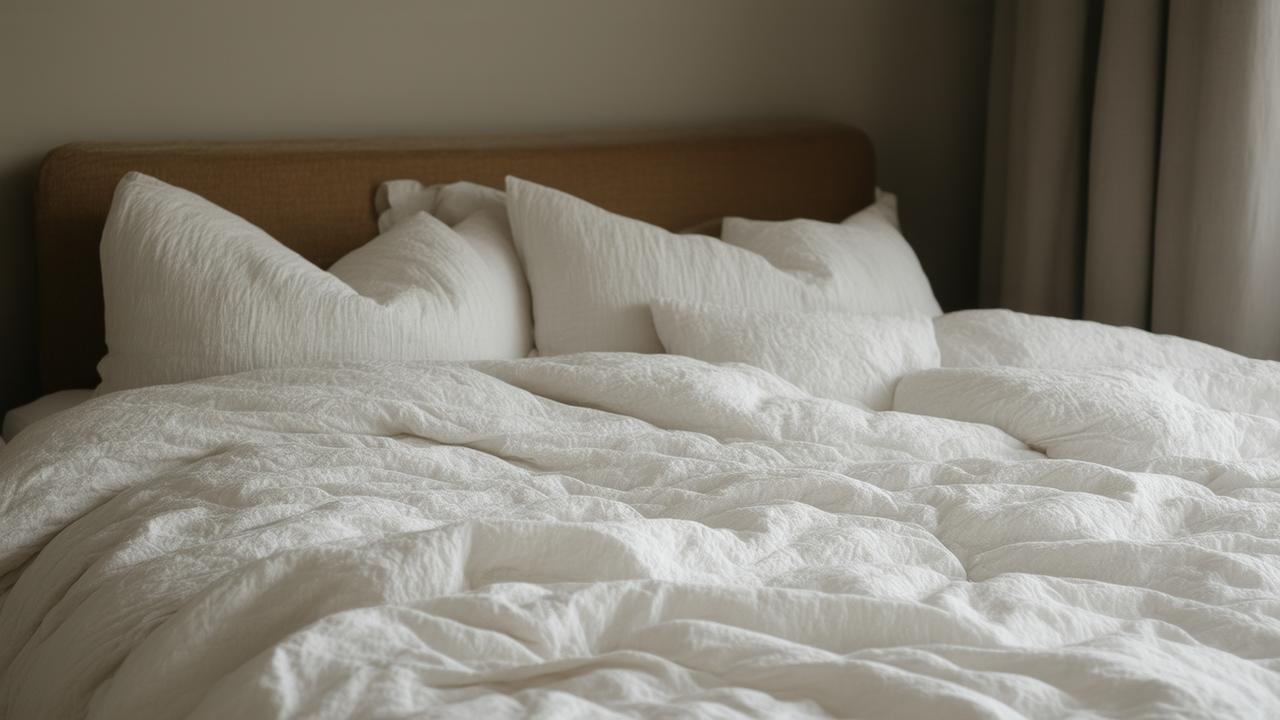
The first thing you notice is the absence of bulk. No mountain of duvet swallowing the bed, no lumpy mass slumped to one side after a restless night. Just a smooth, layered landscape of fabric: light, flat coverlets folded with almost casual grace; a quilted throw that looks like it came straight out of a boutique hotel; a fine wool blanket lying ready at the foot of the bed in case the night gets cold. It’s the winter of 2026 in a small apartment in Lyon, and the bed looks… different. Somehow lighter, quieter, more intentional. If you listen closely, you can almost hear the soft rustle of change sweeping across French bedrooms.
The curious disappearance of the big fluffy cloud
For decades, the duvet reigned as the undisputed monarch of French nights. That big, fluffy cloud of polyester or feather, zipped into its cover with a muttered curse and a desperate shake, was the universal symbol of comfort. Parents bought them in bulk for kids going off to university. Newlyweds chose their first “grown-up” duvet together. Ikea bags bulged with them on every RER line out of Paris.
And yet, walk into many French homes in 2026, and you’ll notice something surprising: beds that look like they belong in carefully styled interior magazines, layered with thin quilts, cotton bedspreads, lightweight blankets. The heavy duvet has… vanished. Or at least, been quietly folded away into storage.
This isn’t a sudden minimalist whim. It’s the result of a slow, almost invisible cultural drift—nudged along by sweaty summer nights, skyrocketing energy bills, a new obsession with aesthetics, and that peculiarly French talent for making practicality look effortlessly chic.
The rise of the “layered bed” revolution
When climate scientists started talking about “nights that don’t cool down,” most people shrugged. Then came the first summers where even at midnight, the temperature refused to drop. In cities like Toulouse, Bordeaux, and Paris, bedroom windows stayed open, fans whirred on full blast, and the duvet—that winter ally, faithful from November to April—began to feel like a lead coat nobody actually wanted to wear.
So, piece by piece, the layered bed returned. Not as a nostalgic nod to grandma’s eiderdown, but as something streamlined, intentional, and Instagrammable. What was once a purely practical rural tradition—thin sheets, a woven blanket, maybe a quilt for deeper cold—morphed into a modern design statement, perfectly aligned with the French taste for natural fabrics and subtle color palettes.
Now, your typical urban French bed is more likely to be dressed in a quiet stack of textiles: a breathable cotton or linen flat sheet, a lightweight quilt, maybe a matelassé coverlet, and a throw blanket for extra chill. You can add or peel off layers according to the season and your own internal thermostat. It feels like personal weather control—done with fabric instead of apps.
Comfort you can fine-tune, night after night
Talk to people who’ve abandoned duvets, and one phrase comes back again and again: “Je peux enfin régler ma nuit.” I can finally fine-tune my night.
With a duvet, you’re committed. Too hot? You kick it off and wake up cold an hour later. Too cold? You pull it back up and trap the heat, sweating into the early morning. There’s no nuance, just on or off.
A layered bed works differently. Your body can adjust in tiny gestures. One leg slips out from under the quilt. A hand reaches down for the extra wool blanket at 3 a.m. Your partner can sleep under two layers while you do fine with one. It’s not just a stylistic choice—it’s a quiet act of bodily respect, listening to your temperature signals and responding with folds of fabric instead of big, suffocating fluff.
The French design twist: when practical turns irresistibly chic
Of course, what really accelerated the duvet’s decline wasn’t only comfort or climate. It was style. France is, after all, a country where the question “Mais c’est joli, ça?” (But is it pretty?) carries as much weight as “Does it work?”
Interior designers, Instagram influencers, and small independent brands started showcasing beds that looked like they’d been lifted directly from a seaside boutique hotel in Biarritz or a farmhouse guest room in Provence: crumpled linen throws in sea-glass tones, honeycomb cotton bedspreads, waffle blankets in muted terracottas and stormy greys.
A duvet, with its ballooned bulk and sometimes awkward corners, suddenly felt… clumsy. It disrupted the clean lines of small Parisian bedrooms. It hogged space on narrow balconies where everyone now dries their laundry to save energy. It looked out of place in the new aesthetic that worships texture over volume, nuance over one-size-fits-all.
The textile palette: from fluffy to tactile
Run your hand along one of these duvet-free beds and you feel it instantly. Linen that’s been washed a dozen times until it melts softly against the skin. Light cotton piqué that sighs when you sit on it. A fine merino or alpaca throw waiting like a secret weapon for winter’s first sharp night.
Instead of one thick, homogeneous sensation, you get layers of touch. Cool sheet, cozy quilt, fuzzy edge of a throw. The bed stops being a padded island and becomes a landscape of textures—subtle enough to please the eye, rich enough to satisfy the fingertips.
And under it all, something else is happening: people are quietly investing more in fewer, better pieces. A high-quality made-in-France blanket instead of three cheap duvets that lose their loft after one season. A naturally dyed cotton matelassé coverlet that looks good dragged into the living room for movie night as well as neatly spread on the bed.
| Aspect | Classic Duvet | Layered Bed (Quilts & Blankets) |
|---|---|---|
| Temperature control | All-or-nothing warmth | Fine-tuned, adjustable by layer |
| Aesthetic | Bulky, rounded silhouette | Slim, hotel-like, textured look |
| Care & washing | Bulky, needs big machine or dry cleaner | Pieces wash separately, often quicker to dry |
| Seasonal flexibility | Often too warm in shoulder seasons | Same set adapts from summer to winter |
| Space & storage | Bulky to store off-season | Stacks flat; uses minimal space |
Energy bills, open windows and the new nighttime logic
The shift also has a harder, more pragmatic edge. Energy prices in Europe have turned the simple act of heating a bedroom into a math problem. Do you pay to keep the room at 20°C all winter, or accept sleeping in a cooler space and use smarter bedding instead?
More and more French households are choosing the second option. Rather than cranking up the heat so a thin duvet “is enough,” they lower the thermostat a degree or two and add a dense wool blanket or a padded cotton quilt to the bed. It’s easier on the bills and, for many, easier on sleep too.
There’s also the quietly spreading belief that a slightly cooler bedroom—and the ability to layer up or peel back—is better for the body. Less night sweats, fewer wake-ups, more even sleep. Doctors have long suggested cooler rooms for healthy sleep; now textiles are finally catching up to that advice.
Allergies and air: breathing easier without fluff
Another understated factor: air quality. Duvets, especially older synthetic ones, have a well-earned reputation as dust traps. Mites, micro-dust, all sorts of invisible life settle into those generous fibers. You can wash the cover, sure. But the core? That’s a trickier business.
Flat blankets, quilts, and throws are simpler creatures. A quick shake out of the window. A spin in the washing machine. A day hanging in the cold winter sun. The layers that touch your body are easy to launder frequently, and the ones on top can be cleaned on a simple seasonal schedule.
For people with allergies or asthma, losing the duvet often feels like removing a weight from the chest—literally as well as figuratively. The bed breathes, and so do they.
How French homes are actually layering in 2026
So what does this duvet-free revolution look like in real apartments and houses, far away from magazine shoots? It’s not a rigid rulebook, but certain patterns are emerging, whispered across dinner tables and interior forums.
➡️ France suffers a €3.2 billion blow as a last-minute reversal kills a major Rafale fighter jet deal
➡️ Neither boiled nor raw : the best way to cook broccoli for maximum antioxidant vitamins
➡️ France turns its back on the US and drops €1.1 billion on a European detection “monster” with 550 km reach
➡️ Day will turn to night during the longest total solar eclipse of the century occurring across regions
➡️ Seniors behind the wheel: will licenses be pulled automatically after 70 from ?
➡️ Goodbye kitchen cabinets: the cheaper new trend that won’t warp, swell, or go mouldy over time
➡️ Scientists discover an object from another solar system racing toward us at record speed
In Marseille, where winters are short and damp more than icy, many people get by with just a linen sheet and a textured cotton bedspread most of the year, with a thin wool throw added from December to February. In Strasbourg or Clermont-Ferrand, where the cold bites harder, the stack grows deeper: a sheet, a quilted coverlet, and a thick blanket folded at the foot of the bed, ready to be pulled up when the Mistral or mountain wind decides to grow teeth.
Couples also find new negotiations. Instead of one duvet they’re meant to “share nicely,” each side of the bed can have variations: an extra folded plaid on one side, a double layer of quilt on the other. The battlefield of tugged duvets transforms into something quieter, more diplomatic. Everyone gets their own climate zone.
Making the switch without regret
The most common fear is that abandoning the duvet will mean nights of shivering resentment. But the stories you hear, again and again, sound more like this: “We tried it one autumn weekend, just for fun. And suddenly, in January, I realized we hadn’t taken the duvet out again.”
The key is to start with what you already have. A good sheet. That old wool blanket from your grandmother’s house. A quilt you bought on holiday and never quite knew how to use. Layer them. Sleep. Notice. Too warm? Remove a layer. Still cold at 4 a.m.? Add another, but only to your side.
Soon you begin to read your own nights differently, like weather reports: “Last night was a two-blanket night.” “It’s almost spring; we’re back to the quilt only.” You become sensitive to the small shifts: the first evening the air smells faintly of frost again, the first dawn when you wake up with a bare foot poking out from under everything, searching for cooler air.
So, no more duvets in 2026?
Will duvets disappear completely? Probably not. In drafty stone farmhouses, in Alpine chalets, in children’s rooms where building a “duvet fort” is a non-negotiable childhood right, they’ll hang on. Some people truly love that enveloping, marshmallow sensation, and there’s room for that pleasure in the fabric of French life.
But something has undeniably shifted. The duvet is no longer the automatic default. It’s a choice among others—sometimes the nostalgic one, sometimes the winter-only one, sometimes the guest-room relic.
Meanwhile, the layered bed has slipped quietly into the center of the stage. Elegant without effort, lighter on the planet, easier on the thermostat, kinder to allergies, tuned to bodies that run hot or cold on their own schedule. It looks good left unmade in the morning, with its folds and shadows and soft transitions. It invites an evening ritual: pulling up one layer, unfolding another, listening to what your body asks for tonight.
Stand at the doorway of a French bedroom in 2026 and you can sense this new philosophy in the air. Sleep is no longer about hiding under one big puffy shield from the cold. It’s about composing your own small climate from cotton, linen, and wool. It’s about movement, possibility, and the clean, quiet pleasure of a bed that feels like it belongs to this moment in time—and to you.
FAQ
Are duvets really disappearing from French homes?
They’re not vanishing completely, but they’re losing their status as the automatic default. More French households, especially in cities, are choosing layered bedding—quilts, blankets, and coverlets—instead of a single thick duvet, particularly as summers get hotter and energy prices rise.
Is a layered bed actually warm enough in winter?
Yes, if you choose the right materials. A combination of a cotton or linen sheet, a quilt or coverlet, and a dense wool or heavy cotton blanket can be as warm—or warmer—than a typical duvet, with the advantage of being adjustable as temperatures change through the night.
Isn’t it more work to make a layered bed every morning?
Surprisingly, it often feels easier. Instead of wrestling with a bulky duvet, you’re smoothing flat surfaces and refolding one or two lighter layers. Many people simply pull the top layer up, straighten the throw, and are done in under a minute.
What fabrics work best if I want to try this?
Linen and cotton are popular for sheets and light coverlets because they breathe well. For warmth, look for wool, cotton flannel, or padded quilts with natural fillings. The idea is to combine breathable layers rather than relying on one ultra-thick item.
Can I still keep my duvet and layer on top?
Of course. Some people keep a duvet for the coldest weeks of winter, then transition to a layered setup for the rest of the year. Others use a very light duvet as just one part of the layering system. There’s no strict rule—only what makes your nights more comfortable.





