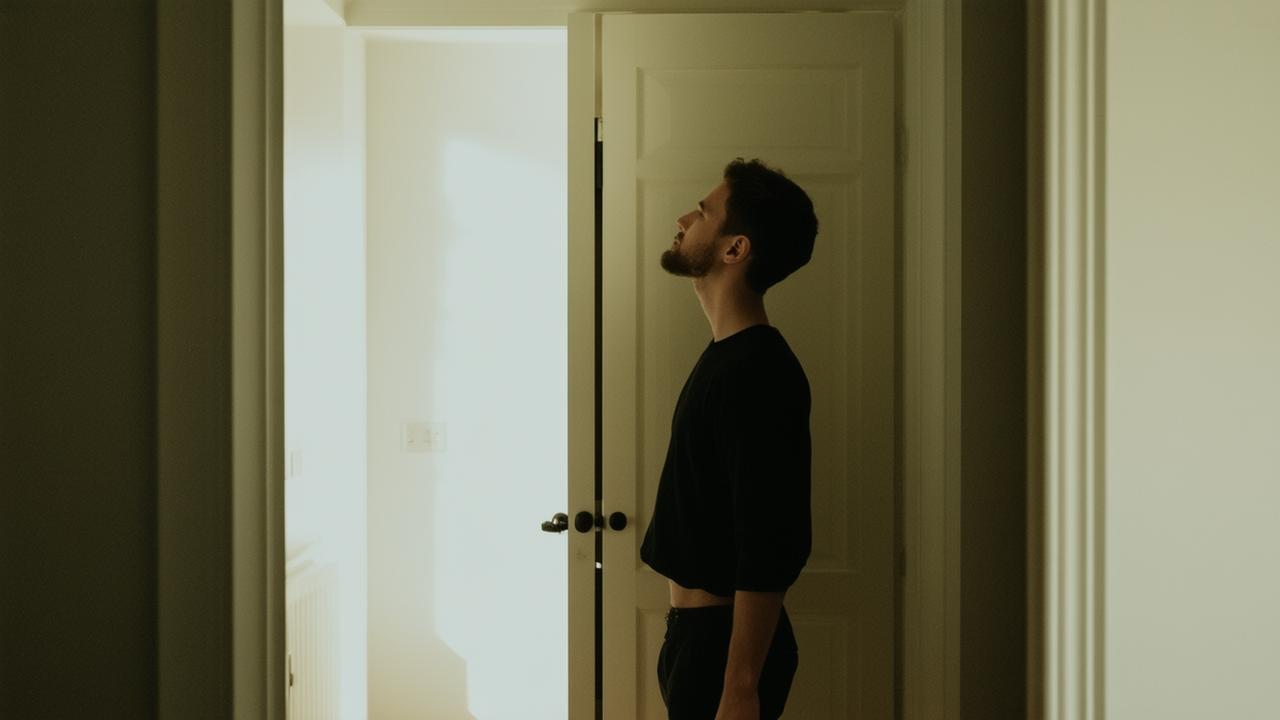
The first time I tried it, the hallway felt like a river I had never noticed in my own home. Afternoon light spilled across the floorboards, that faint, dusty gold you only see when the sun is leaning low. Somewhere in the kitchen, the refrigerator hummed. A car rolled past outside, then another. And for once, instead of rushing from my desk to the next task, I paused with one hand on the doorframe and let myself simply arrive in the next room.
I didn’t think something as small as walking through a doorway differently could matter. None of us do, really. We move from room to room the way we scroll a feed: fast, distracted, already leaning toward the next thing. But that day, I stepped slowly. My bare feet found the cooler patch of floor near the window. My shoulders softened. I noticed my breath, a thin, shallow thing, and without trying, it dropped deeper into my chest.
It took maybe eight seconds. Ten, at most. Yet by the time I crossed into the living room, it felt as though I’d washed a little storm out of my nervous system. Not fully calm, not magically transformed—just slightly less clenched. The way the world feels right after rain, when the air is still damp but the worst of it has passed.
The Doorway Trick Your Nervous System Has Been Waiting For
There’s a simple way of moving between rooms that quietly reduces tension, and it starts with treating every doorway like a tiny threshold ritual.
Nothing mystical, nothing elaborate. No chanting, no incense, no need for a yoga mat or fancy breathing app. Just a brief, intentional pause when you pass from one space to another. A soft reset for your nervous system, built right into the architecture of your home or office.
Here’s how it looks in practice: you’re leaving your work desk to grab a glass of water. Normally, your mind is still chewing over emails, shoulders tight, jaw set. But this time, you approach the doorframe and imagine it as a gentle border between “what just happened” and “what comes next.” You slow down. Maybe you even stop at the threshold for two breaths. Inhale through your nose. Exhale slowly through your mouth, like you’re fogging a cold window.
Then you notice one small detail: the way the doorknob feels cool against your hand, the scent from the kitchen, the echo of your footsteps. You don’t analyze any of it; you just let your senses register that you are, increasingly, here. By the time you step into the next room, you’ve swapped a little bit of tension for presence.
It’s such a tiny move that your brain might dismiss it as pointless. But your body knows thresholds. The nervous system loves cues, and a doorway, repeated enough times with the same gentle pattern—slow step, breath, arrival—becomes a reliable signal: this is where we soften, even just a little.
Why Thresholds Quiet the Body’s Inner Noise
Modern life has smoothed out so many of the old transitions. Once, the day was shaped by light and dark, by walking to fields or workshops, by seasons telling muscles when to push and when to rest. Now, the shift from “work” to “home” might be a single click on a laptop, or a swivel of the chair. We hop between roles with zero warm-up: teammate, parent, partner, friend—sometimes all before lunch.
Our bodies, though, are still wired to respond to transitions. Think of how your shoulders drop when you step outside after a long meeting and feel a breeze on your face. That’s your nervous system reading the environment: we’ve moved. Something changed. It can ease now, just a bit.
Doorways offer a smaller version of that same signal. Each threshold gives your brain a chance to update its map: different soundscape, different light, different smells, different tasks. If you meet that moment with awareness—even for a breath or two—you transform an automatic movement into an intentional one. Your body gets to renegotiate how much tension it truly needs to carry into what’s next.
This is not about performing calmness. It’s about creating tiny, consistent invitations for the body to downshift from “urgent” to “enough.” A brief pause in a doorway interrupts what researchers sometimes call “continuous partial attention”—that buzzing, fragmented way of being half in the inbox, half in the room, half in tomorrow’s to-do list.
Instead, for those few seconds, you become fully in transit. Not where you just were, not yet where you’re going—just crossing. And in that in-between space, the nervous system finds a moment to loosen its grip.
How to Turn Every Doorway into a Soft Reset
You don’t need to remember a complicated routine. Think of it as a three-step rhythm you can tuck into almost any transition. Let’s call it: pause, feel, choose.
1. Pause at the Frame
As you approach a doorway, slow down just enough to notice it. You can stop fully or simply let your step become deliberate rather than automatic. This doesn’t have to be obvious or dramatic—no one at the office needs to suspect you’re conducting a personal experiment in micro-calm.
Let your hand rest on the doorframe or the handle for a heartbeat longer than usual. That moment—a small hitch in your usual momentum—is where the reset begins.
2. Feel Your Senses
Next, shift your attention to raw sensation. Choose one or two senses and let them anchor you:
- The feeling of your feet in your shoes, or against the floor.
- The temperature of the air as you leave a warm room for a cooler hallway.
- The murmur of voices from the next space, or the distant rattle of traffic.
- The smell of coffee drifting from the kitchen, or printer ink, or rain.
You don’t need to name these sensations with words in your head. Just let yourself receive them, like you’re noticing the first details upon entering a quiet forest trail.
3. Choose Your Next State (Gently)
Finally, ask yourself one quiet question: “How do I want to arrive in the next room?” Not in some grand, performative way—just in this next tiny slice of time.
Maybe you’re walking from a tense Zoom call into the kitchen, where someone you love is standing by the sink. Maybe you’re stepping from a child’s messy playroom into your own bedroom. Weighty or ordinary, each transition gives you a chance to choose: do I carry all this static with me, or can I set a little of it down?
For many people, that choice looks like one fuller breath. Inhale slowly. Then let the exhale be a fraction longer than the inhale, as though you’re letting the day leak out of your shoulders. When you step through, imagine your footfall as the first sentence in a new chapter, not a continuation of the last argument or email thread.
A Tiny Ritual That Works in Almost Any Space
One of the gifts of this practice is that it doesn’t care what kind of rooms you move between. A cramped city apartment, a rambling farmhouse, a cubicle maze, a coworking loft—they all come with thresholds. Even open-plan spaces have psychological doorways: the edge of your desk, the line between carpet and tile, the shift from fluorescent hum to natural light.
Consider a few everyday crossings:
- From bedroom to bathroom at dawn, still groggy, mind already reaching for news headlines.
- From kitchen to living room with a mug of tea, body buzzing from the day.
- From office corridor into a conference room, heart rate a little higher than usual.
- From front door into your home, shoulders stacked with the weight of the commute.
Each of these is an unnoticed hinge point in your day. If you thread even three or four doorway pauses into your routine, the cumulative effect can feel like adding shallow pools of rest along a long hike.
| Transition | Tiny Doorway Ritual | Tension Shift |
|---|---|---|
| Desk → Kitchen | Touch the frame, take 2 slow breaths, notice one sound. | From mental swirl to mild clarity. |
| Front Door → Home | Pause, feel feet on the floor, exhale longer, soften jaw. | From braced commute mode to “I’m allowed to land.” |
| Bedroom → Day | Hand on knob, notice light, set a simple intention. | From autopilot wake-up to a gentler start. |
None of these moves will win you any productivity medals. They won’t show up on a to-do list or impress anyone scrolling by. But they change the texture of your day. They put a bit of breathable space between one demand and the next.
➡️ This small adjustment helps reduce the feeling of bodily overload
➡️ What it means psychologically when you avoid talking about yourself, even when asked
➡️ I noticed my stress dropped once my cleaning goals became realistic
➡️ This is how to show interest without forcing enthusiasm
➡️ The one breathing mistake most people make daily without realizing it affects their stress levels
➡️ Why doing one task at a time is healthier than multitasking
➡️ I realized my cleaning system was built for a life I don’t live
Let Your Home Become a Quiet Co-Conspirator
Once you start treating thresholds as allies, your home begins to feel different. Hallways are no longer just strips of utility; they’re short decompression tunnels. Doorways become quiet punctuation marks instead of invisible margins.
You can even let the physical space help you remember. A small stone on the floor by the bedroom door. A piece of driftwood resting on the hallway table. A favorite postcard taped near the kitchen entrance. Not decor for anyone else’s approval; just visual cues whispering: “Pause as you pass.”
Over time, these mini-rituals begin to stack. The day that might once have felt like a single, unbroken line of tension—computer glare, traffic, conversations, chores—starts to feel more like a string of short chapters. You leave a little of the meeting behind before you enter the living room. You don’t carry the sharpness of a phone call into the next room where your dog is waiting, whole body wagging. You cross each threshold a shade lighter than you approached it.
Of course, there will be days when you forget entirely. You’ll march through doorways with a full head of steam, only realizing hours later that you’ve been stuck in a tight, narrow breath all afternoon. That’s fine. The practice doesn’t punish you; it patiently waits at the next frame, ready whenever you remember.
Beginning Again, One Door at a Time
Imagine the day ahead of you tomorrow. The small, repeating choreography of waking, dressing, working, feeding, resting. You will walk through so many thresholds without noticing: bedroom, bathroom, hallway, kitchen, car, office, store, home again. Dozens of invisible crossings, each one a tiny fork in the road.
What if even a handful of those became invitations? Not grand transformations, just gentle course corrections—two breaths slower, one muscle softer, one fragment of attention returned from your phone to your body.
The world will still be loud. The inbox will still refill. The news will still crash in waves against your quiet moments. But between all that noise, there will be frames: strips of wood, bands of painted wall, the simple geometry of one room ending and another beginning. Inside those few inches of space, you have a choice that requires almost nothing and gives back more than it seems it should.
Pause. Feel. Choose. Step through.
The hallway may not exactly turn into a forest path, and the kitchen won’t suddenly become a mountaintop. But your nervous system, given these small, repeated chances to soften, will begin to believe you when you wordlessly say: it’s okay to unclench now. We’re here. We’ve arrived. We can begin again in this next room.
Frequently Asked Questions
Does this doorway practice really reduce stress, or is it just in my head?
Tension and stress are experienced both in the mind and in the body. By slowing down, breathing, and noticing your senses at a doorway, you’re signaling your nervous system to shift away from a constant “on” state. The effect may feel subtle at first, but repeated often, these small resets can noticeably reduce your overall sense of strain across a day.
How long should I pause in a doorway?
Even 3–10 seconds can make a difference. You don’t need a full minute; one or two slower breaths while your hand rests on the frame or handle is enough to begin training your body to associate thresholds with softening.
What if I’m in a busy office and feel self-conscious?
You can keep this practice very discreet. Simply slow your step slightly as you pass, let your inhalation and exhalation deepen a little, and feel your feet on the floor. No one has to notice that you’re doing anything different from just walking into a room.
Can I use this technique even if there’s no physical doorway?
Yes. You can treat any clear boundary as a threshold: stepping from one type of flooring to another, leaving your desk, entering a garden, or even closing one app and opening another. The key is to mark the transition with a brief pause, a breath, and a choice about how you want to arrive.
How many times a day should I do this for it to help?
Start small. Choose two or three common transitions—like leaving your workspace, coming home, or entering your bedroom at night—and practice there for a week. As it becomes more natural, you can let the ritual spread to more doorways. It’s the regularity, not the total number, that begins to ease accumulated tension over time.





