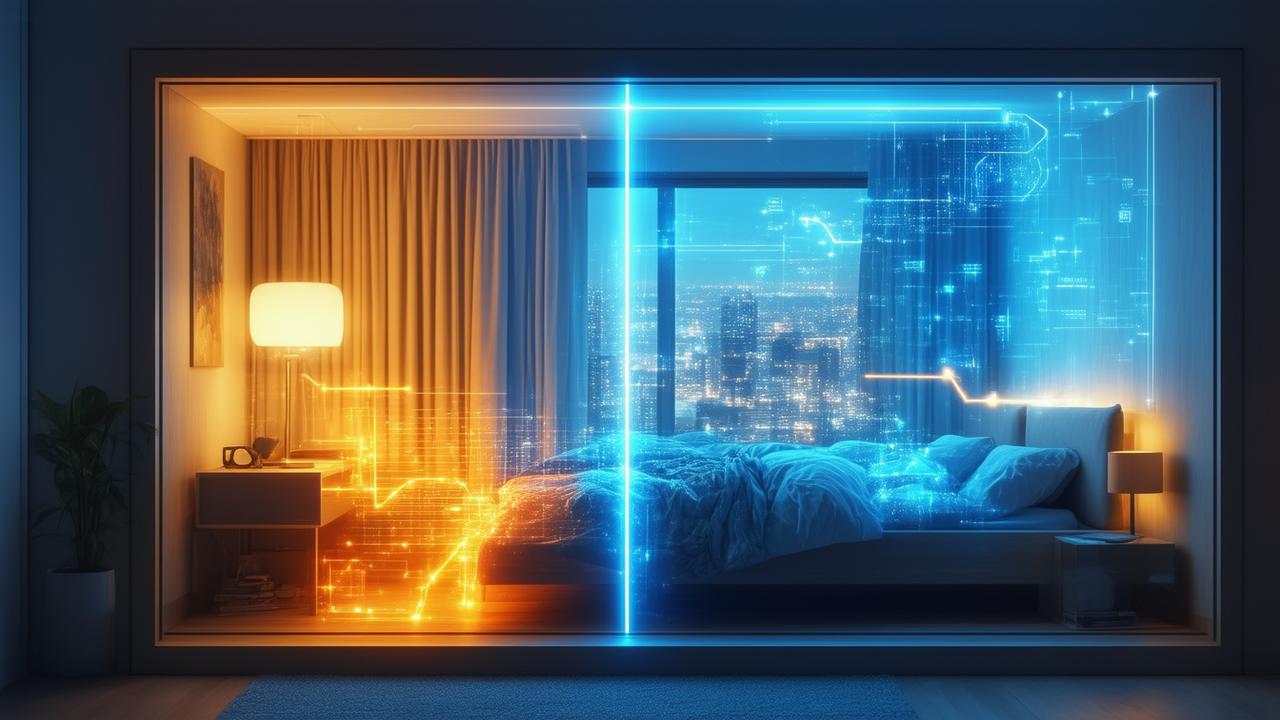
You notice it first in the quiet moments—how the room feels a little heavy, the air a touch stale, as if it’s been breathed a few times too many. The window is shut against the street noise, the curtains barely moving, and the bedside lamp casts that familiar warm halo over the same four walls you see every night. You pull the duvet up, roll onto your side, and there it is again: that faint sense of stuffiness you can’t quite name, but your body recognizes it. You tell yourself it’s nothing—you’ll be asleep soon anyway. But your brain knows. Your lungs know. And over the next few hours, as you dream and toss and half‑wake, the air around you slowly changes in a way you can’t see, but you can definitely feel in the morning.
The Night the Door Stayed Open
Maybe it happens by accident. You forget to click the latch into place one night, or your cat nudges the door open with a quiet paw, leaving a narrow wedge of darkness open to the hallway. You notice it as you’re drifting off: the faint ribbon of cooler air brushing across your face, a distant hum of the fridge from the kitchen, the soft creak of the house settling.
There’s something strangely comforting about it, this thin connection to the rest of the home while you’re cocooned in your bed. You fall asleep to the gentle passage of air through that gap, like an invisible tide washing in and out.
And then, when morning comes, something feels different. You’re not as groggy. Your head is clearer. The weight that usually lingers behind your eyes isn’t there. You try to blame it on going to bed earlier, on the new pillow, on dumb luck—but the pattern holds. On the nights you leave your bedroom door open, you wake up just a little more refreshed. A little more present. A little more you.
What changed? The walls didn’t move. The mattress didn’t magically get softer. But the air did. Quietly, invisibly, it shifted—and your body noticed.
The Invisible Guest in Your Bedroom: Carbon Dioxide
We’re used to thinking of air as this neutral, empty thing that just “is.” But your bedroom, once the lights go out, becomes a tiny ecosystem. You’re lying there, breathing in oxygen, breathing out carbon dioxide (CO₂). If the room is closed up tight—door shut, windows sealed, vents mostly blocked by curtains or furniture—every exhale you give the room is one more invisible brushstroke of CO₂ building up in the space where you sleep.
CO₂ at the levels we’re talking about isn’t poisonous in the dramatic, movie‑style sense. But it doesn’t need to be toxic to change how you feel. Research has shown that elevated CO₂ levels can make you feel drowsy, foggy, and less sharp. That’s during the day. At night, while you’re trying to rest, it can make your sleep more shallow and restless. You might not fully wake up, but your brain stays a little more alert than it wants to, surfacing just enough to disturb deep sleep.
Now imagine: eight hours in a closed room, especially if you share the bed with a partner, a pet, or both. Two or three sets of lungs quietly exhaling into the same sealed box. No fresh inflow. No escape route for that gradual build‑up of CO₂. The levels rise, the room grows stale, and you sleep in air that slowly drifts further and further from what your body finds comfortable.
All it takes is one small change to alter that night‑long chemistry experiment: a crack in the door. An open path to the hallway, where the air has more space, more volume, more turnover. A way for that exhaled CO₂ to diffuse out instead of spiraling around your pillow all night.
How an Open Door Changes the Way You Sleep
Think of your home as a set of connected lungs. The hallway leads to the living room, which opens into the kitchen, which breathes into the dining nook—and somewhere in that network is your bedroom, often tucked away at the edge. When the bedroom door is closed, it’s like a bubble sealed off from the rest of the system. Air can only move in and out through the smallest cracks: maybe beneath the door, maybe around a window frame, maybe a ceiling vent if you’re lucky.
But when you open the door—even just a little—you widen the throat of that bubble. The air doesn’t feel stuck anymore; it has somewhere to go. Warm air rises and drifts into the hallway. Cooler air slides in to take its place. Your slow, steady breathing no longer saturates a single space; instead, the exhaled CO₂ mixes with the air of the house at large. The concentration drops.
You may not feel gusts of wind or dramatic drafts, but your body senses subtle changes: the air is less suffocating, less saturated with what you’ve already exhaled. Your nervous system relaxes into that quiet, fresher environment. Micro‑awakenings—those tiny, mostly forgotten moments when you pop out of deeper sleep for a heartbeat—may become less frequent. Your brain can sink more confidently into the deeper stages of sleep, where memory consolidates, hormones reset, and tissues repair.
Some people describe it as a different kind of morning. Colors seem a touch sharper, thoughts a little quicker. The fog lifts faster. It’s not magic; it’s chemistry and airflow. By opening your bedroom door, you’re just giving your body an atmosphere that better matches what it evolved for: moving air, modest CO₂ levels, and a gentle exchange rather than a stagnant pool.
A Quiet Experiment in Your Own Home
You don’t need fancy equipment to explore this. For a week, keep your bedroom door shut at night, paying attention to how you feel each morning. Not just “tired” or “not tired,” but the details: do you wake with a dry mouth? A slight headache? A numb, cottony feeling in your thoughts? Then, the next week, sleep with the door open—completely or even just cracked halfway—and notice the difference.
If you ever get the chance to use a basic air quality monitor, you may actually see the CO₂ numbers climb with the door closed and stabilize when it’s open. But even without devices, your body is its own sensitive meter. It will most likely tell you the story through your mood, your alertness, and how easily you slip into the day.
But What About Noise, Light, and Safety?
Leaving the door open at night isn’t just a question of airflow. It’s also a matter of feeling safe, comfortable, and relaxed. Maybe you live on a busy street where hallway light spills in. Maybe you share a hallway with roommates who stay up late, the muted thrum of their lives pressing against your sleep. Or perhaps you grew up with the rule: doors closed at night—for privacy, for safety, for habit.
Your body relaxes best when it doesn’t feel exposed. If an open door feels like an invitation to worry, then better air might come at the cost of mental rest—which defeats the purpose. The trick is to find a middle ground that allows air to move while still caring for your nerves.
Finding Your Own Balance
You might try leaving the door open just a few inches, enough space for air to exchange but small enough that you still feel enclosed. A draft stopper beneath the door can soften noise from the hallway while still leaving the upper gap free for airflow. A dim hallway night‑light aimed away from your room can keep the corridor safe to walk through without flooding your pillow with brightness.
Some people feel more secure when they know who or what can enter the room. If you live with pets, an open door might mean nighttime visits from a restless cat or enthusiastic dog. That can break your sleep more than any CO₂ ever could. In that case, a baby gate at the doorway, or closing off the pet’s access to the hallway at night, lets you keep the airflow without the surprise paw on your chest at 3 a.m.
The goal is not to follow a strict rule of “door open, always,” but to respect both sides of the equation: air and ease. You’re trying to craft a sleeping environment where your lungs and your nervous system both feel like they can settle in.
➡️ How cleaning baseboards first shortens total cleaning time significantly
➡️ India: king cobras may be spreading by accident – by train
➡️ He hired a dog sitter then his home camera revealed the sitter was bringing unknown people into his apartment in ways he never expected
➡️ How often can you dye your hair without damaging it?
➡️ It’s now official: heavy snow is expected to begin late tonight as authorities urge residents to exercise extreme caution
➡️ Lidl is set to launch a Martin Lewis–approved gadget next week, arriving just in time to help households get through winter
➡️ Inheritance law shake-up confirmed: a new reform arriving in February will significantly change the rules for heirs
The Air You Don’t See: A Simple Comparison
It can be hard to picture what’s actually changing in your room when you crack the door. Here’s a simple way to imagine the difference between a tightly closed bedroom and one that quietly breathes with the rest of the house.
| Bedroom Setup | What Happens to the Air | How You Might Feel |
|---|---|---|
| Door closed, windows shut | CO₂ slowly builds up through the night; air becomes warmer and more stale, especially in small rooms. | Groggy on waking, slight headache, heavier feeling in your body, more mid‑night awakenings. |
| Door slightly open, windows shut | Air mixes with the hallway; CO₂ levels rise more slowly and may stabilize at a lower level. | Clearer head in the morning, fewer micro‑awakenings, deeper, calmer sleep. |
| Door open, plus gentle fan in hallway | Consistent airflow, more even temperature, quicker dilution of exhaled CO₂. | Cooler, fresher sleep, often easier to fall back asleep if you wake at night. |
None of this requires technology more advanced than a doorknob. You’re working with the same forces that move breezes across a field or send leaves tumbling down a street: warmer air rising, cooler air sliding in to take its place, pressure differences nudging invisible currents through doorways and vents.
Small Rituals, Deeper Rest
There’s something intimate about the way we prepare our bedrooms at night. We dim lamps, fold back covers, maybe place a book on the nightstand. Switching your door from “closed” to “open” can become part of that ritual, a quiet signal that you’re inviting not just sleep, but better air, into the space where you rest.
As you stand in the doorway, you can feel the difference with your own skin: the cooler sigh from the hallway, the way the room seems to exhale when the barrier is lifted. Turn out the light, slip into bed, and pay attention. Not to the thoughts that wander in and out, but to the physical feel of the room around you. The taste of the air when you inhale, the way it flows along your nose and throat, the absence of that heavy, trapped warmth that so often gathers in a sealed room.
Over time, this choice—door open or closed—stops being abstract and becomes body knowledge. You begin to notice how quickly your room goes stuffy if you forget to open it. You learn the right angle, the right crack, the right balance between privacy and breathability. Maybe you add a small habit: opening the door wide for a few minutes before bed, letting the day’s air flush through before you dim everything down.
Deep sleep is not a luxury. It’s a quiet, biological negotiation between your body and the space around it. The surface of your skin, the rhythm of your lungs, the softness of your pillow, the chemistry of the air. Keeping your bedroom door open at night is a humble, nearly effortless way to tell your body, “I’ve thought about this. I’ve made room for you to rest.”
Tomorrow morning, when you swing your legs out of bed and plant your feet on the floor, you might not remember the precise moment you drifted into deep sleep. But your body will remember how easy it was to stay there.
FAQs
Does keeping my bedroom door open really lower carbon dioxide levels?
In most homes, yes. An open door allows the air in your bedroom to mix with the larger volume of air in the hallway and adjacent rooms. This mixing generally slows the buildup of CO₂ compared with a tightly closed room, especially if more than one person is sleeping there.
Will an open door make my room colder or cause drafts?
It can make the room slightly cooler if the rest of your home is cooler than your bedroom, but most people experience this as a gentle, more comfortable airflow rather than a harsh draft. You can control it by adjusting how wide the door is open and using rugs or draft stoppers on the floor if needed.
What if I’m sensitive to noise from the hallway?
If noise is an issue, try opening the door just a few centimeters instead of fully. Soft textiles like rugs, curtains, and upholstered furniture in the hallway can also absorb sound. Earplugs or a low white‑noise machine in your room can help mask small sounds while you keep some airflow.
Is it safe to sleep with the bedroom door open?
Safety depends on your home and personal situation. Some fire safety guidelines recommend sleeping with doors closed to slow the spread of smoke and flames. You’ll need to balance this with your need for air quality, possibly by improving other ventilation options such as vents or slightly opening a window if that’s feasible.
Can I get the same benefits by just opening a window?
Often, yes. An open window can bring in outside air and lower indoor CO₂ levels. However, outside noise, temperature, pollution, or security concerns can make this impractical. In many cases, a partially open bedroom door is a quieter, safer compromise that still improves airflow and can deepen your sleep.





