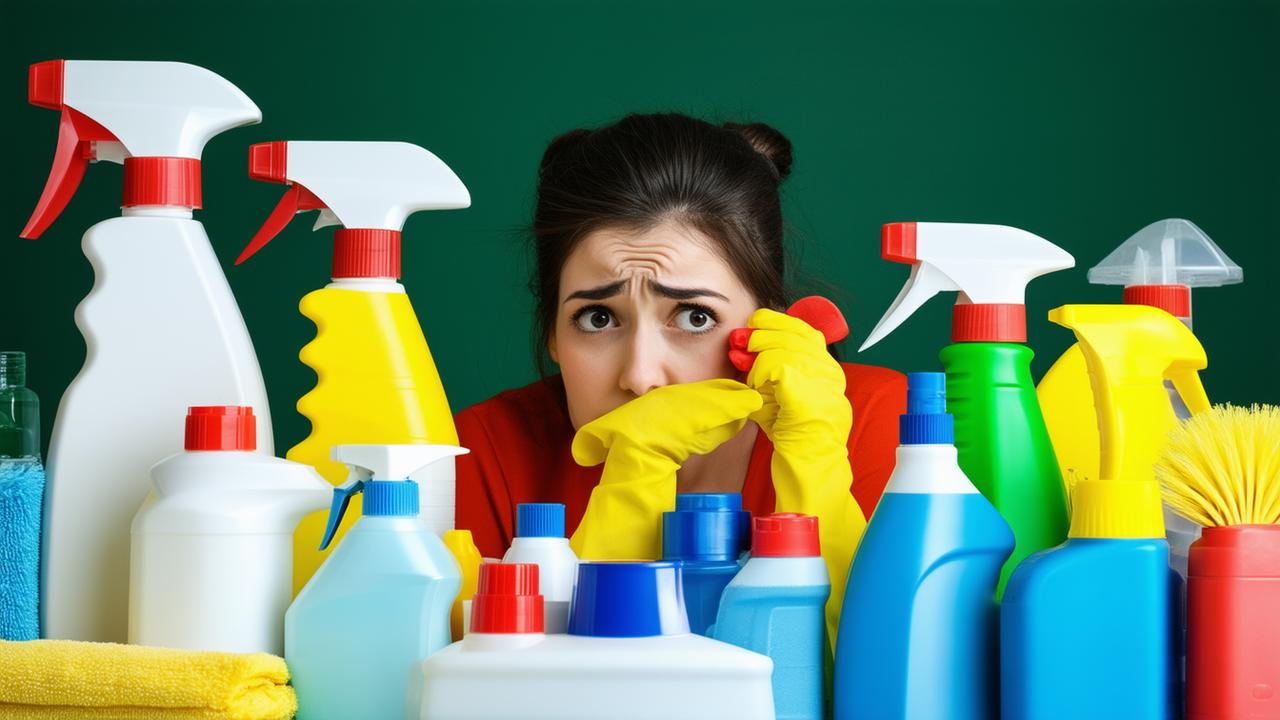
The lemon oil hit first—sharp and sunny, curling through the hallway like a bright ribbon. Then came the low whir of the vacuum, the rhythmic clack of dishes stacked just so, the faint, constant hiss of something being wiped, scrubbed, or folded. It was a Sunday morning like so many others in this house, and yet the air felt tight, as if the walls themselves were sucking in their breath, bracing for inspection.
On the couch sat a child holding a book in midair, her fingers paused between pages not because she was lost in the story, but because she had been told twice, already, not to “crumple the cushions.” In the kitchen, a partner moved silently, rinsing a mug so quickly after its last sip of coffee that the warmth had barely left it. And in the middle of the living room stood a woman with a cloth in one hand and a spray bottle in the other, shoulders flinched toward her ears, studying the coffee table like it had personally offended her.
This wasn’t a house. It was a stage set—everything in its place, nothing out of line, and no room for the mess of being alive. Overcleaning had snuck in slowly, disguised as virtue, disguised as care, disguised as “just wanting things nice.” But somewhere between the streak-free windows and alphabetized spice rack, something softer had been scrubbed away.
The Quiet Creep of “Too Clean”
It rarely starts with an obsession. It starts with good intentions and quiet comparisons.
Maybe you scroll past a photo-perfect living room online—linen sofa, neutral tones, a single ceramic cup on a flawless coffee table—and feel a small tug of envy. Maybe a relative visits and comments, “You’re brave, living with the toys out,” with that half-laugh that lands more like a judgment. Maybe you grew up in a house that was always chaotic, surfaces buried under paper and laundry, and you once promised yourself, My home will never feel like that.
So you clean. You organize. You put systems in place. At first, it feels grounding. A freshly wiped counter at the end of a long day is a small, bright victory. The smell of soap is reassurance. You start to believe that a tidy home means a tidy mind, and for a moment, it’s true.
But cleaning has a way of creeping. The more you notice what’s sparkling, the more you notice what isn’t. Crumbs that once went unseen now glare at you in the evening light. Handprints on the staircase wall blaze like accusations. The chessboard of the living room—pillows, blankets, books, toys—becomes a battlefield where peace is measured in straight lines and flat surfaces.
This is where overcleaning begins to take root: not in the act itself, but in what it starts to mean. A stray sock isn’t just a sock anymore. It’s a failure. A sticky spot on the table isn’t just juice; it’s disrespect, laziness, loss of control. The story changes from “I like my home tidy” to “My home must be perfect, or I am not enough.”
How Overcleaning Turns Home Into a Performance
Home is supposed to be where our shoulders drop, where our shoes—and our guards—come off. But in an overcleaned home, something strange happens: everyone becomes a performer, tiptoeing around the set to avoid smudging the illusion.
You hear it in the way people move:
- The child who hesitates before taking out the craft box, asking, “Is it okay if I make a mess?” with eyes already expecting the answer.
- The partner who eats over the sink instead of at the table, to avoid leaving crumbs.
- The friend who visits and jokes, “I’m scared to touch anything,” but laughs just a little too tightly.
A home that is too clean can start to feel less like a refuge and more like a museum—beautiful to look at, but not meant to be lived in.
And then there’s the invisible pressure on the person who upholds the cleanliness. Maybe that person is you.
You hear a chair scrape and your body tenses. You notice a trail of shoes by the door and your heart rate bumps. Something spills and your instinct is not, “Are you okay?” but “How fast can I fix this?” You’re not chasing joy; you’re chasing the absence of irritation, of visible chaos.
Overcleaning transforms care into control. It shifts from, “I want my family to feel comfortable,” to “I need everything to stay within my comfort zone, all the time.” The home becomes a place that reflects not just who you are, but whether you are succeeding at being who you think you must be.
When Clean Becomes a Silent Metric of Worth
Inside many overcleaned homes, there’s a quiet equation at work:
Clean home = good parent / good partner / responsible adult.
Messy home = failure, shame, proof I’m falling behind.
Even if you don’t say it out loud, your body lives by that math. You’re more polite, more relaxed, more generous when the floors are vacuumed and the dishes are done. You’re quicker to snap, sigh, or shut down when the sink fills or toys multiply in the corners.
This is how overcleaning creates pressure: not just in to-do lists and endless chores, but in identity. It fuses your self-worth to your surfaces.
The trouble is, life does not behave around this equation. Life is inherently messy. Children are sticky. Meals splatter. Seasons bring mud, rain, leaves, sand. Grief, illness, new babies, deadlines—none of them pause to ask if your house is ready to stay guest-post worthy.
When your sense of okayness is tethered to a spotless space, you put yourself—and everyone in that space—under a constant, low-grade stress. You’re not simply cleaning a home. You’re constantly trying to prove something through it.
The Emotional Cost of a Spotless Floor
In an overcleaned home, the cost is often hidden in small moments that pass quickly but cut deeply.
The teenager who stops inviting friends over because “Mom will freak if they move anything.” The partner who tiptoes around asking for help with something messy—a project, a hobby, a recipe—because they know it will “stress you out.” The toddler who learns that painting is “too messy for inside,” and slowly trades joyful experiments for quiet, contained play.
Each of these moments is like a tiny tax paid to the god of spotless floors.
Over time, the emotional costs stack up:
- Less spontaneity. You don’t bake brownies on a whim because you already cleaned the kitchen.
- Less connection. You spend evenings “just finishing up” rather than sitting down together.
- More resentment. You feel alone in your standards, irritated that no one else seems to see what you see.
- More self-judgment. When you’re too exhausted to keep up, you turn the same harshness on yourself.
The house is gleaming, but the atmosphere is brittle. You might not even notice how much tension lives in the air until you experience the opposite—walking into a home where there are dishes on the drying rack, shoes by the door, a faint smell of last night’s dinner still lingering—and feeling your chest actually loosen. “Ah,” your body says, “someone really lives here.”
A Gentle Look at Why Overcleaning Hooks Us
It’s easy to scold yourself for overcleaning—to call it vanity, control freak behavior, perfectionism. But underneath, there is often something softer asking to be noticed.
Overcleaning can be:
- A way to manage anxiety when life feels unpredictable.
- A survival skill learned in childhood: “If everything looks perfect, no one will be angry.”
- A socially rewarded habit, constantly praised with comments like “I don’t know how you do it all!”
- A way of avoiding rest, because rest feels unfamiliar, even undeserved.
When cleaning is the one place you reliably feel control, accomplishment, or safety, of course you’ll return to it. The problem isn’t that you clean; it’s that cleaning becomes the only door you know how to open when you’re stressed, scared, or uncertain.
Understanding this doesn’t mean you need to abandon your love of tidy spaces. It simply means recognizing the emotional layers beneath the shine—and gently questioning whether this much effort is still serving you and the people you live with.
Finding the Line Between Care and Control
There’s nothing wrong with wanting a clean, nurturing home. Clean dishes matter. Clear pathways matter. Being able to find your keys when you’re already late definitely matters. The goal isn’t to swing from one extreme to the other—from spotless to squalor—but to find a living middle, where your home is both cared for and lived in.
➡️ Gardeners are rethinking soil turning after noticing long-term damage
➡️ If your plants seem healthy but attract recurring problems, the cause may be underground
➡️ Over 60 and experiencing stiffness in the morning? This is what your body needs most
➡️ Over 65? This overlooked part of the foot plays a key role in stability
➡️ Restoring sight without major surgery: the quiet revolution behind a new clear eye gel
➡️ Add just two drops to your mop bucket and your home will smell amazing for days, no vinegar, no lemon needed
➡️ Space almost ignited a serious conflict between China and the United States over secret military ambitions no one wants to admit
One useful way to check in with yourself is to notice how cleaning feels in your body.
- Does your chest feel tight or soft?
- Are your actions rushed, almost frantic, or steady and rhythmic?
- Do you feel more open to others when you’re done, or simply relieved that no one will “see” anything wrong?
You can start to gently redraw the boundaries between care and control by experimenting with small, deliberate imperfections—and noticing what rises in you.
Leave the breakfast dishes for an hour after you eat and sit at the table talking instead. Let the kids keep the pillow fort up overnight. Allow the laundry basket to be visibly full without “just quickly finishing it” before bed. See what stories your mind starts to tell: This is lazy. This is slipping. This means I’m failing. Then ask, quietly, “Is that actually true? Or is this just different?”
Care is about tending to what supports life. Control is about bending life to match a picture in your mind. Your home will tell you which one you’re practicing by how people feel inside it—tense and careful, or relaxed and real.
A Simple Table to Notice Pressure Patterns
Sometimes it helps to see things laid out clearly. Here’s a compact comparison you can glance at on your phone whenever you’re wondering if the line has been crossed:
| Sign | Healthy Cleaning | Overcleaning & Pressure |
|---|---|---|
| Timing | You clean when it fits your energy and schedule. | You clean immediately, even when exhausted or busy. |
| Emotions | You feel satisfied and lighter afterward. | You feel on edge, and any new mess upsets you. |
| Family behavior | People use spaces comfortably. | People apologize for normal, small messes. |
| Standards | “Clean enough” is okay most days. | Only “perfect” feels acceptable. |
| Identity | A messy day doesn’t change how you see yourself. | Mess makes you feel like you’re failing at life. |
Letting Your Home Be a Place You Can Exhale
Imagine, just for a moment, walking into your home on an ordinary afternoon.
The shoes by the door are not lined up, but they tell a story: someone made it home, tired and safe. The couch cushions are slouched, but warm from a recent nap. The kitchen smells faintly of toast and coffee, the dishes stacked but not yet washed. On the table, there’s a scatter of colored pencils and half-finished drawings, like evidence that imagination was here recently and will return.
Your shoulders lower. You breathe, not in relief that everything is under control, but in recognition that everything is alive.
This is the subtle shift that loosens the pressure overcleaning creates: seeing mess not as a moral failure, but as a signature of presence. A splash of water near the sink says someone cooked. A blanket on the floor says someone rested. A cluster of school papers on the counter says someone is learning, growing, in motion.
You can still care for your home—wipe, sweep, fold, tidy. But what if cleaning became an act of hospitality toward your own life, rather than a way of erasing its traces?
Maybe tonight, instead of “just getting this one more thing done,” you sit with your family amid a not-perfect room, feet up on a not-spotless table, and let conversation wander. Maybe you let the vacuum wait until morning and notice that the world does not, in fact, end. Maybe you begin to trust that worthiness is not measured in square footage of spotless floor.
Homes are not meant to be proof. They are meant to be places. Places where we soften. Places where we can have a bad day and not apologize for the state of the living room. Places where children can grow up learning that love isn’t withdrawn over muddy shoes, and partners can breathe without worrying if the coaster is in the right place.
Let the lemon oil linger, if you like. But let the lived-in air in, too. The world outside already asks so much performance of us. Let your home be the one space where you don’t have to earn your right to be there by how clean everything looks.
Frequently Asked Questions
How do I know if I’m overcleaning instead of just being tidy?
Ask yourself how you feel when something is out of place. If a small mess makes you unusually anxious, irritable, or ashamed, or if you feel compelled to clean even when you’re exhausted, it’s a sign that cleaning may be tied to control or self-worth rather than simple care. Another clue: if others in your home seem tense or apologetic about normal mess, overcleaning is likely creating pressure.
Is it wrong to like a very clean home?
No. Enjoying cleanliness is not the problem. The issue arises when your standards are so rigid that they regularly cause stress—for you or others—and leave little room for rest, play, or spontaneity. A very clean home can be healthy and nurturing as long as it also feels relaxed and people-friendly.
What if I grew up in a messy or chaotic home and cleanliness feels essential?
That history matters. Wanting order after growing up in chaos is a natural response. Instead of trying to abandon cleanliness, experiment with softening it. Keep the structure that helps you feel safe—basic routines, clear spaces—but practice allowing small, temporary messes without treating them as emergencies. You’re not betraying your younger self by easing up; you’re giving them the safety they always needed, without the fear.
How can I reduce the pressure without letting everything slide?
Try setting “good enough” standards for different areas. For example, the kitchen counters cleared once a day is enough, the living room reset in the evening is enough, the kids’ rooms are their responsibility within broad safety guidelines. Create short, shared routines rather than constant solo tidying—ten-minute family cleanups instead of all-day maintenance. This protects both your time and the home’s sense of ease.
How do I talk to my family about this without blaming them or myself?
Frame the conversation around how you want the home to feel, not who is doing what wrong. You might say, “I’ve realized I’m so focused on keeping everything spotless that it’s making all of us tense. I want our home to feel more relaxed and lived-in. Can we try loosening the rules a little and sharing the basic tasks?” Invite their input, listen to what feels stressful to them, and agree on a middle ground that protects both comfort and connection.





