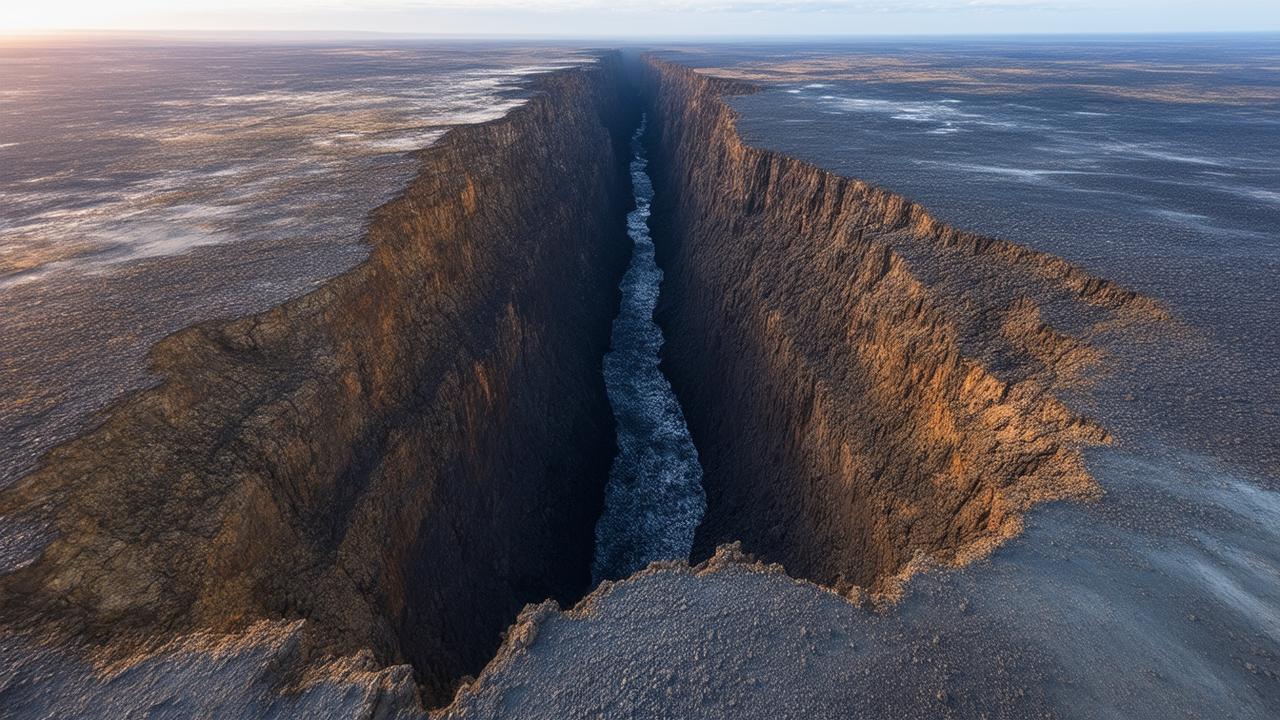
On a hot afternoon in eastern Africa, a goat herder once walked across his usual path and found the land simply… missing. Where yesterday there had been hard, sun-cracked soil, today a deep, jagged wound sliced across the earth, steaming in the heat. The air smelled of dust and something metallic, ancient. Villagers stood at the edge of the new chasm in stunned silence, peering down as if looking into the planet’s memory. Phones appeared, videos rolled, and within hours the rupture had circled the globe. Headlines shouted: “Africa is splitting in two!” It sounded like science fiction. But beneath the shock and the drama was a quieter, deeper story—one that geologists have been patiently tracing for decades. Africa, it turns out, really is tearing itself apart. Just not on the timescale that lives in a news cycle.
The Slow Tear You Can’t Feel Under Your Feet
Imagine standing barefoot on the ground, feeling perfectly solid earth under your toes, while that same ground is silently drifting… at the pace your fingernails grow. That’s the hidden reality under the African continent. Thousands of kilometers of rock, crust, and mantle are in motion, shifting a few millimeters to a few centimeters each year. It’s a motion so slow you could stand there for a lifetime and never feel it—yet powerful enough, over millions of years, to carve continents apart and create new oceans.
The place where this grand unzipping is on live display is the East African Rift System: a vast geological scar stretching from the Red Sea down through Ethiopia and Kenya, and farther south into Tanzania, Malawi, and Mozambique. In satellite images, it looks like someone has tried to peel the continent open from the top, leaving a branching, tortured network of valleys, cliffs, and volcanoes.
Scientists describe this region as a divergent plate boundary—a place where the African plate is pulling away from itself, splitting into two main parts: the Nubian Plate to the west and the Somali Plate to the east. You can think of the continent as a giant loaf of bread slowly rising in the oven, warmed from below, then starting to split down the middle along a weak seam. molten rock wells up from the mantle, the crust bulges and thins, and eventually, it cracks.
We’re not seeing this as an abstract diagram in a textbook; we’re seeing it in living color, on the surface. Roads buckle and break when the earth drops away. Cliffs continue to rise. Long, linear lakes like Tanganyika and Malawi nestle inside the deepest parts of the rift, water quietly filling the spaces where the continent is physically stretching apart.
The Viral Crack in Kenya: Drama Above, Deep Forces Below
In 2018, a video from Kenya rocketed around the internet: a gaping fissure, in some places nearly twenty meters deep and several meters wide, opened up near Mai Mahiu in the Rift Valley. A section of highway sank into the void. Families watched chunks of their farmland slough off and crumble into darkness. To many, it felt like the ground had betrayed them overnight.
The footage was gripping: people picking their way along the edges of the chasm, vehicles stranded, a landscape suddenly alien. “Africa is ripping apart!” the headlines declared. The implication was that this dramatic event had come out of nowhere, a sudden planetary crisis. Scientists, though, saw something else: a dramatic but localized expression of a process that had been quietly underway for tens of millions of years.
Part of what happened that week wasn’t purely tectonic; torrential rains combined with already weakened ground to trigger sudden collapses along pre-existing faults. The rain carved into the loose volcanic ash and soil like a knife through cake, exposing a deep fracture system that had long been there, hidden. Still, the underlying story was real: Kenya sits in one of the most active segments of the East African Rift. The earth there is literally being pulled apart.
The video gave the world an unfiltered, visceral glimpse of geology in motion. Instead of lines on a scientific map, there were villagers and highways and homes perched on the edge of change. And behind that visual drama lay an enormous, invisible engine: heat deep inside the planet, welling up, pushing, stretching, tearing.
What the Evidence Really Shows Beneath the Headlines
Strip away the viral excitement, and you’re left with a body of evidence that’s sober, layered, and surprisingly beautiful. Geologists have spent decades mapping this region—from the slopes of Ethiopian volcanoes to the Tanzanian plains—using tools that read the earth like a living diary.
Seismometers record the faint tremors as faults shift and micro-earthquakes tick along the rift like a patient clock. GPS stations, no bigger than a backpack, are anchored in bedrock and tracked by satellites, measuring how bits of Africa move relative to each other—millimeter by millimeter, year after year. Seismic tomography, which uses earthquake waves like an X-ray, reveals hot, partially molten rock rising from the mantle beneath Ethiopia and Kenya. The crust here is thinner, warmer, more stretched than in the plains and plateaus far to the west.
From the air, you see long curtains of cliffs: fault scarps that mark where one block of crust has dropped relative to another. From the ground, they loom over you as walls of rock, often hundreds of meters high, their faces stained ocher, charcoal, and rust. Lakes sit snugly in the lowest parts of the rift, aligning like a string of blue-green beads: Turkana, Naivasha, Manyara, Malawi. Their elongated shapes and steep shores are textbook signatures of a world being pulled in two directions.
Volcanoes add another chapter. Mount Nyiragongo, Ol Doinyo Lengai, Erta Ale—these are not random peaks. They rise along the faulted zones where magma can more easily find a path to the surface through thinned crust. In northern Ethiopia, near the Afar Depression, you can even walk across landscapes so freshly made that the rock is still sharp and glassy, as if the earth had recently exhaled and hardened mid-breath.
A New Ocean in the Making
Talk of Africa splitting into two often comes with a more astonishing claim: that a whole new ocean will one day flood the gap. To imagine this, stand at the edge of the Red Sea or the Gulf of Aden and look out across the water. Those stretches of ocean are actually baby scars from earlier phases of continental breakup, places where land once sat where waves now roll.
The Afar region, where Ethiopia, Eritrea, and Djibouti meet, is one of the strangest places on Earth. It’s a tectonic junction where three rifts intersect: the Red Sea Rift, the Gulf of Aden Rift, and the East African Rift. Here, the crust is not just stretching; it’s already begun to tear so completely that new oceanic crust—denser, basaltic rock formed directly from mantle melts—is forming in narrow zones. In a sense, the ocean is already trying to be born here; it’s just not full of seawater yet.
Over millions of years, if the stretching continues, the central and eastern parts of Africa—the Somali Plate—will drift away from the rest, creating a new landmass separated by water. The Red Sea and Gulf of Aden could eventually connect deeper into the continent, with seawater rushing in to flood the deepest valleys of the rift. It would be a slow-motion redrawing of the map, generations stacked upon generations watching the landscape around them subtly sink, shift, and, finally, drown.
To bring this immense scale into a human-friendly frame, imagine time-lapse footage of the next 50 million years. Lakes gradually elongate and widen, their shores crumbling into them. Volcanic fields brood and flare, then go quiet as new fissures form elsewhere. Low valleys deepen, their floors dropping as the crust thins. At some threshold, a narrow, salty tongue of the sea breaks through from the north or east, creeping inland like a quiet invasion. Centuries later, that tongue has become an arm of the ocean. Millennia on, what was once interior Africa is now coastline.
How Fast Is “Slow”? A Timeline You’ll Never Feel
The scale of this transformation invites a natural question: Should anyone alive today worry? The answer is no, but the story is still very much worth paying attention to.
Rifting in East Africa is occurring at rates on the order of a few millimeters to perhaps a centimeter per year in many segments. In human terms, that’s laughably slow. Stand on one side of the rift while a friend stands on the other, and neither of you will ever notice yourselves drifting apart in your lifetimes—or in the lifetimes of your distant descendants. Yet stretch that same rate across ten million years, and you get a gap hundreds of kilometers wide, deep enough to invite an ocean to move in.
The timeline for a fully formed ocean basin is typically on the order of tens of millions of years. For context, the Atlantic Ocean itself began as a rift not so different from what we see in East Africa today, back when the supercontinent Pangaea started to crumble. What is Tanzania today once nestled much closer to what is now eastern South America. None of the species, landscapes, or languages we know today were around then. By the time Africa’s new ocean is a reality, the world will again be unrecognizably different.
➡️ Restoring sight without major surgery: the quiet revolution behind a new clear eye gel
➡️ Add just two drops to your mop bucket and your home will smell amazing for days, no vinegar, no lemon needed
➡️ Space almost ignited a serious conflict between China and the United States over secret military ambitions no one wants to admit
➡️ Once dismissed as a “poor people’s fish,” this affordable species is becoming a prized staple as Brazilians rediscover its safety and nutritional power
➡️ A bowl of salt water by the window in winter: this simple trick works just as well as aluminum foil in summer
➡️ “Suede Blonde” is the hair color everyone wants this winter (it brightens the complexion)
➡️ Snow alerts intensify as meteorologists confirm up to 30 cm of accumulation and release the detailed hour-by-hour timing that each region needs to prepare for
| Stage | What Happens | Very Rough Timescale |
|---|---|---|
| Initial Rifting | Crust stretches and cracks; valleys and small basins form; volcanoes become more active. | 0–10 million years |
| Mature Rift | Deep rift valleys, large lakes, frequent faulting; continental crust thins significantly. | 10–30 million years |
| Birth of an Ocean | Seawater invades; oceanic crust begins to dominate the rift floor. | 30–50+ million years |
Living on a Moving Continent
If you travel along the East African Rift today, the science never feels separate from human life. In parts of Ethiopia, farmers tend terraced fields that step down into rift valleys shaped by ancient faults. In Kenya, giraffes and zebras wander across plains lined by towering escarpments—geological walls that script where rain falls, where rivers run, where people build their homes.
Rifting brings hazards: earthquakes, ground cracking, landslides, and volcanism. Swarms of small earthquakes can rattle homes and crack plaster; in rarer cases, stronger events shake entire towns. Lava from volcanoes can bury roads and fields. Fissures, like those filmed in Kenya, can appear or widen after heavy rain or seismic activity, tearing through farms and neighborhoods.
Yet rifting also creates opportunities. Volcanic soils are often rich and fertile, supporting agriculture. Geothermal fields—hot water and steam rising along faults—provide a clean, renewable energy source, something Kenya and Ethiopia are already tapping into. Rift lakes support fisheries and tourism; their waters nourish crops and wildlife alike.
For communities living in these landscapes, the rift is both a gift and a risk, a dynamic stage on which daily life unfolds. Staying safe means listening closely to the land and the scientists who study it: monitoring earthquakes, mapping unstable slopes, planning infrastructure with the earth’s restless nature in mind.
Seeing the Video, Understanding the Story
When you come across another video of a sudden crack in the ground, it helps to hold two truths at once. First, these events are very real and can be devastating on a local scale. A broken road can cut off a village from markets and hospitals. A collapsing field can erase a family’s harvest. The fear people feel when the earth opens beneath them is utterly justified.
Second, the larger narrative behind those images is not one of sudden catastrophe for the entire continent, but of slow, grand, planetary change. The crack you see on your screen is the surface whisper of deep processes—mantle plumes, plate boundaries, the bending and breaking of the crust—that have been shaping Earth for billions of years and will continue long after we’re gone.
In that sense, every fissure, every tremor, every tilted layer of rock is like a frame in a film that runs far beyond our lifetimes. Africa’s future ocean is one scene in a story that includes the birth of the Atlantic, the rise and fall of mountain ranges, and the migration of continents across the globe. Watching that Kenyan video, you’re not just gawking at a crack in someone’s field—you’re witnessing a single, vivid moment in the making of a new world.
Frequently Asked Questions
Is Africa really splitting into two continents?
Yes, but extremely slowly. The East African Rift marks where the African Plate is dividing into the Nubian Plate (to the west) and the Somali Plate (to the east). Over tens of millions of years, this process could separate eastern Africa into its own large landmass.
Will a new ocean actually form in Africa?
Most geologists think so, if rifting continues. In regions like the Afar Depression, the crust is already thinning and behaving like the early stages of an ocean basin. Eventually, seawater from nearby bodies like the Red Sea could flood into the deep rift valleys, forming a new ocean.
How dangerous is this rifting for people living nearby?
On human timescales, the main risks come from earthquakes, ground cracking, landslides, and volcanic eruptions. These can be serious locally but do not threaten the entire continent at once. Monitoring, good building practices, and hazard planning greatly reduce the risks.
Did the big crack in Kenya appear overnight?
The dramatic collapse looked sudden, but it mostly exposed pre-existing fractures in weakened ground. Heavy rainfall and ongoing tectonic stretching combined to create the visible chasm. It was a dramatic moment in a very long, gradual process.
Can we see Africa’s splitting from space?
Yes. Satellite imagery and GPS measurements show the rift valleys, fault lines, and subtle movements of the crust. Scientists use these tools to track how different blocks of the continent are drifting in relation to one another, millimeter by millimeter per year.





