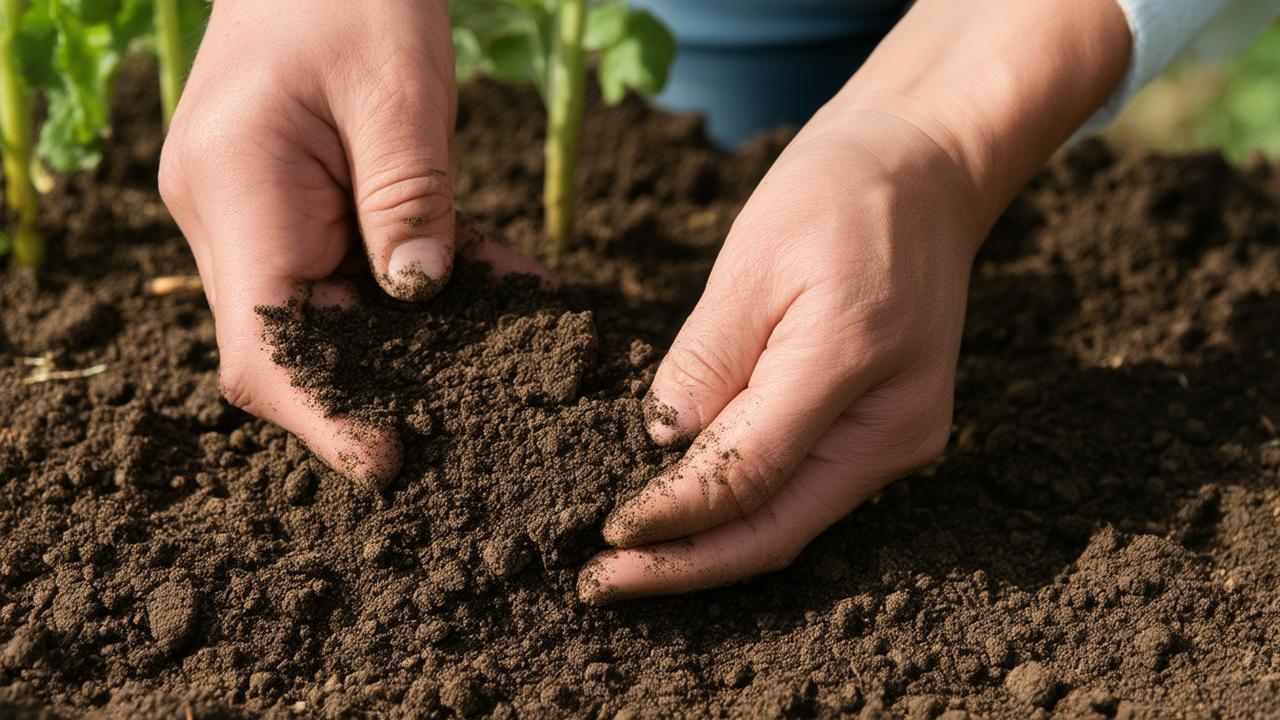
The first time I pressed my fingers into the garden bed that spring, the soil pushed back. It didn’t crumble. It didn’t welcome my hand. It resisted—stubborn, hard, and strangely dead-feeling. No earthy smell, no soft give, no sense that anything living might actually want to grow there. Just a dull, compacted weight, like a parking lot that someone had sprinkled with last year’s leaves.
The Day Your Soil Starts Talking Back
Maybe you’ve had that moment too. You slip on your gloves, step into your garden with a hopeful tray of seedlings, and the ground tells you a story you don’t want to hear. Your shovel clangs instead of sliding in. Your trowel bends. Water runs off instead of soaking in. And when you finally do manage to dig a hole, the soil breaks into hard chunks instead of soft, rich crumbs.
That uneasy feeling creeps in: Something is wrong here. The plants echo it too. Leaves turn a pale, almost washed-out green. Growth slows. Carrots twist and fork trying to wiggle through the compaction. Tomato roots circle desperately in the planting hole, reluctant to leave the fluffy potting mix for the heavy ground beyond.
It’s tempting to jump straight to solutions—buy fertilizer, haul in bagged compost, sprinkle something promising from the garden center shelves. But before any of that, there is one deceptively simple test that can tell you far more about what your soil is missing than a whole shopping cart of quick fixes.
You won’t need a lab. You won’t need a pH meter. You won’t even need to spend a penny. All you need is your hands, a little patience, and the willingness to get curious about what’s happening below the surface.
The Crumble Test: One Handful That Changes Everything
Gardeners give it different names—the squeeze test, the crumble test, the handful test—but the idea is beautifully straightforward. You’re not trying to measure numbers; you’re learning how to listen to your soil with your senses.
Here’s how to do it:
- Wait until your soil is moist but not soggy. The day after a rain is ideal, or give your bed a deep watering and come back the following day.
- Push your trowel in about 4–6 inches and lift a good handful of soil from the root zone, not just the dry surface crust.
- Hold that handful in one palm and close your fingers around it, as if you’re gently making a snowball.
- Open your hand and observe what happens.
This moment tells you more than you might think. How does it feel? How does it smell? How does it look when you gently nudge it apart with your fingers?
If your garden soil feels hard and lifeless, this simple test is about to reveal what’s truly missing. Not just nutrients, but the living structure and breath that make a soil more than ground—make it a home.
What Healthy, Living Soil Feels Like
Squeeze a living, well-balanced soil and it forms a soft clump that gently holds together. When you tap or crumble it, it breaks into small crumbs—what soil scientists call “aggregates.” Your fingers can easily push through it. It feels springy, almost like a rich cake. Tiny roots, fragments of leaves, and bits of decomposing organic matter weave through it like threads.
Bring it closer to your face and you’ll catch a deep, sweet, almost forest-like smell. That scent—earthy, warm, and surprisingly comforting—is the smell of life: bacteria, fungi, and countless invisible workers turning dead material into plant-available treasure.
Now compare that to what your soil did when you opened your hand. That difference is the story of what’s missing.
If It Clods, Crusts, or Dusts: Reading the Signs
Your soil’s behavior in your hand reveals its biggest needs. Think of it as a conversation in textures, smells, and shapes.
| What Your Hand Sees | What It Means | What’s Missing |
|---|---|---|
| Hard clod that won’t break easily | Compacted, poor structure, roots struggle | Air pockets, organic matter, soil life |
| Forms a tight ribbon when smeared | High clay, holds water but drains poorly | Loosening agents, organic matter, deep roots |
| Falls apart into flour-like dust | High sand or dried-out, no structure | Moisture retention, organic matter, mulching |
| Sticky, gummy, slick when wet | Waterlogged, oxygen-poor, roots suffocate | Drainage, air spaces, raised beds or contouring |
| Crumbly, earthy, full of small bits | Living soil, good structure and biology | Mostly in balance—maintain with gentle care |
Feel free to repeat the test in different beds, or even different corners of the same bed. Soil can change quickly from place to place, especially near paths where feet have pressed it down, or under eaves where rain pounds the surface.
As you start to recognize these patterns, an important truth emerges: your garden doesn’t just need “more nutrients.” It needs more life, and life begins with structure. Without air pockets, moisture balance, and shelter for living organisms, fertilizer is like handing vitamins to a locked door.
The Quiet Heroes: Air, Water, and the Underground Crowd
Stand still in your garden for a moment. Under your feet, an entire city is either thriving or struggling. Microscopic fungi stretch their filaments through soil like fine threads, swapping nutrients with roots. Bacteria cluster around organic matter, breaking it down into forms plants can sip. Earthworms roll tiny casts of transformed soil through their bodies, aerating as they go.
When soil feels hard and lifeless, it often means this underground city has been evicted. Heavy foot traffic, repeated tilling, bare ground baking in the sun, or constant chemical inputs can all crush, starve, or disrupt the creatures that give soil its bounce and breath.
What’s missing, more than anything, is habitat—tiny pores filled with air and water, and a steady diet of organic matter for the soil food web. When those go, compaction moves in. Water can’t soak down; it either puddles on the surface or runs away. Roots hit dense layers and circle back, or simply give up. It looks like a fertility issue above ground, but below ground, it’s a housing crisis.
The crumble test exposes this in the most honest way possible. If your handful of soil feels like a brick or powder, the message is clear: it’s time to start rebuilding a home for life.
One Simple Addition That Changes the Story
There’s a reason experienced gardeners seem almost obsessed with one thing: organic matter. Compost, shredded leaves, aged manure, grass clippings, straw, and old plant material, properly decomposed—these are not just “add-ons.” They are the raw materials of structure, the pantry for your soil’s invisible residents.
When you mix or layer organic matter into a struggling soil, you’re doing three powerful things at once:
- Feeding soil life, which in turn feeds your plants.
- Creating spongy structure that holds both water and air.
- Buffering extremes—of moisture, temperature, and even pH.
The change doesn’t always happen overnight. But month by month, season by season, that lifeless feeling begins to fade. Your crumble test shifts—from stubborn clods to gentle clumps that fall apart with a light touch. And with it, your garden’s behavior changes too: less runoff, fewer cracks, deeper roots, calmer plants in heat waves and storms.
From Hardpan to Haven: A Gentle Path Forward
The beauty of the crumble test is that it doesn’t shame or overwhelm you. It doesn’t hand you a complicated report full of numbers; it hands you a starting point. Once you know what your soil is missing, your actions become simpler, more focused, more humane—both for you and for the landscape you’re tending.
➡️ Snowfall insanity looms as up to 55 inches threatens to paralyze roads and railways while authorities argue people should just stay home
➡️ This baked chicken breast recipe stays juicy thanks to a short marinating step
➡️ This is how to move through the day with less tension
➡️ Why financial balance matters more than aggressive saving
➡️ “I blamed my workload”: but it was my routine doing the damage
➡️ This simple reset helps your body release pressure
➡️ Why your body needs regular pauses to function well
If your handful revealed hard, compacted clods, consider:
- Mulching thickly with leaves, straw, or wood chips to protect the surface and invite life back.
- Growing deep-rooted cover crops—like clover, daikon radish, or grasses—to pierce and loosen from within.
- Reducing tilling and heavy digging that collapse fragile structure each season.
If your soil puffed away into dust, try:
- Adding generous amounts of compost to help it hold moisture.
- Keeping it covered year-round, with living plants or mulch.
- Watering more deeply but less often, encouraging roots to explore.
If it turned slick and gummy when wet, consider:
- Raising beds slightly to improve drainage.
- Blending in coarse organic matter and letting roots and worms do the rest.
- Redirecting or slowing excess water that accumulates in that spot.
None of these are instant fixes. But they are gentle, cumulative acts of repair. You move from “How do I force plants to grow here?” to “How do I make this a place where plants want to grow?”
And every time you come back to that simple handful test, you get to celebrate small, tangible shifts. The smell deepens. The crumbs get finer. The resistance softens. The soil that once pushed back starts to yield, to welcome, to breathe again.
Listening With Your Hands, Season After Season
There will always be more sophisticated ways to analyze soil. Lab tests, nutrient panels, pH readings—all have their place. But the crumble test sits at the heart of a different kind of gardening: one that values relationship as much as results.
When you slip your hand into the earth and gently squeeze, you’re not just testing structure. You’re practicing a kind of attention that makes you a better caretaker. You start noticing the way spring moisture feels different from late-summer dryness. How a mulched bed responds differently from a bare one. How a year of cover crops leaves the soil looser, darker, more fragrant.
In time, what felt like hard, lifeless ground becomes something else entirely: a living fabric you’re stitching together with every leaf you return, every bare patch you cover, every heavy step you choose not to take on wet soil. The test becomes less about “What’s wrong?” and more about “How is it healing?”
So the next time your shovel hits resistance, pause before frustration takes over. Kneel down. Take a handful. Squeeze. Listen. Let that simple test reveal what’s missing—and more importantly, what’s possible—beneath your feet.
Frequently Asked Questions
How often should I do the crumble test?
Once or twice a season is enough to track changes, especially in spring and late summer. If you’re actively improving your soil, repeating it in the same spot each year helps you notice progress.
Can the crumble test replace a lab soil test?
It doesn’t replace a lab test, but it complements it. Lab tests tell you about nutrients and pH; the crumble test tells you about structure, compaction, and biological health, which are just as important.
What if my soil feels different in different parts of the garden?
That’s normal. Paths, low spots, and areas near buildings or trees often behave differently. Test several locations and treat each area according to its own needs.
How long does it take to improve hard, compacted soil?
You may notice small improvements within a season if you add organic matter and protect the surface. Significant transformation usually takes one to three years of consistent, gentle care.
Is tilling a good way to fix hard soil quickly?
Tilling can loosen soil in the short term, but it often destroys structure and harms soil life, leading to worse compaction later. For long-term health, it’s better to use organic matter, roots, and minimal disturbance.





