The first time I noticed it, I was standing barefoot in my kitchen, the late afternoon light slanting across the tiles, waiting for the kettle to boil. The counters were scrubbed. The sink was empty. The bin had just been taken out. It looked, by every usual measure, “clean.” And yet something felt… off. The room didn’t feel restful. It didn’t feel like the kind of place where you’d want to linger over a cup of tea. My shoulders were tight, my jaw clenched, my eyes darting from one small annoyance to the next. Only when the kettle clicked off did I realize what was wrong: there was simply too much stuff demanding my attention.
The Quiet Weight of “Almost Clean”
We live in a culture obsessed with deep cleaning. There are entire weekends devoted to it, checklists pinned to fridges, endless products promising sterile perfection. We steam the carpets, scrub the grout, disinfect the handles. We chase “sparkling” the way some people chase sunsets.
But here’s the overlooked detail that makes a bigger difference than all that scrubbing: visual quiet.
Not disinfected. Not polished. Quiet.
Walk through your home and notice what your eyes land on. The pile of mail on the hall table. The six half-burned candles on the mantle. The tangle of chargers by the sofa. The three almost-empty shampoo bottles in the shower. None of these things are “dirty,” exactly. But they shout. Each one makes a tiny demand on your brain: decide about me, use me, move me, remember me.
This is where the tension creeps in, even in an otherwise clean space. The countertop may be spotless, but if it’s crowded with appliances and knickknacks, your nervous system doesn’t get the memo. It’s like someone whispering “do more, do more, do more” under the hum of the fridge.
The Detail You’re Not Looking At (But Feel Every Day)
Science is starting to catch up with what many of us already feel but can’t quite name: clutter—especially visual clutter—drains us. Studies suggest that when our eyes have to process too many unrelated objects at once, our brains work harder just to exist in the room. It’s a low-level cognitive tax we pay all day long without noticing the invoice—until we’re exhausted, snappy, and mysteriously restless in our own homes.
Deep cleaning attacks dirt. Visual quiet lightens load.
The difference shows up in small but profound ways. You walk into a room with clear surfaces and intentional objects, and your breath subconsciously deepens. Your shoulders drop half an inch. Suddenly there’s mental room to think, to daydream, to notice the way the afternoon light settles on the floor like a friendly cat.
Visual noise, though, keeps you stuck in micro-alert. You may not register the basket of random cables on the shelf or the leaning tower of unread magazines on the coffee table, but your brain does. Each item is an unresolved story: “Someday I’ll sort this.” “I really should read that.” “I might need this one day.” Multiply that by a few hundred, and you’re living in the middle of a thousand small unfinished sentences.
How Visual Quiet Feels (And Why It Beats Sterile Perfection)
Imagine two kitchens.
In the first, everything is scrubbed, sanitized, and gleaming, but every inch of counter space is occupied: toaster, blender, knife block, drying rack always half full, a ceramic jar of mismatched utensils, a row of decorative jars you never actually open. It smells faintly of lemon cleaner and urgency.
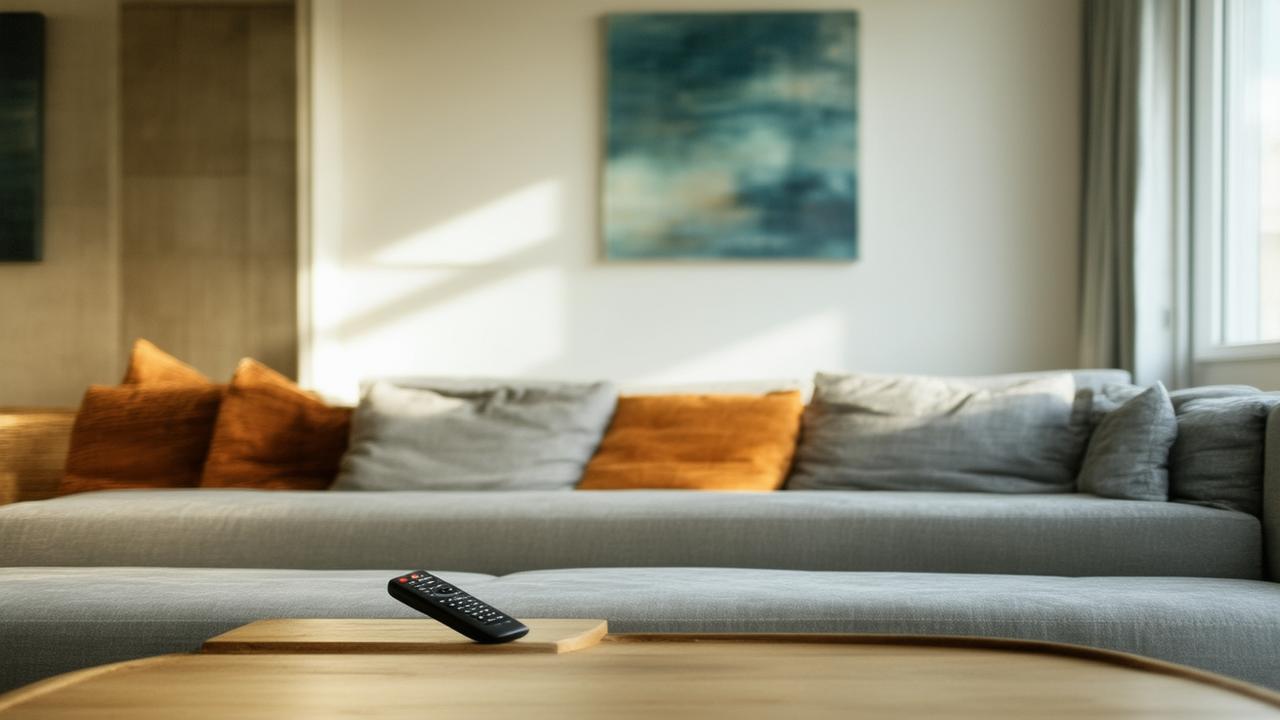
In the second, there might be a few crumbs hiding under the toaster and a coffee ring or two you haven’t wiped yet. But the counters? Mostly clear. A cutting board. A bowl of lemons. A kettle. That’s it. Your gaze rests easily. You can see the worktop, the backsplash, the empty space where possibility lives. Your shoulders soften, your brain finds neutral.
Which would you rather cook in after a long day?
Deep cleaning is about erasing evidence of the past. Visual quiet is about making space for the present.
Small Shifts, Big Calm
The good news is that you don’t need a full minimalist conversion or a rental dumpster parked outside to feel the difference. This overlooked detail isn’t about getting rid of everything. It’s about what your eyes meet first.
Think in terms of “lines of sight.” Stand at your front door. What’s the first thing your eyes trip over? That’s your starting point. Then try this simple sequence in any room:
- Clear, don’t clean (at first)
- Remove, don’t rearrange
- Decide, don’t delay
Instead of diving straight into scrubbing, focus first on what your brain’s been quietly trying to ignore.
The 10-Item Reset (A New Kind of “Cleaning”)
Pick any surface that’s been bothering you: a dresser top, your desk, the bathroom counter. Set a timer for 10 minutes. Then remove just 10 items—no more, no less.
Each of those 10 items must either:
- Go back to a real home (a drawer, a shelf, a basket), or
- Be tossed, recycled, donated, or used up this week
After those 10 things are dealt with, stop. Don’t keep going, even if you feel the momentum. Let your brain register the difference on a small scale. You’re not trying to conquer the room; you’re trying to teach your nervous system what “quieter” feels like.
Often, you’ll realize that your space didn’t need deep cleaning as badly as it needed fewer visible decisions yelling at you from every angle.
Where Visual Noise Hides (More Than Dust Bunnies)
Visual clutter isn’t always obvious. Sometimes it hides in things we’ve stopped really seeing.
Corners, Surfaces, and the Story They Tell
Look at the places where items tend to gather: entryway tables, nightstands, the top of the fridge, that one chair that’s technically a seat but practically a clothing rack. These zones become narrative dumps—places where the story of your day gets dropped and never edited.
Try this exercise: choose one small zone and ask, “What story does this tell about my life?” Is your entryway saying, “I’m always late and overwhelmed”? Is your nightstand saying, “I’m perpetually tired and never finish what I start”?
Then ask a quieter question: “What story do I want this spot to tell?”
Maybe your nightstand story becomes, “I rest here.” So you clear the pile of half-read books and keep just one. You remove the hand cream collection and keep your favorite. You add a small glass of water, a lamp you actually like, and perhaps a single object that makes you smile—a stone from a hike, a tiny vase, a photo that doesn’t need a frame the size of a billboard.
Nothing about this is about perfection. It’s about editing the scene so your mind doesn’t have to work so hard to be in it.
➡️ Snowfall insanity looms as up to 55 inches threatens to paralyze roads and railways while authorities argue people should just stay home
➡️ This baked chicken breast recipe stays juicy thanks to a short marinating step
➡️ This is how to move through the day with less tension
➡️ Why financial balance matters more than aggressive saving
➡️ “I blamed my workload”: but it was my routine doing the damage
➡️ This simple reset helps your body release pressure
➡️ Why your body needs regular pauses to function well
A Simple Comparison: Cleaning Vs. Visual Quiet
To see how big this detail really is, it helps to lay it out side by side.
| Deep Cleaning Focus | Visual Quiet Focus |
|---|---|
| Scrubbing surfaces, disinfecting, polishing | Reducing visible items, clearing lines of sight |
| Targets germs, grime, stains | Targets mental load and visual noise |
| Requires energy, time, and physical effort | Requires decisions and letting go, but less physical strain |
| Results feel satisfying but can fade fast as things pile up again | Changes how a room feels even when it’s not perfectly clean |
| Best for: health, hygiene, occasional resets | Best for: daily calm, creativity, sense of spaciousness |
We need both. But most of us have tilted so heavily toward “clean” that we’ve neglected “quiet.” And quiet, it turns out, is where ease lives.
Listening To What Your Space Is Trying To Say
Our homes are full of tiny conversations. The shoes left in the middle of the hall say, “No one really arrives here.” The overfull bookshelf says, “I don’t have time to absorb what I take in.” The overdecorated mantle says, “I’m trying hard to prove something.”
When you start removing visual noise, you also start hearing subtler messages.
Maybe you notice that without the pile of work papers on the dining table, dinners feel less rushed, more anchored. Or that with three toys instead of thirty scattered across the living room, your child actually plays longer, deeper, quieter. Fewer choices, more presence.
Nature models this for us all the time. A forest floor isn’t “clean” in the sterile sense—there are fallen leaves, moss, branches, insects, the soft crumble of soil. But it’s coherent. Everything belongs. There’s no random pile of unopened mail under a maple tree, no abandoned blender on a boulder. When you walk through a woodland path, your brain isn’t parsing hundreds of unrelated objects; it’s moving through a pattern-rich, visually harmonious world.
Bringing more visual quiet into your home is less about copying minimalism and more about borrowing this natural coherence. Ask: does this belong in this “ecosystem” of the room? Does it support what actually happens here? Or is it visual static?
Letting “Good Enough” Be Quiet Enough
There’s a gentle rebellion in choosing visual calm over relentless spotless-ness. It’s admitting that life is not a showroom and that your energy is better spent on living than on polishing every surface to a mirror sheen.
Maybe the floor has a few crumbs from breakfast, but the dining table is clear except for a vase with two slightly wilted but still beautiful flowers. Maybe the bathroom mirror could use a wipe, but the counter isn’t buried in products; there’s a hand soap you like and a towel you actually use. The room may not pass a white-glove test, but it passes a far more important one: you actually feel okay in it.
That afternoon in my kitchen, when the kettle finally cooled, I didn’t reach for a mop or a spray bottle. I removed the things that didn’t need to be there. The extra jar of wooden spoons I never used. The decorative tray that collected clutter more than it contained it. The stack of cookbooks I loved but never opened there, which found a new home on a shelf.
Nothing was “deep cleaned.” But when I stepped back, the room exhaled. And so did I.
That’s the overlooked detail: not how hard you scrub, but how gently your space speaks. Not how shiny the surfaces, but how few things demand to be seen at once. When your home becomes less of a to-do list and more of a quiet backdrop, life inside it doesn’t need to be perfect to feel deeply, unmistakably, good enough.
FAQ
Is this just minimalism with another name?
Not exactly. Minimalism often focuses on owning fewer things overall. Visual quiet focuses on what’s in your line of sight and how your space feels. You can still own plenty; you’re simply more intentional about what’s visible and what’s stored.
What if I have kids or a busy household?
Visual quiet becomes even more helpful. Instead of aiming for “always tidy,” focus on a few key zones: a clear dining table, an empty coffee table, or a calm entryway. Think “anchor spots” that return to neutral once a day, even if everything else is wild.
Do I have to get rid of sentimental items?
No. But you may want to display fewer at once. Rotate meaningful objects and store the rest safely. This gives each item more space to breathe—and makes it easier for you to truly appreciate them.
How often should I deep clean if I focus on visual quiet?
That depends on your home and lifestyle, but many people find they can deep clean less frequently when daily life feels calmer and more manageable. Regular light cleaning plus intentional visual quiet often keeps spaces feeling fresher for longer.
Where should I start if my home feels overwhelmingly cluttered?
Start tiny. Choose one surface that you see often: your nightstand, kitchen counter, or desk. Clear just that space and keep it quiet for a week. Let yourself experience how it feels before moving on. Small, honest wins are more powerful than ambitious overhauls you can’t maintain.





