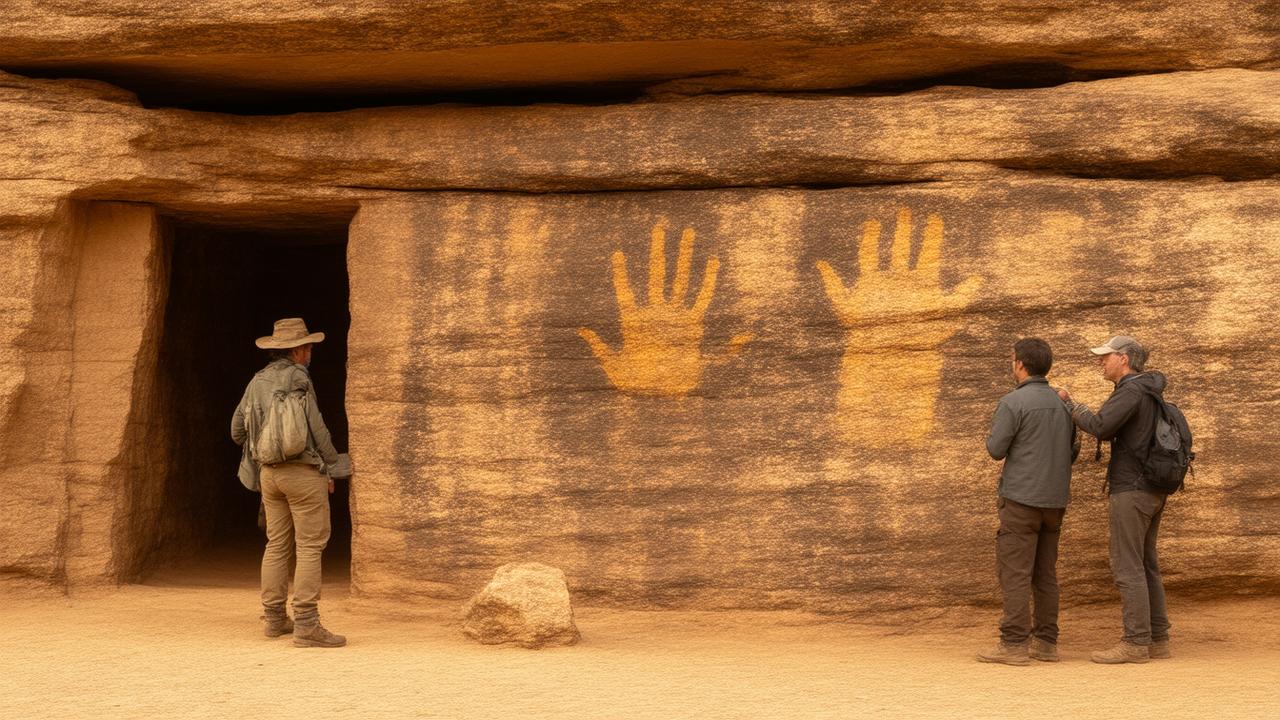
The first thing that hits you is the colour. Not the sky, though it is the kind of piercing blue that seems to ring in your ears, but the rock itself. Ochres of rust and blood and burnt umber, split by black shadows where the stone has cracked and folded over millions of years. The air in the Kimberley is hot enough to taste—dry, metallic, touched by the faint sweetness of spinifex resin. Cicadas drone. Somewhere, unseen, a river moves through paperbark and pandanus, its flow hidden but insistently present. And on the stone, watching across the ages, are the figures: long-limbed, big-eyed, white-ochre beings painted thousands of years before the first European set eyes on this coast.
Following the Red Road into Deep Time
The four-wheel drive shudders along a corrugated track, a thin red scar through open woodland. Dust pours up behind us, a ghostly tail that hangs in the still air. It feels, in that way the Kimberley often does, like we are driving not just across a landscape, but backwards through time. Every kilometre strips away something familiar—bitumen, power lines, mobile reception—until almost nothing stands between the present and the deep past.
When we finally cut the engine, the silence has weight. It presses in, broken only by the soft ticking of cooling metal and a distant crow. Our guide, a local Traditional Owner, lifts a hand and points to a low escarpment just visible between the stringybarks. “They’re up there,” he says quietly. “Old people’s paintings. You walk in soft. You listen.”
As we climb, the ground changes underfoot: loose scree, flakes of stone where the cliff face has slowly exfoliated, century by century. In the overhangs and shallow caves, the air cools markedly, carrying that mineral smell of shaded rock. This is where the art begins to appear, subtle at first—faint smears of red, hand stencils like pale ghosts on the wall. Then, as our eyes adjust, more and more emerges from the rock, until the entire surface seems alive with figures and patterns, stories and warnings, maps of country written in ochre instead of ink.
Meeting the Wandjina and the Gwion Gwion
The Kimberley is home to some of the world’s most extraordinary rock art, and two traditions, in particular, have captured the attention of archaeologists, artists, and policymakers alike: the Wandjina and the Gwion Gwion (sometimes called Bradshaw) paintings.
Under a sweeping rock shelter, the first Wandjina stares down. The figure is tall, painted in white, with a rounded, halo-like head edged by radiating lines. There is no mouth, just wide, dark eyes and a simple nose. Around the figure, lines of dots and streaks of red and yellow give the impression of rain, clouds, and lightning. It is impossibly striking, both gentle and imposing, like a storm held in a single human form.
For many Aboriginal people of the Kimberley, Wandjina are more than images; they are living ancestral beings, associated with rain, law, and creation. They are still repainted today, with careful ceremony, to keep the relationship between people, spirit, and country alive. The rock surfaces are not “finished artworks” in a museum sense; they are dynamic meeting places, renewed and sustained, part of a living cultural practice that outlasts governments and legal systems.
A short walk away, tucked deeper under a ledge, a different style emerges. Slim, elongated human figures dance across the wall: some appear to be running, others are in mid-step, carrying spears, boomerangs, or intricate accessories. Their torsos are adorned with delicate infill patterns—crosshatching, tassels, and sashes that suggest ceremonial dress. These are the Gwion Gwion paintings, and they may be among the oldest figurative artworks on Earth.
Estimates vary, and the science continues to evolve, but some studies suggest Gwion Gwion art could be over 12,000 years old, perhaps significantly older. Whatever the exact age, the impact is visceral. You feel it in the hush that falls over the group, in the way people unconsciously slow their breathing. Here, in a remote pocket of north-west Australia, you’re standing in front of images that were already ancient when the last ice age ended.
When Stories in Stone Collide with Modern Law
Out here, surrounded by rock and silence, the idea of “heritage protection” feels distant, like something that belongs to city offices and legal texts. But the Kimberley’s rock art is quietly, insistently reshaping how Australia thinks about cultural heritage—and how the law should respond to it.
For decades, Australian heritage protections have been a patchwork of state and federal laws, often reactive rather than proactive, and frequently skewed towards built colonial heritage: sandstone terraces, old wharves, churches. Even where Indigenous heritage is recognised, the focus has too often been on discrete, nameable “sites” rather than vast, interconnected cultural landscapes. Rock art, with its sheer abundance and longevity, challenges that narrow focus.
In the Kimberley, there are estimated to be hundreds of thousands of art panels—some visible, others tucked in ravines, still others hidden behind vegetation or under collapsed rock. Many are unrecorded. Traditional Owners know them as part of their Country, part of creation stories and songlines that link rivers, ranges, and coastlines. To protect one shelter in isolation, while blasting a nearby ridge for a road or mine, is to misunderstand the continuity of the place entirely.
Recent national debates around heritage law, spurred in part by high-profile destruction of sacred sites elsewhere in Australia, have cast new attention on the Kimberley. Here, the evidence of an almost unimaginably deep human history is written so vividly on the stone that it’s become impossible to ignore. Policymakers, industry leaders, and the broader public are being forced to confront unsettling questions: If human presence in this landscape stretches back tens of thousands of years, what obligations do we have to the people who kept those stories going? And what does it mean to protect “heritage” when that heritage is not static, but living, ceremonial, and intimately tied to ongoing land rights?
The Kimberley as a Living Cultural Landscape
As we sit in the dappled shade of a rock shelter, our guide traces a line in the dust with a twig. He marks out the river system that winds below us, the ranges in the distance, the sea far to the north. Then he taps the rock behind him, where ochre figures stand in a silent crowd.
“This isn’t just art,” he says. “This is law. This is map, story, our library. When you look after this painting, you look after the water, the animals, the kids. All the same thing.”
In that simple explanation lies the core of the current debate. For many Traditional Owners, rock art cannot be separated from the broader health of Country. To protect one is to protect the other. But governments and companies often operate with a narrower lens: a site boundary on a map, a set of GPS coordinates, a mitigation plan, and maybe a plaque. The Kimberley’s art, sprawling across gorges and plateaus, refuses to be so neatly contained.
Archaeologists, too, are increasingly arguing for a landscape-scale view. Layers of superimposed paintings show changing styles and subjects over millennia—different climate regimes, hunting practices, ceremonial life. Studied together, they tell a story of adaptation and continuity that challenges stereotypes about “static” traditional cultures. Seen this way, blowing up even a “small” cluster of art for development isn’t just losing a handful of images; it’s tearing pages out of a vast, interlinked archive.
Nothing captures this shift better than the way heritage professionals now talk about “cultural landscapes” instead of “sites.” The Kimberley is a critical testing ground for how that language becomes law, policy, and practice on the ground.
Numbers, Pressures, and a New Kind of Reckoning
While the Kimberley can feel timeless, the pressures bearing down on it are thoroughly modern: mining exploration, gas projects, dams, roads, and a growing tourism footprint. In meeting rooms thousands of kilometres south, these pressures are tallied, modelled, and debated. Out here, they manifest in small but telling ways—new tracks, survey flags, tyre marks in creek beds.
To understand the collision between development and heritage, it helps to step briefly into the language of planning: approvals, assessments, social license, impact statements. For mobile readers, here’s a compact view of the forces surrounding Kimberley rock art today:
➡️ Across Australia scientists are mapping a silent rise in urban heat islands
➡️ Why Australian sleep researchers are rethinking blue light guidance for modern households
➡️ Australia’s coastal planners are revising sea wall strategies as storm surges intensify
➡️ What Australia’s bushfire science reveals about the future of smoke exposure in cities
➡️ How Australian marine biologists are tracking coral recovery after repeated bleaching events
➡️ The quiet shift in Australian coffee culture as climate pressures reshape bean supply
➡️ Researchers identify a specific type of adult stem cell with exceptional potential to regenerate human teeth and repair bone
| Factor | What It Means on the Ground |
|---|---|
| Mining & Energy Projects | Exploration tracks, blasting, vibrations, and dust affecting rock surfaces and access to sites. |
| Tourism Growth | More visitors, more foot traffic, risk of unintentional damage but also greater public awareness. |
| Climate Change | Shifts in rainfall, extreme heat, increased fire risk accelerating weathering of rock surfaces. |
| Legal Reform | Push for stronger Aboriginal-led decision-making and recognition of cultural landscapes. |
| Community Leadership | Traditional Owners asserting rights, leading surveys, guiding research, and shaping access protocols. |
Each of these lines represents countless conversations—some collaborative, others tense. Increasingly, Traditional Owners are at the centre of those talks, demanding not just consultation but genuine control. They are establishing Indigenous ranger programs, cultural mapping projects, and their own heritage policies that go far beyond minimal legal requirements.
What’s emerging is a new kind of reckoning: an acknowledgment that you cannot celebrate Australia’s ancient rock art on postcards while treating the people who painted, care for, and descend from its makers as an afterthought. The images in the Kimberley are forcing the country to look, again and again, at just how shallow the colonial timeline is in comparison—and how frail its assumptions about ownership and authority can seem beside tens of thousands of years of continuous culture.
Listening to the Rock, Rethinking the Future
Late in the day, as the sun drops and the cliff faces catch fire in orange light, the paintings shift. Figures that were faint at noon now glow; others retreat into shadow. Swallows skim the cliff-line. Smoke from a distant, cool burn hangs on the horizon, blue and fine as gauze. Time feels thick here—not an arrow, but a series of loops and returns.
Our guide pauses at one last panel before we head back. The painting is more recent, he explains, though still older than any living person. It shows a style of canoe no longer used in this part of the Kimberley, a type of spear rarely seen. Layers of story inside a single outline.
“People sometimes say this is ‘past’ culture,” he says, the word “past” held very gently, almost skeptically. “But we’re still here. We still talk to these ones. We still got that law.” He nods at the rock, then at the ground beneath our boots. “When you protect this, you protect us. When you protect us, you protect this. Same thing.”
In the coming years, Australia’s heritage legislation will continue to be argued over, amended, perhaps transformed. Committees will sit, reports will be tabled, new acronyms will be invented. But out in the Kimberley, the rock art waits, watching with those long, steady eyes. It has already outlived empires, climate shifts, extinctions, and revolutions. What’s being decided now, in essence, is whether modern Australia is willing to see that endurance not as a curiosity, but as a source of authority.
To walk softly under these sandstone overhangs is to feel that decision pressing in from all sides. The Kimberley’s ancient art does more than decorate the stone. It rearranges the very terms of the conversation about what Australia values, who gets to speak for Country, and how far into the future our responsibilities truly extend.
Frequently Asked Questions
Why is Kimberley rock art considered so significant?
The Kimberley holds one of the world’s densest and oldest concentrations of rock art, with traditions like the Wandjina and Gwion Gwion offering evidence of deep-time human presence. The art is not only visually striking; it represents living cultural and spiritual connections for Aboriginal communities, making it crucial to both global history and contemporary Indigenous law and identity.
How old are the Wandjina and Gwion Gwion paintings?
Wandjina paintings are generally younger than Gwion Gwion, though still thousands of years old and often maintained or repainted as part of ongoing cultural practice. Gwion Gwion figures are thought by many researchers to be over 12,000 years old, with some studies suggesting even greater antiquity, though exact dates are still under investigation.
Can visitors see Kimberley rock art sites?
Yes, some rock art sites in the Kimberley are accessible to visitors, often through guided tours operated in partnership with Traditional Owners. However, many sites are restricted or secret, and access is carefully managed to protect both the artwork and cultural protocols. It’s essential to visit only with permission and to follow local guidance on photography and behaviour.
How is rock art in the Kimberley currently protected by law?
Protection comes from a mix of state and federal heritage laws, as well as native title agreements and Indigenous land management plans. However, these systems have been widely criticised as inadequate or inconsistent, especially when weighed against major development proposals. Ongoing reforms are being driven by Traditional Owners, archaeologists, and public pressure to strengthen Indigenous decision-making and recognise entire cultural landscapes rather than isolated “sites.”
What can individuals do to support better protection of Kimberley rock art?
People can support Aboriginal-led organisations and ranger programs, listen to and amplify Traditional Owner voices, and engage thoughtfully with public debates on heritage law reform. For those who visit, respecting cultural protocols, staying on designated paths, and avoiding touching or marking rock surfaces are simple but powerful ways to help ensure the art endures for generations to come.





