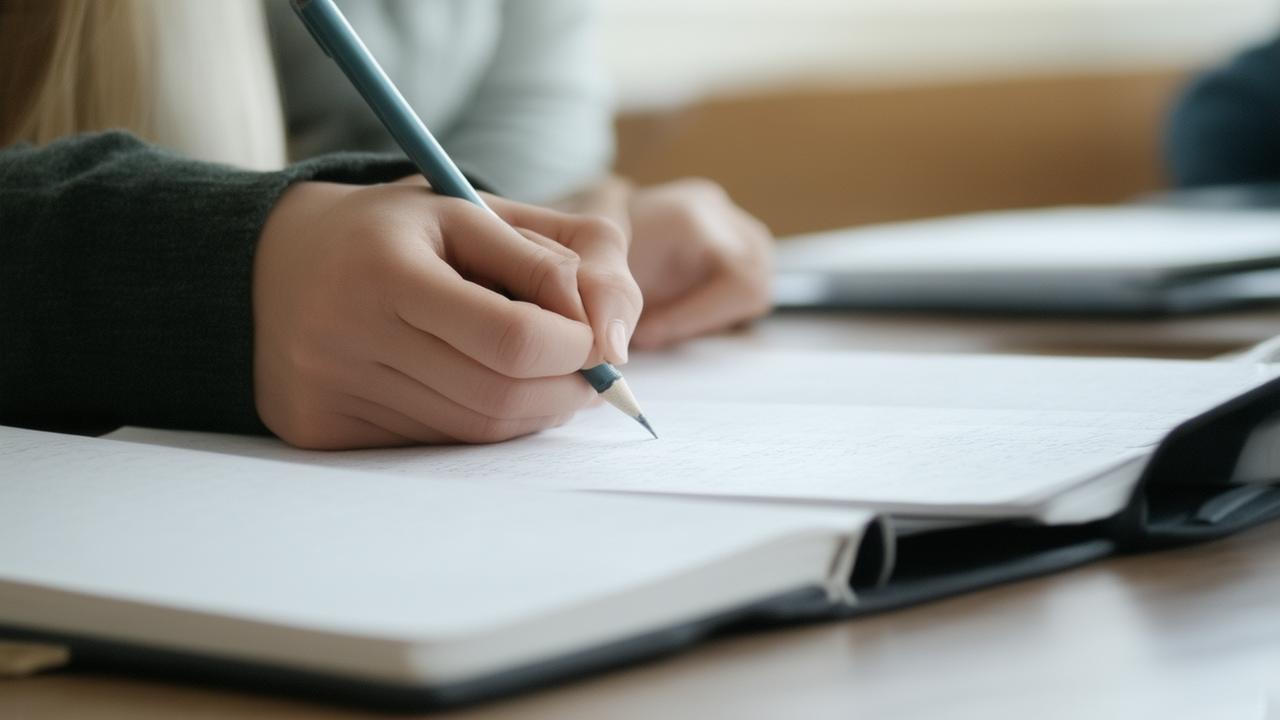
The classroom is unexpectedly quiet. No clatter of keyboards, no blue‑white flicker of tablets reflected in young faces. Instead, you hear it: the soft rasp of graphite sliding over paper, the tiny scratch of ballpoint ink tracing curls and corners of letters. Twenty-seven seventh-graders are bent over notebooks, tongues peeking from the corners of their mouths, hands smudged with graphite. There is a hum in the air, but it’s the low murmur of thought, not the glow of screens. In a world that has grown used to the smooth, glass surface of digital life, the rough grain of paper suddenly feels new again.
Why the Hum of Laptops Is Losing Its Charm
For a while, it seemed every classroom was racing toward the same future: more screens, more apps, more digital everything. Tablets replaced textbooks, smartboards swallowed chalkboards, and typing skills were treated as the new handwriting. Parents proudly posted pictures of their children “coding” in kindergarten, while classrooms transformed into miniature coworking spaces.
But somewhere between the Zoom lessons of 2020 and the infinite scroll of 2024, something shifted. Teachers began to notice that the children who spent their days hopping from app to app seemed more distracted, more anxious, and less able to sit with a single idea for more than a few minutes. Homework finished on laptops vanished in mysterious “syncing errors.” Spelling deteriorated. Essays grew strangely thin, like plants that had sprouted too fast in poor soil.
In staff rooms and PTA meetings, the unease spread. Was all this technology really helping children learn, or just making it easier for them to skim, tap, and scroll without ever truly absorbing anything? Gradually, a quiet countercurrent took shape—teachers began reaching into the cabinets for dusty boxes of notebooks and jars of sharpened pencils. The revival of handwritten learning did not begin with a grand announcement but with the simple courage to say: “Let’s try something slower.”
The Science Hidden in a Scribble
When we write by hand, something intricate and almost mysterious happens inside the brain. Each letter requires a small choreography of muscles, a careful conversation between hand, eye, and mind. Children do not merely copy shapes; they build a memory of movement, a physical trace of thought. Researchers have long noted that students who take hand-written notes, rather than typed ones, tend to understand and remember material more deeply. Handwriting forces a kind of filtering. You cannot catch every word that pours from a teacher’s mouth, so you must listen, sort, and rephrase in your own language.
In one middle school eager to tame its own tidal wave of screens, a language arts teacher named Marisol began a quiet experiment. For six weeks, her students were asked to keep a “learning journal,” handwritten, in which they summarized the day’s lessons in their own words. No typing allowed. At first, there were groans, dramatic sighs, questions about “Why can’t we just use Docs?” But something curious emerged. Students who rarely spoke up in class filled pages with reflections and questions. Spelling improved without direct drills; sentence structures grew more complex. When Marisol asked them to look back over their journals before a test, their faces lit up with recognition: they had written their way into understanding.
Farm-country schools, city magnet academies, and small-town districts are all quietly reporting the same thing: fewer screens, more handwriting, deeper attention. The science supports the stories, but the stories are what make it real—teachers witnessing students settle into a slower, steadier rhythm, as if someone has turned down the background static in their brains.
The Texture of Learning: What Students Actually Feel
Ask a child how it feels to learn on a screen all day, and you’ll often hear words like “tired,” “bored,” or “itchy.” It’s a strange kind of fatigue—the eyes ache, the mind buzzes, and yet nothing solid seems to stay. Handwriting shifts that experience into something more physical, more grounded. There is pressure in the fingers, the mild drag of pen on paper, the faint smell of ink, the subtle sound of flipping pages.
Consider the sensory landscape of a handwritten classroom. On a rainy Monday, the windows sweat with small beads of water. Inside, the room smells faintly of pencil shavings and dry erase markers. A student, head bowed over their notebook, chews the end of their pen—then catches an idea mid-chew, straightens up, and starts writing more quickly, lines of thought catching up with the movement of their hand. Across the room, another student doodles a border of growing vines around the definition of “metamorphosis,” unconsciously linking word to image, concept to shape.
These small sensory moments matter. They give learning a body, a place, a rhythm. The slow reappearance of handwriting in schools is, in many ways, the reappearance of texture—of friction that reminds the brain it is not floating in an infinite digital space, but anchored in a specific here and now. For students who feel scattered or anxious, the simple act of writing by hand can become a kind of steadying practice, like laying down rail tracks for their thoughts.
Balancing Ink and Pixels in the Modern Classroom
None of this means we are heading back to slate boards and inkwells. Most teachers know that the question is not “screens or no screens,” but “how much, for what, and when?” The revival of handwriting is not a rejection of technology, but a rethinking of its role. Many classrooms now look less like a fully wired control center and more like a workshop, with different tools called upon at different moments.
Some teachers have begun adopting a simple rhythm: new concepts are introduced through discussion and board work; students then write key ideas by hand in notebooks, summarizing in their own words. Later, they might use laptops to research, collaborate, or polish a final draft. By separating the reflective work of understanding (often handwritten) from the more mechanical tasks of formatting, searching, or sharing (often digital), schools are learning to let each medium do what it does best.
Parents, too, are noticing the shift. In backpacks, along with crumpled permission slips and forgotten lunch forms, notebooks are coming home, thick with sentences, diagrams, and crossed-out ideas. At kitchen tables, some families are choosing to echo the change: asking children to draft homework answers on paper before turning to the computer, or writing out math problems longhand before entering them into online platforms. The goal is not nostalgia; it is clarity. When the hand moves, the mind often follows more deeply.
Handwriting vs Typing: How They Shape Learning
Instead of treating handwriting and typing as rivals, some educators are beginning to map out their distinct strengths, allowing students to understand the tradeoffs. The following simple comparison often helps families and teachers see why a blended approach makes sense:
| Aspect | Handwriting | Typing |
|---|---|---|
| Speed of Input | Slower, encourages reflection and summarizing | Faster, useful for long essays and quick drafting |
| Memory & Retention | Often linked to better understanding and recall | Can encourage verbatim copying without processing |
| Attention & Focus | Fewer distractions; grounded, tactile experience | Competes with notifications, tabs, and apps |
| Creativity & Idea Flow | Invites doodles, mind maps, and non-linear notes | Easy to rearrange text, collaborate, and revise |
| Physical Experience | Engages fine motor skills; creates tangible records | Less physical, more abstract and screen-based |
Seeing the differences laid out like this, many schools are concluding that the future belongs to a hybrid model—one in which a spiral notebook and a laptop can sit side by side on a desk without one swallowing the other.
Teachers on the Frontlines of the Handwritten Comeback
The movement back toward handwriting isn’t coming from glossy policy documents; it’s emerging from the daily improvisations of teachers who are trying to protect their students’ ability to pay attention, to think clearly, to remember. In a crowded science classroom, a teacher might quietly announce that the next lab will be recorded only in paper lab books—no phones, no tablets. Suddenly, the room feels different. Students lean closer to their beakers, then to their notebooks. Drawings of leaves or circuits bloom in the margins, turning bland diagrams into personal maps of discovery.
In a bustling urban elementary school, a fourth-grade teacher brings out a box of old-fashioned composition books on the first day of the year. The covers are stiff and speckled, the pages lined in faint blue. She asks her students to write their names slowly on the first page, then add one thing they hope to learn this year. The room fills with concentrated silence. Some children write in large, looping letters, others in cramped print, but each one experiences a tiny, private moment of authorship. This is my name. This is what I want to learn. It belongs to me.
➡️ Nightlife venues are adjusting as sober socialising becomes a mainstream choice
➡️ Farmers are experimenting with regenerative grazing to rebuild soil after decades of depletion
➡️ Ocean chemistry data is pointing to faster acidification along sensitive marine habitats
➡️ Fashion labels are returning to wool as demand grows for durable climate smart fabrics
➡️ Archaeologists are returning to old shipwreck sites with new imaging technology
➡️ Households are embracing minimalism as rising costs challenge traditional consumer habits
➡️ Space startups are expanding beyond satellites as deep tech exports gain momentum
And in a rural high school where Wi-Fi blips out regularly, an English teacher has discovered that handwritten in-class essays, done in twenty-minute bursts, are his secret weapon. Without the crutch of autocorrect or the temptation of copy-paste, students produce messier, more honest work. They cross things out. They start again. They create sentences that lurch and stumble and, eventually, find their feet. Only later do they move these ideas onto screens to revise. The first draft, though, remains anchored in ink.
A Quieter Glow: What This Means for the Future
In conversations with students, a surprising theme emerges. Many of them are not cheering for fewer screens because they dislike technology—they have grown up inside its soft light, after all. Instead, they talk about a desire for balance. One teenager describes handwritten note-taking as a “brain break from the internet noise.” Another says it feels “more real, like I’m actually the one making the words, not the computer.” Younger children sometimes put it even more simply: “I like seeing my thinking on the page.”
The revival of handwritten learning in schools wary of screen overload is not simply about nostalgia for neat cursive lines or the romance of ink stains. It is about reclaiming the physical dimension of thinking in a world that risks becoming entirely weightless. As schools rebuild their relationship with technology—choosing carefully instead of lunging toward whatever seems newest—handwriting is emerging not as an old habit, but as a quiet act of resistance against the fragmentation of attention.
In the end, perhaps the goal is not to pit paper against pixels, but to let them form a kind of duet. There are moments when the rapid clatter of keys will be exactly what a student needs to pour out ideas faster than their hand can move. And there are moments when the slow whisper of a pen across a page will be the sound of real learning taking root. Between these two textures, a more humane education is starting to take shape—one that understands that minds are not lines of code, but living, breathing, scribbling things.
Frequently Asked Questions
Why are some schools reducing screen time and returning to handwriting?
Many schools are noticing that heavy screen use can lead to distraction, eye strain, and shallow engagement with material. Handwriting slows the pace of learning just enough to deepen attention, improve memory, and give students a more grounded, tactile experience of their own thinking.
Does handwriting actually improve learning and memory?
Research suggests that handwriting helps students remember information better because it engages more parts of the brain. Writing by hand forces learners to process, summarize, and organize ideas rather than simply copying them verbatim, which strengthens understanding and recall.
Are schools abandoning technology completely?
No. Most schools are trying to strike a balance. They still use digital tools for research, collaboration, and final drafts, but they are reintroducing handwriting for note-taking, journaling, brainstorming, and early drafting to support deeper learning.
How can parents support this shift at home?
Parents can encourage children to keep handwritten journals, draft homework answers on paper before typing them, and use notebooks for planning or problem-solving. Creating short, screen-free study periods centered on pen and paper can help reinforce what schools are doing.
What about students who struggle with handwriting?
For students with fine motor difficulties or learning differences, schools often use a flexible approach. These students might blend handwriting with assistive technology, dictation tools, or typing. The goal is not perfect penmanship, but giving every student access to the cognitive benefits of slower, more deliberate thinking—whether that comes through handwriting, technology, or a mix of both.





