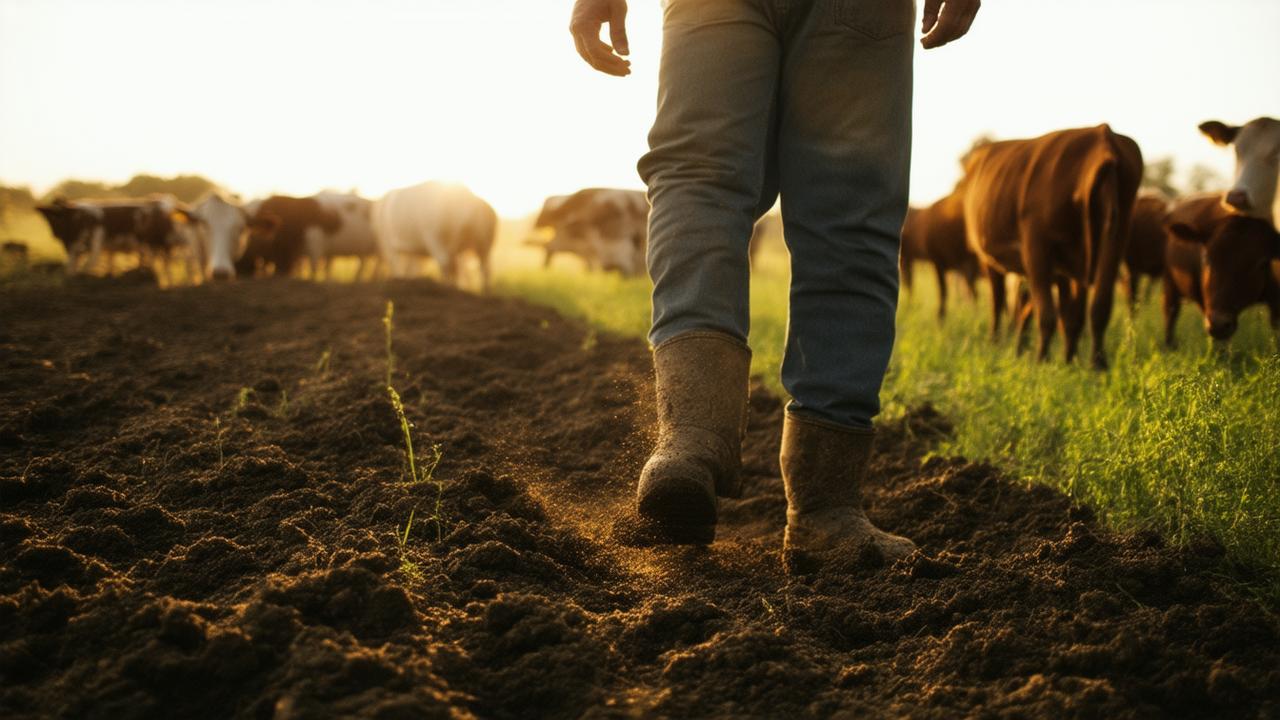
The first thing you notice is the sound: a soft tearing, like paper slowly pulled apart. It comes from a hundred muzzles working through the morning dew, tongues wrapping around blades of grass, hooves sinking gently into the softened ground. The air smells of clover, wet soil, and something else—possibility. Out here, on a patch of land that was once hard as concrete and the color of old bones, the soil is waking up again. And the people waking it are doing something that once sounded almost backward: they’re letting cows heal the land they helped destroy.
Where the Soil Went Quiet
For decades, this field—like millions of acres across the world—was treated as a machine. Inputs in, outputs out. Fertilizer, herbicides, tillage, repeat. The soil was a surface, not a living body. It grew corn, then soybeans, then more corn, year after year, its black richness slowly fading to a tired, dusty brown. The worms left. The birds stopped visiting. Rain, once a blessing, began to feel like a threat, because when it came it sheared the topsoil away in muddy sheets.
Ask a farmer who has watched their topsoil wash into the ditch what that feels like, and they’ll tell you it’s not just dirt washing away—it’s time, money, and a sense of inheritance. It’s the fear that the land you pass along to your kids will be poorer than the land you were given. And for a long time, the solution presented to farmers was always some new product, some stronger chemical, some higher-yield seed. Rarely did the conversation circle back to the ground itself, to the living skin of the farm.
But in the quiet panic of thinning soils and shrinking margins, some farmers began to look in a different direction—backward, in one sense, to the way wild grasslands once functioned, and forward, in another, to a soil-centered kind of agriculture that might actually last.
The New Old Idea: Moving Herds, Healing Ground
Regenerative grazing sounds technical, but on the ground it looks surprisingly simple. Instead of turning cattle loose on a big pasture all season long—where they nibble their favorite plants to the nub and ignore the less delicious ones—farmers divide their land into smaller paddocks and move the animals frequently. Sometimes it’s daily, sometimes multiple times a day. The cows get a fresh salad bar every few hours; the grass gets long rest periods to recover.
The idea is borrowed from nature. Before fields were fenced, vast herds of grazing animals moved constantly, driven by predators and the need for new forage. They would graze an area intensely for a short time, trample plant material into the soil, fertilize with their manure and urine, and then move on, not returning until the plants had fully recovered. That rhythm—graze, rest, regrow—built some of the deepest, richest soils on Earth.
Modern regenerative graziers are trying to imitate that dance with electric fences, careful observation, and a willingness to become, in a way, choreographers of grass. They talk more about “stock density” and “recovery periods” than about feed rations and outputs. Many of them carry not just a pocketknife but a soil spade, and they stick it in the ground like a doctor checking a pulse.
Seeing Soil As a Community, Not a Commodity
To understand why this matters, you have to imagine what’s happening beneath your feet. Healthy soil isn’t mere dirt—it’s more like a bustling city of microbes, fungi, insects, roots, and organic matter. It has architecture: pores and channels that let water slip down and air move through. It has economy: plants trade sugars with fungi in exchange for nutrients. It has memory: each season’s plant roots and manure become next year’s fertile ground.
Continuous grazing—the old model where cows linger in the same pasture—tends to stress plants over and over, never giving them a chance to regrow strong roots. Their underground networks shrink. Bare soil appears between tufts of grass, exposed to sun and wind. When a heavy rain comes, with no plant cover and weak structure, the ground gives up its topsoil easily. It’s a slow, quiet unraveling.
Regenerative grazing interrupts that pattern. High-density, short-duration grazing means hooves press trampled grass and manure into the soil surface, creating a mulch that retains moisture and feeds microbes. The plants, bitten once and then left alone, respond by pushing more roots deeper, pulling carbon from the air and turning it into underground life. Bit by bit, the soil starts to knit itself back together.
Walking the Pasture With New Eyes
Walk a regeneratively grazed pasture with a farmer who’s been at it for a few years, and the tour sounds less like an agronomy lecture and more like someone introducing old friends. “See this clover coming in? I never planted it—it just showed up once we stopped hammering this field. And look at this,” they’ll say, kneeling to pull up a chunk of earth with their hands. The soil doesn’t crumble into powder; it comes away in dark, moist clods laced with fine roots and thin, white fungal threads.
There’s a feeling, on such a farm, that the land is exhaling. The grass is denser, more varied. Birds flush from the sward; insects hum in the thatch. If you dig a few inches down, you might find the glossy pink bodies of earthworms—nature’s tillage team—twisting away from the light. Water infiltrates instead of pooling. And when a summer drought hits, the fields somehow stay greener longer than the neighbor’s.
Farmers notice. They notice that after a few years of managed grazing, they can cut back on fertilizers. They see cow pies disappear faster, broken down by beetles and microbes. They notice that their cattle seem calmer, more content, less prone to stand in muddy lots waiting for the next truckload of hay. For people whose lives are bound up with land and animals, this matters deeply—even if it doesn’t always show up on a spreadsheet right away.
From Depletion to Data: Measuring the Turnaround
Some skeptics shrug and call regenerative grazing a feel-good story. The soil proves otherwise. On farms where careful records are kept, patterns are emerging, and they’re hard to ignore. Organic matter—a key measure of soil health—often starts to climb after just a few years of rotational or adaptive grazing. Water infiltration rates improve. Erosion drops. Pasture productivity increases, sometimes dramatically.
Of course, every farm is different, and the numbers vary. But to give a sense of the shift many farmers are reporting, imagine a field that started with tired, compacted soil and thin grass cover. After several seasons of intensive, well-managed grazing, it might look something like this:
| Soil & Pasture Indicator | Before Regenerative Grazing | After Several Years |
|---|---|---|
| Soil Organic Matter | 1–2% (low, depleted) | 3–5% or more (richer, darker soil) |
| Water Infiltration | Slow; puddling, runoff after storms | Faster; rain soaks in, less runoff |
| Plant Diversity | Mostly a few grasses, bare patches | Mix of grasses, legumes, forbs, thicker cover |
| Visible Life in Soil | Few worms or insects when digging | More worms, beetles, roots, fungal threads |
| Forage Availability | Short grazing season, more bought-in feed | Longer grazing season, less purchased feed |
These improvements are not magic. They’re the cumulative result of thousands of small decisions: when to move the herd, how long to rest a paddock, whether to graze a little lighter before a forecasted drought, when to back off and let the land recover. Regenerative grazers often describe themselves less as managers and more as students of their farms, watching how the grass responds, how the cows behave, how the soil smells after a rain.
The Emotional Weather of Change
Still, changing a farm is never just about changing a system. It’s about changing a life. Many of the farmers experimenting with regenerative grazing came from families that prized straight furrows and bare fields, where “resting” land looked suspiciously like “wasting” it. To let pastures grow tall and shaggy, to run temporary electric fences instead of permanent barbed wire, to move cows daily—it can look, to neighbors, like you’ve lost the script.
So there’s a certain bravery in those first steps. Fences have to be bought. Water lines might need to be rerouted. Schedules change. Instead of feeding cattle out of a bunk in winter, you might find yourself unrolling hay on dormant pastures, letting the animals spread seeds and manure. Your days become a little less about operating heavy machines and a little more about walking, watching, reading the land.
And then something subtle shifts. When farmers talk about their early years of regenerative grazing, they often mention a moment of surprise—a spring when the grass grew thicker than they’d ever seen, a storm that should have flooded their low ground but didn’t, a neighbor who asked, “What are you doing over there?” with more curiosity than criticism.
Not a Silver Bullet, But a Living Tool
It would be easy to turn regenerative grazing into a tidy story: put cows on pasture, move them a lot, and the climate is saved, the soil is healed, and everyone lives happily ever after. Reality is more complicated. This approach doesn’t fit everywhere, or for every operation. Some landscapes are too arid or too steep. Some farmers do better integrating trees and silvopasture, or mixing cropping systems with grazing. Some places still need careful, conventional management while transitions unfold.
What regenerative grazing really offers is less a miracle cure and more a different lens. It says: what if the animals weren’t the enemy of the land, but part of its repair? What if the measure of success wasn’t just yield per acre, but life per acre—worm counts, bird calls, the feel of soil that holds your boot print for a moment before springing back?
➡️ Ice shelf monitoring is intensifying as Antarctic systems show worrying instability
➡️ Native ingredients are becoming everyday staples in kitchens and fine dining alike
➡️ Mining towns are grappling with sudden growth as critical minerals attract global investors
➡️ Remote clinics are leaning on video consultations as specialist shortages deepen
➡️ River allocations are becoming a political flashpoint as drought pressure returns upstream
➡️ New apartment builds are reviving debate about ventilation and indoor health outcomes
➡️ A new generation of filmmakers is reshaping national culture through intimate documentary work
Scientists are still quantifying its full potential—how much carbon can really be stored, how resilient these systems are under extreme weather, how scalable the practices are beyond pioneering farms. But even while the papers and debates continue, the experiment is unfolding in real time, on fields that had all but given up.
Listening to the Ground Again
Back in the morning pasture, the herd has eaten its way to the edge of the temporary fence. They lift their heads as the farmer approaches, a coil of polywire over one shoulder, fence posts clacking softly like wind chimes. The animals have learned the pattern: a few clicks, a gate moved, bright new grass ahead. They move forward, not in a frantic rush but in a steady wave, spreading themselves across fresh ground.
Behind them, the just-grazed section looks rough and trampled, stems bent and cow pies dotting the surface. To an untrained eye, it might even look damaged. But given time, the trampling becomes mulch, the manure becomes fertilizer, and the once-brittle soil below begins to stitch itself back together. Life feeds life.
Decades of depletion don’t reverse in a season. They don’t even fully reverse in a decade. But somewhere between the old habit of squeezing the land until it gives out and the new practice of working with its rhythms instead of against them, there is a different future taking shape. A future where a field is not just a platform to grow commodities, but a living membrane that connects sky, plant, animal, and human.
For now, that future looks like a farmer sliding a spade into the ground and smiling at what comes up: dark, crumbly soil that smells faintly sweet and alive. It sounds like birdsong over a pasture that used to be silent. It feels like rain soaking in instead of racing away. And it tastes—if you follow the chain all the way through—like milk and meat from animals that have spent their lives on grass, walking across land that’s finally learning how to heal.
FAQ: Regenerative Grazing and Soil Health
What is regenerative grazing in simple terms?
Regenerative grazing is a way of managing livestock where animals are moved frequently through small paddocks, allowing grasses long rest periods to recover. The goal is to mimic natural grazing patterns, improve soil health, increase plant diversity, and build long-term resilience on the land.
How is regenerative grazing different from traditional grazing?
Traditional continuous grazing often keeps animals on the same pasture for long periods, leading to overgrazed plants and bare soil. Regenerative grazing uses planned, short, intense grazing followed by long rest periods, which encourages deeper roots, more ground cover, better water infiltration, and healthier soils.
Can regenerative grazing really rebuild depleted soils?
Yes, in many cases. While results vary by climate and management, farmers frequently see increases in soil organic matter, improved structure, and more biological activity after several years of regenerative practices. It doesn’t restore soil overnight, but it can set depleted land on a clear path to recovery.
Does regenerative grazing work only for cattle?
No. The principles can be applied to sheep, goats, bison, and other grazing animals. What matters is managing animal numbers, grazing duration, and rest periods so that plants and soils have time to recover and thrive.
Is regenerative grazing economically viable for farmers?
Many farmers report long-term economic benefits: reduced need for purchased feed and fertilizers, longer grazing seasons, and improved resilience to droughts and heavy rains. There can be upfront costs and a learning curve, but over time, healthier soils often translate into more stable and diversified farm income.
Can small farms or homesteads use regenerative grazing?
Yes. Even on a few acres, dividing pastures into smaller sections with temporary fencing and moving animals regularly can improve grass growth and soil health. The scale is smaller, but the core ideas—short grazing, long rest, constant observation—remain the same.
Does regenerative grazing eliminate the need for all other soil management?
Not necessarily. Many regenerative graziers also use practices like cover cropping, limited or no-till planting, and integrating trees or shrubs. Regenerative grazing is a powerful tool, but it works best as part of a broader, soil-centered approach to farming.





