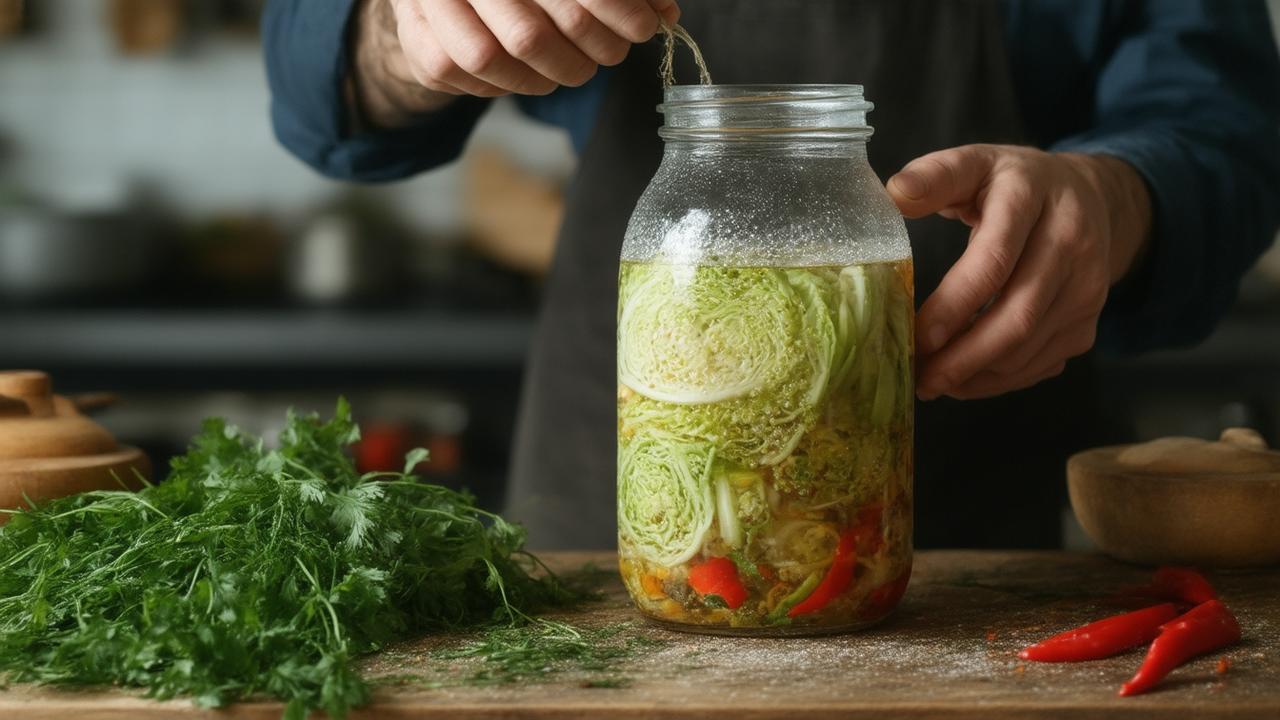
The first jar was an accident, or so she tells the story now. A forgotten head of cabbage at the back of the fridge, a late-night search for “how not to waste this,” and suddenly Maya was elbow-deep in salted leaves in her tiny apartment kitchen. The room smelled sharp and green, like rain on a hot pavement, and her hands worked clumsily, pressing, squeezing, packing. Three weeks later, when she cracked the jar open, the tang hit her first—bright, fizzy, alive. She speared a piece with shaking chopsticks, tasted it, and laughed out loud. Somehow, in that quiet kitchen, she’d turned time and bacteria into flavour. And she was hooked.
Why Fermentation Feels Suddenly… Everywhere
Open any social feed and it starts to feel like the whole world is bubbling. Jars of jewel-toned pickles line windowsills. Sourdough loaves with crackling, blistered crusts star in photo carousels. Kombucha SCOBYs—those strange, jellyfish-like discs—float in wide-mouthed jars like props from a sci‑fi movie. What once belonged to your grandmother’s pantry or a niche corner of homesteading forums has slipped into the daily lives of home cooks who, just a few years ago, barely knew what a starter was.
This isn’t just another fleeting kitchen trend like charcoal lattes or unicorn-coloured foods. Fermentation has roots that reach back thousands of years, across cultures and continents. It’s the reason soy sauce, miso, cheese, yogurt, wine, beer, salami, and chocolate exist. Our ancestors relied on it to keep food safe before refrigeration, but they also prized the deep, layered flavours it created. Somewhere along the way, as “fresh” and “fast” became the gold standards of modern food, we quietly put those slow processes aside.
Now, they’re back—and not just for nostalgia. Flavour and health, two powerful currents in today’s food culture, are converging. The result: home kitchens humming again with tiny, invisible life.
The Alchemy of Time, Salt, and Microbes
Fermentation can feel like a magic trick the first time you watch it unfold. You begin with something simple: cabbage, flour, milk, chili, fruit. You add salt, or starter, or culture. Then you wait. On the counter, your jar looks deceptively still. But under that lid, whole microbial communities are busy at work.
Lactic acid bacteria crunch through plant sugars, turning them into acid and fizz. Yeasts chew on simple sugars in dough, filling bread with air. In a crock of kimchi, waves of microbes rise and fall in predictable succession, each group changing the environment just enough for the next to take over. The end result is more than just “preserved” food. It’s food transformed—chemically, nutritionally, texturally.
Home cooks talk about this process in reverent tones. The word “alive” comes up almost every time: alive food, living cultures, active jars. There’s a sensory thrill in hearing the soft hiss when you open a long-fermenting lid, in seeing bubbles climb to the surface, in tasting the difference between day two and day seven. You begin to understand that your role is part cook, part caretaker, part quiet witness to an ecosystem you can’t see but can absolutely taste.
Flavour First: The New Obsession with Depth
Walk into a kitchen mid-fermentation boom and it smells like a promise. There’s the malty, warm scent of a sourdough starter, the garlicky bite of kimchi brine, the faint apple cider tang of vinegar experiments on the windowsill. For many modern home cooks, the hook wasn’t health claims—it was the chase for flavour they couldn’t get from supermarket shelves.
Fermented foods stretch the palate in all directions. Kimchi is not just spicy; it’s sour, savoury, a little sweet, and unmistakably funky. Sauerkraut can be clean and lemon-bright or earthy and deep depending on time and spice. Even something as simple as fermented garlic honey turns two familiar ingredients into something altogether different: floral, mellow, complex.
Umami—the savoury “fifth taste”—is where fermentation shines brightest. Miso paste adds a depth to soups that no broth cube can touch. A spoon of fermented chili paste folds into mayo and suddenly your sandwich tastes like it came from a hidden alley cafe. The more people play with fermentation, the more they realize that what they’ve been missing isn’t more seasoning, but more time. Time for microbes to do what only they can: build flavour from the inside out.
Health Meets Heritage in a Glass Jar
At the same moment taste buds are waking up to funk and sour and tang, health conversations are shifting. The word “microbiome” has gone mainstream. People speak casually about gut health at brunch. Probiotic and prebiotic labels shout from yogurt, snack bars, even sodas. Into this swirl of wellness language steps an ancient practice that somehow feels like the latest thing.
Fermented foods, in their traditional forms, are rich in beneficial bacteria and organic acids. Many home cooks don’t need a study to tell them that a spoonful of sauerkraut alongside a heavy meal makes their body feel lighter, or that eating yogurt and fermented vegetables regularly just seems to “settle” their system. Still, modern science is catching up to what older culinary traditions quietly knew: diets that regularly include fermented foods are often linked to diverse gut microbes and, potentially, to better overall health.
What’s fascinating now is how health and heritage overlap at the kitchen counter. A Korean-American college student calls her mom for the family kimchi recipe, “for my gut.” A granddaughter pulls an old, handwritten note from a recipe box describing how to “sour” cream, and realizes she’s been eating probiotic food since childhood. What once felt like old-fashioned frugality—turning surplus cabbage into sauerkraut, saving the whey from cheese—now sits at the crossroads of nostalgia and wellness culture.
A Quick Look at Common Fermented Foods at Home
While professional fermentation can get wildly complex, many of the most popular home ferments are surprisingly simple. Here’s how some of them compare in terms of effort and everyday use:
| Fermented Food | Typical Prep Time | Fermentation Time | Common Everyday Uses |
|---|---|---|---|
| Sauerkraut | 20–30 minutes | 1–4 weeks | On sandwiches, with eggs, as a side to rich dishes |
| Kimchi | 45–60 minutes | 3 days–3 weeks | With rice, in stews, in grilled cheese, on noodles |
| Sourdough Starter | 5–10 minutes/day | 5–10 days to establish | Bread, pancakes, waffles, crackers |
| Kombucha | 20 minutes per batch | 7–21 days | Daily drink, cocktail mixer, mocktails |
| Yogurt | 15–30 minutes | 6–12 hours | Breakfast bowls, sauces, baking, marinades |
Fermentation as Quiet Rebellion Against “Instant Everything”
There’s a deeper reason fermentation resonates with people whose lives are dominated by screens and speed. It forces a different tempo. You cannot rush sauerkraut. No setting on your phone can fast‑forward a sourdough’s rise without compromising its character. In a culture that sells shortcuts as virtue, leaving a jar on the counter for two weeks feels almost radical.
Home cooks describe it as soothing: the nightly check on the bubbling jar, the gentle burp of gas escaping, the soft press of vegetables below their brine line. It’s a small ritual of trust. You are choosing to believe that if you do the simple things right—clean jar, adequate salt, the patience to wait—something good will come. Not from a push notification or a two‑day delivery truck, but from time itself.
This slowness has a way of spilling out into the rest of life. People who start with sauerkraut often find themselves baking slower, planning meals further ahead, paying a different kind of attention to seasons. They seek out cabbages when they’re sweetest and firmest, fruit when it’s just about to turn, milk from sources they trust. Fermentation can quietly turn consumption into relationship—between person and ingredient, between present and past.
Fear, Safety, and the First Bubble
Of course, none of this transformation happens if you never make that first jar. Many would-be fermenters hover on the edge, worried about food safety, about “doing it wrong,” about accidentally growing something sinister on their countertop.
➡️ Everyday language is shifting as migration reshapes identity in suburbs and workplaces
➡️ Defence planners are recalibrating strategy as submarine procurement reshapes regional security
➡️ Old maps and coastal records are changing the story of early contact in the north
➡️ Portion sizes are shrinking in supermarkets while prices hold steady on the shelf
➡️ Ice shelf monitoring is intensifying as Antarctic systems show worrying instability
➡️ Native ingredients are becoming everyday staples in kitchens and fine dining alike
➡️ Mining towns are grappling with sudden growth as critical minerals attract global investors
The truth is that most traditional vegetable ferments are astonishingly safe when basic guidelines are followed. Salt concentrations, submerging vegetables under brine, and clean equipment all create an environment where beneficial lactic acid bacteria thrive and spoilage microbes struggle. The process is self-protecting: as acid builds, it pushes out the kinds of microbes that can cause harm.
Once you see your first successful ferment, fear tends to soften into caution and curiosity. You learn what harmless kahm yeast looks like versus mold that needs your batch discarded. You start to trust your senses: the sour but clean smell, the crisp bite instead of sliminess, the vibrant rather than dull colours. Every jar becomes a small lesson in applied biology you can taste.
From Trend to Tradition: What Comes Next?
Will fermentation still matter when the next bright food craze arrives? It’s likely to stick, not because it photographs beautifully (though it does), but because it slips into the fabric of daily life so easily. Once you have a jar of pickled, fermented carrots in your fridge, it’s hard to imagine eating a salad, taco, or bowl of rice without them. Once you’ve tasted the difference between supermarket bread and a loaf you nursed from starter to crust, something in your expectations quietly ratchets upward.
The newest chapter of this ancient craft may not look like crocks in cellars, but like jars on apartment balconies and batches of yogurt in instant pots. Home cooks are merging inherited methods with modern tools, passing recipes through group chats instead of only through family kitchens. Workshops spring up in community centres; neighbours trade SCOBYs in reusable containers.
In the end, fermentation’s resurgence feels less like discovery and more like remembering. Remembering that some of the most complex flavours come from the simplest ingredients. That preservation can be a form of abundance, not scarcity. That “healthy” can mean deeply pleasurable, not punishing. And that, in a world rushing ever faster, there is still immense value in projects that demand you pause, wait, and trust that life—on the microscopic level and your own—will quietly, steadily, transform.
Frequently Asked Questions
Is fermentation safe to do at home?
Yes, when done with basic care. Use clean equipment, follow trusted recipes, keep vegetables submerged in brine, and use the recommended amount of salt. If you see fuzzy mold, smell anything rotten or musty, or notice unusual colours, discard and start again.
How do I know if my ferment has gone bad?
Trust your senses. Signs of spoilage include fuzzy mold in green, black, or pink, strong rotten or cheesy odours, slimy textures, or an off, unpleasant taste. A thin white film (kahm yeast) on vegetable ferments can be harmless and skimmed off, but mold means the batch should be discarded.
Do I need special equipment to start fermenting?
No. For most basic ferments you need only a clean glass jar, non-iodized salt, water, and your chosen ingredients. Over time, you might add airlock lids, weights, or crocks, but they’re optional rather than essential.
Are store-bought fermented foods as good as homemade?
Some are excellent, especially if they’re unpasteurized and stored in the fridge. However, many commercial products are heat-treated or use vinegar instead of fermentation, which reduces or removes live cultures. Homemade versions let you control ingredients, fermentation time, and flavour.
How much fermented food should I eat for health benefits?
There’s no single rule, but many people start with small amounts—one to three tablespoons of fermented vegetables or a small glass of kombucha per day—and increase as tolerated. Listen to your body and, if you have health conditions or a restricted diet, consult a healthcare professional before making big changes.





