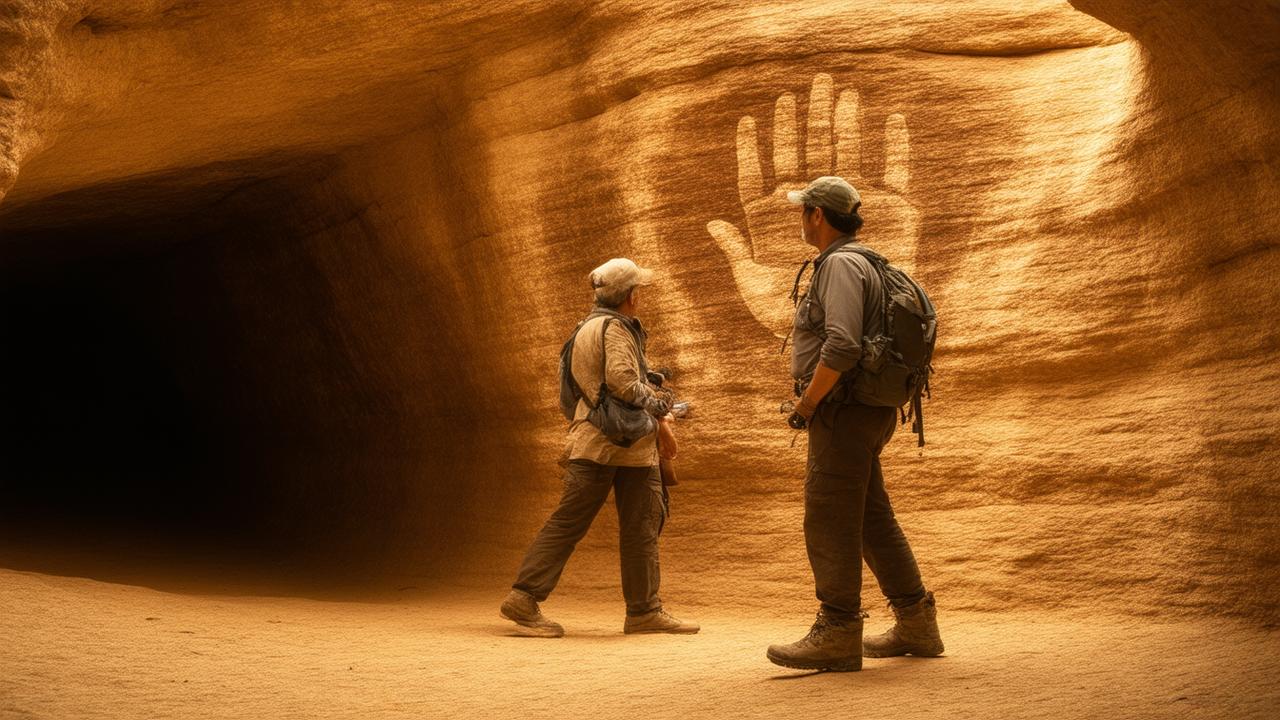
The first thing you notice is the silence. Not the empty kind, but a full-bodied quiet that seems to hum inside your chest. The air in the Kimberley at dawn feels almost solid, warm against your skin, carrying the smell of dust, eucalyptus, and the faint sweetness of flowering grevillea. Somewhere, unseen, a butcherbird peels a liquid note into the pale sky. Then, as your eyes adjust, the rock shelter comes into focus—an overhang worn by millennia of wind and rain, paint still visible on its belly, as if the stone itself is remembering out loud.
Walking Into Someone Else’s Time
When people talk about “ancient rock art” in the Kimberley, it can sound abstract, like something locked away in museums or books. But standing beneath a sandstone shelter in the early heat, you understand how alive it still is. The figures—slender, elongated, haloed with delicate headdresses—seem almost to vibrate in the half-light. These are the Gwion Gwion paintings, also called Bradshaw art, and they may be among the oldest figurative artworks on Earth.
The Kimberley region in Western Australia is larger than many countries, a labyrinth of escarpments, gorges, rivers, and cracked plateaus. For tens of thousands of years, Aboriginal people have made this landscape home, and its shelters have held story after story. Every ledge, every shaded recess, feels like a page in a book written long before modern borders were drawn.
But in recent years, rock shelters like these have become the center of something else: a surge of arguments, court cases, and policy papers. What once felt immovable and eternal is now precariously caught between mining leases, heritage acts, and the drumbeat of development. The Kimberley’s ancient rock shelters are forcing a conversation Australia has avoided for too long: who gets to decide what survives?
When the Ground Becomes a Legal Document
To outsiders, the idea of “heritage enforcement” can sound dry and bureaucratic. To people on the ground in the Kimberley, it’s immediate and visceral. It can mean the difference between a rock shelter being left to quietly weather for another thousand years—or disappearing in a single blast of explosives.
In the wake of high-profile site destructions elsewhere in Australia, governments rushed to tighten laws, rewrite heritage protections, and speak earnestly about “never again.” But out here, the landscape doesn’t fit easily inside paperwork. A single mining proposal might cover a valley with dozens, even hundreds, of sites: art panels, burial areas, ceremonial grounds, grinding stones, and places still used for song and ceremony.
Aboriginal ranger groups talk about heritage laws in a way that’s pointedly physical. It isn’t just “compliance”; it’s the lived reality of trying to protect their grandparents’ stories carved into the rock, intertwined with dreaming tracks—songlines—that crisscross the region. Meanwhile, mining companies and pastoral leases push to define heritage as something that can be mapped, catalogued, mitigated, and, if necessary, “offset” elsewhere.
In many ways, the Kimberley has become a test case: can modern law ever truly recognise that some places are not negotiable? Or will the ancient shelters be squeezed into a world of permits, timeframes, and impact assessments that see heritage as another box to tick on a development pathway?
Rock Shelters as Living Ancestors
One of the deepest tensions in these debates is also one of the hardest to translate into legal language: these shelters are not just “cultural heritage places”—they are kin. Many Traditional Owners describe the shelters not as objects to be protected, but as beings in an unbroken relationship with them.
Think of a rock shelter tucked into a cliff face above a dry season riverbed. On the sandstone walls, ancestral figures dance, fish, hunt, and float in ochre-red stillness. For generations, stories tied to those images have been sung in language that carries the shape of the very river below. Some of those stories cannot be spoken in public. Some are restricted to certain families, certain age groups, certain seasons.
Yet, when a project assessment occurs, those same elders are often asked to reveal, explain, and justify these stories to outsiders—consultants, government officers, company reps—who may fly in for a few days at most. The request is often framed as: “Help us understand the significance so we can protect it.” But with the Kimberley’s rock shelters, the paradox is cruel: to prove the importance of the place, you may have to betray the protocols that make it sacred.
The result is an ongoing clash of worldviews. One side tends to see the shelter as a place of measurable values—archaeological, artistic, perhaps even tourism potential. The other experiences it as part of an ancestral network: a living law ground where human authority is always secondary to the law of Country itself.
Stories Written in Stone and Policy
New heritage enforcement debates are trying, in awkward fits and starts, to account for that lived reality. Some proposals aim to give Traditional Owners a formal right of veto, allowing them to say “no” to any impact on a rock shelter or songline. Others focus on co-management, or require that decisions be made by independent panels heavily weighted toward Aboriginal cultural authority.
On paper, these reforms look promising. On the ground, their success depends on something far less tangible: trust. The Kimberley’s Traditional Owners have seen promises come and go before, often swept aside when political winds change or when a major resource project is deemed “too important to delay.” That history lingers in every negotiation.
Numbers in the Dust: What’s at Stake
It can be tempting to talk about the Kimberley’s rock shelters in big, abstract terms—“tens of thousands of years,” “thousands of sites,” “irreplaceable heritage.” But the reality is both more granular and more personal. Each shelter has its own story, style, and set of responsibilities attached to it. Each new road, exploration licence, or tourist trail threads its way through that intricate web.
The figures below offer a simplified snapshot—not complete, but enough to give a sense of the scale and pattern of what’s unfolding:
| Aspect | Indicative Picture in the Kimberley |
|---|---|
| Estimated rock art sites | Many tens of thousands, with only a fraction comprehensively documented |
| Key site types | Rock shelters, burial places, grinding sites, ceremonial grounds, engraved panels |
| Common pressures | Mining, gas exploration, pastoral activity, tourism, road building, erosion, vandalism |
| Main decision makers | Traditional Owners, government agencies, industry, heritage specialists |
| Core debate | Whether some sites should be absolutely untouchable, regardless of economic cost |
Behind each line in that table are people—rangers walking along escarpments on blistering days, archaeologists cataloguing fragments in shaded camps, lawyers combing through legislation, and elders sitting quietly with a cup of tea, weighing whether to agree to something that might change Country forever.
The Fine Line Between Access and Impact
Complicating everything is the question of who gets to visit these rock shelters and how. Tourism boards talk about “unlocking the Kimberley’s ancient wonders,” while conservationists warn that even a single careless touch can permanently damage fragile pigments. Some elders welcome visitors, seeing it as a way to share culture, create jobs, and strengthen Country by keeping it active and known. Others want specific shelters kept secret, or visited only through carefully guided experiences.
New heritage enforcement frameworks must account for that diversity of preference. A one-size-fits-all approach—either total closure or unrestricted access—simply doesn’t match the mosaic of beliefs and responsibilities across language groups. Instead, access becomes another negotiation point: who manages tours, who controls the narrative, and who benefits economically when people come to see these places?
Here too, the rock shelters are reshaping policy. Enforcement is no longer just about stopping bulldozers; it’s about regulating footsteps, camera flashes, drone flights, and Instagram geotags. The very tools that draw attention to the Kimberley’s beauty can become threats to its most delicate sites, if not handled with care.
The Weight of “Never Again”
For many Australians, the urgency of these debates only truly lands when a disaster happens—when a rock shelter is blasted, an art panel defaced, or a significant site quietly bulldozed on a weekend. Only then do images flood the news: before-and-after shots, angry statements, solemn promises.
In the Kimberley, the phrase “never again” has become a familiar echo. Communities are now insisting that it cannot just be a slogan deployed after the damage is done. They want law written with the assumption that some values outrank the short-term gains of development. That may mean walking away from highly profitable projects, or demanding much slower, more careful assessment processes that respect seasonal ceremonies and cultural protocols.
➡️ Australia’s changing rainfall patterns are altering the nation’s wheat belt predictions
➡️ How Australia’s museums are rethinking colonial collections and repatriation pathways
➡️ Australia’s housing design is shifting toward passive cooling as summers grow harsher
➡️ What Australian doctors are learning from long COVID clinics in major cities
➡️ Australia’s space industry is quietly expanding beyond satellites into deep tech exports
➡️ Emergency wards are reporting a sharper spike in dehydration cases during prolonged heatwaves
➡️ Bushfire smoke is turning air quality monitors into everyday household essentials
Not everyone agrees. Industry groups warn of “red tape” and “sovereign risk,” arguing that unpredictable heritage decisions could scare off investment. Some politicians frame strong heritage enforcement as a brake on “progress,” especially in remote regions touted as new frontiers for energy, agriculture, and tourism. Yet as the debates sharpen, an uncomfortable truth keeps surfacing: progress for whom, and at what cost?
A Different Kind of Timeline
One of the most profound shifts the Kimberley’s rock shelters invite is a rethinking of time itself. In policy debates, time is often measured in project phases, election cycles, quarterly reports. For Traditional Owners and for the ancient art itself, time stretches in both directions—back tens of thousands of years, and forward toward descendants yet unborn.
Spend a day scrambling between shelters and the illusion of short-term thinking falters. You see ghostly hand stencils layered over one another, as if generations have been reaching out from the stone to greet each other. You see paintings partially washed by centuries of seasonal waterfalls, their outlines softened, but still there. You feel, viscerally, that the decisions made in a boardroom far away this year could echo in these rocks long after current leaders are forgotten.
That scale of time makes phrases like “acceptable risk” and “mitigation measures” feel small. It doesn’t erase the need for practical enforcement—laws, fines, inspections, real consequences—but it asks that those tools be guided by humility. When you walk under a rock ceiling painted before the pyramids were built, certainty feels out of place. What grows instead is a cautious respect: we are brief here, but our impacts are not.
Listening to the Country That Watches Back
As the sun leans west and the shadows stretch longer across the Kimberley plateau, the rock shelters seem to come alive in a different way. The glare softens and the colors deepen; fine white figures emerge from what a few hours earlier looked like random stains. A breeze moves through the spinifex, carrying a dry, grassy whisper. Somewhere an elder is telling a story in language, words falling into the stone like they belong there.
In these moments, heritage debates feel less like abstract policy and more like a series of questions that each visitor, each Australian, has to answer for themselves. Can we accept that some places are off-limits, not because we can’t reach them, but because we choose not to? Can we allow those most connected to this Country—those whose ancestors painted these walls—to lead, even when it complicates our plans?
Ancient rock shelters in the Kimberley are not simply objects of wonder or archaeological data points. They are mirrors held up to a nation still learning how to live honestly with its past. Every new law drafted, every enforcement action taken or ignored, becomes part of the story these stones will hold about us.
As you step away from the shelter, the light catching the last hints of ochre on the rock, it’s hard to escape the feeling that the Country is watching back, patient but not passive. The question hanging in the warm, humming air is simple and immense: will we be remembered here as good ancestors—or as the brief, noisy people who knew better and looked away?
Frequently Asked Questions
Why are the Kimberley’s rock shelters considered so significant?
They hold some of the oldest known figurative art on Earth, created over tens of thousands of years. For Aboriginal communities, these shelters are living cultural sites, tied to law, ceremony, and identity—not just historical artifacts.
What are the main threats to these ancient shelters?
Key pressures include mining and gas projects, road and infrastructure development, uncontrolled tourism, pastoral activity, natural erosion, and occasional vandalism. Even small changes, like increased vehicle access, can create long-term damage.
How do Traditional Owners participate in heritage decisions?
Traditional Owners are consulted through legal processes and cultural heritage assessments, and in many areas they work as rangers and cultural advisors. However, debates continue over whether current laws give them enough real power—especially the power to say “no.”
What does “heritage enforcement” actually involve?
It includes the laws, regulations, and on-the-ground actions used to protect cultural sites: approvals, permits, monitoring, site inspections, fines, and sometimes criminal penalties. Effective enforcement also relies on resources for ranger programs and heritage officers.
Can visitors see rock art sites in the Kimberley responsibly?
Yes—if done with care. The best approach is to visit sites with Traditional Owner–led tours or ranger groups, follow all guidance about access and photography, stay on designated paths, and never touch the art or rock surfaces. Respecting local protocols is part of protecting the shelters for future generations.





