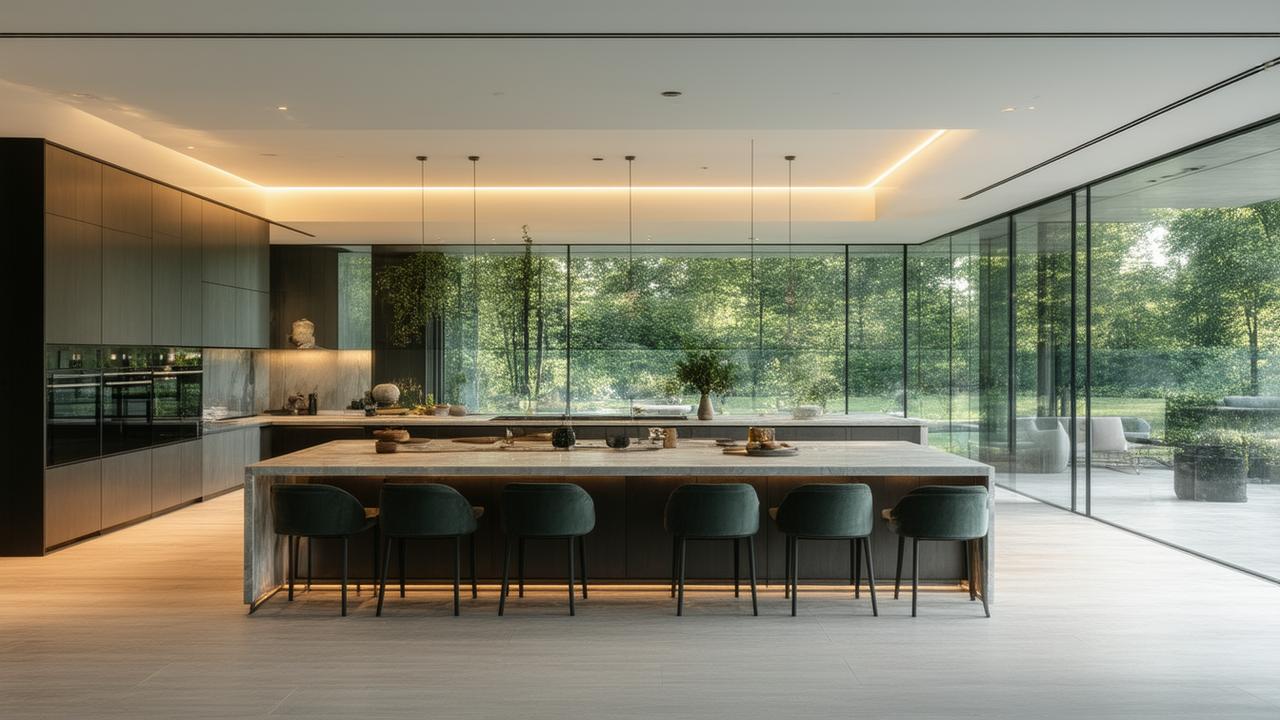
The first thing you notice is the space. Not the glossy benchtops or the moody pendant lights, but the sheer, quiet sense of breathing room. Where a bulky kitchen island once stood, there’s now an open stretch of warm timber, a slender prep station hugged against the wall, and a long, welcoming dining table that feels more like a country homestead than a showroom kitchen in suburban Brisbane. Someone puts down a platter of grilled prawns, a kid races through with a football, and nobody bumps a hip on solid stone. It’s still a high-end kitchen, but the centre of gravity has shifted—and it’s not in the middle of the room anymore.
The Island Era Is Ending (And Aussies Are Ready)
For nearly two decades, the kitchen island has ruled Australian homes. It was the backdrop of renovation shows, the dream feature in real estate listings, the non-negotiable in countless building plans. Big, bold, and stone-topped, the island promised extra storage, more seating, and an instant social hub.
But somewhere between the fifth lockdown kitchen reno episode and the hundredth Instagram photo of identical white islands, something changed. Homeowners started to notice the downsides: the bottlenecks around breakfast time, the lack of proper dining space, the awkward dance between sink, stove, and fridge. In smaller Aussie homes, especially in inner-city Sydney and Melbourne, the island wasn’t just a feature—it was a roadblock.
Designers quietly started to ask a simple question: what if the kitchen didn’t need a monument right in the middle?
The answer has become one of the strongest emerging trends for 2026: the return of the kitchen dining table and wall-aligned preparation zones—a more practical, more elegant approach that’s already transforming how Australians cook, eat, and gather.
The New Centrepiece: Tables, Not Monoliths
The trend replacing kitchen islands is deceptively simple: integrated dining tables, slim wall-side prep benches, and flexible furniture-based layouts instead of one heavy, immovable block. It’s less about a single product and more about a philosophy: the kitchen as a living, shifting, human space—rather than a stone altar to Caesarstone.
Across Australia, architects and interior designers are nudging clients towards:
- Generous dining tables positioned close to the main kitchen run, replacing the need for island seating.
- Wall-aligned prep benches, often with integrated appliances, that free up the centre of the room.
- Peninsula-style counters that hug one wall or corner, rather than standing solid in the middle.
- Moveable trolleys and butcher’s blocks that offer extra prep space when needed, then roll away.
- Banquette seating built into nooks, turning corners into cosy, cafe-like dining spaces.
This new approach feels instantly more relaxed, more Australian. It nods to the farmhouse table, the backyard barbecue table, the long table you squeeze ten mates around at Christmas when half of them end up on mismatched chairs. You don’t perch here; you stay. You spread out school projects, laptop cords, and the salad someone forgot to toss.
Designers are finding that when they remove the island, people don’t mourn it for long. They notice instead how walking paths open up, how conversations flow more naturally, how the kitchen stops feeling like a barrier between cook and guests and starts feeling like part of the living room again.
Why This Shift Makes Perfect Sense in Australian Homes
Australians live large—but increasingly, in small and multi-purpose spaces. Apartments in cities are shrinking. Townhouses are climbing up rather than spreading out. Even in freestanding homes, the great Aussie open-plan space now has to work much harder: it’s a home office, a homework zone, a Friday-night cocktail bar, a Sunday roast kitchen, sometimes all at once.
Kitchen islands, for all their drama, rarely pull their weight in this context. They’re great for extra cupboards and stools, but they’re fixed, often oversized, and surprisingly inefficient in smaller footprints. They also tend to encourage one person standing, cooking, while everyone else sits and eats or scrolls on their phones nearby—a subtle hierarchy that doesn’t always fit how modern Australian households share chores and time.
The alternative—combining smart wall storage, a streamlined prep zone, and a proper dining table—answers a stack of Australian needs at once:
- Multifunctionality: The table becomes desk, craft bench, family meeting spot.
- Accessibility: More room to move, easier wheelchair or pram access, fewer tight corners.
- Climate-conscious design: Less stone and joinery, more timber and furniture that can move with you.
- Indoor–outdoor living: A central table can easily align with a deck, courtyard, or outdoor kitchen.
In coastal homes from the Sunshine Coast to Fremantle, designers are orienting the main kitchen run towards the view, then placing a generous table between kitchen and deck doors. The result is a loose, casual flow: someone’s chopping herbs at a wall bench, someone else is setting the table, kids are running through to the yard, and nobody is getting wedged between a fridge door and a stone slab.
What These “Island-Free” Kitchens Actually Look Like
The shift from islands to integrated tables and wall kitchens isn’t about going minimal or cold. Quite the opposite. Modern Australian homes are leaning into texture, warmth, and furniture-like details in the kitchen, creating spaces that feel less like a lab and more like part of the living soul of the home.
Common features showing up in 2026-forward designs include:
- Timber tables with rounded edges instead of sharp island corners.
- Open shelves mixed with concealed storage, keeping everyday items within easy reach.
- Compact appliance walls with built-in ovens, coffee machines, and pantries in one sleek run.
- Slimline counters hugging walls, sometimes with a raised edge to hide the inevitable cooking chaos.
- Soft lighting from floor lamps and wall sconces around the dining area, rather than harsh island pendants.
You’ll see more banquette seating beneath windows, more stools that tuck under tables completely, and more spaces designed with the knowledge that people will linger long after the plates are cleared.
Instead of a gleaming, untouched island sitting centre-stage for listing photos, real life gets a starring role: school notes spread across the table, someone scrolling recipes on a laptop, a vase of native flowers pulled in from the garden, footy gear tossed in the corner while dinner finishes grilling outside.
Islands vs. Integrated Table Layouts: A Quick Comparison
Here’s how the classic island stacks up against the new table-and-wall trend many Australian designers are backing:
| Feature | Traditional Kitchen Island | Table & Wall Prep Layout |
| Space Flow | Can block circulation and create bottlenecks. | Keeps central area open; easier to move through. |
| Flexibility | Fixed; expensive to change or remove. | Furniture can move, adapt, or be replaced over time. |
| Social Use | Perching on stools; cook often stands apart. | Everyone sits at the same level, more inclusive. |
| Small Homes | Can dominate limited floor area. | Works well in compact spaces; easier to scale. |
| Cost | High stone and joinery cost, more complex services. | Can reduce stone usage; spend redirected to quality table and chairs. |
Designing Your Own Island-Free Kitchen in Australia
If you’re planning a renovation or new build and wondering whether to skip the island, it helps to think less about trends and more about how you actually live.
Stand in your current kitchen and watch your own habits: where do you naturally drop your bag, where do people gather, where do kids do homework, how often do you sit at a proper table versus perching at a bench? For many Australians, the honest answer is that the island is nice to look at, but the dining table—if it exists at all—does the heavy lifting.
➡️ Psychologists share the sentence that lets you decline any offer politely and still look confident
➡️ I only learned this at 60: the surprising truth about the difference between white and brown eggs that most people never hear about
➡️ According to astrological forecasts, these zodiac signs are destined for major prosperity in 2026
➡️ By planting over 1 billion trees since the 1990s, China has slowed desert expansion and restored degraded land
➡️ Boiling rosemary is a simple home tip I learned from my grandmother, and it can completely transform the atmosphere of your home
➡️ A Nobel Prize–winning physicist says Elon Musk and Bill Gates are right about the future : we’ll have far more free time: but we may no longer have jobs
➡️ Goodbye Kitchen Islands : their 2026 Replacement Is A More Practical And Elegant Trend
Here are a few practical design ideas suited to Australian homes:
- Swap bar stools for real chairs: Prioritise comfortable, supportive seating around a table you can linger at.
- Consider a peninsula instead of a full island: A bench attached at one end can define the kitchen without blocking the entire room.
- Use a narrow prep bench: A slightly shallower counter along one wall can offer storage and workspace without intruding into the room.
- Think about kids and ageing: Seated prep, wheelchair access, wide walkways—it’s easier to get right without a block in the middle.
- Orient towards light and landscape: Place your table where morning light falls, or where doors open to a yard or balcony.
In many Australian climates, the kitchen-dining space is now the bridge between indoors and out. Removing the island amplifies that connection. You can swing open the stacker doors, extend the table onto the deck, and let the whole space breathe. The kitchen stops being a fortress and becomes more like a verandah: open, welcoming, easy to cross.
From Showpiece to Shared Space: The Emotional Shift
Underneath all the cabinetry choices and layout diagrams, this 2026 trend is ultimately about emotion: about how a home makes you feel the second you step inside. The island once represented status, permanence, an anchor. It still has its place in some larger homes and entertainer’s kitchens, but the cultural story is changing.
More Australians are craving softer, slower spaces—rooms that encourage real connection, not just great listing photos. We want to pull up a chair, not hover on the edge. We want kids scribbling across the same table where someone’s rolling pastry. We want Friday-night dumpling sessions with friends where everyone sits together, instead of standing on one side of a stone bench while one person stirs on the other.
When you strip out the island and replace it with a well-loved table and a quieter, smarter kitchen wall, something subtle happens: you stop performing “my dream kitchen” and start simply living in it. There’s room for mess, for elbows, for second cups of tea. The kitchen is no longer a stage; it’s a campfire—with everyone sitting in a circle, not lined up on stools.
By 2026 and beyond, expect to see more Australian homes ditching the monolithic island in favour of layouts that feel less like airports and more like bush shacks and beach houses—honest, generous, and deeply lived in.
FAQ: Goodbye Kitchen Islands – What You Need To Know
Are kitchen islands completely “out” in 2026?
No, they’re not gone altogether, but they’re no longer the automatic default. In large, open homes, especially with serious home cooks, an island can still work brilliantly. The shift in Australia is away from “every kitchen must have an island” towards “every kitchen must suit the way its owners actually live.”
Will removing an island hurt my resale value?
Not if the replacement layout is well designed. Buyers are increasingly looking for practical, flexible spaces and a comfortable dining area. A generous table, good storage, and clear flow can be just as appealing—sometimes more so—than a bulky island, especially in smaller or medium-sized homes.
Can I still get extra storage without an island?
Yes. Many designers are using tall pantry walls, deep drawers, appliance cupboards, and bench-to-ceiling cabinetry to more than make up for lost island storage. Banquette seating with built-in drawers is another quiet storage hero.
Is a table-based layout suitable for small apartments?
It can be ideal. A compact, extendable table and a single, efficient wall kitchen or L-shaped bench can free up precious floor area. You gain one surface that does everything—work, study, meals—without sacrificing circulation.
What kind of table works best in place of an island?
Look for a sturdy, easy-to-clean table with rounded corners and enough legroom for comfortable daily use. In many Australian homes, timber with a durable finish works beautifully. If your space is tight, consider an extendable design or a table with built-in bench seating on one side.





