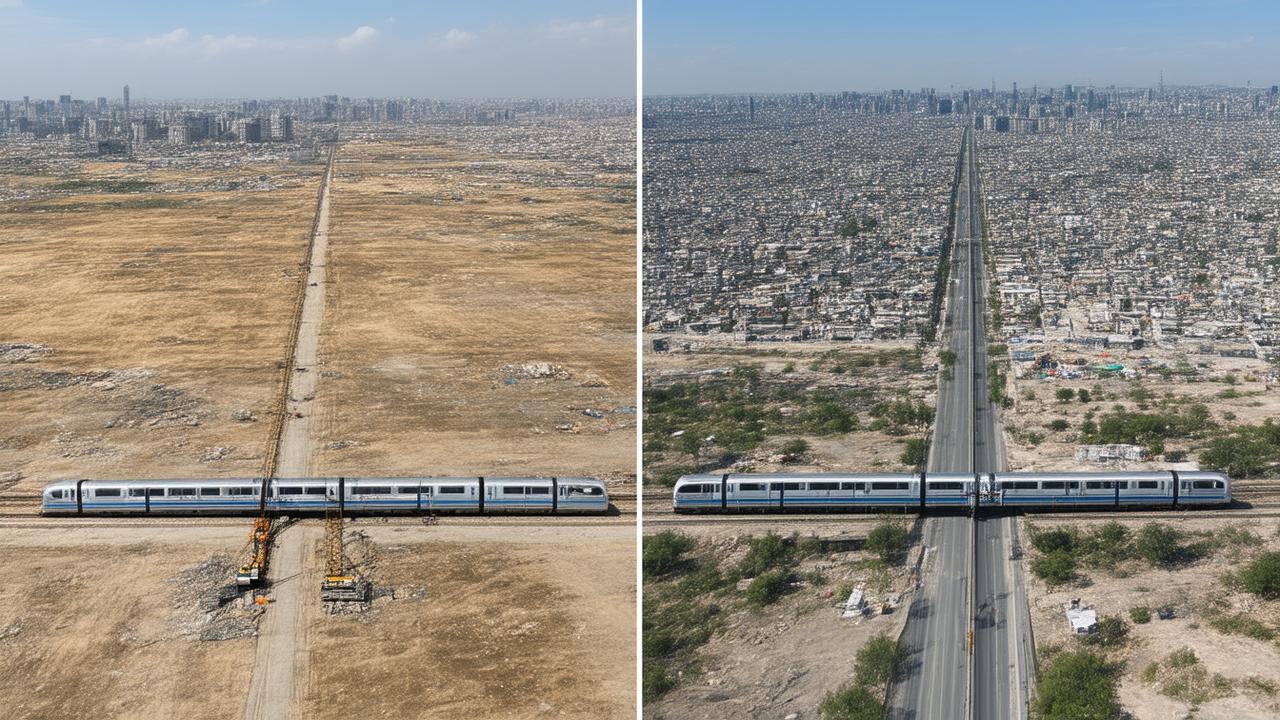
The station platform was spotless, silent and almost eerily bright. Outside, through the glass doors, there was… nothing. No city skyline, no traffic, no crowds, just a scatter of low buildings, vacant lots and the faint outline of distant hills in a grey Beijing dawn. Back in 2008, as the world’s cameras zoomed in on China for the Olympics, images like this drifted quietly across the internet: brand-new metro stations seemingly “in the middle of nowhere.” Commentators scoffed. Bloggers joked about ghost trains and vanity projects. It all felt absurd and slightly futuristic, like a sci‑fi set that forgot to add the characters.
But as we edge through the 2020s, those ghost stations don’t seem so foolish anymore. In fact, they’re starting to look like a warning shot—and maybe a guide—for countries like Australia, perched on the edge of a population boom and a climate‑defined century.
How Ghost Stations Became Front-Row Seats to the Future
To understand why China built metro stations in the middle of nowhere, you need to imagine something that doesn’t come naturally to most democracies: building for people who haven’t arrived yet.
In the years leading up to the Beijing Olympics, China was deep in one of the fastest urbanisation waves in human history. Farmland was turning into high‑rises; villages were being absorbed into new districts; satellite cities were sketched out in planning offices long before the first café opened its doors. Transport planners drew subway lines not for the city that existed, but for the city that was rushing toward them like a dust storm on the horizon.
It looked mad from the outside. Why put a multibillion‑dollar underground station under a paddock? Why open platforms to serve a suburb that hadn’t been built yet? The answer, as Chinese officials quietly explained at the time, was almost boring: “If we don’t, they’ll come with cars.”
They were designing behaviour. Build rail first and you normalise rail. Make it the default, the easy choice, the habit formed on Day One. Wait until the traffic jams and tower blocks arrive, and the politics of carving tunnels under already‑angry neighbours becomes a nightmare.
The Strange Logic of Building Before There’s Demand
If you live in Sydney, Melbourne, Brisbane or Perth, this all sounds very… upside down. We’re used to the opposite rhythm. We add tracks and platforms only once the complaints are deafening, the roads are choking and the cost of doing something—anything—can be sold as unavoidable.
China gambled in the other direction. It laid down heavy infrastructure like railway tracks across empty landscapes, betting that the people would come. At the time, foreign journalists stood on those lonely platforms and wrote about hubris. But quietly, year by year, the void around many of those stations began to fill in—shops, university campuses, hospitals, dense housing blocks and bustling markets.
Not every bet paid off. Some stations remained underused for years. Some are still waiting for their moment. But the pattern is there: the “middle of nowhere” slowly turned into somewhere central. And that logic—building for the city before it exists—is being sharply re‑evaluated as we grapple with climate, housing and congestion in countries like Australia.
Why “Nowhere” Was Never Really Nowhere
The phrase “middle of nowhere” hides an important truth: these places weren’t random. They were mapped into detailed urban plans that stretched decades into the future. The empty fields were earmarked for tech parks, housing estates, industrial clusters or university districts. The stations went in first because everything else was supposed to grow around them.
Think of it like planting a seed: the station is the trunk and the buildings are branches that spread out over time. Once rail is there, developers lean in. High‑density housing makes sense. Offices cluster along the line. Cafés and shops open near exits. The station becomes a magnet, pulling a new kind of city into shape—more vertical, more walkable, less car‑dependent.
In other words, “nowhere” was never an accident. It was a forecast.
An Australian View from the Platform Edge
From an Australian vantage point, the story feels both alien and strangely familiar. We know the pain of being late. Try building a new motorway interchange in an established suburb and you’ll see the fury. Try carving a rail line through someone’s backyard and the legal fights drag on for years.
Our cities grow like spilled coffee—spreading outward, irregular, sticky with car dependence. New estates appear on former farmland, their cul‑de‑sacs neat and new, while the nearest train station lies a long, hot bus ride away. People move in while infrastructure negotiations crawl along behind them.
China flipped the script. It didn’t always get it right, but it treated rail like a skeleton: put it down first, let everything else grow off that frame. It’s a mindset Australian planners are cautiously starting to adopt with projects like Sydney’s Metro and Melbourne’s Suburban Rail Loop—but our version is slower, more contested, less all‑in.
What It Feels Like When a “Ghost Station” Wakes Up
Picture stepping off a train in one of those once‑lonely stations in outer Beijing today. The air smells faintly of roasted sweet potatoes from a street vendor just outside the exit. Office workers weave through students huddled over bubble teas. Electric scooters buzz past like oversized insects. Neon reflections slide across glass façades that simply didn’t exist a decade ago.
The station is no longer an outpost. It’s a front door.
There’s a strange intimacy to this transformation. Locals remember when this stop served almost nobody, when you could sit on a bench for twenty minutes and hear only the echo of your own footsteps. Now, every square metre of platform space has a purpose: queues, signage, impatient glances at phones. That sense of time stretching—of seeing infrastructure wait patiently for its city—feels almost impossible in the context of Australian politics, where election cycles demand quick wins.
Lessons for Australia Hiding in Chinese Concrete
China’s 2008 “middle of nowhere” stations weren’t just about speed; they were about shaping destiny. For Australia, the question is not whether to copy China’s playbook wholesale (we can’t and shouldn’t), but what we can learn from its boldness—and its failures.
1. Build for Future Residents, Not Just Current Voters
Future Australians don’t get to vote today, but they will inherit the gridlock we leave behind. China’s early metro stations forced planners to reckon with people who hadn’t arrived yet. It’s a deeply ethical—and deeply political—idea: investing now so that a kid growing up on the fringe of Brisbane in 2035 has a train within walking distance instead of relying on a second‑hand hatchback.
2. Make Rail the Default, Not the Luxury
In many parts of our cities, a train line feels like a prize you hope your suburb might win one day. In China’s fast‑growing regions, rail was treated as a baseline assumption, the core that anchored everything. The more we see rail as an optional extra, the more we lock ourselves into car dependency that is expensive, isolating and high‑emissions.
3. Accept That Some Stations Will Be “Too Early”
China’s story is not tidy. Some stations did open too soon. Some still serve more pigeons than passengers. But here’s the twist: in the long timeline of a city, “too early” is usually a more forgivable sin than “too late.” Being early costs money and invites ridicule; being late costs trust, productivity and, increasingly, climate resilience.
➡️ The streak-free window-cleaning method that still works flawlessly even in freezing temperatures
➡️ The quick and effective method to restore your TV screen to like-new condition
➡️ Thousands of passengers stranded in USA as Delta, American, JetBlue, Spirit and others cancel 470 and delay 4,946 flights, disrupting Atlanta, Chicago, New York, Los Angeles, Dallas, Miami, Orlando, Boston, Detroit, Fort Lauderdale and more
➡️ The sleep pattern that predicts alzheimer’s risk 15 years before symptoms
➡️ These zodiac signs are destined for major prosperity in 2026, according to astrological forecasts
➡️ The RSPCA urges anyone with robins in their garden to put out this simple kitchen staple to help birds cope right now
➡️ The RSPCA urges anyone with robins in their garden to put out this simple kitchen staple today
4. Integrate Housing, Jobs and Transport From the Start
A station in the middle of nowhere only makes sense if “nowhere” is carefully planned to become “somewhere worth living.” Many Chinese projects paired metro lines with zoning for high‑density housing, schools, hospitals and office parks. The rail wasn’t a standalone project; it was the spine of a living district.
Australia is tiptoeing toward this idea through transit‑oriented development, but our execution is patchy. Too often a new station lands without enough homes nearby, or a high‑density project rises without strong public transport. China’s example suggests that aligning the two—at scale and with commitment—is where the real magic happens.
A Quiet Table in the Middle of the Story
To see the contrast more clearly, it helps to strip away the politics and look at the bones of the approach.
| Aspect | China’s 2000s Metro Strategy | Typical Australian Approach |
|---|---|---|
| Timing of major rail | Builds lines and stations before districts are fully developed. | Adds rail after growth has already sprawled. |
| View of “demand” | Plans for projected population and future travel patterns. | Relies heavily on current usage and existing congestion. |
| Urban form that results | High‑density, rail‑anchored districts. | Low‑density sprawl, car‑oriented suburbs. |
| Public perception at launch | Ridicule for “empty” stations; scepticism about cost. | Frustration at delays; anger over disruption and expense. |
| Long‑term potential | Creates strong foundations for low‑carbon, high‑access cities. | Risk of locking in congestion and higher emissions. |
So, Why 2008 Matters More Than We Thought
The Beijing Olympics were meant to showcase China’s arrival on the world stage. We remember the fireworks, the Bird’s Nest stadium, the tightly choreographed opening ceremony. Few people remember the quiet platforms, the freshly tiled tunnels waiting in outer districts for their future passengers. But history is often written in concrete more than in fireworks.
In 2008, those stations symbolised overreach for many foreign eyes. In 2024 and beyond, they look more like a blueprint for survival in a warming, urbanising world.
Australia is not China. We move slower. We argue more. Our planning system is more fragmented and our cities smaller. Yet the underlying challenge is the same: we are racing population growth, climate change and infrastructure decay, all at once. At some point, we’ll need to ask a braver question than “What can we get away with building this term?” We’ll need to ask: “What will seem obvious in 20 years that feels radical today?”
Somewhere on the fringe of a Chinese city, another station still waits. Its stairwells echo. Its escalators hum quietly for a handful of commuters. Outside, the roads are dusty, the towers half‑finished, the street trees still staked and fragile. It looks, to an impatient eye, like waste. But to a different way of thinking, it is simply patience made visible. A promise laid down in steel and stone before the lives it was built for have fully unfolded.
When we finally understand why China built metro stations in the middle of nowhere in 2008, we’re really understanding something about our own future. The real question is whether we’ll be brave enough to build for the Australians who haven’t arrived yet—and whether we’ll let them step off a train instead of into a traffic jam.
Frequently Asked Questions
Did all of China’s early metro stations become successful?
No. Some lines and stations are still underused compared to central networks. However, many of the once‑quiet stations have grown steadily with surrounding development, and the long‑term trend favours increasing usage as cities expand and densify.
Could Australia copy China’s metro strategy directly?
Not directly. China’s political system, funding mechanisms and planning powers are very different. But Australia can adapt some principles—such as building key corridors early, integrating housing with transport, and planning for future demand rather than only current pressure.
Isn’t building stations early a waste of money?
It can look that way in the short term. Yet over decades, early investment can be cheaper than retrofitting transport into built‑up suburbs, and it helps avoid costs linked to congestion, emissions, and social isolation in car‑dependent communities.
Are there examples of “stations in the middle of nowhere” in Australia?
There are a few partial examples, such as stations that opened before full nearby development or lines that initially seemed underused. But generally, Australia has been more cautious, tending to build transport after significant demand already exists.
How does this relate to climate change and emissions?
Metro systems move large numbers of people efficiently with far lower emissions per trip than private cars. Designing future suburbs around rail, rather than roads alone, is one of the most effective ways to cut urban transport emissions over the long term.





