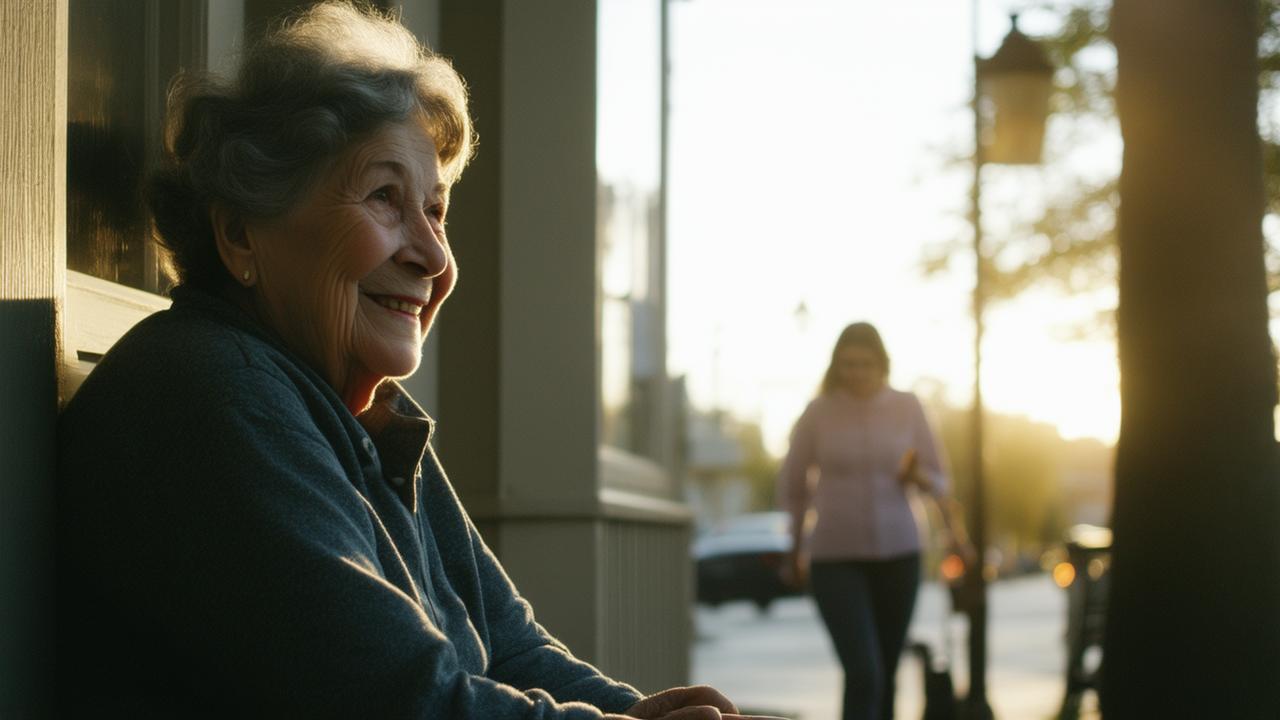
The old bloke at the end of the jetty notices you before you notice him. He’s sitting on an upturned bucket, rod balanced loosely in one hand, stubby in the other, watching a pair of pelicans drift past on the tide. It’s late afternoon on the New South Wales coast, that magic hour when the sky turns peach and the wind finally gives up. You’re half‑tempted to take a photo for Instagram—the light is ridiculous—but your phone is at 7% and your notifications are already stacked like traffic on Parramatta Road.
He doesn’t have a phone out. No earbuds. No smartwatch buzzing. Just a faded hat, sun‑spotted hands, and the sort of relaxed posture people spend thousands trying to buy back at yoga retreats in Byron.
He glances over, catches your eye, and smiles like there’s all the time in the world. And in that tiny exchange, you realise something that’s both irritating and oddly comforting:
The older generations—the ones we quietly label as “behind the times”—might actually be enjoying life more than the rest of us. And none of us wants to admit it.
The secret nobody really wants to talk about
When conversations turn to age in Australia, we’re obsessed with two things: staying young and staying busy. We talk about “active ageing” and “reinventing retirement”, or we joke about becoming grey nomads in a caravan park up north. But under all the banter, there’s an uneasy truth.
Many Australians in their 60s and 70s—your parents, your neighbours, the lady who chats to everyone in the bakery queue—seem, quietly and without fuss, more at ease in the world than a lot of thirty‑somethings juggling Slack messages, doomscrolling and Afterpay debt.
They’re not immune to problems, of course. There are health scares, money worries, loneliness, grief. But there’s also something else: a kind of settled, sensory presence in daily life that so many younger Australians keep trying to buy from meditation apps and digital detox retreats.
Ask them how their day was and they’ll tell you about the sunrise over the back fence, the tomatoes finally coming good, the grandkids’ weird new slang, the lorikeets that have discovered the birdbath. Ask a younger friend and they’re more likely to shrug and say, “Busy, mate. Knackered.”
The strange comfort of having less to prove
By the time someone hits their late 60s or 70s in Australia, a lot of life’s proving grounds have quietly closed. The career ladder is what it is. The mortgage is either dealt with or it isn’t. The kids are adults. The dog’s grey around the muzzle. There’s not a lot left that anyone expects you to “crush”.
For many, that shift brings a surprising freedom: the invisible pressure eases. No one’s measuring your success by your LinkedIn updates or your side hustle. No one cares how quickly you answer an email. The scoreboard—whatever it was for them—has stopped blinking.
So instead of chasing the next thing, older people often lean into what’s already here. Morning walks instead of 6am Zooms. A quiet coffee on the veranda instead of a frantic takeaway latte sculled in the car. Slow chats at the post office. Free time without the guilt of needing to “optimise” it.
It’s not that they’re saints, or that they don’t still worry. But the chasing instinct has softened. They’ve learned, sometimes the hard way, that not every missed call is a crisis, not every message needs an immediate response, and nobody on their deathbed wishes they’d spent more time on their phone.
The phone that stays on the bench
Next time you’re at a family barbecue, watch who reaches for their phone first when the conversation stalls. Chances are it’s not the retiree carefully turning the sausages.
For younger Australians, the phone is a nervous reflex. Awkward silence? Check Instagram. Mild boredom? Scroll the news. Slight discomfort? Open TikTok. We’ve built a whole culture around escaping the present moment in three‑second bursts.
Older people have technology, yes. Plenty are on Facebook, some on WhatsApp, a few braver ones on FaceTime every second day with their grandkids in Queensland. But for many in their 60s and 70s, the phone is an accessory, not an emotional lifeline.
They can leave it on the kitchen bench while they sit in the yard listening to magpies gargle evening songs. They’ll answer it when it rings. They’re not refreshing weather apps every ten minutes unless there’s a cyclone heading for the coast.
That small difference—whether your attention lives in your hand or in the air around you—shapes the entire texture of your day.
When the body slows down, the senses wake up
Ageing isn’t gentle. Joints ache. Eyes weaken. Stairs turn from background detail into daily negotiation. In a culture obsessed with youth, it’s easy to see this only as loss. But for many older Australians, the slowing of the body nudges something deeper awake.
You notice more when you can’t rush as much.
The pace of a beach walk at 70 is not the same power‑stride you did at 30. It’s slower. More deliberate. There’s time to feel the give of the sand under your feet, to smell the salt crusting on your skin, to stand still long enough to watch a pod of dolphins surface beyond the breakers.
On a suburban street in Adelaide or Perth, a simple stroll might turn into a running commentary: the neighbour’s jacaranda has exploded into purple; the council’s finally fixed that dodgy bit of footpath; the bakery has changed hands (again). None of it is spectacular. All of it is real.
These small, sensory details often fade into background noise for tech‑distracted younger people, who can walk three blocks and arrive with no memory of the journey—only the videos they watched along the way.
Less FOMO, more “this is enough”
If you grew up before smartphones, you learned to live with what was directly in front of you because there wasn’t much alternative. The TV had four channels. The radio reception cut out past the edge of town. If you wanted excitement, you made it—cricket on the street, a drive to the servo for a Paddle Pop, a Sunday roast that felt like an event.
Now, from a single couch in Melbourne or Brisbane, you can scroll through a hundred lives in ten minutes: Bali holidays, engagement parties, new Teslas, abs sculpted in boutique gyms, brunches with cocktails that look like science experiments.
It feels like connection, but it quietly breeds a chronic, shimmering discontent. Whatever you’re doing starts to feel slightly less than. Your own life becomes a rough draft compared to everyone else’s highlight reel.
Older Australians aren’t immune to comparison, but many simply aren’t swimming in that same digital soup all day. Their FOMO is often smaller, more grounded: will I miss the grandkids’ school concert? Can I still manage that camping trip? Will my roses flower before the heatwave hits?
Instead of an endless sense of “not quite enough”, there’s a surprising amount of “this will do nicely, thanks.” A quiet afternoon with a book. A cuppa on the back step watching clouds stack over the hills. A game of cards. A good ABC drama. An early night, no guilt.
➡️ The quick and effective method to restore your TV screen to like-new condition
➡️ Thousands of passengers stranded in USA as Delta, American, JetBlue, Spirit and others cancel 470 and delay 4,946 flights, disrupting Atlanta, Chicago, New York, Los Angeles, Dallas, Miami, Orlando, Boston, Detroit, Fort Lauderdale and more
➡️ The sleep pattern that predicts alzheimer’s risk 15 years before symptoms
➡️ These zodiac signs are destined for major prosperity in 2026, according to astrological forecasts
➡️ The RSPCA urges anyone with robins in their garden to put out this simple kitchen staple to help birds cope right now
➡️ The RSPCA urges anyone with robins in their garden to put out this simple kitchen staple today
➡️ What you see is not a ship : at 385 metres long, Havfarm is the world’s largest offshore salmon farm
Why we resist admitting they might be happier
You’d think we’d celebrate if our parents and grandparents were quietly nailing life satisfaction. But culturally, we dodge that truth. We prefer the story that youth is peak joy and everything afterwards is damage control.
Why? Because admitting that older people might be more content forces younger Australians to look at the lives we’ve built on a shaky altar of constant connectivity and productivity. It raises uncomfortable questions:
- If all this tech is meant to make life easier, why are anxiety and burnout everywhere?
- If we’re more “connected” than ever, why does loneliness still feel like a national epidemic?
- If we can access any entertainment at any time, why are so many of us bored in a way that feels bottomless?
It’s easier to gently mock older people for not understanding streaming services or using cash instead of tapping their phone, than to admit that their simple routines might actually be closer to what humans are wired for.
They prioritise face‑to‑face chats, physical landscapes over digital ones, repetition over relentless novelty, and presence over performance. In other words: everything our tech‑addled culture has quietly pushed to the side.
A quiet kind of courage
There’s also a deeper bravery in growing old that younger people sometimes miss. It takes courage to keep showing up in a body that doesn’t always cooperate. To face funerals, fading independence, and the long, slow letting‑go that ageing demands.
Many older Australians carry that courage with a lightness that feels almost defiant. They plant lemon trees they may never see at full size. They renew library cards. They learn how to video call. They book holidays a year in advance knowing anything could happen between now and then—and go anyway.
That willingness to still invest in life, knowing full well its limits, often creates a deeper gratitude for small pleasures. The first swim of the season. A good report from the cardiologist. The way a grandchild’s hand fits inside their own. These moments don’t need to be captured, edited and shared. They’re enough in themselves.
What younger Australians can quietly borrow
This isn’t about pretending older people have it all worked out, or that being young in 2020s Australia isn’t genuinely tough. Housing is harder, work is more precarious, and the climate crisis hums underneath everything like an overloaded transformer.
But there are things we can borrow—habits, really—that don’t require ditching technology or pretending it’s 1978 again. Think of it less as “going backwards” and more like remembering a human setting we accidentally turned off.
| Younger default | What older Aussies often do | What you could try |
|---|---|---|
| Check phone first thing on waking | Make tea, look out window, listen to morning sounds | Give yourself 10 phone‑free minutes each morning |
| Eat while watching videos or scrolling | Sit at a table, chat, notice the food | One screen‑free meal a day, even if it’s just toast |
| Fill every pause with content | Stare into space, people‑watch, daydream | Leave your phone in your bag while waiting in queues |
| Fitness as punishment and performance | Movement as maintenance: walking, gardening, swimming | Swap one “workout” a week for a gentle walk or swim |
| Constant group chats, little in‑person time | Regular in‑person catch‑ups, even if simple | Plan one low‑key, face‑to‑face catch‑up per week |
None of this will break the internet. But that’s the point. The joy older people often carry isn’t viral or spectacular. It’s woven into the ordinary day, into rhythms that have room for both grief and laughter, uncertainty and calm.
It’s the knowledge that life doesn’t have to be constantly optimised to be worthwhile. Sometimes it’s enough to sit at the end of a jetty with a fishing rod, feel the boards creak under you, taste the salt on your lips, and know that—for this one, small, unphotographed moment—you’re exactly where you’re meant to be.
Frequently Asked Questions
Are older Australians really happier than younger people?
Studies often show a “U‑shaped” curve of happiness, with life satisfaction dipping in midlife and rising again in later years. Many older Australians report feeling more content and less driven by comparison, even while dealing with health or financial challenges.
Is technology the main reason younger people feel more anxious?
Technology isn’t the only cause, but it amplifies stress by keeping people constantly connected, constantly comparing, and rarely fully present. Work pressure, housing costs and broader social issues also play major roles.
Do all people in their 60s and 70s feel this relaxed?
No. Older Australians are a diverse group. Some feel lonely, stressed or unwell. But many have developed coping skills, perspective and routines that help them find joy in ordinary days, even alongside difficulties.
Does enjoying simple things mean giving up on ambition?
Not at all. You can still have goals and dreams while also learning to enjoy daily life. The lesson from many older people is about balance: ambition without constant self‑pressure and comparison.
How can younger Australians start to “de‑stress” their daily lives?
Small shifts help: set boundaries with your phone, build regular offline catch‑ups, spend more time outdoors, create simple daily rituals (morning tea, evening walks), and treat rest as necessary maintenance, not a guilty indulgence.





