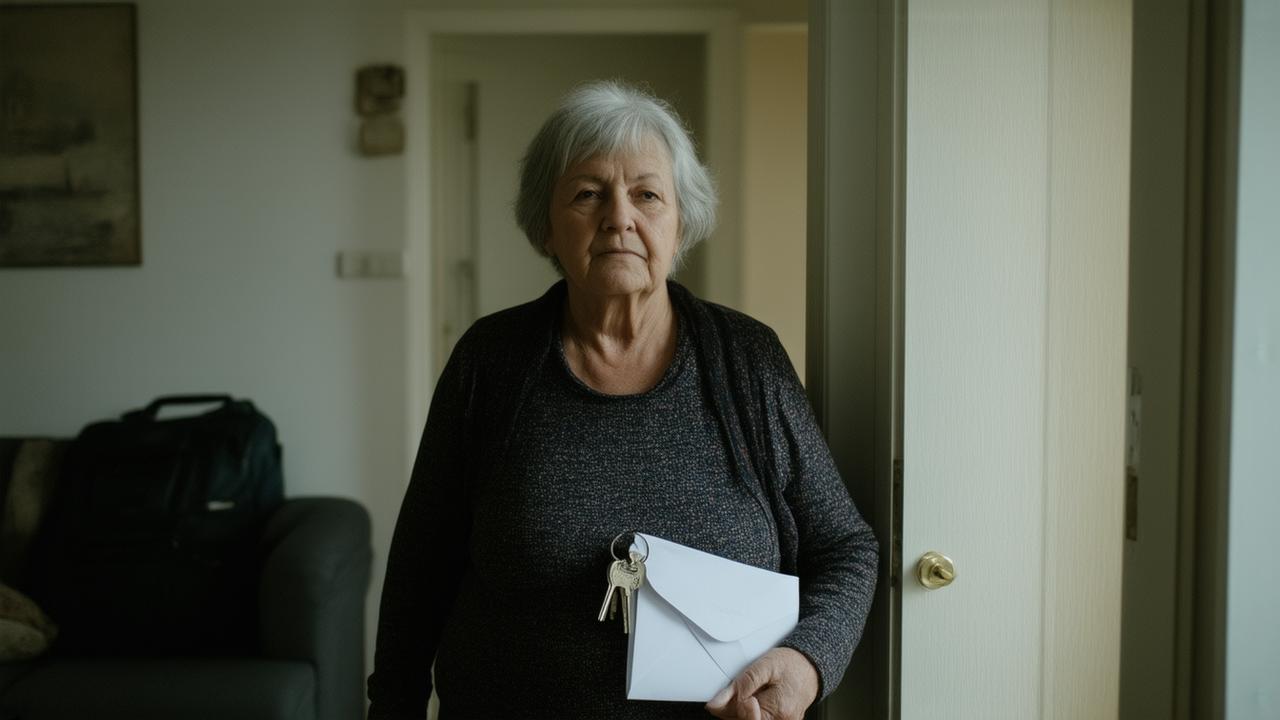
The first thing you notice about the building is the silence. The kind that doesn’t feel peaceful so much as unfinished, like someone pressed pause on a life and forgot to press play again. A lace curtain hangs crooked in a third-floor window, yellowed by sun and time. Lights rarely come on there. The mailbox below is stuffed with supermarket flyers, election circulars, and a single faded envelope, edges curled like dry leaves. The neighbor on the second floor has a simple way of describing it: “I haven’t seen her in two years.”
And yet, on the official documents of the city, that window still belongs to someone—or rather, to one particular woman. A retiree. Quiet, polite, invisible in the way older people so often become. On paper, she still lives there. In reality, her social housing apartment has become something else entirely: a second home. A place she dips into occasionally, like a forgotten coat you only pull out once in a while, not a primary shelter but a fallback, a reserve, a memory. And now, the city wants it back.
Where Home Becomes a Question
In most stories, “home” is obvious. It’s where you sleep, eat, argue, water your plants, misplace your keys. But for this woman—let’s call her Marie—home has softened at the edges. It has become two places: the apartment she long ago secured through social housing, and another, quieter corner somewhere else where she now spends most of her time. Maybe with a new partner in a nearby town. Maybe closer to family in the countryside. Maybe in a tiny studio she bought decades ago when prices were still modest. The file doesn’t reveal all of that; bureaucracies never really capture the scent of a kitchen, or the reason someone leaves the light on for themselves in one place but not another.
What we know is this: Marie’s name is still on the lease of a social housing flat in a city where waiting lists are long, where families sleep in temporary shelters and young workers rotate between couches. Social housing is meant to be a lifeline—a primary residence for people whose income can’t stretch to meet the brutal elasticity of the rental market. The rules are clear: you live there, you truly live there. You don’t just drop in like a weekend guest at your own life.
But time slipped by. Two months away turned into six, then twelve, then twenty-four. The neighbor upstairs, the one who waters her geraniums with a kind of brisk tenderness, realized she hadn’t bumped into Marie in the stairwell, hadn’t heard the old familiar rattle of keys at dusk. The mail piled up. The smell of cooked onions that used to seep under the door disappeared. A life, once so physical and present, became an outline.
The Neighbor Who Saw Nothing
In social housing audits, neighbors play an unexpected role. They quietly become witnesses. Not official ones with signatures and stamps, but human barometers of presence. When inspectors come asking gentle but pointed questions—“Do you still see her often?”—neighbors’ answers fold into the story the system is trying to piece together.
The neighbor who “hasn’t seen her for two years” is not malicious. She is simply honest. She remembers that Marie used to greet the postman, used to carry a small shopping bag from the corner shop, used to complain about the faulty elevator. Then one day, that daily background hum faded. In its place was absence. A darkness behind the lace curtain that never shifted, no music, no radio, no footsteps. Absence, stretched over seasons.
For housing authorities, such absence is a red flag fluttering in plain sight. A social housing apartment can’t legally be kept as a pied-à-terre, a backup address to hold “just in case,” not when the entire point of the system is to house those who have nowhere else to live. To them, Marie’s long, quiet absence speaks of misuse. To Marie, it may simply speak of a life that didn’t follow any clean, straight lines.
| Aspect | Housing Authority View | Marie’s Possible View |
|---|---|---|
| Length of absence | Two years away suggests non-occupation and misuse of social housing. | “Life circumstances kept me away, but I never stopped considering this my home.” |
| Primary residence rule | Apartment must be lived in on a regular, permanent basis. | “Primary doesn’t mean constant. I always intended to come back.” |
| Unused space | An empty flat while others wait: a breach of social fairness. | “I earned this place through need; that need didn’t just evaporate.” |
| Moral dimension | Every unjustly kept home means another family remains unhoused. | “My story is complex; don’t reduce it to a number on a waiting list.” |
The Thin Line Between Rule and Life
It’s easy, from a distance, to imagine this as a neat legal case. The housing authority audited, investigated, and then mailed out a letter on heavy, official paper. The kind that lands with a flat thud in a metal mailbox and changes everything: notification of eviction proceedings. The message is stark: the apartment is not a holiday home, not a second residence, and if Marie does not live there as her primary home, she must give it up.
Marie contests this. Through a lawyer or perhaps with the help of an association, she pushes back against the sterile description of her absence. Because the rules—logical in the abstract—feel differently when your name is on the letter. They don’t account for the texture of a life, for the bridge years between independence and frailty, for the fear of losing “your” place even if you’re not sleeping there every night.
Maybe she left slowly, visiting a new companion more and more often. Maybe an illness made climbing the stairs unbearable, and she moved temporarily to a ground-floor flat with her daughter. Maybe a hospital stay blurred months into one long corridor of beeps and soft-soled shoes. For many retirees, life becomes a puzzle of temporary accommodations: here for treatment, there to help a sick relative, somewhere else to escape loneliness. In that maze, an old apartment key can feel like a lifeline, a proof that you still belong somewhere, that there is a door you can open if everything else falls apart.
When a Safety Net Becomes a Scarcity
Social housing, at its core, is a collective promise: we will not let you be swallowed by the market’s indifference. But that promise collides with another truth: there is never enough. Every empty or semi-empty apartment echoes with the absence of those who could live there fully—families in cramped hotel rooms, workers in precarious sublets, single parents packing and repacking suitcases because they never truly unpack.
For the system, Marie’s long absence is not just a personal quirk; it’s a symbol of scarcity gone wrong. When a retiree uses social housing as a second home, even out of fear or habit, the safety net tangles. The logic is brutal in its simplicity: if she’s mostly living elsewhere, someone else should live here. The law, like a ruler held against a crooked line, shows the gap.
And yet, law is written in ink, while human lives are written in erasable pencil. Suppose Marie’s other “home” is precarious—a boyfriend’s house where she has no legal rights, or an informal stay with family already squeezed into a small space. The social housing apartment may be quiet and dark, but it is hers, legally. It is the only address over which she has true control. To call it a “second home” might be technically accurate, but emotionally, it feels like calling a last refuge a luxury.
The Day the Papers Arrive
Imagine the moment she opens the envelope. The crackle of paper, the sharpness of the printed words. Administrative language has a particular chill: “non-compliance,” “irregular occupation,” “termination of lease,” “eviction proceedings.” There is no room in those sentences for the smell of furniture wax in a corridor, for the worn armchair by the window, or the plant she left on the balcony thinking she’d be back soon.
She might sit at a small table, hands trembling slightly, tracing the paragraphs with a finger. Her name at the top, as if that alone were enough to make this impersonal letter intimate. Maybe she knew this was coming. Maybe she thought the system wasn’t really watching. Or maybe she truly believed that as long as she paid her rent, no one would ask how often she was there.
Now she has a choice: surrender the apartment quietly, or fight. She chooses to contest the eviction. To say, “No, this is still my home,” even if the neighbors haven’t seen her in two years. She might argue health reasons, family obligations, temporary absence. She might invoke the right to stability in old age, the fear of becoming housing-insecure again, the dread of having nowhere officially “hers” if the other arrangements in her life dissolve.
Courts, Waiting Rooms, and the Weight of Silence
Legal battles for housing rarely look dramatic. They unfold in waiting rooms with scuffed floors, in small offices where files stack in nervy towers, in courtrooms where people speak softly and the clock ticks too loud. Marie’s case will be one among many, a line in a docket. The judge will listen to the housing authority’s representative explain the rules and the facts: long-term absence, neighbor testimony, unopened mail, perhaps even energy consumption records showing barely any electricity use.
Then it will be Marie’s turn. Maybe her voice shakes. Maybe she is surprisingly firm. She might describe the apartment as her anchor, even if she has drifted from it. How do you quantify a sense of belonging? How do you prove that you “live” somewhere, when living today might mean being pulled between multiple addresses out of necessity rather than choice?
The court will have to decide: is this a misuse of social housing—a retiree clinging to low rent while living elsewhere—or is it a fragile, imperfect way of staying afloat in a late chapter of life? Is the empty apartment an injustice to others, or a justifiable reserve in a world that offers so few safety nets to the elderly?
What This Story Says About All of Us
Strip away the legalese, and this story is less about one woman and more about how we define home in a time of scarcity. In booming, expensive cities, housing is no longer simply shelter; it’s power, security, inheritance, and sometimes, survival. Social housing grew out of the idea that not everything should be left to the brutal arithmetic of the market. But even within that gentler system, tough questions emerge.
➡️ The neighbor hasn't seen her for two years: a retiree uses her social housing as a second home and contests her eviction
➡️ People who snack constantly often confuse boredom with hunger
➡️ Astronomers confirm the century’s longest eclipse will briefly turn day into night
➡️ Garden experts say it: these harvest leftovers beat the best fertilizer
➡️ In Finland, many homes are heated without radiators, using a simple everyday object you probably already own
➡️ Astronomers release stunning new images of the interstellar comet 3I ATLAS, captured across multiple observatories with unprecedented clarity
➡️ Once dismissed as a “poor people’s fish,” this affordable species is becoming a prized staple as Brazilians rediscover its safety and nutritional value
Should someone be allowed to “under-occupy” a social home if they are emotionally attached but physically absent most of the year? Should age grant a special margin of tolerance? Does fairness to thousands on waiting lists outweigh one retiree’s quiet fear of losing her keys to a place that once saved her?
The neighbor’s statement—“I haven’t seen her for two years”—becomes more than casual observation. It becomes evidence, a pivot. But it’s only one angle on a complex life. Maybe, if you asked Marie, she would say: “I have never really left. My things are there. My name on the doorbell. My memories in the walls.” The system, however, measures presence more pragmatically: electricity, heating, neighbor testimony, the hum of daily life.
At the heart of this tension lies a simple, haunting image: a darkened window in a building where lights could be on, where voices could echo, where someone could be cooking, studying, raising children. An empty chair at a table someone else desperately needs.
Between Compassion and Rules
There may not be a perfect ending to this story. Perhaps the court will side with the housing authority, and Marie will be given a final deadline to clear out, her keys no longer fitting the lock of what was once her sanctuary. Perhaps a compromise will emerge: a delay, assistance to find a smaller or more suitable place, a soft landing instead of a hard fall.
Either way, her case forces a question onto the public square: how do we balance compassion for one person’s complicated life with the collective responsibility to use limited, subsidized housing fairly?
In an ideal world, no one would feel compelled to cling to an apartment “just in case.” No elderly retiree would fear that losing one set of keys could send them tumbling into precarity. No neighbor would become an accidental witness in a story of absence. But we don’t live in that ideal world. We live in this one, where silence behind a lace curtain can trigger an investigation, and where a woman who hasn’t been seen for two years must now step into the brightest, harshest light of all: a courtroom’s gaze.
And so the building remains, quiet for now. Behind one door, an apartment waits in limbo, holding its breath, suspended between being a home and becoming, once more, an opportunity for someone else. The mail keeps coming. The neighbor waters her plants. Somewhere, Marie folds and refolds the eviction letter, wondering what “home” will mean next year, and whether anyone will still remember that once, long ago, this address was the place that made her feel safe.
FAQ
Why can’t someone use social housing as a second home?
Social housing is designed to be a primary residence for people with limited income. It is heavily subsidized compared to market rents, so keeping such an apartment as an occasional or backup residence is considered unfair to those on waiting lists who have no stable home at all.
How do authorities know if a tenant is not really living in their social housing?
Housing providers may look at several indicators: neighbor testimony, accumulation of unopened mail, very low utility consumption over long periods, lack of regular activity in the building, and sometimes administrative checks on declared primary residence. These elements together can raise suspicion of non-occupation.
Can long absences ever be justified?
Yes, in some cases. Serious illness, hospitalization, caring for a sick relative, or other exceptional circumstances can justify temporary absence. However, tenants usually need to inform the housing authority and may be asked to provide proof. Prolonged, unexplained absence often leads to disputes.
What happens if a court confirms the eviction?
If a judge rules in favor of the housing provider, the lease can be terminated. The tenant is then given a deadline to leave. If they refuse or cannot move out, forced eviction procedures may follow, often involving social services to try to prevent homelessness, especially for vulnerable people like retirees.
Is there any way for the tenant to keep the apartment?
It depends on the case. If the tenant can prove that the absence was temporary, justified, and that they intend to resume true, regular occupation, a judge may show leniency. Sometimes, mediated solutions are found, such as relocation to a more suitable dwelling or a grace period to organize a dignified move.





