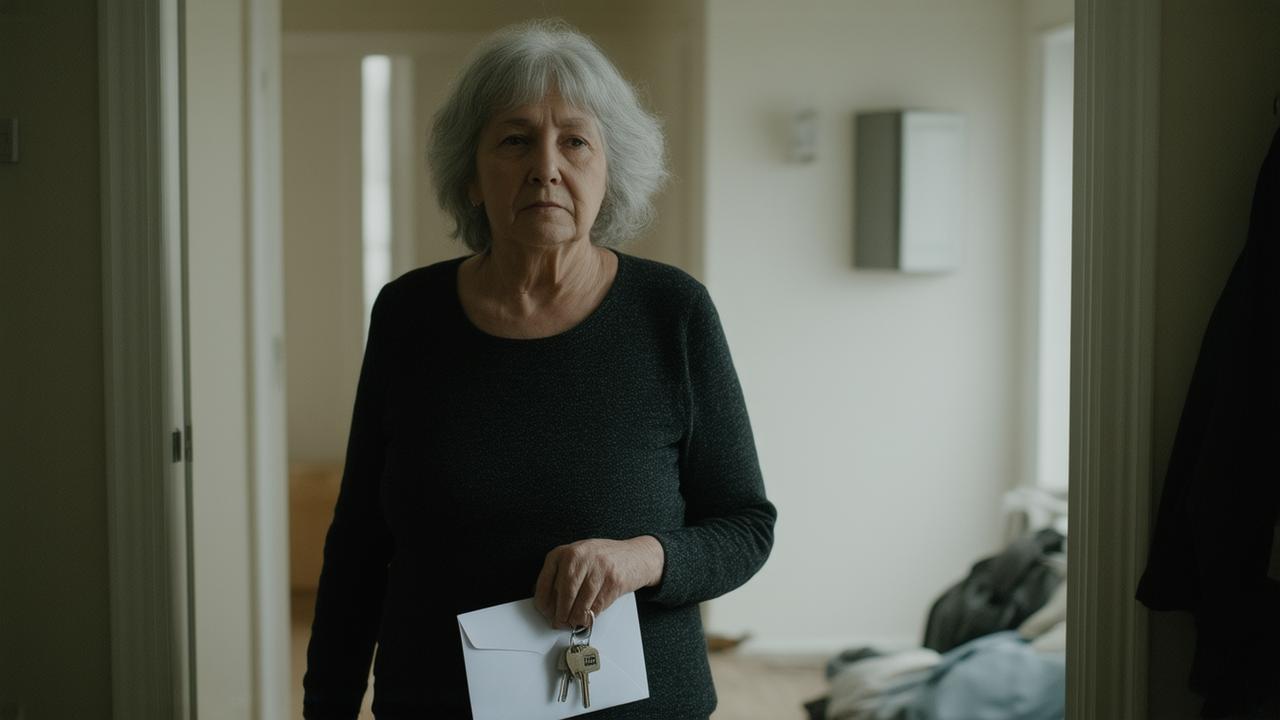
The first time anyone mentions the woman in apartment 3B, it’s because of the plants.
They are the kind of plants that tell on you. The spider plant, once lush and green, now trails dry, brittle leaves down the balcony like frayed rope. The geraniums, which used to erupt into scandalous pink each spring, have become small, crusted bundles of stems. On a warm Tuesday afternoon, with the sunlight pressing against the concrete of the courtyard, the neighbor across the hall realizes she has not seen the woman who owns those plants in two full years.
In the beginning, it was just a feeling—an absence more than a fact. No footsteps in the corridor. No shuffle of keys. No soft cough from behind the thin walls. Just a door, always closed, and behind it a life that seemed to have gone silent.
The Quiet Door at the End of the Hall
The building itself is a kind of city in miniature, a social housing block with every kind of story stacked above and below your feet. Children clatter down the stairs in the mornings, the elevator lurches arthritically, and someone is always frying onions. But halfway down the third-floor corridor, the air changes. It becomes still, almost shy, as if sound itself is reluctant to linger outside 3B.
The neighbor, Mireille, is the one who notices. She is retired too, in the way older people sometimes are: partly, reluctantly, stretching their days out between the supermarket and the television. She stands in her doorway one afternoon, wiping her hands on a dishcloth, and realizes she cannot remember the last time she heard the lock of 3B click.
She thinks of the woman who lives there—Hélène, seventy-three, white hair like a handful of dandelion fluff, small shoulders always wrapped in a cardigan, even in July. The last memory she can place is of Hélène dragging a suitcase down the hallway, murmuring something about visiting family, about “going away for a bit.” But was that last summer? The one before? Time in these buildings can fold in on itself, days identical as stacked plates.
That night, as a storm leans against the windows and the television washes the walls in cold blue light, Mireille lies awake and listens to the silence outside. No taps. No television bleeding through the wall. No kettle whining. The quiet from 3B feels less like peace and more like something abandoned.
The Second Home No One Was Supposed to Have
When the letter first arrives, it’s not for Mireille, and it’s not for the building. It’s for Hélène, wherever she is. Official paper, blocky font, a logo that makes people’s hearts skip for all the wrong reasons. The social housing authority has been watching the patterns: no regular electricity use for months at a time, water bills that rise and fall like tides, neighbors who report a door that is only sometimes opened.
In a city where thousands of people wait years for a subsidized apartment, where some sleep in cars, in hostels, in overflowing family homes, the math becomes unforgiving. A social housing flat, they say, is not meant to be a holiday cottage. It’s meant to be lived in—daily, fully, with the mess and noise of ordinary life.
But for Hélène, the story is more complicated. When she finally shuffles back into the building one winter evening, hair flattened from a train seat, suitcase wheels rattling on the cracked tiles, she finds the letters waiting: first one, then a reminder, then a notice of inspection. The accusation is clear: she has turned her social housing apartment into a second home, spending long stretches at a small house her late sister left her in the countryside.
She doesn’t see it that way. How, she asks, can a retiree really have a “second home” when both places feel half-empty and slightly borrowed? The house in the country is where she goes when the city feels too loud, when the concrete and sirens crowd her thoughts. The apartment in 3B is where her doctor is, where her pension paperwork is, where old friends and memories still live—not to mention her file at the local pharmacy, and her comfortable armchair that fits her back like a memory foam hug.
To her, she is not hoarding apartments. She is surviving, splitting her life between two places that together barely add up to the feeling of home.
Inside the Apartment Everyone Talks About
The inspection day dawns with a damp chill that curls under doors and seeps into bones. Hélène has tried to make the place look “lived in,” though to her it always did. There is dust on the mantel, yes, and the plants on the balcony are beyond help, but inside, the apartment is an archive of presence.
The hallway smells faintly of lavender cleaner. A row of worn shoes waits on a rubber mat. In the kitchen, mugs with tea stains circle the sink like pale moons. On the small table by the window, a crossword lies half-completed, pencil abandoned mid-sentence. The bed is made but not perfectly; one corner of the sheet has lost its hold.
The inspector walks through with the polite detachment of someone who has seen every possible version of this story: the sublet rooms, the empty wardrobes, the suitcase under the bed. She checks the fridge—milk, a half-eaten yogurt, a bag of apples starting to freckle. She notes the box of medication on the counter, the calendar with appointments circled in careful blue pen. Her clipboard is a kind of silent metronome, tapping, recording, measuring presence in kilowatt-hours and water meters.
But presence is not always easy to read in numbers. How do you measure the way Hélène’s cardigan hangs on the back of the chair, or the soft groove worn into her favorite spot on the sofa? How do you account for the way her hands move with casual familiarity through the drawers, knowing exactly where the tin opener is, or the spare batteries, or the photograph of her parents on their wedding day?
Still, the file thickens with notes. The inspector sees what the system has trained her to see: long absences, inconsistent use, a retiree who spends months elsewhere while others dream of a place just like 3B.
The Tension Between Rules and Lives
In the weeks that follow, the building murmurs with speculation. On the benches outside, where the concrete is warmed by a fitful sun, neighbors discuss it between drags of cigarettes and sips of carton wine. Some are furious on behalf of the invisible list of families waiting for housing. Others are quietly sympathetic.
“She’s old,” one woman says, shifting her grocery bags. “Let her go to the country if her knees prefer grass to stairs.”
Another shakes his head. “If she can afford to keep a house there, why should she keep this too? My daughter’s been sharing a studio with her kids for three years.”
The argument is not really about Hélène, not entirely. It’s about something larger: what we think people owe the community when the roof above their head is only possible because the community, through its taxes, holds it up.
Housing authorities often put it in stark terms. Social housing is a social contract, they say. In exchange for rent that sits below the market rate, tenants agree to live there as their primary residence. It is a lifeline in a housing market that treats homes like assets and people like afterthoughts. If someone uses such an apartment “part-time,” the logic goes, they are holding that lifeline halfway out of reach of someone who might grab it with both hands.
But real lives are messy. Especially the lives of retirees like Hélène, who stand at the intersection of grief, habit, health, and thin finances. When her sister died, the country house became less a luxury and more a quiet inheritance of obligation and memory. Selling it felt like betrayal; giving up the city flat felt like sawing off a familiar limb. So she chose neither, or rather, she tried to choose both in half-measures.
When Absence Becomes Evidence
In social housing cases like this, absence itself becomes a kind of witness. What the neighbor hasn’t seen becomes as important as what she has. For two years, no one watched Hélène’s mail pile up inside the door because most of it followed her to the countryside. But the flicker of her TV at night, the smell of cooking, the shuffle in the hallway—all of that vanished. The building took note in the only way it knows how: in gossip, in raised eyebrows, in the slow creep of official awareness.
It’s strange, how your life can be reconstructed from things you didn’t do. The coffee you didn’t make on Tuesday. The shower you didn’t take for three weeks in March. The elevator you didn’t call. Each absence stacking up until it forms an accusation.
At the center of it all is a woman in her seventies who never thought of herself as a rule-breaker. She pays her rent. She drags her trash down to the courtyard bins. She sometimes brings a tart to the building’s yearly gathering, the one with mismatched plastic chairs and warm soft drinks. Her rebellion, if it is one, is quiet: choosing to spend some winters where the air smells like damp soil and woodsmoke instead of exhaust fumes and hot asphalt.
When the eviction notice is confirmed, it arrives with the same bureaucratic chill as the first letter. It gives dates, options for appeal, references to regulations. It does not mention the spider plant on the balcony or the shape worn into the sofa. It does not mention the way she sits down at her small table and runs her fingers along the form, as if trying to feel the edges of something invisible and enormous.
Fighting for a Place That Is Already Half-Lost
Hélène decides to contest the eviction. In part, because her lawyer tells her she has some ground to stand on: she still receives her mail there, she keeps belongings there, she returns regularly. In part, because pride stiffens her spine. And in part, because the idea of giving up 3B feels like tugging a thread that will unravel the rest of her life.
➡️ People who snack constantly often confuse boredom with hunger
➡️ Astronomers confirm the century’s longest eclipse will briefly turn day into night
➡️ Garden experts say it: these harvest leftovers beat the best fertilizer
➡️ In Finland, many homes are heated without radiators, using a simple everyday object you probably already own
➡️ The neighbor hasn't seen her for two years: a retiree uses her social housing as a second home and contests her eviction
➡️ Astronomers release stunning new images of the interstellar comet 3I ATLAS, captured across multiple observatories with unprecedented clarity
➡️ Once dismissed as a “poor people’s fish,” this affordable species is becoming a prized staple as Brazilians rediscover its safety and nutritional value
At the legal aid office, under fluorescent lights that flatten everyone into the same tired shade, she sits with a young attorney who flips through her file and scribbles notes. They talk about “primary residence,” about “continuous occupation,” about proof. The lawyer’s pen pauses when Hélène mentions her health—heart medication, check-ups at the nearby clinic—and how difficult it would be to find another place, at her age, on her income.
They draft letters that smell faintly of toner and desperation. They gather evidence: utility bills, doctor’s letters, statements from neighbors who remember seeing her tired silhouette in the stairwell even last year. They try to translate a life lived between two addresses into a story that will fit inside the edges of the law.
Outside, in the corridors of the housing office, others wait with their own files on their laps—families with kids tugging at sleeves, a man with paint on his trousers, a woman staring into the distance as if she has misplaced something she cannot name. Everyone here is fighting, in some way, for the same thing: the right to stay, to belong, to claim a patch of space and call it home.
A Balcony as a Barometer of Belonging
From the courtyard below, the balconies are like open books. Some burst with laundry and potted herbs; some are bare, just concrete lips facing the sky. 3B’s balcony has become a kind of neighborhood weather vane. When the shutters are up and the curtains parted, the courtyard mutters, “She’s back.” When they stay down for months, people shrug knowingly. “Country house,” someone will say, with a mix of envy and judgment.
It is here, on this balcony, that the contradictions of the story gather. The apartment is lived in, but not always. The tenant is vulnerable, but also, in the eyes of some, unfairly lucky. The system is strict, but also straining under demand.
To see it more clearly, imagine a simple comparison, the kind of thing the housing authority might sketch on a whiteboard when explaining their policy to a skeptical audience.
| Situation | How It Looks | What the System Thinks |
|---|---|---|
| Full-time resident | Lights on most nights, regular bills, neighbors see them daily | Primary home, contract respected |
| Occasional user | Long absences, spikes of usage when they return | Possible misuse as second home |
| Subletting | Different people coming and going, tenant rarely seen | Breach of contract, grounds for eviction |
| Split life (like Hélène) | Regular but not constant presence, personal belongings clearly there | Grey area: contested, decided case by case |
Hélène lives in that grey row of the table. The place where the rules have to wrestle with empathy, and where numbers on a bill can’t quite capture the feeling of holding two fragile pieces of a life and trying not to drop either one.
What We Owe Each Other, and What We Allow
As her case winds through the slow machinery of appeals, the building goes on with its small rituals. Children still chase each other around the courtyard in expanding loops. Someone still leaves unwanted furniture near the bins, as if the concrete itself might want a new coffee table. Mireille still stands at her doorway and listens, sometimes, to see if she can hear 3B’s lock turning.
The question of whether Hélène should lose her apartment does not have a clean, satisfying answer. On one side is fairness in the strict sense: the idea that a subsidized home must be used fully by someone who needs it every day. On the other is fairness in the human sense: recognizing that aging, grief, and thin pensions create lives that don’t always fit neatly into policy paragraphs.
In the end, perhaps, the story is not only about one retiree and one threatened eviction. It is about what kind of housing culture we build together. Do we see social housing as a rigid resource to be guarded with suspicion, or as a shared safety net that can make gentle room for the complexities of real lives?
The neighbor hasn’t seen her for two years, people say. But when she does see her—back on the balcony, coaxing a new spider plant into the weak autumn light—she sees not a villain of the system, not a rule-breaker with a secret second home, but a small woman trying to stretch the idea of “home” across more years than her income was ever designed to cover.
What happens to 3B will be decided by people in offices, with files and forms and precedents. What happens to Hélène, though, will be decided in a quieter way: in how willing we are to look at the closed doors on our own corridors and wonder, not just whether the rules are being followed behind them, but what kind of fragile, complicated lives might be unfolding—or retreating—on the other side.
Frequently Asked Questions
Is it usually allowed to keep social housing as a second home?
In most systems, no. Social housing is designed to be a primary residence. Tenants are generally required to live there most of the year, and using it mainly as a secondary or occasional home can be considered a breach of contract.
How do housing authorities decide if someone is really living there?
They look at patterns: utility consumption, official address records, frequency of visits reported by inspections, and sometimes testimonies from neighbors. No single factor is absolute, but together they create a picture of presence or absence.
Can health or age influence eviction decisions in such cases?
They can, particularly if the tenant can show medical needs tied to the location (nearby doctors, care networks) or particular vulnerability. Authorities and courts may weigh these factors when deciding whether eviction is proportionate.
What can a tenant do if they receive an eviction notice for alleged second-home use?
They should seek legal advice quickly, gather evidence of regular use (bills, medical appointments, personal belongings, witness statements), and file an appeal if the law allows. Timelines can be short, so acting fast is crucial.
Why is second-home use of social housing seen as such a problem?
Because demand for affordable housing is high and supply is limited. When one apartment is only partially used, authorities see it as blocking another household that might need a full-time, stable home. It becomes a question of collective fairness and resource distribution.





