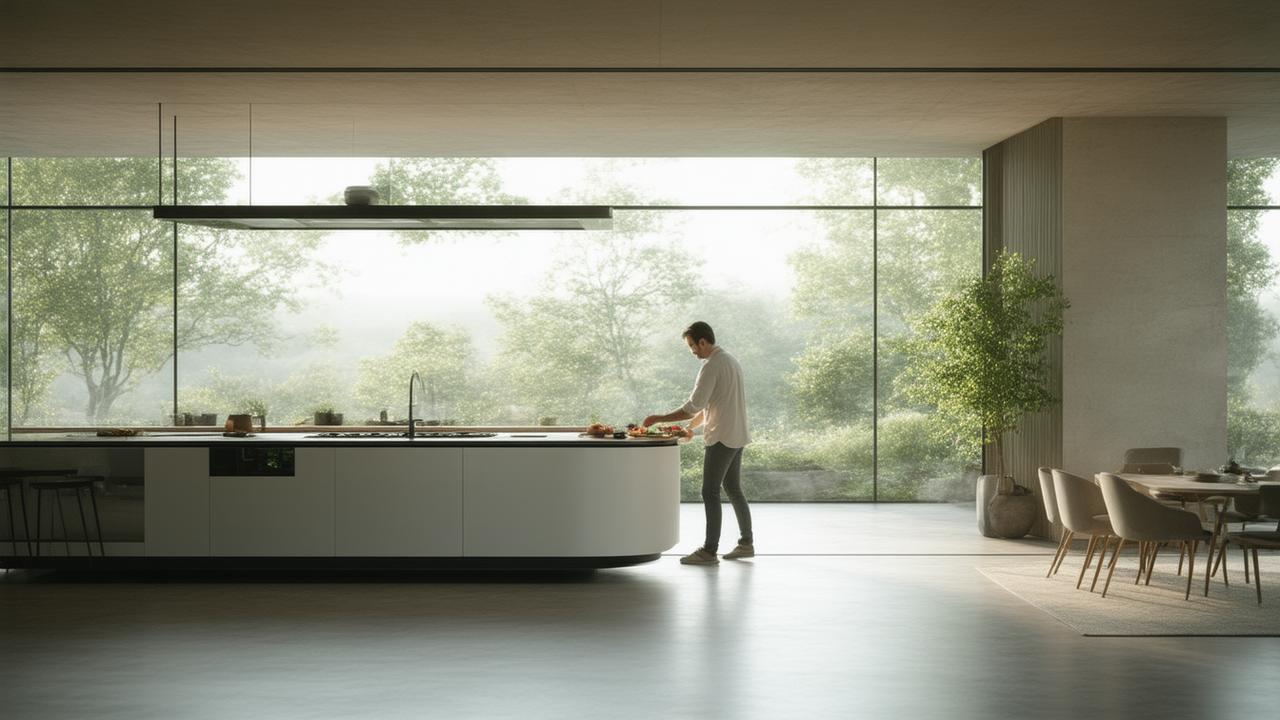
The first thing you notice is the emptiness. Not the hollow kind, but the calm kind—the kind you feel when you step into a room that finally has enough space to breathe. Where you once would have found a bulky kitchen island jutting into the room like a parked SUV, there’s now a long, low silhouette along the wall, a soft glow of under-counter lighting, and a strange, wonderful feeling: everything you need is right there, but nothing is in the way.
The Quiet Goodbye to the Kitchen Island
Step into almost any newly renovated home from the early 2010s, and you could predict the layout without even seeing it. Open-concept living area? Check. Shiny stone-topped kitchen island in the middle of the room? Absolutely. Barstools lined up like a diner counter? Of course.
For a long time, the kitchen island was more than a design choice—it was a status symbol. It said, “We have the space. We entertain. We belong in those glossy home magazines.” It became the command center of domestic life: homework spread across one end, dinner prep at the other, laptop open somewhere in between.
But by 2026, something quieter and more thoughtful has been taking its place. Designers and homeowners are saying goodbye to the oversized island and turning instead to a more graceful, more efficient solution: the kitchen peninsula and perimeter workstation—a return to the edges, the walls, the flow around the room instead of the blockage in the middle.
This isn’t a trend born of minimalism alone; it’s born of movement, of the way we actually live and cook. The kitchen island, for all its popularity, has slowly revealed its flaws: bottlenecked walkways, awkward corners, and a tendency to turn the kitchen into a crowded stage rather than a comfortable place to be. The new wave of 2026 design quietly asks: what if the best kitchen doesn’t show off, but simply lets you move?
The New Heart of the Kitchen: Perimeter Workstations & Peninsulas
In place of those big centered blocks, kitchens are starting to bend and hug the walls again. Imagine this: a long perimeter counter stretching along the main wall, soft wood or stone under your fingers, with deep drawers that glide open instead of clattering cabinet doors. To one side, instead of a squared-off island, a slim peninsula extends out like an outstretched arm—inviting you in, but not cutting the room in half.
The peninsula is one of the quiet heroes of this shift. Where islands stand alone, peninsulas connect. They link the kitchen to the living or dining area without demanding center stage. You can lean against one side with a glass of wine while someone chops vegetables on the other, and you both still feel part of the same space.
Along the perimeter, the “workstation” idea is reshaping how kitchens function. Instead of one all-purpose surface that has to do everything, the new designs carve the kitchen into specialized zones: a prep zone near the sink with built-in cutting boards and compost drawers, a cooking zone flanked by spice drawers and utensil storage, a baking zone with lower counter height for rolling dough comfortably, and a clean-up zone that isn’t in the direct path of everyone walking through.
All of this exists mostly at the edges of the room, clearing the center and opening sightlines. The room feels bigger, yet more intimate. You can walk in a smooth circle instead of playing a strange little dance around a big fixed block in the middle.
| Feature | Traditional Island | 2026 Perimeter & Peninsula Layout |
|---|---|---|
| Traffic Flow | Can create bottlenecks around corners | Open center, smoother circulation |
| Visual Impact | Large central block dominates room | Clean lines, airy sightlines along walls |
| Function Zones | One big multi-purpose surface | Dedicated zones for prep, cooking, baking, serving |
| Space Efficiency | Requires generous room all around | Works in smaller and medium-sized kitchens |
| Seating | Barstools facing one direction | Flexible seating along peninsulas or nearby nooks |
The Sensory Shift: How These Kitchens Feel to Live In
Stand inside one of these new 2026 kitchens and pay attention to the details. There’s a different soundscape. Without that central monolith to walk around, you don’t hear the scrape of barstools as often, or the clatter of bags and keys dumped on a single crowded surface. Instead, things seem to have a place to land.
You might notice the smell of coffee drifting from a slim, built-in beverage zone tucked along the wall, far from the cooking chaos. The light hits the room differently too. With the center floor cleared, natural light crosses from window to window unbroken, sliding along clean counters, reflecting off subtle hardware, bouncing gently off matte cabinet finishes.
The air feels looser. Conversations shift, too. Instead of everyone clustering shoulder to shoulder around one rectangle, people lean against different edges of the room, facing each other, rather than all lined up like an audience. Someone at the peninsula can talk easily with a person at the stove and another at the dining table. It feels less like a performance and more like a shared rhythm.
And then there’s the tactile pleasure. Deep drawers glide out, revealing carefully organized utensils, pots nested in soft dividers, mixing bowls stacked in pull-out shelves. The sink area might be framed by a raised lip that keeps water from splashing outward. The whole space whispers: you were considered when this was designed. Your hands, your steps, the way you turn from sink to stove to fridge—nothing is accidental.
The Practical Elegance Behind the Trend
Underneath the sensory experience is a strong current of practicality driving this 2026 shift. As more people cook at home, work from home, or blur the lines between the two, the need for a kitchen that actually works has replaced the urge to simply impress.
Removing or reducing islands solves a surprising number of daily irritations: strollers no longer jam against corners, guests don’t block the fridge while they linger at the bar, and the classic “triangle” of sink, stove, and fridge becomes smoother and less cramped. Cleaning, too, gets easier. Fewer edges in the middle means fewer places for crumbs to gather and less awkward shuffling around obstacles with a full trash bag or a hot pan.
Peninsulas and perimeter counters also tend to cost less than large, freestanding islands that require added electrical, plumbing, and structural support. For many homeowners, that difference gets redirected into better cabinetry hardware, higher quality surfaces, or integrated storage solutions—investments that quietly change day-to-day life instead of just changing the photos.
There’s elegance in the visual restraint as well. Lines are longer, cleaner, more architectural. A wall of continuous cabinets and counters can feel like tailored clothing: nothing bulky, everything fitting just right. In small and medium-sized spaces, this is transformative; in larger spaces, it turns what could be an echoing hall into a place that feels coherent, graceful, and grounded.
Why the Island Era is Ending—Without Disappearing Completely
It would be easy to declare the kitchen island dead, but that’s not the whole story. What’s really happening in 2026 is a rebalancing. The oversized, overbuilt, “see and be seen” island is fading, while slimmer, more intentional workstations along the edges and at one side of the room quietly take center stage—or, more accurately, take away the center stage.
In some homes, the island is being replaced completely by a peninsula and a nearby dining or breakfast nook. In others, a small, mobile prep table on hidden casters takes the place of a permanent block, adding flexibility rather than dominance. And in many new builds, what once would have been a giant square of stone is now a narrow, gentle arm that barely reaches into the room but offers just enough surface for a plate, a glass, a book.
The shift is also philosophical. The old island-first mindset assumed the kitchen should always act like the home’s social stage. The new perimeter-based designs recognize that sometimes you just want to cook, quietly, without an audience leaning on the counter three feet away. They allow for both—connection and privacy—without forcing either.
Designers are listening more intently to the lived realities of their clients: multiple cooks in one kitchen, neurodivergent family members who need calmer layouts, aging parents who require clear, unobstructed paths, kids who help with prep but also need somewhere soft and out of the way to sit and draw or snack. The solution isn’t a bigger island; it’s a smarter room.
How to Rethink Your Kitchen Without an Island
If you’re looking around your current kitchen and eyeing the island with suspicion, the good news is that this new 2026 trend is surprisingly adaptable. You don’t need a full gut renovation to bring some of this flow and practicality into your space.
Start with movement. Walk through your kitchen and notice where you naturally step. Where do you turn? Where do you bump into someone else? Mark those mental “collision points.” If your island is part of the problem, ask whether it could be downsized, reshaped, or replaced with a peninsula along one side. Sometimes removing just one segment creates an unexpected spaciousness.
➡️ Astronomers release stunning new images of the interstellar comet 3I ATLAS, captured across multiple observatories with unprecedented clarity
➡️ Once dismissed as a “poor people’s fish,” this affordable species is becoming a prized staple as Brazilians rediscover its safety and nutritional value
➡️ Plumbers reveal the half-cup household trick that clears blocked drains fast Plumbers reveal the half-cup household trick that clears blocked drains fast: without vinegar, baking soda or harsh chemicalswithout vinegar, baking soda or harsh chemicals
➡️ An old-style, no-name moisturizer has been crowned the number one choice by dermatology experts outperforming major brands
➡️ An exceptionally large African python is officially confirmed by herpetologists during a certified field expedition
➡️ Clocks will change earlier in 2026, bringing new sunset times that could significantly disrupt daily routines across UK households
➡️ At 2,570 meters below the surface, the military uncovers a record-breaking discovery that could reshape modern archaeology
Next, think in zones rather than surfaces. Could you designate one stretch of counter as your prep zone, with knives, cutting boards, and mixing bowls all within arm’s reach? Could the area around the oven become a true cooking station, with oils, spatulas, and pans directly underneath instead of scattered around the room? The perimeter layout thrives on this idea of dedicated stations, even within an existing kitchen.
Consider turning part of your island—if you keep it—into more of a peninsula or anchored element. That might mean attaching it to a wall or cabinetry run, or visually grounding it with a low hutch or open shelving above, so it feels less like a barrier and more like part of a flowing line.
And don’t underestimate the power of seating choice. Moving everyday seating away from the main prep surfaces—to a built-in bench along the wall, a small table near a window, or a slender overhang on a peninsula—can immediately shift your kitchen from “crowded stage” to “shared, flexible room.”
Beyond Fashion: A Trend That Might Actually Last
So many home design trends feel like they’re designed for photos rather than people. The move away from kitchen islands toward perimeter workstations and peninsulas feels different because it’s rooted in how bodies move, how families live, and how homes hum through the day.
It’s more practical, because it minimizes wasted space, prevents traffic jams, and emphasizes functional zones over one overcrowded surface. It’s more elegant, because it lets the room’s architecture breathe—window light, wall lines, cabinetry, and materials all have a chance to speak without one oversized block shouting in the middle.
Most of all, it’s already quietly reshaping modern interiors in a way that feels less like a fad and more like a correction. We tried the island as the star of the show. For a while, it felt thrilling. But now the spotlight is softening, and the beauty is drifting back to the edges: to the long counter under the window, to the slim peninsula that invites a conversation rather than a performance, to the small, well-considered corners where real life actually happens.
When you step into one of these new kitchens, the difference is subtle but unmistakable. You don’t feel the need to gather around a single point. You’re free to move, to pause, to lean wherever feels right. The room is not telling you where to stand; it’s quietly asking how you want to live—and then, gently, rearranging itself around the answer.
FAQ
Are kitchen islands completely out of style in 2026?
No. Islands aren’t disappearing, but oversized, central, and purely decorative islands are fading. The trend is shifting toward slimmer, more functional layouts that prioritize flow, often using peninsulas and perimeter counters instead.
What is replacing kitchen islands in most new designs?
Perimeter workstations and peninsulas are becoming the new backbone of kitchen design. They hug the walls, open up the center of the room, and create dedicated zones for prep, cooking, baking, and serving.
Is this trend suitable for small kitchens?
Yes, especially for small and medium kitchens. Removing a bulky island or avoiding one altogether often makes the room feel larger, more navigable, and less cluttered, while still providing generous work surfaces along the edges.
Can I keep my island and still follow this 2026 trend?
Absolutely. Many homeowners are slimming down their islands, turning them into peninsulas, or redefining them as secondary workstations while focusing more design energy on functional perimeter zones.
Is a perimeter-focused layout more expensive than an island?
Not usually. Large islands can require extra structural support, electrical, and sometimes plumbing. Perimeter-focused layouts often allow you to invest the same budget into better storage, hardware, and materials rather than sheer size.
Will this design still feel good for entertaining?
Yes, but in a different way. Instead of crowding everyone around one large block, guests can gather more naturally around peninsulas, nooks, and adjacent dining areas, creating a calmer, more comfortable flow.
How do I know if my kitchen would benefit from losing the island?
If you frequently bump into others, struggle with tight walkways, or rarely use the full surface of your island, your space might benefit from a perimeter-focused layout or a slimmer peninsula that opens the center of the room.





