The first sound is not a hiss. It is the rasp of dry grass parting, a low hush that brushes the ankles of the scientists as they move through the late-afternoon heat. Somewhere ahead, a francolin bursts into the air, its frantic wings clapping against the silence. The sun hangs low and burnished over the African savanna, turning dust into gold. No one speaks. Every eye is on the narrow game trail snaking between the termite mounds, on the promise—half rumor, half legend—that something impossibly large lives out here, sliding unseen through the world.
The Rumor in the Grass
The first stories sounded like any other campfire exaggeration. A python “as thick as a man’s chest,” villagers claimed. A snake that stole goats in a single, greedy swallow and left drag marks in the soil like a fallen tree. Local herders said it moved at night, a living shadow along the river, longer than a pickup truck and twice as unsettling. For years, herpetologists heard these tales, smiled politely, and wrote them off as the familiar dance between fear and imagination.
But two things changed the tone of the conversations. First: the tracks. In the damp mud along a shallow oxbow, a team of field researchers found a sweeping belly drag wider than any python mark they’d ever documented in this region. Second: a blurred but telling image from a camera trap, meant for monitoring leopards, that captured something coiled at the frame’s edge—just the midbody of a snake, and yet thick as an elephant’s foreleg.
It was enough to turn rumor into hypothesis and hypothesis into a funded expedition. Permits were prepared. Measuring gear, scales, radio transmitters, and humane restraint tools were packed into dust-covered trucks. Local guides, who knew every secret bend in the river, were hired. And under a pale pink dawn, a team of herpetologists set out to see if the stories of an extraordinarily large African python were grounded in scales and muscle… or in myth.
The Day the Legend Took Shape
The heat had become the kind that hums against your skin when the first real sign appeared. One of the local guides, a lean man named Kabelo, lifted his hand, fingers splayed, and dropped into a crouch. Just ahead, in a patch of flattened grass, something had fed recently. There were feathers—dappled, dark, and torn—and the heavy, unmistakable imprint of a body that had lain there, coiled and patient, waiting for the right moment.
“Sekgoma,” Kabelo murmured, using a local name that loosely translates to “the great one that crushes.”
A faint, musky scent hung in the air, old reptile and damp earth, the kind that sticks at the back of the throat. The team fanned out quietly, moving with the wary, deliberate care of people who know that the animal they seek is not merely long, but strong enough to rearrange the destiny of any creature it decides is food—or threat.
When they finally saw her, the world briefly shrank to the space between two termite mounds. At first, she looked like nothing more than a fallen log shaded in dappled brown. Then, her flank moved, a slow flexing wave beneath a pattern of chocolate and olive blotches. Head lifted slightly, tongue tasting the air, she watched them from the shadow of scrubby bushes. Her eyes, a deep, liquid bronze, reflected nothing of human curiosity back—only calculation.
“Good Lord,” one of the researchers whispered, not as an exclamation, but as a quiet, almost reverent acknowledgment. You could feel the weight of her in the ground, in the stunned air, in the sudden, shared realization that the stories had undersold her.
Measuring a Monster
Confirming the size of a python in the wild is not a swashbuckling moment of triumph; it is a careful, methodical, and deeply respectful process. The team had rehearsed it in their minds for days. They waited, letting her settle. No one rushed. An animal this large, if stressed, could injure herself or the people around her. Time, they reminded themselves, was a tool.
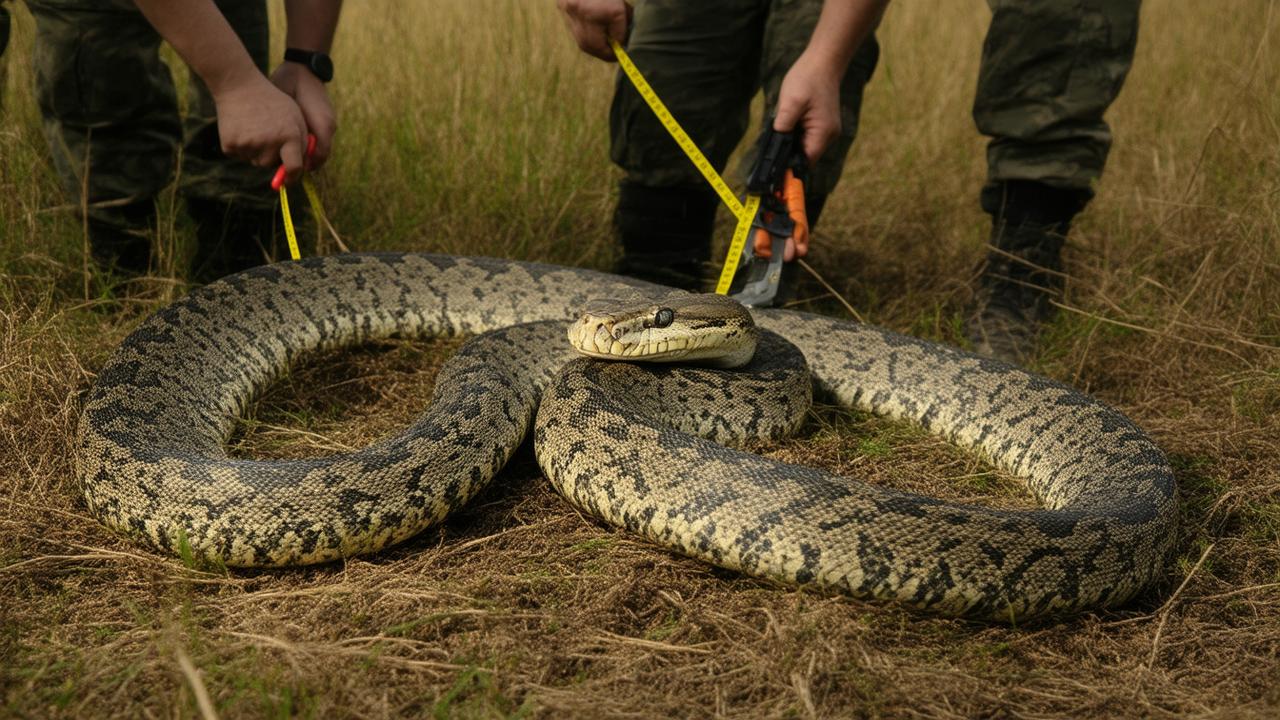
Gradually, and with the practiced choreography of people who understand their place in the food chain, they moved into position. Two experienced handlers gently secured her head using padded hooks and firm, calm hands. Others worked along her body, keeping her supported to prevent injury to her spine or muscles. It took nearly all of them to lift and align her along a specially marked fabric tape, the kind used for field measurements of large reptiles.
Her body felt like living stone: cool at first touch, then subtly warm, a slow furnace under layers of muscle and scale. When she tightened slightly in protest, everyone felt it—a dense, unhurried strength, the sort that does not need to boast. Her heartbeat, faint but steady, pulsed under skin patterned with evolutionary perfection.
The callout of numbers came in a clipped, professional voice that tried and failed to hide its excitement. From the blunt, wedge-shaped head to the tip of the tail, the measurement stretched longer and longer across the tape, spilling past the marks they expected.
“Four-point-nine,” the lead herpetologist read aloud. “Four point nine meters.”
A murmur rippled through the team. That’s over sixteen feet of snake.
Her girth at midbody was measured next: an astonishing circumference that testified to well-fed success in this ecosystem. Weight estimation, done as safely and briefly as possible, confirmed what their eyes already knew—this was not just a large python. This was one of the largest African pythons officially recorded in the region by a certified field expedition.
| Measurement | Value | Notes |
|---|---|---|
| Total Length | 4.9 meters (approx. 16.1 ft) | Measured snout-to-tail using calibrated field tape |
| Midbody Girth | Over 70 cm circumference | Recorded at widest point of torso |
| Estimated Weight | 60–70 kg (132–154 lbs) | Calculated from girth and segment sampling |
| Species | African rock python (Python sebae) | Confirmed by scalation and patterning |
| Sex | Female | Larger average size consistent with females |
Numbers, in a notebook, are one thing. Numbers wrapped around your arm like a living boulder are another. As they completed their records, tiny details etched themselves into memory: the matte shimmer of each scale, the faint scar near her tail hinting at an old encounter with something bigger or braver than most. A life story, written in texture.
Why This Giant Matters
It is easy, in the adrenaline of such a moment, to think only of size. But to the herpetologists kneeling in the dust, brushing sweat from their eyes, this python was more than a marvel for the record books. She was ecological evidence. A snake this large does not appear out of nowhere; she is the end result of years—decades, perhaps—of successful hunting, safe refuges, and a food web that still (just barely) works.
Apex or near-apex predators like African rock pythons are living barometers of ecosystem health. They regulate populations of rodents, small antelope, birds, and sometimes even other predators. Their absence can mean an explosion of prey that ravages crops, spreads disease, and unravels the quiet balance of the wild. Their presence, especially in robust sizes and numbers, hints that the old rhythms of predator and prey still beat beneath the human noise.
“Finding an individual like this tells us the system can still support giants,” one researcher explained later. “She is not just a large snake. She is proof that there are still pockets where nature is allowed to grow to its proper scale.”
For local communities, the implications are more complex. A massive python near villages can stir old fears and fresh anxieties. Goats and chickens are valuable. Children walk along these paths. The team knew that any conversation about conservation had to include the people who share this land, who read its signs as fluently as they read their own stories.
Between Fear and Respect
That evening, under a sky spattered with impossible stars, the scientists and villagers sat around a fire, the air thick with smoke and wood and the far-off grunts of hippos on the river. Kabelo spoke quietly about the python, and the elders listened. Some smiled; they had grown up with tales of snakes large enough to swallow men, creatures that blurred the line between animal and spirit.
“You see her as data,” an elder woman said, her voice cracking with age and authority. “We see her as a warning and a blessing. If such a big one still lives here, then not everything is broken yet.”
➡️ Astronomers release stunning new images of the interstellar comet 3I ATLAS, captured across multiple observatories with unprecedented clarity
➡️ Once dismissed as a “poor people’s fish,” this affordable species is becoming a prized staple as Brazilians rediscover its safety and nutritional value
➡️ Goodbye to kitchen islands: the 2026 home design trend replacing them is more practical, more elegant, and already reshaping modern interiors
➡️ Plumbers reveal the half-cup household trick that clears blocked drains fast Plumbers reveal the half-cup household trick that clears blocked drains fast: without vinegar, baking soda or harsh chemicalswithout vinegar, baking soda or harsh chemicals
➡️ An old-style, no-name moisturizer has been crowned the number one choice by dermatology experts outperforming major brands
➡️ Clocks will change earlier in 2026, bringing new sunset times that could significantly disrupt daily routines across UK households
➡️ At 2,570 meters below the surface, the military uncovers a record-breaking discovery that could reshape modern archaeology
The conversation wandered—how to protect livestock, where children should avoid playing, what to do if another sighting occurred. The team shared their findings, and in return, villagers offered their own: old nesting hollows where snakes liked to curl in the dry season, stories of egg-laying in termite mounds, anecdotes about how the behavior of birds could betray the presence of something serpentine and secretive below.
It was, in its own way, another form of measurement. Not of length or weight, but of coexistence. How much wildness can a landscape hold while still cradling human lives? How many legends can we allow to stay alive?
Letting the Giant Go
The Python was released exactly where she’d been found, under the muted, amber light of the slipping afternoon. There is an art to giving a wild animal back to the wild as gently as you borrowed it. The hands that had held her now slipped away, one after another, until it was just her and the grass and the unblinking sky.
For a moment, she paused, a single massive coil resting in place. Then, with an economy of movement that bordered on arrogant, she flowed forward, body unspooling in loops of rippling muscle. In seconds, she was half-hidden. In less than a minute, she was gone, swallowed by thickets and shadow, reduced once more to rumor and track, to the occasional flash of patterned scales against sunlit dust.
The team packed their instruments, but they carried a new weight now—a responsibility to translate what they had seen into something that might outlive the fading echoes of this field season. Data would be analyzed, reports written, species accounts updated. The record of an exceptionally large African python, confirmed by herpetologists during a certified field expedition, would enter the quiet halls of scientific literature.
Yet the truest record would remain here, imprinted in the landscape and in the stories people told when the sun went down and the bush grew loud again. Somewhere out there, she would keep hunting, keep growing, her presence bending the world subtly around her.
Questions Coiled in the Dark
As the trucks rolled away, trailing dust into the violet horizon, a question lingered in the minds of everyone who had stood within an arm’s length of that enormous, pulsing body: How many more giants are left, unseen and unmeasured, holding the last wild angles of the world in their slow, patient coils?
In a time when so much of the planet is shrinking—forests, rivers, species lists—it feels almost subversive to encounter an animal that defies smallness, that insists on existing at a scale we once took for granted. The giant python is not a relic, not yet. She is a reminder. That there are still places where the grass parts for something older than our fences, older than our borders. That, for now, if you move quietly enough and listen carefully to the hush in the reeds, you might slip into a story where the wild is still allowed to be large.
FAQ
Is this the largest African python ever recorded?
No. While this individual is exceptionally large and among the biggest officially documented in this region, some African rock pythons have historically been reported at over 5 meters. Reliable, certified measurements of such extremes are rare, which makes this confirmed 4.9-meter specimen scientifically valuable.
Are African rock pythons dangerous to humans?
They can be. Large individuals are capable of injuring or, in very rare circumstances, killing a person. However, most incidents occur when snakes are cornered, harassed, or handled improperly. In general, they avoid humans when given space and respect.
What do such large pythons typically eat?
Big African rock pythons may prey on medium-sized antelope, warthog piglets, large birds, monkeys, and domestic animals like goats or poultry near villages. They are ambush predators, relying on camouflage and explosive power rather than pursuit.
How do scientists safely measure such a large snake?
Researchers use trained handlers, padded hooks, and coordinated restraint to minimize stress and prevent injury. The snake’s body is fully supported while a flexible measuring tape is run along the spine from head to tail. All handling is done as quickly, quietly, and gently as possible.
Why not move the python away from nearby villages?
Relocation is risky and does not always solve conflicts. Pythons have home ranges and may attempt to return, or another predator may simply take their place. Instead, scientists and communities often work together on practical measures—like securing livestock at night and avoiding known snake habitats—to reduce conflict while keeping the ecosystem intact.





