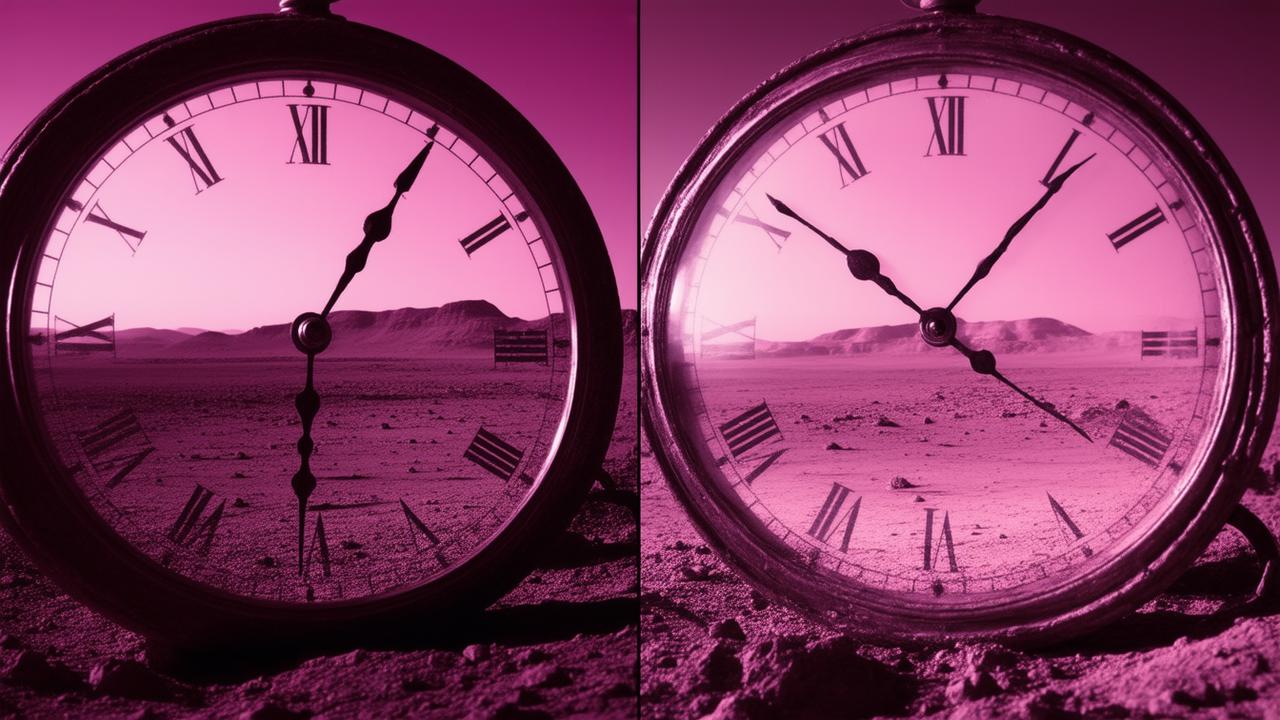
The first clock on Mars didn’t tick the way it was supposed to. At least, that’s how it felt to the engineers huddled around their glowing monitors in the dim mission control room on Earth. A few microseconds here, a fraction of a second there—nothing your body could sense, nothing your eyes could see. And yet, it was real. Time, the most constant thing we think we know, was quietly misbehaving on the red planet. Einstein, who once imagined riding alongside beams of light, would not have been surprised. He predicted this strange bending and stretching of time a century ago. Mars has now turned his equations into a lived reality, and future explorers will have to learn to live inside that warped flow.
The Planet Where a Day is Not Quite a Day
To understand what’s happening on Mars, you have to start with something deceptively simple: a “day.” On Earth, we feel it as sunrise, commute, lunch, sunset, sleep. A 24‑hour rhythm woven so deeply into our biology that it feels like part of who we are. On Mars, that rhythm stutters and shifts.
A Martian day, called a sol, lasts about 24 hours, 39 minutes, and 35 seconds. It sounds trivial—just under 40 extra minutes. But imagine going to sleep at 10 p.m. Earth time every night, and each evening your bedtime slides 40 minutes later. One week in, you’re wide awake at 3 a.m. Another week, and your internal clock is colliding with noon in a haze of fatigue. That’s what early Mars mission teams on Earth actually did: they lived on “Mars time,” their watches and schedules gradually spinning free from the rest of humanity.
Even before we bring Einstein into the room, Mars asks us to renegotiate our relationship with time. Every landing, every rover drive, every data transmission is stitched around sols instead of days. But behind that obvious difference lies something stranger: the planet itself is sitting in a slightly different current of spacetime than Earth.
Einstein’s Clockwork Universe—That Never Really Ticks Evenly
Einstein’s theory of relativity is easy to summarize and hard to truly feel: time is not universal. It changes depending on gravity and motion. Stronger gravity slows time down. High speeds stretch it. Put two identical clocks in different places—one high in orbit, one on the surface of a massive planet—and they will slowly drift out of sync. Not because of a mechanical failure, but because their reality is different.
Earth’s gravity already plays this trick. GPS satellites tick slightly faster than clocks on the ground because they’re farther from Earth’s gravity well and zipping around at high speed. If we didn’t constantly correct for relativity, your navigation app would be lost by kilometers within a day.
Mars joins this subtle cosmic game with its own twist. It’s smaller and less massive than Earth, which means its gravitational grip is weaker. And that means: time on Mars runs just a tiny bit faster than it does on Earth. Not by something you’d ever perceive in a single human lifetime, but by enough that our most precise instruments care deeply. Mars is, in a sense, a planet where the universe breathes just a hair more quickly.
| World | Length of Day | Surface Gravity | Time Flow vs Earth* |
|---|---|---|---|
| Earth | 24 hours | 1 g | Reference (0 difference) |
| Mars | 24h 39m 35s | 0.38 g | Runs slightly faster |
| High Mars Orbit | N/A | Weaker than surface | Runs faster still |
| *From the perspective of precise atomic clocks; not noticeable in daily life, but critical for navigation and communication. | |||
The Moment Mars Proved the Equations Right
In the quiet hum of a deep-space tracking station, a stream of numbers arrived from a spacecraft skimming past Mars. They weren’t dramatic. No breaking news. Just timing signals, ranging measurements—light traveling between antennas and a distant robotic explorer. Yet buried inside those signals was the slow heartbeat of relativity itself.
Mission planners had to know, down to the nanosecond, how long it took a radio signal to leave Earth, reach the spacecraft or rover, bounce back, and return. Distances of millions of kilometers demand that level of precision. When they compared expected values—based on Newton’s older, “flat” universe—to the actual data, a pattern emerged. Minuscule discrepancies, entirely consistent with Einstein’s warping of spacetime, appeared in the way Mars and its orbiting sentinels kept time.
The difference wasn’t a surprise. It was a confirmation. Just as Earth’s GPS system silently obeys relativity, the time systems around Mars now must as well. Clocks on orbiters and landers are adjusted to account for where they sit in Mars’s gravitational field and how fast they’re moving. Even the very shape of the light’s journey is bent by the gravity of the Sun and the pull of Mars.
In the sterile language of mission reports, you’d see references to “relativistic corrections,” nothing poetic, nothing emotional. But take a step back, and there’s something deeply unsettling—and beautiful—about it: the clocks we send to Mars do not agree with the clocks in our pockets on Earth, and it’s not a malfunction. It’s the universe exposing one of its core secrets.
Living on a Planet Where Your Clock is Lying
Imagine standing on a wind-scoured Martian plain, the sky a thin, burnt orange. The Sun crawls across the horizon more slowly than you’re used to, your shadow stretching strangely over the dust. You raise your wrist. On it, a hardened digital watch, synced to a network of satellites that purr silently overhead. That watch is capable of extraordinary precision—but precision is suddenly not enough.
On Mars, a “second” measured by your wristwatch and a “second” calculated by mission control on Earth are cousins, not twins. For early robotic explorers, that misalignment was handled quietly in the background by software and system updates. For future human crews, it becomes something more intimate.
Daily routines will be written in sols, not days. Calendar apps will juggle Earth Coordinated Time, Mission Elapsed Time, and local Mars time zones. A call to a loved one on Earth might happen at what feels like your late Martian evening, but appears as mid-morning on the blue planet hanging invisibly beyond the sky.
The deeper implication lies in navigation and safety. If a crewed rover is racing a dust storm to shelter, and orbiters above are tracking its path, every calculation relies on knowing not just where everything is, but when everything is, in a universe that refuses to keep a single universal beat. Relativity isn’t a physics lecture; it’s the thread holding together life-support systems and return trajectories.
The Future Space Missions That Must Bend with Time
As we trade brief robotic visits for sustained human presence, Mars stops being a distant target and starts becoming a world with its own infrastructure—its own internet, its own navigation, its own rhythms. And those systems will have to be built from the ground up with Einstein baked in.
Picture a future Mars: orbiters forming a GPS-like constellation, surface habitats scattered across crater rims, autonomous drones buzzing above canyon cliffs. Every one of these machines carries a clock. Every clock drifts, not only from age and temperature, but because of relativity: altitude, speed, and gravity subtly sculpt their ticking.
Engineers already compensate for this on Earth, but Mars introduces new layers: a weaker gravitational field, a longer day, different orbital speeds, a new web of communication relays stretching between planets. The more independent Mars becomes, the more it will choose its own temporal language. Earth time will be an accent, not the default.
Planning long-duration missions now means asking: how will we synchronize time between an Earth-based control room, a crew in orbit, and a team on the surface whose bodies are adjusting to a 24.6‑hour day? How will financial transactions, scientific logs, medical doses, and emergency responses line up across a gulf where even the definition of “now” is slippery?
It sounds abstract—until a spacecraft has to fire its engines during a narrow gravitational slingshot window, or a base must shut an airlock during a sudden storm. Then, the math of relativity becomes as practical as a pressure gauge.
A Human Body Caught Between Two Clocks
There’s another layer beneath the physics and electronics: us. Our internal clocks are not designed for Mars. Here on Earth, our circadian rhythm hums at just over 24 hours. It’s a fragile “agreement” between biology and planet, negotiated through billions of sunrises and sunsets. On Mars, that contract is ripped up and rewritten.
In those early mission control rooms, when teams lived on Mars time, people reported feeling permanently jet-lagged as their workdays drifted around the clock. Now imagine actually living under that foreign sky, your bedroom window filled with a landscape that shifts colors in a thinner atmosphere, your mealtimes slowly spiraling away from Earth-based schedules.
➡️ Nightlife venues are adjusting as sober socialising becomes a mainstream choice
➡️ Farmers are experimenting with regenerative grazing to rebuild soil after decades of depletion
➡️ Ocean chemistry data is pointing to faster acidification along sensitive marine habitats
➡️ Fashion labels are returning to wool as demand grows for durable climate smart fabrics
➡️ Archaeologists are returning to old shipwreck sites with new imaging technology
➡️ Households are embracing minimalism as rising costs challenge traditional consumer habits
➡️ Space startups are expanding beyond satellites as deep tech exports gain momentum
Over months and years, that extra 39 minutes per sol will pull your waking hours into strange alignments with Earth. You might be making coffee at what—on Earth—would be the middle of the night. Your child back home might be walking to school while outside your Mars habitat, the stars are sharp and fierce in the cold darkness.
In a way, Mars will teach us that “time zones” are no longer slices of a single planet, but different branches of reality. Earth time, Mars time, ship time on the voyages in between—all slightly out of step. Our species will have to carry multiple times in our heads and hearts at once.
Einstein’s Shadow Across the Red Planet
When Einstein described spacetime as a kind of fabric, curved and twisted by mass and energy, he was thinking in chalk lines and thought experiments. He probably didn’t picture dust devils spiraling across a Martian plain, or astronauts checking synchronized clocks before a hike along the rim of Valles Marineris. Yet that’s where his ideas are leading us.
Every confirmation from Mars—from the way signals arrive a whisper off from Newtonian predictions, to the slow drift of clocks in orbit and on the surface—is another brushstroke in a grand cosmic painting he started. Mars doesn’t just sit there, a cold red rock; it actively reshapes the flow of time. Slightly. Subtly. But enough that our species must notice, and must adapt.
In our lifetimes, we are witnessing something extraordinary: the transition from treating other planets as remote destinations to experiencing them as places with their own rules of existence. Gravity feels different. The sky looks different. And now we must admit: time itself behaves differently, too.
Someday, a child may be born in a Mars habitat, their first breath drawn in recycled air under a faint salmon dawn. For them, a sol will not be a curiosity; it will simply be a day. The slight speeding up of time compared to Earth—from the viewpoint of an atomic clock—will be as invisible and irrelevant to their feelings as the spin of galaxies is to our morning coffee.
And yet, in the background, every message home, every interplanetary journey, every shared holiday between worlds will be gently choreographed by Einstein’s equations. It will be as though his ghost walks with us across the red sands, smiling faintly as our instruments, our ships, and eventually our cities learn to live inside his peculiar, beautiful universe.
Time, we are discovering, is not a universal river flowing evenly through all worlds. It is more like a branching delta, each planet its own channel, each clock its own little boat. Einstein charted the map. Mars has now underlined one small, stunning truth on it: leave Earth, and you do not just go to another place—you step into another tempo.
Frequently Asked Questions
Does time really flow differently on Mars than on Earth?
Yes, but the difference is extremely small. Because Mars has weaker gravity than Earth, time passes slightly faster there according to relativity. The effect is measurable with precise clocks, but not noticeable to a human being in daily life.
Is the longer Martian day caused by relativity?
No. The longer Martian day (a sol) is due to how fast Mars rotates on its axis, not relativity. Relativity affects the rate at which time flows, whereas the length of a sol is simply how long Mars takes to spin once.
Why do space missions need to care about these tiny time differences?
Navigation, landing, and communication all depend on highly accurate timing. Even tiny relativistic time shifts can add up to large errors over interplanetary distances. Correcting for relativity keeps spacecraft on course and mission data reliable.
Will people living on Mars feel “out of sync” with Earth time?
They won’t feel relativity itself, but they will feel the different length of a sol. Daily schedules, sleep cycles, and work shifts will be tuned to the 24.6‑hour Martian day, which will gradually drift relative to Earth clocks.
How will future Mars colonies keep time?
They will likely use a local Mars time system based on sols for everyday life, along with coordinated standards that translate between Mars time and Earth time for communication, navigation, and interplanetary operations. Multiple time references will coexist, all adjusted using Einstein’s relativity.





