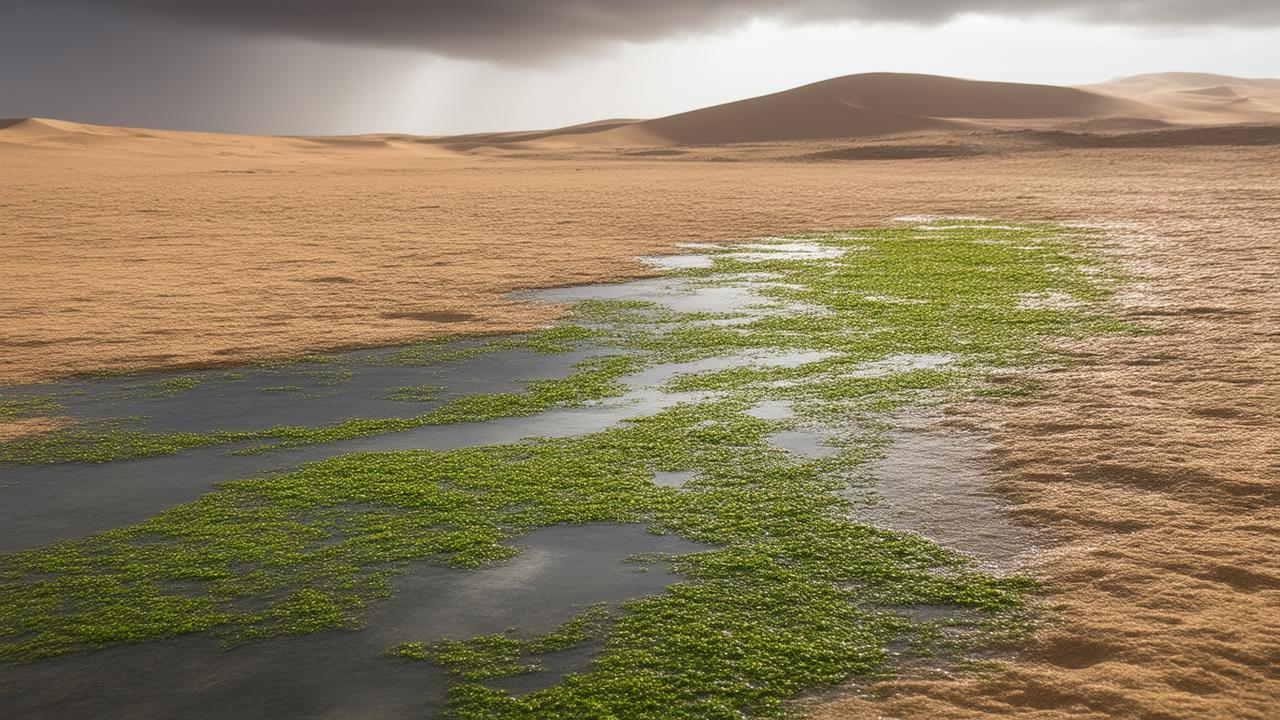
The air above the central Sahara just before dawn feels strangely heavy, like the breath the world takes right before speaking. There is a smell too—faint, metallic, unfamiliar. For generations, this hour has belonged to silence: wind combing through dunes, the distant shuffle of a nomad’s camel, the crackle of cooling stone. But in this imagined dawn, something else arrives. A sound people here are not used to hearing very often. A sound that, in other parts of the world, is almost ordinary.
Rain.
At first just a hesitant tapping on tent cloth and corrugated roofs, then a bolder drumming on sand that has rarely known such intimacy with water. Children, half-asleep, stumble outside, faces upturned. The dunes darken, swallowing the falling sky. The desert, long defined by absence, flirts with abundance. This is what new research suggests could become far less rare: surges of rainfall sweeping across one of Earth’s driest regions.
Yet for all the joy in that first cool downpour, there’s an unsettling question hanging in the charged air: What happens to a continent when the Sahara, the great desert that shapes its winds, its seasons, its migrations, begins to change?
The Desert That Holds a Continent Together
It’s easy to think of the Sahara as empty—a blank, beige void between the lush Mediterranean north and the greener belts of central and southern Africa. But deserts are not nothingness; they are engines, and the Sahara is one of the most powerful on Earth.
Hot air rising off its pale sands helps drive atmospheric circulations that ferry moisture north and south. Dust lifted from its surface travels across the Atlantic, dropping nutrients into Amazonian soils and the Atlantic Ocean, like a ghostly transoceanic fertilizer service. The Sahara’s vast heat reservoir shapes the West African monsoon, nudging rain clouds toward or away from the Sahel—the slender, semi-arid strip that runs like a scar across the continent’s middle.
When the desert bakes, it strengthens pressure gradients that help pull in moist air from the Gulf of Guinea. When it cools more than usual, the whole machinery can stumble. Too much or too little rain in the Sahel, and life there trembles. Crops fail or flood, livestock weaken, rivers withdraw or roar. Stability in Niger, Mali, Chad, Sudan, and beyond is stitched with threads of seasonal rainfall patterns that are already fraying under climate change.
Now, some climate models suggest another twist: the possibility of excess rainfall over and around the Sahara in coming decades, as warming oceans and shifting jets deform old patterns. Excess, in a place built around scarcity, might sound like a gift. But deserts, like people, don’t always respond well to sudden abundance.
The Sahara That Once Was Green
To understand what might come, scientists often look back. The Sahara, after all, has not always been a sandy colossus. Between roughly 14,000 and 5,000 years ago, large parts of it were green—sprinkled with lakes, grasslands, and savannas. This period, sometimes called the “Green Sahara” or African Humid Period, was a radically different world.
Fossil pollen trapped in ancient lake mud tells of grasses, shrubs, and woodland replacing bare sand. Stone tools, rock art, and bones show that hippos, elephants, giraffes, and even crocodiles lived where only dunes stand today. People fished in lakes in what is now northern Chad. They left behind images of cattle, boats, and spirals of swirling figures that might have watched the same storms sweep across a wetter sky.
That transformation was driven by subtle wobbles in Earth’s orbit that strengthened the African monsoon, tugging more moisture northward. Vegetation fed back into the system, darkening the land, helping pull in yet more rain. A positive feedback loop of greening and wetting took hold—until the orbital configuration weakened the monsoon and the system collapsed back into aridity over a few thousand years.
Today’s climate change is different. We are not gently leaning into a new orbital phase; we are jolting the atmosphere with greenhouse gases, upsetting oceans, and rearranging winds at a much faster pace. Yet the echoes of that ancient green Sahara matter. They show that this desert is not fixed. They whisper that under the right (or wrong) conditions, rain can reshape one of our planet’s most iconic landscapes.
When Too Much Rain Becomes a Problem
Rain in a dry place is not always salvation. In the Sahel, communities are already grappling with a paradoxical new reality: longer dry spells punctuated by more violent downpours. Instead of gentle, soaking rains, storms now arrive like hammer blows.
When intense bursts of water strike soils that have hardened under chronic dryness, the ground often refuses to absorb it. The water runs, fast and angry, carving gullies, tearing out crops, sweeping away the thin skin of fertile topsoil that farmers depend on. Villages perched along wadis—usually dry streambeds—have watched them explode into sudden, churning torrents that sweep through homes in the dead of night.
Now imagine that pattern stretched northward. A wetter Sahara does not necessarily mean a lush, gentle rebirth. It might mean more frequent, more powerful storms rolling over land unprepared to hold them. It could spike flash floods in places with little infrastructure, wash out the fragile trackways that serve as roads, rearrange dunes in chaotic ways.
For pastoralists who guide camels, goats, and cattle along routes honed over generations, the transformation of desert into seasonal scrub might scramble everything. New water points might appear in unexpected places; old routes might become impassable. Ticks, mosquitoes, and other disease carriers might follow the damp, bringing health threats to people and animals unaccustomed to them.
Even beneath the surface, change would ripple. Greater rainfall could recharge ancient aquifers more quickly—or, in some regions, disrupt the delicate balance that has preserved fossil groundwater for millennia. Wells might become more plentiful in some areas, and contaminated in others. In a continent where water already triggers conflict, shifts in where and when it appears are not just environmental questions; they are political ones.
Upsetting Africa’s Fragile Balance
Across Africa, the Sahara is not a boundary so much as a massive hinge between very different worlds. To the north, Mediterranean climates, coastal cities, and long-settled farmland. To the south, the Sahel’s fragile mosaics of millet fields, sorghum, acacia, and scrub, giving way to richer savannas and forests. Any large-scale rearrangement of rainfall over the Sahara risks nudging that hinge out of place.
The West African monsoon is especially sensitive. If excess rainfall over the Sahara changes surface temperatures and pressure patterns, it could shift the monsoon’s reach—dragging rain belts northward or pushing them back toward the equator. Croplands in the Sahel might swing suddenly from drought risk to flood risk. Regions that have slowly adapted to marginal rainfall could find themselves overwhelmed, while others, accustomed to seasonal abundance, might dry out.
Food security, already precarious in many parts of the Sahel, could worsen. A farmer who plants millet based on a half-remembered calendar of “normal” rains might watch their field drown under a late-season deluge. A herder who once moved south in search of pasture might instead face unexpected fodder in the north—but also new competition from others racing to claim that grass.
Migration routes—of both humans and wildlife—would twist and fray. Wildlife that clings to life along the Sahara’s southern and northern edges might find new refuges in emergent wetlands or grasslands, or might be stranded as habitats shift faster than they can move. People already forced to leave villages by desertification could face a new set of pressures: flood damage, unstable soils, waterborne disease, or resource-driven clashes in newly “green” zones.
And beyond Africa, a remade Sahara could echo through the global climate. Changes to its dust emissions—those veils of fine particles blown into the sky—might alter how much sunlight the Atlantic absorbs. That, in turn, could ripple into hurricane patterns, European heatwaves, and even rainfall in the Americas. A wetter Sahara is not just Africa’s story; it is a global subplot in the climate narrative we are all writing together, often without meaning to.
A Landscape Caught Between Past and Future
Scientists trying to forecast these changes are essentially doing detective work in a room where the clues keep rearranging themselves. Climate models suggest that as greenhouse gases rise, certain patterns—warming seas, shifts in the jet stream, altered land-atmosphere feedbacks—could raise rainfall over parts of the Sahara and the Sahel. But exactly where, when, and how much remains shrouded in uncertainty.
Some scenarios hint at a partial return of patchy grasslands and seasonal lakes in central and northern regions. Others point to more modest increases, focused along the desert’s southern rim. Observations already show that in parts of the central Sahel, rainy seasons have become shorter but more intense, concentrating annual rainfall into fewer storms. If similar dynamics expand northward, the Sahara’s character might not so much “flip” to green as blur into something new: a desert pocked with transient flushes of life and sudden, erosive rage.
For communities on the ground, the details of these projections matter less than the visible drift of the seasons. Rains arriving later, or all at once. Winds that feel strange. Old stories that no longer match the sky. In this sense, the Sahara stands at a crossroads between its memory of greenness thousands of years ago and an uncertain, human-heated future.
➡️ This small adjustment helps reduce the feeling of bodily overload
➡️ What it means psychologically when you avoid talking about yourself, even when asked
➡️ I noticed my stress dropped once my cleaning goals became realistic
➡️ This is how to show interest without forcing enthusiasm
➡️ The one breathing mistake most people make daily without realizing it affects their stress levels
➡️ Why doing one task at a time is healthier than multitasking
➡️ I realized my cleaning system was built for a life I don’t live
To navigate that crossroads, scientists and local knowledge keepers are beginning to speak more. Satellite data meets oral history. Rain gauges meet proverbs. Farmers and herders, who know the tilt of a cloud’s shadow and the way certain birds call before a storm, carry a different kind of climate archive. Together, these perspectives might help anticipate where water will gather, which lands will destabilize, and how best to adapt.
Some adaptation ideas sound like science fiction—managed “greening” corridors to stabilize soils, strategic reforestation or shrub planting to guide moisture patterns, redesigning settlements to live with floods rather than vainly resist them. Others are simpler: rebuilding traditional rainwater harvesting systems, protecting seasonal wetlands, securing land rights so that people can adjust their use of shifting landscapes without being pushed aside.
Numbers Behind the Shifting Sky
Amid the sensory swirl of thunderheads and dust storms, numbers quietly tell their own story. They are blunt, imperfect, but revealing. Here is a condensed snapshot of how a wetter Sahara could sit within Africa’s already fragile context:
| Aspect | Current Situation | Potential Impact of Excess Rainfall |
|---|---|---|
| Rainfall Patterns | Highly variable; Sahel marked by droughts and short intense storms | More frequent heavy downpours, possible northward extension of storm tracks |
| Agriculture | Rain-fed, vulnerable smallholder systems dominate | Flooded fields, soil erosion, shifting viable crop zones, new opportunities in some areas |
| Pastoralism | Long-distance seasonal migrations following scarce pasture | New grazing grounds, altered routes, intensified competition over emergent “green” zones |
| Ecosystems | Desert and semi-desert with isolated oases and Sahelian savanna to the south | Patchy greening, expansion of seasonal wetlands, changing wildlife ranges and diseases |
| Social Stability | Already stressed by resource scarcity, conflict, and rapid population growth | Heightened risk of displacement, disputes over land and water, but also windows for cooperation |
These are not certainties but signposts—reminders that water is never just water. It is timing, intensity, and place. It is whether the ground is ready to receive it.
Listening to the First Drops
Picture again that early-morning storm over the dunes. The first drops melt into the sand, darkening it to a rich, improbable bronze. For a few hours, the desert smells almost sweet—like dust, awakened. Tiny seeds that have waited years, even decades, stir under the surface. In a day or two, if the heat is not too vicious, a faint green haze may spread across hollows and slopes. Life, always patient, answers when called.
But zoom out from that single storm to a continent. Imagine these events not as anomalies but as a new rhythm. A Sahara that sweats more often under cloud-shadow. A Sahel that must relearn its seasons. Palm-fringed oases finding themselves ringed with grasses where there was once only rock. Cattle lowing where only sand grouse once cried. Villages shored up against floods that their grandparents would have called impossible.
In the quiet between storms, people will make choices. Do they deepen wells or move to higher ground? Do governments heed the warnings in climate reports and river gauges, or chase short-term gains in newly opened lands? Do we, far from the desert, understand that the fate of this immense, shimmering expanse is chained to our own decisions about fossil fuels, forests, and consumption?
The Sahara does not ask these questions aloud. It mutters them in the language of wind, in the track of clouds that drift or refuse to form. Yet the questions are there, waiting for an answer as the first raindrops fall on sand that has seen this story before—and knows it can end in greenness, in collapse, or in some unstable in-between.
Somewhere on the edge of the desert, a child stands in the rain, laughing, not yet aware that the water on their skin is part of a vast rebalancing. The drops slide down their face, into the soil at their feet, into the roots of a scrubby plant that suddenly has reason to grow. The storm passes. A bird calls. The air smells of wet stone and distant change.
The Sahara is listening to the sky. The question now is whether we are listening too.
Frequently Asked Questions
Is the Sahara really becoming greener?
Satellite observations show signs of “greening” along parts of the Sahara’s southern edge and within the Sahel, mainly due to shifting rainfall patterns and land-use changes. However, this is uneven and fragile. It does not mean the entire Sahara is turning into grassland, but rather that some areas are seeing more vegetation during certain seasons.
How can excess rainfall be dangerous in dry regions?
Dry soils often become hard and compacted. When heavy rain falls suddenly, the ground cannot absorb it quickly, leading to rapid runoff, flash floods, and severe erosion. Infrastructure, homes, and fields built around the expectation of low, steady rainfall are especially vulnerable to such intense storms.
Could a wetter Sahara improve food security in Africa?
Potentially, some regions might gain new areas suitable for grazing or limited cultivation. However, the transition is likely to be chaotic, with floods, unstable soils, shifting crop zones, and social tensions over newly valuable land. Without careful planning and local involvement, the risks may outweigh the benefits.
What does this mean for people living in the Sahel and Sahara today?
Communities may have to adjust migration routes, farming calendars, and settlement patterns. Some may benefit from new water sources, while others face increased flood risk or land loss. Supporting local adaptation—through early warning systems, resilient infrastructure, and secure land and water rights—will be crucial.
Can we prevent these changes from happening?
We cannot stop all climate-driven shifts, but reducing global greenhouse gas emissions can limit how extreme they become. At the same time, local and regional adaptation—planned with the knowledge of the people who live closest to the land—can soften the shocks, helping societies live with a Sahara whose skies are no longer quite as predictably dry.





