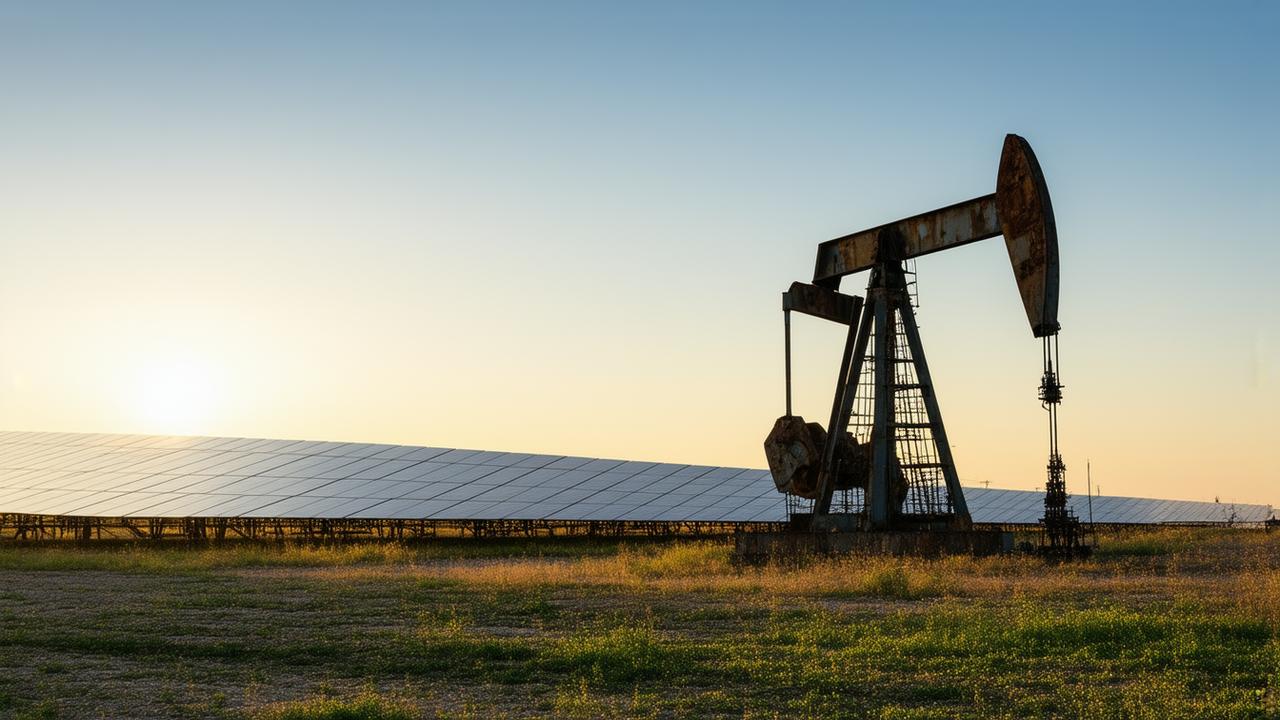
The turbines looked like ghosts at dawn, pale blades turning above a sea of abandoned derricks and rusted pumpjacks. Out here on the edge of a Texas town built on oil, the sun rose over a landscape in transition: solar panels glinting from old cattle pastures, storage batteries humming softly in metal sheds, and a line of laid-off rig workers standing outside a shuttered diner, holding paper cups of coffee that had gone cold too fast. The wind smelled faintly of dust, diesel, and change. The kind of change that doesn’t ask permission.
The Coming Solar-Only World
Behind the glow of that sunrise, there’s a louder storm brewing—one of numbers, graphs, and dire warnings delivered in calm academic voices. In conference halls and government briefings, climate scientists and energy modelers keep returning to the same brutal conclusion: if we want a livable planet, solar energy can no longer be just one option among many. It has to become the backbone of civilization’s power supply. Some say it must become nearly the only source of energy we use.
The logic is simple in its harshness. The carbon budget—the amount of greenhouse gases humanity can still emit and stay within relatively “safe” warming—is almost spent. Fossil fuels, particularly coal and oil, are the main culprits. Every new pipeline, every fresh oil field, every gas-fired power plant is another lock on a door we’re trying desperately to escape through. Solar, say the experts, is the key that can open it fast enough and cheaply enough.
On paper, it’s a dazzling solution: panels that grow cheaper year after year, silently harvesting light from a star that will shine for billions more years. In practice, it looks much messier. Because beneath the elegant charts arguing that solar must dominate the future, there are people whose present is being dismantled—fossil fuel workers, families, and entire towns built around an industry now deemed an enemy in an existential war.
When some of these experts speak, the vocabulary is clinical: “phase-out,” “stranded assets,” “labor displacement.” But what many workers hear is simpler: We have to save the world, and you are collateral damage.
The Cruel Math of Carbon and Sunlight
Walk into a meeting of climate scientists and energy economists, and the conversation feels like stepping into a different reality. Here, the world is reduced to terawatts, gigatons, and percentile risks. If global warming is to be stabilized near 1.5°C or even 2°C above preindustrial levels, the models agree: fossil fuel use must plummet sharply within the next decade. Some estimates say nearly all coal and most oil must stay in the ground; gas, once hailed as a “bridge fuel,” must be a short bridge indeed.
Solar, in contrast, behaves like a lifeline. The more we build, the more its costs fall. The more we install, the less we need to burn. It scales quickly. Panels can be laid on rooftops, strung across deserts, floated on reservoirs, stitched into farmland. If we pair solar with batteries, transmission upgrades, and smarter grids, we can power much of modern life without the black smoke, the methane leaks, the invisible scatter of carbon that thickens the sky.
Many models now show scenarios where solar power provides the lion’s share of global electricity—60, 70, even 80 percent or more—supplemented by wind, hydro, and a pinch of other technologies. In the most aggressive visions, solar doesn’t just lead; it becomes nearly exclusive. Fossil fuels are relegated to history, squeezed out not only by climate policy but by pure economics.
Inside this math, there’s little room for nostalgia. An oil field’s sentimental value does not reduce carbon concentration. A coal town’s history cannot bend the laws of physics. The numbers, in their own way, are merciless. And in that mercilessness, an uncomfortable narrative has emerged: to win the “energy war,” some people—and their livelihoods—will be sacrificed. Not out of malice, but out of calculation.
Collateral Damage in an “Energy War”
Stand at the bar of a small-town pub near a shuttered mine or a declining refinery, and the language of “necessary transition” tastes different in the mouth. Here, energy isn’t an abstract system; it’s the reason a father could pay for his kid’s braces, or why a grandmother kept her house after her husband died. It’s Christmas bonuses and overtime pay, softball leagues sponsored by the local gas company, scholarships endowed by the refinery down the road. It’s the invisible web of dependence that keeps a community stitched together.
Now imagine being told, in the span of a single policy cycle, that your skills are a problem to be solved, not an asset to be valued. That your decades of dangerous work in the bowels of the earth or thirty miles offshore are now carbon crimes on a planetary ledger. In the rhetoric of some climate advocates and even a few experts, fossil fuel workers are framed as obstacles—barricades on the road to a solar-powered Eden.
Those same experts will insist, correctly, that the true victims of fossil fuels are the people most exposed to climate change: farmers facing relentless droughts, coastal communities losing land to rising seas, children breathing smoke-thick air in cities shadowed by coal plants. In that framing, the laid-off refinery worker in Louisiana or the oil sands truck driver in Alberta is a smaller tragedy in a much larger catastrophe.
But that’s exactly what “collateral damage” means. You acknowledge the harm and accept it anyway. A lesser loss, weighed on a global scale. A necessary casualty in what some have begun to call an “energy war”—not fought with guns and tanks, but with subsidies, regulations, and technologies that decide who gets to keep the lights on and who gets left in the dark.
Under the Same Sun: Whose Future Counts?
Go back to that Texas sunrise. The panels are tilted like rows of dark petals, all facing east, waiting. Each one is a promise: fewer emissions, cleaner air, quieter mornings without the constant cough of engines. For many of us, the vision is beautiful—cities run on sunlight, homes powered by quiet rooftops, children growing up without ever seeing a skyline tinted brown by smog.
Yet the beauty is complicated. Because somewhere, in the shadow of those panels, stands a worker with years of experience handling high-pressure pipelines, or maintaining massive drilling rigs, or monitoring wells in the dead of winter. They are not the villains in this story. Often, they were told for decades that they were the heroes—powering the nation, fueling progress, keeping the cold at bay. Now, some feel they have become the enemy overnight.
In private, a few of the more blunt climate experts will say something like: “We can’t save every job if we want to save the planet.” The urgency is real. The physics is non-negotiable. But the way this transition unfolds is not predetermined. The choice isn’t between planetary survival and kindness. It’s between a rushed, brutal shift where workers become casualties—and a difficult, intentional, slower shift where they are treated as central characters in the story, not background noise.
The sun doesn’t pick sides. It pours down its energy on offshore platforms and solar farms alike, on pipeline right-of-ways and experimental microgrids. We are the ones who decide whose future counts in its light.
What a Solar-Dominated Future Might Actually Look Like
Strip away the slogans, and a solar-only or solar-dominated world is less a utopian dream than a sprawling infrastructure project. It’s fields of panels that hum in the heat, tracked by flocks of birds; factory roofs covered in PV glass; highways framed by silent, glittering arrays. It’s neighborhoods with batteries tucked into garages, and dusty substations upgraded with smart inverters and digital controls that sip and share power with quiet intelligence.
In such a world, the rhythms of daily life shift subtly. Midday becomes not just the brightest time of day, but the most energy-abundant. Industrial processes might be timed to peak sunlight. Cities could glow less at night, trading some of our 24/7 blaze for a gentler, more balanced pattern of use. The hum of gas turbines would fade; the sudden blare of flares over refineries would be gone.
It’s a world where children might grow up thinking of the sky not as a dumping ground for invisible gases, but as a source of power that never needs to be burned. Yet it’s also a world that must learn to manage intermittency, supply chains for minerals, the lifecycle of billions of panels and batteries, and new forms of environmental impact. There are no perfect systems—only better and worse ways of harvesting the energy that keeps us alive.
Against this vast engineering canvas, the fate of a few million fossil fuel workers might seem numerically small. But stories aren’t written in percentages; they are written in households, in kitchen-table conversations, in crossroads moments when someone asks, “What happens to us now?”
A Glimpse at the Human Scale of Transition
This isn’t just theory. The numbers can be sobering when you zoom down from gigawatts to jobs and incomes. Here is a simplified snapshot of how this tension might look at the street level:
➡️ Baking soda becomes the unexpected remedy for wrinkles and dark circles say beauty specialists
➡️ France and Rafale lose €3.2 billion deal after last?minute U?turn
➡️ Climate scientists caution that compounding snow intensity and wind shear could generate near-whiteout conditions exceeding historical safety thresholds
➡️ The passenger plane disappeared just before landing: 15 people were on board, including a member of parliament
➡️ The EU is clearing the path for a major tech shift: here’s why our smartphones may soon ditch USB-C entirely and move toward devices with no physical ports at all
➡️ Using a common bathroom product to stop overwintering garden rats has split communities between pest control and animal rights
➡️ No tricks, only treats: Bats glow under ultraviolet light
| Aspect | Fossil Fuel Worker | Solar Economy Reality |
|---|---|---|
| Typical Experience | 10–25 years in drilling, mining, refining, or maintenance | Many skills transferable, but retraining rarely guaranteed |
| Income Level | Often above local average; hazard pay and overtime common | Entry solar jobs may pay less; location and training matter |
| Community Dependence | Whole towns tied to one plant, field, or mine | Solar sites more dispersed; benefits spread unevenly |
| Transition Support | Often promised but patchy, short-term, or politicized | Experts agree “just transition” is vital, but funding lags |
| Emotional Reality | Pride, fear, anger at being labeled part of the problem | Optimism about clean energy, but anxiety about fairness |
Those rows hint at the heart of the conflict. Solar may be our best hope, yet hope doesn’t automatically translate into justice. A job building or maintaining a solar farm three states away is not the same as the job a worker lost in the refinery down the road, no matter how rosy the job statistics might look from the capital city.
Choosing Between Speed and Solidarity
In quiet corners of research papers and policy memos, a tension keeps surfacing: can we move fast enough to avoid climate breakdown and move gently enough to avoid breaking people? Many experts, perhaps traumatized by decades of delay and denial, lean hard into speed. Their focus is to shut off the carbon tap as fast as possible and push solar and other renewables into every corner of the grid.
This is where the rhetoric of “necessary energy war” creeps in. Wars are waged with the understanding that some will be hurt to protect many more. The logic of sacrifice becomes acceptable. Every month of delay, these experts warn, locks in more warming, more flooding, more heat waves, more wildfires, more forced migrations. Against that backdrop, the pain of laid-off workers can begin to look like a grim but minor cost.
Yet history shows that transitions forced through without dignity or dialogue often trigger backlash. People who feel discarded will not quietly fade away; they will organize, resist, vote, and sometimes sabotage. A transition bulldozed through in the name of planetary good can fracture the very social fabric needed to sustain it.
So perhaps the most radical thing we can do is refuse the false choice. Refuse to accept that a solar-powered civilization must be built on the bodies of workers we decided were expendable. Refuse to treat them as footnotes to a heroic tale of technological salvation.
The sun will keep rising over oilfields and solar farms alike. The question is whether we can learn to stand together under that light—coal miner, climate scientist, solar installer, refinery worker—and demand something better than an energy war: an energy peace, forged without pretending the wounds are imaginary, and without declaring anyone’s life an acceptable loss.
Frequently Asked Questions
Are experts really saying solar must become the only power source?
Most experts don’t literally argue for solar as the only power source, but many scenarios show it as the dominant one, providing the majority of global electricity. They see solar, combined with wind, storage, and grid upgrades, as the fastest and cheapest path to deep decarbonization.
Why do some people describe this as an “energy war”?
The term “energy war” reflects the sense of urgency and conflict: policies and investments are shifting rapidly, undermining fossil fuel industries while boosting renewables. For communities tied to oil, gas, and coal, it can feel like a battle they’re losing without ever having chosen to fight.
Are fossil fuel workers really just “collateral damage”?
They shouldn’t be—but in practice, many are treated that way. Promises of retraining and support are often underfunded or delayed. When decisions prioritize rapid emissions cuts without robust plans for workers and communities, people on the ground experience the transition as abandonment.
Can fossil fuel skills transfer to the solar industry?
Yes, many can. Expertise in heavy machinery, electrical work, safety protocols, and project management is valuable in renewables. However, pay, location, and stability may differ, and workers often need targeted training and clear pathways into new roles.
Is it possible to have a fast and fair transition?
It’s difficult but not impossible. It requires deliberate policies: long-term funding for worker support, community-led planning, strong labor protections, and honest dialogue. Speed and solidarity don’t naturally align; they have to be intentionally woven together.
What can ordinary people do to support a just energy transition?
Support policies that both cut emissions and protect workers, back local renewable projects that include community benefits, listen to and amplify the voices of affected workers, and hold leaders accountable when “green” plans ignore human costs.
Will a solar-dominated world really be better for everyone?
Overall, a world powered mainly by solar and other renewables offers cleaner air, more stable climate conditions, and healthier ecosystems. But “better for everyone” depends on how we manage the transition. Without justice at its core, even a cleaner world can leave many people behind.





