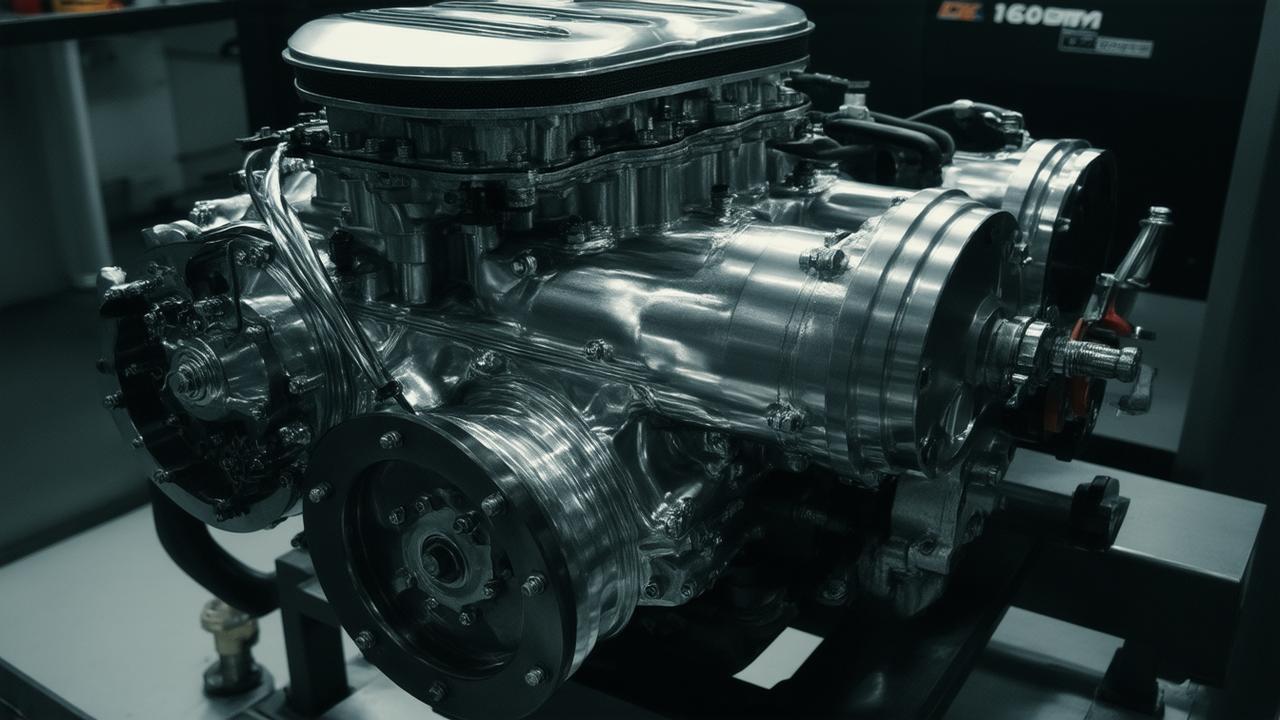
The first time you hear it, you don’t think “car.” It’s thinner, sharper, almost like a superbike screaming down a straight, a high metallic wail that seems to stretch the air itself. Then you realize it’s coming from what looks like an ordinary compact hatchback, slipping past in a blur, and the sound hangs over the tarmac for a few long seconds: five cylinders, 16,000 rpm, the furious heartbeat of Europe’s latest attempt to keep petrol from fading into history.
The Sound of a Future That Refuses to Go Quiet
Stand trackside on a cool autumn morning somewhere in central Europe and this new engine feels less like a mechanical object and more like a statement. The air is a mix of damp grass, hot brakes, and that unmistakable tang of burned fuel, but it’s the noise that makes everyone instinctively turn their heads.
Where today’s turbocharged fours often bark and thud, this thing sings. At idle, it’s a nervous, uneven burble, the odd-cylinder layout giving it a syncopated character. But as the driver feeds in the throttle, the revs don’t just climb—they rush. Six thousand, eight, ten, twelve. The tone tightens, rising into a banshee shriek as the needle flashes past the sort of redline that, not long ago, belonged only on MotoGP bikes and F1 cars.
The data sheet says 240 horsepower. In isolation, that number isn’t shocking in 2026. But the context is radical: five cylinders, tiny displacement, ultra-high revs, and an engineering brief that doesn’t read like a eulogy for internal combustion—but like a comeback tour.
This isn’t some nostalgic side project, either. In a Europe increasingly dominated by charging stations and range charts, this engine is being groomed as a proof of concept: that petrol can be cleaner, leaner, and still wildly, unapologetically emotional.
The Little Five That Wants to Rewrite the Rules
On paper, the engine sounds almost contradictory. It’s physically compact, lighter than many three-cylinders on sale just a few years ago, and yet it spins faster than most people can wrap their minds around. Sixteen thousand revolutions per minute: that’s the crankshaft making 266 complete turns every single second.
Engineers talk about it in quiet, precise language, but there’s a gleam in their eyes that betrays something more personal. You hear phrases like “specific output” and “thermal efficiency,” but underneath all the graphs and simulations is a basic, almost childlike goal: how do we keep the magic of combustion alive in a world that doesn’t quite trust it anymore?
Part of the answer lies in the layout. Five cylinders are an odd choice in a market obsessed with four-cylinder modularity and three-cylinder cost-cutting. Yet that very oddness is the point. A five-cylinder can be incredibly narrow and compact, helping with aerodynamics and packaging, while still offering more breathing capacity than a three or four of similar footprint. Paired with direct injection, variable valve timing, clever friction reduction, and ultra-light internals, it becomes a willing, rev-hungry companion instead of a reluctant compromise.
Then there’s the power figure: 240 horsepower. Coming from this little bank of metal and ceramic and oil, that number tells a different story than some hulking V6 making twice as much. This engine is about efficiency per drop and emotion per decibel. It’s about getting the most, not just in power, but in experience, from every turn of the crank.
| Key Feature | Specification |
|---|---|
| Cylinders | Inline-5 |
| Peak Power | 240 hp |
| Maximum RPM | 16,000 rpm |
| Approx. Displacement | ~1.0 – 1.2 liters (concept range) |
| Primary Fuel Strategy | Highly efficient direct injection, e-fuel compatible |
The Radical Logic Behind the Five
Choosing five cylinders in 2026 is like showing up to a minimalist art gallery with an oil painting the size of a wall. It’s a deliberate break from the script. Automakers have spent the last decade pruning cylinders, trimming displacement, and leaning on turbochargers to do the heavy lifting. The engines became more efficient, yes—but also quieter, more distant, more similar.
The five-cylinder is a stubborn refusal to flatten everything into sameness. Mathematically and mechanically, it sits between the balanced smoothness of a straight-six and the simplicity of a four-cylinder, but it has a voice all its own. There’s a characteristic off-beat rhythm—especially at mid-range revs—that gives it an almost musical phrasing. It doesn’t just rev; it builds, like a melody.
Engineers exploit that. By carefully staggering firing intervals and fine-tuning intake and exhaust geometry, they’ve shaped the sound as much as the power curve. Acoustic engineering isn’t an afterthought; it’s baked into the early CAD models. In the age of EVs, where motors tend to whisper, the fact that anyone is investing this much time into the sound of an engine says a lot about what’s at stake.
And yet, this is no dinosaur. That wild 16,000 rpm figure isn’t about chest-beating for its own sake. High revs allow smaller displacement to make more power without the big pistons and big emissions of traditional performance engines. Spin faster, burn cleaner, and you get a different kind of efficiency—not the silent, invisible efficiency of electrons, but a honed, sharpened mechanical one.
Petrol’s Last Stand, or Its Quiet Evolution?
Europe is under no illusions. The legislative winds are still blowing firmly toward electrification. Cities are converting curbside space into chargers. Highways are sprouting fast-charging hubs like mushrooms after rain. For most daily use, the answer is electricity.
Yet in the same test facilities where battery chemistries are being tortured by endless cycles, a small group of engineers is betting that internal combustion isn’t facing extinction, but reassignment. In that future, petrol engines won’t be the default—they’ll be the specialists, called in not because they’re the easiest option, but because they do something nothing else quite can.
The five-cylinder, 240-horsepower, 16,000-rpm experiment is a prototype for that role. Not necessarily in its exact form, but in its philosophy. Think of it less as a mass-market commuter solution and more as a flagship of what’s technically and emotionally possible if we stop treating combustion as the enemy and start treating it as a rare luxury that must earn its existence.
Part of how it earns that existence is through cleaner operation. Europeans regulators are increasingly open to low-volume, synthetic-fuel-compatible engines that approach carbon neutrality over their life cycle. That’s where this little monster starts to make sense beyond the racetrack. Run it on e-fuels made using captured CO₂ and renewable electricity, and suddenly that 16,000 rpm wail isn’t just an indulgence—it’s a soundtrack to a more nuanced transition.
Why 16,000 rpm Changes Everything
Numbers alone don’t tell the whole story, but some figures are hard to ignore. Most modern performance engines hit a redline between 6,500 and 7,500 rpm. A handful of exotic road cars stretch into the eights or nines. Race engines go further. But 16,000 rpm in an engine designed with road use in mind, even conceptually, is like learning your friendly neighborhood runner just completed an Olympic-level marathon before breakfast.
At this speed, every component lives in a different world of physics. Pistons don’t just move; they flick back and forth so fast that any extra gram becomes a liability. Connecting rods are sculpted like bones, with stresses flowing through them as if through living tissue. The valvetrain can’t be a traditional mass of springs and steel—it has to be lighter, quicker, often aided by technologies borrowed from racing: pneumatic valve systems, advanced alloys, coatings so smooth and hard they feel more like glass than metal.
All of this obsessive engineering has a purpose beyond just bragging rights. High engine speed can mean more complete combustion, better atomization of fuel, and—when carefully managed—impressively low emissions for the power produced. Pair that with start-stop systems, hybrid assistance, and smart gearing, and you end up with something paradoxical: a tiny, furious, screaming heart that can actually sip fuel gently when asked.
In the driver’s seat, though, those technicalities fade into sensation. You roll onto a quiet stretch of road, shift down, and let the revs rise. Around 8,000 rpm, where other engines would be pleading for mercy, this one is just waking up. Ten, twelve, fourteen. The cabin vibrates with a high, insistent energy. Your fingertips tingle on the wheel. Past fifteen, the world narrows into the sound and the surge, until you lift, heart racing, realizing you’ve just had a conversation with a piece of metal spinning 16,000 times a minute—and it made you feel something an EV never quite has.
Europa’s Bet: Emotion as a Feature, Not a Flaw
This engine isn’t being developed in a vacuum. It’s a node in a larger web of European projects trying to answer one question: how do we transition away from fossil fuels without flattening the emotional landscape of mobility into a single, silent note?
Some answers are obvious: trains gliding between cities, electric hatchbacks humming through dense urban cores, delivery fleets running on hydrogen. But there’s also a quieter acknowledgment, often heard in after-hours conversations at conferences and design studios: people like engines. Not everyone, not all the time—but enough people, in enough ways, that a future without any pistons at all feels not just cleaner, but emptier.
➡️ This small adjustment helps reduce the feeling of bodily overload
➡️ What it means psychologically when you avoid talking about yourself, even when asked
➡️ I noticed my stress dropped once my cleaning goals became realistic
➡️ This is how to show interest without forcing enthusiasm
➡️ The one breathing mistake most people make daily without realizing it affects their stress levels
➡️ Why doing one task at a time is healthier than multitasking
➡️ I realized my cleaning system was built for a life I don’t live
So Europe is experimenting with a “layered” ecosystem. EVs as the backbone. Hybrids as the bridge. And highly specialized combustion engines—tiny, efficient, e-fuel-ready—as the spice. You won’t see this five-cylinder in every driveway. But you might hear its descendants in weekend track cars, low-volume sports coupes, maybe even in small aviation or performance hybrids where a light, compact, rev-happy engine pairs with electric torque for something genuinely new.
That’s the real gamble: that we’ll value emotion as a legitimate design metric. That the grin you get from hearing a 16,000 rpm pull isn’t a guilty pleasure, but a recognized part of why people care about movement at all. In that framing, combustion stops being an obstacle and becomes a carefully rationed resource—used where it matters most, in ways that justify the complexity and cost.
Will Engines Like This Actually Reach the Road?
There’s an honesty to the way the project’s engineers talk about “series potential.” This is a hero concept, a technological overreach meant to pull the rest of the industry forward. The final road-going versions might be softer, slower, more modest. But every crazy prototype reshapes expectations.
A decade ago, a three-cylinder engine in a family car sounded like a compromise. Now it’s normal. Tomorrow, a tiny five-cylinder spinning beyond 12,000 rpm in a special-edition hybrid might sound equally reasonable. The apex version—the full 16,000 rpm screamer—could live in a halo model, produced in numbers small enough to make regulators shrug and enthusiasts whisper.
Even if this exact engine never hits showroom floors, the lessons it teaches will. New coating technologies, lightweight reciprocating parts, clever cooling circuits, and multi-fuel adaptability will filter down into more sensible machinery. The story of this five-cylinder isn’t just about one engine—it’s about refusing to write off an entire technology just because it’s no longer the main character.
And that may be the quiet miracle buried inside all the howling noise: the idea that “petrol” in Europe’s future vocabulary won’t mean what it did in the past. It will be rarer, cleaner, more intentional. If engines are going to stay, they’ll have to be this good—or better.
FAQ
Is this five-cylinder, 16,000 rpm engine already in production cars?
No. In its most extreme form, it is a prototype-level concept used for development and testing. However, toned-down versions and the technologies behind it are being evaluated for future limited-production and performance-oriented road cars.
Why use five cylinders instead of three or four?
Five cylinders offer a compact layout with more breathing capacity and a unique firing order that creates a distinct sound and power delivery. It balances packaging efficiency, performance potential, and emotional appeal in a way that three- and four-cylinder units often cannot.
How can an engine rev to 16,000 rpm without destroying itself?
It relies on ultra-light components, advanced materials, reduced friction, and highly optimized valvetrain design—often drawing on racing technologies like pneumatic valve actuation, specialized coatings, and sophisticated cooling and lubrication systems.
Is this engine compatible with synthetic or e-fuels?
Yes. One of the key goals is compatibility with low-carbon synthetic fuels made using renewable energy and captured CO₂. This allows the engine to deliver strong performance while dramatically reducing its net carbon footprint compared to traditional fossil petrol.
Does this mean Europe is abandoning electric vehicles?
No. EVs remain central to Europe’s long-term mobility plans. Engines like this five-cylinder are being developed for more specialized, low-volume roles—performance cars, enthusiast vehicles, and niche applications where emotional engagement and lightweight, high-energy-density powertrains still offer unique advantages.
Will engines like this be affordable for ordinary drivers?
In the near term, highly exotic, high-revving units will be relatively expensive and reserved for premium or limited-run models. Over time, though, some of the underlying technologies can trickle down into more affordable, modestly tuned engines.
What makes this engine “radical” compared to modern turbo engines?
Instead of using a large turbo to add low-end torque to a small engine, it pursues extremely high engine speeds, ultra-low mass internals, and cleaner combustion as its route to performance. It’s a return to mechanical purity and revs—updated with cutting-edge efficiency and emissions strategies—to create a uniquely emotional yet future-aware petrol engine.





