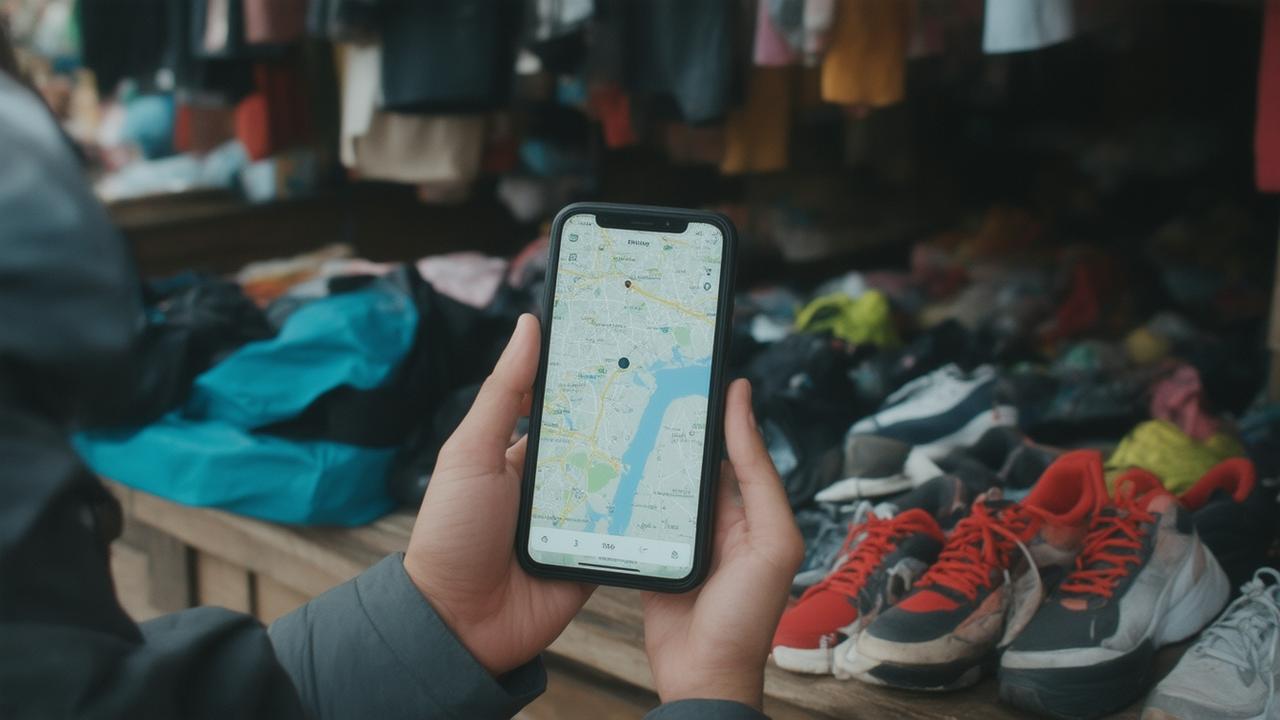
The sneakers were nothing special. Scuffed rubber, a faint mud stain that never fully washed out, laces that remembered every mile. But on the morning he decided to give them away, Jonas held them a second longer than necessary, thumb tracing the worn heel, listening to the quiet of his apartment. The city outside his window hummed with normal Saturday noise—distant sirens, the clang of the tram, a dog barking at something only dogs could see. In the kitchen, the kettle rattled just before it boiled. A chill from the open window set the curtains breathing. And that was when the idea clicked into place, as neatly as the little white disc he held between his fingers.
The Little Experiment in the Shoe Box
The AirTag was cool and smooth, no larger than a coin and twice as mysterious. Jonas turned it over in his palm, wondering whether this was curiosity or something less flattering. He pried open the insole of the left sneaker, the foam sighing as it lifted, and tucked the tracker into a small hollow he’d carved the night before with a dull kitchen knife. It fit perfectly, as if the shoe had always been built for secrets.
He pressed the insole back down, smoothing it out with his thumb, then slipped both sneakers into an old shoebox. Cardboard rasped softly as he closed the lid. On the coffee table, his phone lit up—a quiet confirmation, a new device added, its tiny digital heartbeat pinging from the center of his living room floor.
To make sure it all worked, he took a walk. Down the stairs, past the familiar smell of dust and takeout in the stairwell, and out into the late-morning light. He carried the shoebox tucked under one arm, cradling it like something fragile. The map on his phone showed a blue dot—him—and just beside it, a grey icon marking the AirTag. They moved in tandem, down cracked sidewalks and past the bakery that always smelled better than its bread tasted.
The Red Cross donation center sat in a converted storefront two tram stops away. Its windows were cluttered with signs about relief efforts and hand-written notices for volunteers. Inside, the air was warm and smelled faintly of fabric softener and old books. Piles of neatly folded clothes, sorted by restless hands, lined tables. Behind the counter, a young woman with a tired ponytail and a bright red vest looked up and smiled when he approached.
“Just these,” Jonas said, sliding the shoebox forward.
She lifted the lid, quick glance only, as if the volume mattered more than the content. “Thank you,” she said, already reaching for a pen to log the donation. “We really appreciate it.”
He almost said something about the sneakers, about the miles they’d seen, the quiet dawn runs along the river. Instead he just nodded. The phone in his pocket warmed for a moment as he locked the screen, leaving the sneakers—and the AirTag—behind.
What Happens to Our Good Intentions?
On the tram back home, Jonas watched the grey icon settle into the Red Cross building on the map. People were coming and going, phones in pockets, every passing signal renewing the AirTag’s faint presence in his app. He stared at it with the comfortable detachment of a man who’s sure he won’t see someone again but still looks back through the train window as the platform slides away.
Charity, he’d always assumed, was a straight line. You give something; it reaches someone in need. Simple. Clean. A quiet moral equation. But the news had been full of stories lately—rows of donated clothes gathering dust in warehouses, bags of shirts and shoes diverted into a murky secondhand economy that sprawled across ports and markets thousands of miles away.
There was no outrage in him, not even really suspicion. What he felt was closer to a stubborn curiosity, the kind that keeps you awake at night wondering where an old friend ended up or whether the restaurant on the corner still serves that perfect soup. He wanted to see it for himself. Wanted to know what happened after “thank you” and ledgers and polite smiles.
Back in his apartment, he opened the app again. The sneakers glowed quietly on the little map, as if they were resting. He sat at his kitchen table, the kettle now cold, and watched. An hour passed. Then another.
The First Move
Sometime in the early afternoon, the icon shifted. Not far at first—just a slide across the road, deeper into the neighborhood. He pinched the screen, zooming in: they were in the back, where the building opened into a small loading area. Maybe being sorted, he thought. Maybe packed.
By late evening, after he’d half-watched a movie and eaten standing over the sink, the sneakers began to travel. The map showed them riding east, hugging the course of the river. He imagined them in a van, bumped against black garbage bags full of clothes, contributions from a city that liked to feel generous.
The phone traced their path in pale lines: out of the city, past an industrial park, then to a vast, anonymous shape labeled only as a “logistics center.” The kind of place that swallows parcels, pallets, and promises alike.
For the next two days, the sneakers barely moved. Every few hours, Jonas refreshed the app, watching the same grey icon blink at him from between anonymous warehouses. Around day three, he stopped checking so often. Life reclaimed its usual rhythm: work emails, coffee runs, a late-night call from his sister describing storms in another country.
Then, on the fifth morning, he woke to a different map entirely.
Across Borders, Inside a Screen
The city on his phone was not his city. The language on the map labels curled differently, letters he couldn’t pronounce spilling across districts he’d never heard of. Under the blue circle that marked his own location, his quiet street yawned into winter. Under the grey icon, sunlight fell on a place many time zones away.
The sneakers, his old running shoes with their secret passenger, had flown.
He scrolled out, drawing the map into a globe. A thin, pale arc of travel connected his country to another continent, the line like a hair on the Earth’s digital skin. He tried to imagine their journey: boxed, scanned, lifted on forklifts that beeped their way across cavernous warehouses. A rolling track, the plastic smell of bubble wrap, then the belly of a plane. The sneakers watched the world shrink beneath them, then wake up somewhere entirely new.
In the evenings, he found himself returning to the app the way someone might come back to a favorite storybook. Each time, the grey icon had shifted: from an airport edge to a commercial district, then to a dense tangle of streets where the map’s satellite view revealed corrugated roofs and sun-bleached alleys. The AirTag, dumb and obedient, simply kept reporting where it lay.
On the seventh day, movement stopped. The icon settled at a crossroads, right on the edge of a sprawling market that the map labeled only as a “bazaar.” Zoomed in, the streets looked like veins, branching and looping, pulsing with small businesses and hustled livelihoods.
The Market Stall
He stared at that word—bazaar—for a long time. It held the taste of spices he’d never smelled, the echo of voices in languages he didn’t speak. He pinched the screen again, reaching for more detail. The satellite view sharpened: tarps stretched over metal poles, colorful smudges that might be umbrellas, the hint of narrow aisles crammed with something. Everything.
At 10:17 a.m. local time, the sneakers moved a few dozen meters, no more. A stall, he guessed. Maybe a table or a rug rolled out on the dust. He imagined them among piles of other shoes—some new, some old, some allegedly “donated.” A stranger lifting them, weighing their worn soles with a practiced eye. How much would they ask? A few coins? Enough to buy bread?
The thought should have made him angry, or so he’d expected. After all those collection bins and well-meaning marketing campaigns, here his donation was, likely priced and haggled over. But as he sat there, hunched over a glowing rectangle thousands of miles from the heat of that market, he felt something more layered instead: a quiet, uncomfortable understanding.
On one hand, the story was simple: the shoes he’d meant to give freely were being sold. A profit line, somewhere, tracing its way through ports, customs offices, and the plastic-tied bundles of secondhand trade. On the other, the story complicating itself: someone at that market stall was trying to make rent. Someone else, with less than he had, was probably eyeing those sneakers because their own shoes had given up weeks ago.
The Red Cross had likely done what made logistical sense. Surplus clothes, too many donations, too few local needs—so they’d been sold in bulk to a broker. Money from that sale, he imagined, would cycle back into budgets, fuel trucks, pay staff, maybe stock emergency kits. The charity continued its work, the market continued its buzz. The shoes simply passed from one story into another.
What the AirTag Couldn’t Tell
He began to check the icon less like a scientist and more like a distant relative, hoping for a glimpse of a life he’d never really know. Each time the AirTag stirred, shifting a meter this way, two meters that, he pictured hands lifting the sneakers, feet sliding into them. He imagined the warmth of another person’s skin filling the shape where his had been. The creak of laces. The first test steps taken along a dusty, cramped aisle.
The map could show proximity, but not ownership. It knew the coordinates but not the story. Maybe the shoes had sold quickly. Maybe they’d been tried on and rejected, set aside for another day. Maybe a teenager with a running dream but no running budget had argued with a vendor, both of them laughing in the end. The AirTag recorded none of it. It simply pulsed from inside its foam hiding place, loyal to a former life.
There was a point, a few weeks in, when the icon wandered out of the bazaar and into a dense residential area. It stopped near a cluster of low buildings, huddled close together like neighbors leaning in to share news. Jonas zoomed in until the map gave him nothing more—just anonymous roofs and the imagined pipelines of everyday life: cooking fires, arguments, laughter, the thin music of a radio.
For three nights, the AirTag stayed there. Its static location felt oddly intimate, as if the sneakers had finally come to rest by the door of a home, kicked off after a long walk. The image in his head shifted: not traders and price tags now, but a single person moving through their days—standing in line somewhere, hurrying across a lane of chaotic traffic, toes tapping under a table.
➡️ After 25 years of reforestation, once-barren landscapes are now absorbing millions of tons of CO annually
➡️ Goodbye Kitchen Islands : Their 2026 Replacement Is A More Practical And Elegant Trend
➡️ Not vinegar, not wax: the simple home trick that makes hardwood floors shine like new
➡️ An exceptionally large African python has been officially confirmed by herpetologists during a certified field expedition, and now scientists are bitterly divided over how this shocking discovery should be handled
➡️ Day will slowly turn to night as the longest total solar eclipse of the century passes across several regions, creating a rare and spectacular event that scientists say will captivate millions for hours
➡️ Day set to turn into night as the longest solar eclipse of the century now has an official date, with experts highlighting its remarkable duration and the extraordinary visibility expected
➡️ Day set to turn into night as the longest solar eclipse of the century now has an official date, with experts highlighting its remarkable duration and the extraordinary visibility expected
The Quiet Line Between Surveillance and Concern
He caught himself, more than once, wondering whether he’d crossed a line. The technology had made it too easy: a simple tap on his screen, and he was peering into the rough outline of another life. Not their face, not their name, but still—a presence, reduced to movement dots and coordinates. The AirTag didn’t care about privacy; it was built to obey. But what did it mean for him to keep watching?
He thought about disconnecting it, erasing the device from his account. The ethical answer seemed straightforward: he had released the sneakers into the world; they no longer belonged to him. Whoever now wore them had no idea that their steps traced ghost lines back to a stranger’s phone in another country.
And yet, each time he opened the app, a different emotion anchored his finger before it reached the “remove” button: responsibility. Not for the person—he didn’t know them—but for the story he had started. The experiment was his idea. He’d slipped the AirTag in. If anyone was trespassing, it was him.
So he made himself a small rule: he would check less and less. A slow fading-out. First daily, then every few days, then weekly. The less he knew, the more the shoes could belong wholly to their new life. So he tried. Habits loosened. The app icon slid away from the front screen of his phone, tucked into a forgotten folder.
Where Stories Go When We Let Them
Spring crept into his own city almost without him noticing. The river thawed; thin green lines of grass bullied their way through cracks in the pavement. On a rare warm afternoon, he laced up a different pair of sneakers—their soles still stiff with newness—and ran along the same routes the old pair had once known. His breath found a familiar rhythm. His thoughts stayed with his feet.
It was only that evening, muscles pleasantly sore, that he remembered the AirTag again. On a whim, he opened the app. The icon appeared after a brief pause, still there on that foreign map, but something had changed.
The sneakers had moved a little further out of the dense neighborhood and closer to a main road. Perhaps their wearer had moved, or perhaps they’d been sold again—markets within markets, trades within trades. But the more he stared, the less the specifics mattered. What he felt instead was a quiet, almost tender awareness of connection: a line of rubber, foam, sweat, and intention binding him, however faintly, to the life of someone he would never meet.
His experiment had started with suspicion; it ended with humility. Charity, he realized, was less a straight line and more a river delta, branching into countless channels, some of them murky, some of them life-giving, many of them both at once. Goods moved, money changed hands, needs were met, and yes—pockets were lined along the way. But at the far end of it all, a person somewhere was lacing up the same sneakers he once had, tightening them before stepping into a day of their own unknowns.
The AirTag, for all its quiet precision, could never tell that story fully. It couldn’t weigh whether the system was fair or broken, efficient or exploitative. It couldn’t capture the texture of those streets, the way dust rose in the afternoon heat, or how the shoes felt as they hit new ground. It could only draw a thin line and blink, alive.
A week later, he finally did it. He opened the device list, found the AirTag labeled simply “left shoe,” and tapped “Remove.” The app asked him to confirm, as if it were more invested than he was. He hesitated, then pressed yes. The little grey icon dissolved. The map returned to its default expanse, blank and indifferent.
Somewhere, though, the sneakers kept moving.
A Small Table of What the Journey Revealed
As the weeks turned into months, Jonas found himself thinking less about where the shoes were and more about what their journey had quietly shown him about the path our donated things might take.
| Stage | What He Assumed | What He Observed |
|---|---|---|
| Donation | Shoes go straight to someone in need nearby. | They first entered a sorting and logistics system. |
| Transit | Maybe a local shelter or regional center. | They crossed borders and oceans to another continent. |
| Destination | Direct, no-money exchange with recipients. | They landed in a sprawling secondhand market. |
| Exchange | Pure charity, no commercial layer. | They were likely sold, supporting both traders and charities. |
| Outcome | A simple, linear act of giving. | A tangled but real path where multiple lives intersect. |
In the end, he kept donating, but with eyes a little more open. He chose more carefully what he gave. He read the fine print on those glossy appeals. And when he tied his own laces in the mornings, he sometimes thought of that other pair, still out there somewhere, carrying someone else forward step by invisible step, the signal finally silent but the story very much alive.
Frequently Asked Questions
Is it legal to put an AirTag in donated items?
Laws vary by country, but placing a tracking device in an item that will be used by someone who has not consented can raise serious privacy and ethical concerns. In some places, it may be considered covert tracking and potentially unlawful. Even if no identity is revealed, monitoring someone’s movements without their knowledge is generally discouraged.
Do charities really sell donated clothes and shoes?
Yes, many large charities sell part of their donated clothing in bulk to textile recyclers or secondhand exporters. The revenue often supports their core programs and emergency work. Only a portion of donations may go directly and locally to individuals in need, depending on demand and storage capacity.
How do donated clothes end up in overseas markets?
Surplus clothing is frequently sorted, baled, and sold to brokers who export it to other countries. There, local traders buy the bales and resell individual items in markets. This creates complex economies—supporting livelihoods but also raising questions about local textile industries and waste.
Is it still worth donating clothes if they might be resold?
Generally, yes. Even when clothes are resold, they can provide affordable options for buyers and funds for charities. The key is to donate items that are clean, wearable, and likely to be useful. Reading a charity’s policies helps you understand how your donation will be used.
How can I donate more responsibly?
Focus on quality over quantity, give items that are genuinely wearable, and avoid using donation bins as a way to discard trash. Whenever possible, check the organization’s guidelines, support local shelters or groups with clear distribution plans, and consider whether repairing, reusing, or sharing directly within your community might sometimes be better than simply dropping a bag into a bin.





