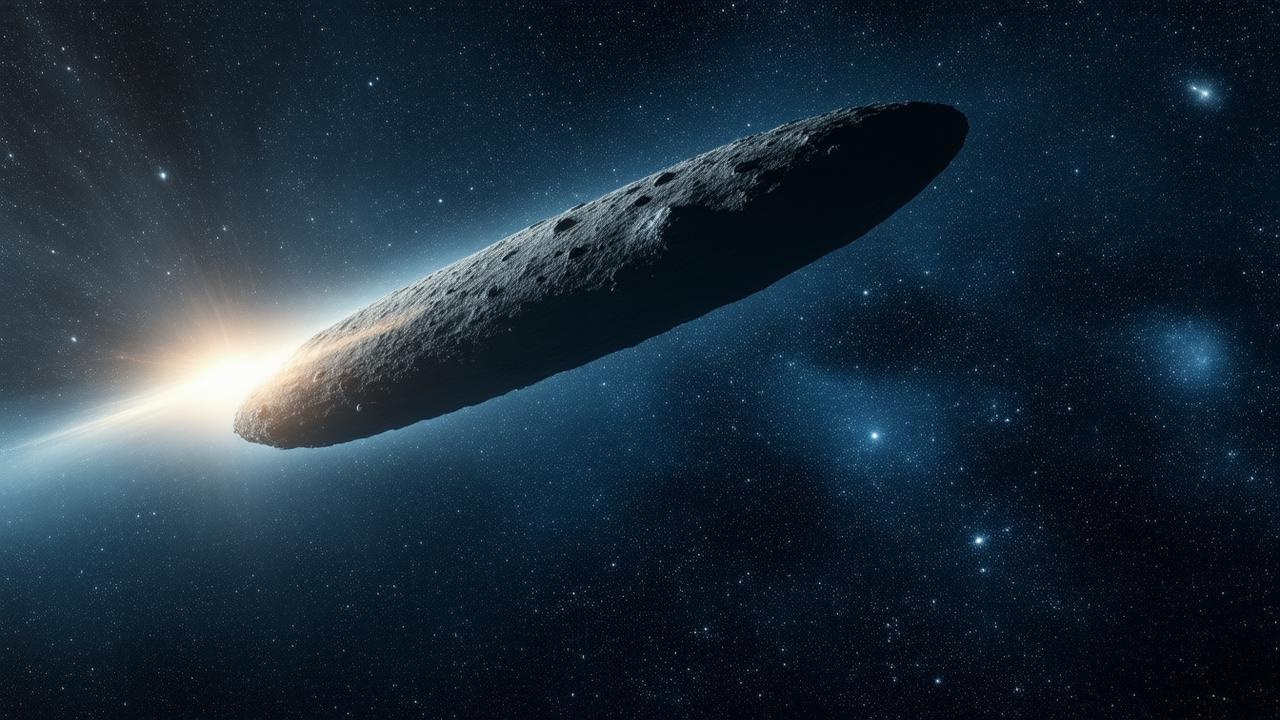
The alert arrived just after midnight, slipping into the inboxes of a few sleepy astronomers like a quiet knock on the door of the universe. At first, it looked like just another faint streak against the dark—one more object among millions. But the numbers refused to behave. The trajectory was wrong, the speed was wrong, and the orbit… it had no orbit at all. Within hours, a whisper began to spread across observatories and research centers around the planet: something was coming. Something fast. Something not from here.
A Visitor That Doesn’t Belong
It started, as so many modern discoveries do, with a survey telescope combing the sky for changes—a nightly ritual of watching shadows move between stars. On an otherwise ordinary evening, the system flagged a dot that had shifted just a little too much between exposures. It was small, faint, and easily ignorable. But when a graduate student ran the initial calculations, the numbers snapped into focus with an almost physical jolt.
The object was moving at a blistering pace, far too fast to be gravitationally bound to our Sun. Faster, in fact, than anything naturally orbiting within our solar system. Its path was hyperbolic, a sharp, swooping curve slicing through the plane of our planets like a skipped stone on cosmic water. That shape meant one thing: this object was an interstellar traveler, arriving from another star system and heading somewhere beyond us.
By dawn, observatories in both hemispheres had turned their mirrors toward the approaching speck. Radio telescopes listened. Optical telescopes watched. Infrared arrays searched for the faint warmth of reflected sunlight. Slowly, a picture began to form—not just of what was coming, but of what it meant to be visited by something the galaxy had tossed our way.
The Sky’s Subtle Disturbance
Imagine stepping outside into a cold, clear night. The stars are pinned above you, steady and indifferent, scattered like salt across black velvet. Nothing appears to move at any pace you can feel. The sky is, in human terms, motionless. But hidden in that apparent stillness, this visitor is tearing through space at record-breaking speed—tens of kilometers every second, an invisible bullet racing through the dark.
No one can see it with the naked eye. It’s too small, too far, too dim. Yet, through telescopes, it leaves a signature: shifting coordinates, changing brightness, a subtle flicker as it responds to sunlight in its own peculiar way. Astronomers sit in warm control rooms while winter winds batter the domes above them, watching real-time plots of light curves and position angles. Outside their screens, the universe feels unchanged. Inside their data, the universe has just become suddenly, thrillingly different.
Part of the strangeness lies in how alien the object’s movement is compared to the well-behaved dance of planets and asteroids we know. Our familiar neighbors orbit the Sun like disciplined dancers around a central fire. This thing, on the other hand, is barging straight through the ballroom, ignoring the choreography, pausing only momentarily as gravity curls its path and then flings it back out toward the deep.
A Table of Cosmic Extremes
As observations poured in, scientists began assembling a simple comparison—a way to explain to curious journalists, students, and late-night radio hosts just how extraordinary this object really is. Numbers are cold things, but in this case, they tell a story of an outsider that refuses to slow down.
| Object | Typical Speed (km/s) | Bound to the Sun? |
|---|---|---|
| Earth orbiting the Sun | ~30 | Yes |
| Typical main-belt asteroid | 17–25 | Yes |
| Comet plunging from outer solar system | Up to ~70 near the Sun | Yes |
| Previous known interstellar visitor | ~25–30 (relative to the Sun far away) | No |
| New interstellar object | Record-breaking speed (well above prior visitors) | No |
To astronomers, the table is both thrilling and disquieting. The numbers say this object is not just another interstellar rock drifting lazily between stars. It is racing. Whatever tossed it out of its original solar system did so violently enough that, even after crossing gulfs of interstellar space, it has not slowed to the speeds we usually see.
What Does an Interstellar Stone Look Like?
Descriptions of the object begin with caveats and end with more questions than answers. It is small, perhaps only a few hundred meters across, maybe less. That’s enough to carve a city-sized scar on a planet, but in space, it is a grain of sand. No telescope on Earth can resolve its surface; instead, scientists infer its shape and nature from the way its light changes over time.
As the object rotates, its brightness flickers. The pattern of those fluctuations suggests an irregular body—maybe elongated, maybe lumpy, tumbling rather than spinning in a neat, balanced way. Some nights, the light suggests a darker, carbon-rich surface like a dormant comet; other nights hint at something more reflective, as if ice or metal or both might be scattered across it. Interstellar space is harsh. Any original volatiles—ices, gases, delicate compounds—may have been stripped away over millions of years by cosmic rays and micrometeorite impacts.
The truth is that this object has had a life before us. It may have been born in the crushed outskirts of a young star system, then flung outward by a gravitational misstep near a giant planet. It may have spent eons adrift in the dark between stars, each passing millennium leaving it a little more eroded, a little more quiet. And only now, by chance, its long, silent voyage happens to slice through our neighborhood, catching the stray glint of our Sun for a few short weeks.
Listening to a Stranger in the Dark
The more data astronomers gather, the more intimate their relationship with this visitor becomes. They speak of it late at night over coffee and cold pizza, referring to it by its catalog number with an almost affectionate shorthand. They debate its density based on its spin, argue about whether tiny outgassing jets may be nudging its trajectory, and obsess over each spectral line as if decoding a secret letter from another world.
Sometimes, it’s easy to forget that, at a human scale, nothing about this looks dramatic. There is no blazing fireball, no streak of light dominating the sky. The drama lives in the measurements, in the idea that we are, for a brief and unrepeatable moment, sharing our cosmic address with a traveler from elsewhere.
Is It Dangerous?
The first question almost everyone outside the scientific community asks is the same: is it going to hit us?
Fortunately, no. Within hours of its discovery, the object’s path was plotted and refined. Each new measurement tightened the constraints and pushed the chances of a collision down into the realm of impossibility. The visitor will pass at a safe distance—far enough not to bother Earth, but close enough to let us observe it with an intensity normally reserved for comets and asteroids that belong to us.
This is not a bullet with our name on it; it is a messenger racing past the door. The danger is not physical. The urgency comes from time. We will not get another chance to study this same object once it’s gone, because it will never return. Our telescopes must capture everything they can, now, before the Sun’s glare overwhelms it, before distance dims it back into anonymity.
Space agencies and observatories are scrambling in a quiet, methodical way. Observation schedules that were booked months in advance are being reshuffled. Targets are dropped or delayed to make room for this fleeting guest. On screens around the world, the incoming speck appears as a jittering white dot—but behind that dot lies a cascade of data that will keep scientists busy for years.
Record Speed, Record Opportunity
The object’s unprecedented speed is both a challenge and a gift. It means the viewing window is short—days and weeks, not months and years. But it also means we’re seeing an extreme example of how violently material can be thrown from other star systems. Its motion is like a footprint in the snow, a hint of whatever forces flung it into the void. Was it slingshotted by a massive planet? Ejected during the chaotic birth of its home system? Tangled in the gravity of a passing star?
By analyzing its speed, direction, and composition, astronomers hope to trace it back—not to a particular star we can point to with certainty, but perhaps to a region of the galaxy, a type of environment, a style of solar system. In that sense, the object is not just a rock. It is a geological sample of somewhere else, delivered without a mission, without a rocket, without the years of planning that interstellar exploration would normally demand.
What This Visitor Tells Us About Ourselves
Step back from the equations and there is something hauntingly personal about the discovery. For most of human history, the stars were a distant ceiling, unreachable and silent. We dreamed of visiting them; we never imagined they might occasionally visit us. But these interstellar objects—this one, and the few we’ve detected before—are reminders that our solar system is not walled off from the rest of the galaxy. It is porous. Open. Connected.
Every time one of these travelers appears, it scratches at the edges of a simple but unsettling idea: we are not just residents of the solar system; we are residents of the Milky Way, exposed to the restless, ongoing exchange of matter between stars. Planets form, collide, eject rubble. That rubble becomes the driftwood of the cosmos, carrying stories of distant shores.
➡️ France suffers a €3.2 billion blow as a last-minute reversal kills a major Rafale fighter jet deal
➡️ Neither boiled nor raw : the best way to cook broccoli for maximum antioxidant vitamins
➡️ France turns its back on the US and drops €1.1 billion on a European detection “monster” with 550 km reach
➡️ Day will turn to night during the longest total solar eclipse of the century occurring across regions
➡️ No more duvets in 2026? The chic, comfy and practical alternative taking over French homes
➡️ Seniors behind the wheel: will licenses be pulled automatically after 70 from ?
➡️ Goodbye kitchen cabinets: the cheaper new trend that won’t warp, swell, or go mouldy over time
In a control room somewhere, an astronomer leans back in a squeaky chair and looks up from the latest data plot. Outside, dawn is washing the sky pale blue, erasing the stars one by one. On the screen, the interstellar object has moved a few more arcseconds along its calculated path, right on schedule. It is just doing what it has done for ages—traveling, indifferent to who watches or cares.
We, on the other hand, can’t quite help caring. In this tiny moving point of light, we see both our limits and our possibilities. We cannot yet go to it, cannot land on it, cannot scoop up a sample and bring it home. But we can measure, infer, model, and imagine. We can treat a faint, fast-moving speck in the sky as a conversation starter with the rest of the galaxy.
After It’s Gone
In a few weeks or months, depending on its path, the object will swing past the Sun and grow fainter as it recedes into the outer dark. Telescopes will turn away, first reluctantly, then permanently, toward other targets. New comets will be discovered. New exoplanets will be announced. The universe will fill our attention with other wonders.
But tucked away in hard drives, notebooks, and published papers, the data from this alien fragment will continue to whisper its story. Students not yet born will one day open those files and reconsider the measurements with better tools, better models, better ideas. Perhaps by then, our species will have sent probes to similar interstellar objects or even learned to intercept one.
For now, we stand on a small, rocky world beneath a thin layer of atmosphere, watching an object from another solar system flash briefly through our sky at record speed. We listen with radio ears, we stare with giant mirrors, we strain our equations to fit its wild trajectory. And somewhere, far beyond what any of our instruments can resolve, this wandering stone races on, carrying the quiet memory of a star we’ve never seen, from a sky we’ve never known.
Frequently Asked Questions
Is this interstellar object going to collide with Earth?
No. Current trajectory calculations show that the object will pass Earth at a safe distance. Its path is well constrained, and there is no realistic chance of impact.
How do scientists know it’s from another solar system?
Its path is hyperbolic, meaning it is not gravitationally bound to the Sun. Combined with its high speed, this indicates it came from outside our solar system rather than originating here.
Why is its speed such a big deal?
The object is moving faster than typical comets and asteroids and even faster than previous known interstellar visitors. That record-breaking speed makes it harder to observe for long, but it also offers clues about the violent processes that ejected it from its home system.
Can we send a spacecraft to intercept it?
With current technology and such short notice, it is extremely difficult to launch a mission in time. Planning, building, and launching an interceptor usually takes many years. For this object, scientists are focusing on remote observations instead.
Could it be artificial, like an alien probe?
All available data so far are consistent with a natural object, such as a rock or icy body. While it is tempting to speculate about artificial origins, there is no evidence supporting that idea at this time.
What can we learn from studying it?
By analyzing its composition, brightness variations, and motion, scientists can infer how other solar systems form and evolve. It’s like getting a free sample from a distant planetary nursery without having to leave our own solar system.
Will we see more interstellar objects in the future?
Yes. As new, more sensitive survey telescopes come online, astronomers expect to detect many more of these interstellar visitors. This discovery is likely just one of the first in a long series of such encounters with material from other stars.





