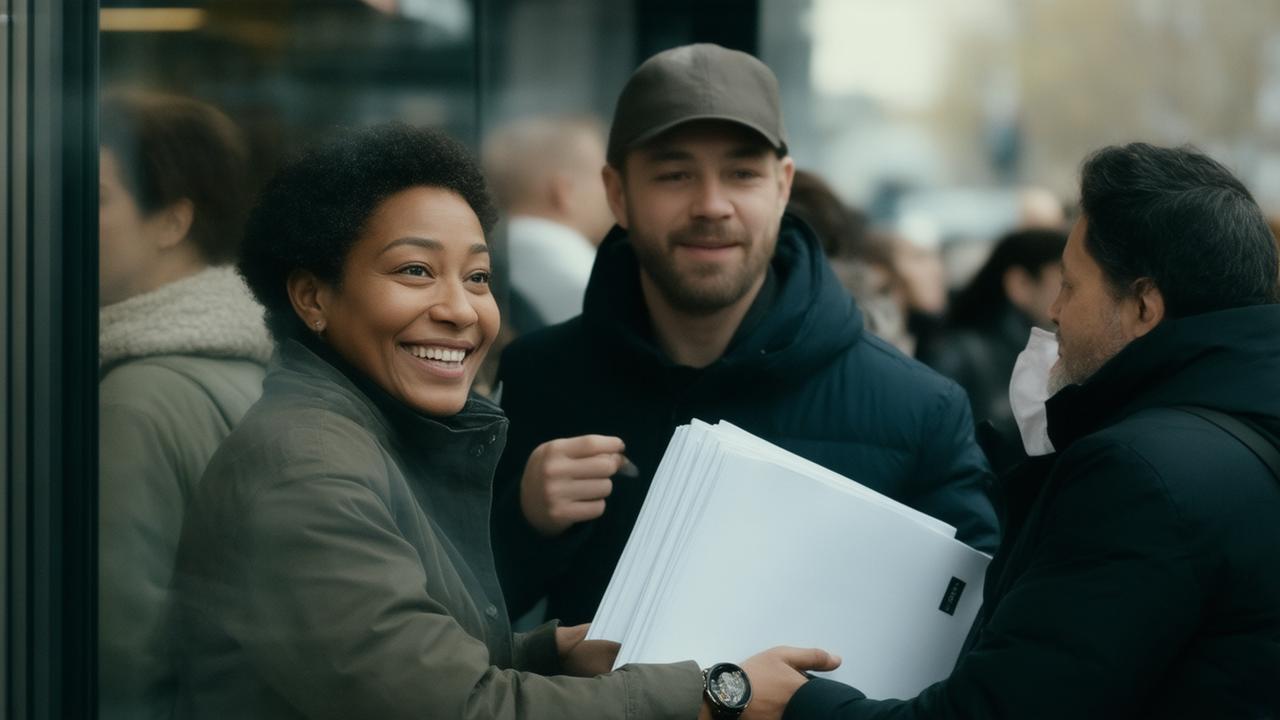
The moment you notice them, they’re already stepping aside. You’re juggling coffee, a buzzing phone, and the quiet panic of running late, when a stranger glances at you, reads the story written all over your posture, and says, “You go ahead.” It’s a tiny act, so small you could miss it if you weren’t paying attention. But your nervous system feels it immediately. Your shoulders drop a little. The clock in your head stops screaming. And in that small exchange, you’re reminded: other people see you. Not just as an obstacle in a line, but as a human being with a day, with a mood, with a life.
The Quiet Superpower Hiding in Everyday Lines
Most of us treat lines as temporary battlefields. First come, first served. Eyes down, attention glued to our phones, counting the people ahead, calculating whether we’ll make it on time. But then there are those rare people who do something different. They stand there, fully present, observing, almost like they’re listening to the emotional temperature of the space.
Maybe you’ve met one in the grocery store: they notice the parent with a restless toddler, the nurse in scrubs glancing anxiously at their watch, the delivery driver who looks like they’ve already lived two days before 10 a.m. And without fanfare, they wave them forward. “You look like you’re in a hurry. Please, go ahead.” No lecture on kindness. No social media post about it later. Just a simple, situational decision.
Psychology has a quiet fascination with moments like these. They’re not grand, heroic sacrifices. They are the tiny, real-time decisions that reveal how a person’s mind is wired to notice others. People who naturally let someone go first in line when they seem rushed are doing much more than being “nice.” They’re demonstrating a cluster of situational awareness traits that most of us never fully develop, mostly because we’re lost in our own thoughts, stress, and schedules.
These traits don’t show up on resumes. They don’t get you a promotion or a gold star from your boss. But they change rooms. They shape how safe people feel around you. They influence trust, cooperation, and how your presence lingers in someone’s memory long after they’ve stepped out of that line.
Situational Awareness in Everyday Life
Situational awareness sounds like something from a pilot’s manual or a tactical training course. But in daily life, it’s much simpler and more human: noticing what’s happening around you, understanding what it means, and responding in a way that makes things just a little better, not just for you—but for others too.
To get a sense of how this plays out in small moments, look at this quick comparison between the “default” way of standing in line and the mindset of someone who intuitively lets others go first:
| Typical Line Behavior | High Awareness Line Behavior |
|---|---|
| Focused on personal schedule and frustration. | Scans others’ faces, posture, and urgency. |
| Sees others as competition for time. | Sees others as people with different pressures. |
| Resents delays, assumes the worst of the system. | Accepts delay, looks for ways to ease tension. |
| Thinks “I just want to get this over with.” | Thinks “Who here might need this more than I do?” |
The difference may seem small, but under the surface, entirely different psychological patterns are at work. Letting someone go ahead in line when they clearly look rushed is a doorway into six lesser-known traits that reveal a deeply tuned, outward-focused awareness.
1. Micro-Observation: Reading the Tiny Signals
Think about how much you have to notice, in just a second or two, to decide that someone should go before you. Their weight shifting from foot to foot. Their eyes flicking to the clock. The way their shoulders tighten when the line doesn’t move. The impatient checking of a phone—not the bored kind, but the anxious, desperate kind.
This is micro-observation: paying attention to small behavioral cues that most people simply blur out as background noise. It’s not mind reading—it’s pattern reading. Psychologists know that humans leak emotional states through posture, gestures, facial micro-expressions, and even how they hold objects in their hands. People with strong situational awareness unconsciously gather this data, almost like a quiet radar turned outward, not inward.
The person who lets you step ahead didn’t need to know your life story. They read the shorthand in your body language. And importantly, they didn’t just notice—they cared enough to act.
2. Empathic Imagination: Filling in the Story You Didn’t Tell
In that brief moment, they also did something softer and quieter inside: they imagined your life. Not in detail, but in essence. Maybe you’re late for work. Maybe you’re afraid of getting charged a fee if you miss this appointment. Maybe you’ve had one of Those Mornings where everything breaks or spills or snaps.
This is empathic imagination—the ability to build a plausible story about what someone else might be going through, even when you don’t have concrete proof. Psychology links this to cognitive empathy: not just feeling what someone else feels, but understanding that they have a complex inner world at all.
Most people stop at “They’re impatient.” The aware person goes a step further: “There’s probably a reason they’re impatient.” That leap—from judgment to curiosity—is where genuine kindness begins. It doesn’t require you to be right about their story. It only requires you to honor that there is one.
3. Ego Suspension: Letting Your Own Urgency Step Aside
Here’s something important: the person who lets you go ahead isn’t necessarily free of their own worries. They might be tired too. They might have somewhere to be, a to-do list hanging over their day like low clouds. But in that instant, they do something psychologically rare: they suspend their ego’s demand to be first.
Ego suspension doesn’t mean erasing your needs or becoming a doormat. It means loosening the grip of “me first” just enough to let other people’s realities matter. Many of us are so wrapped in our own time pressure that we unconsciously treat our schedule as more valid, more serious, more real than anyone else’s.
The quietly aware person entertains a radical possibility: “What if my time is not more important than theirs?” It’s such a simple thought, but it moves the center of gravity away from the self and opens up room for generosity. They don’t dramatize it. They just quietly decide, “I can spare two minutes. They probably can’t.”
4. Emotional Regulation: Calm Enough to Be Kind
You can’t notice much around you if your own nervous system is on fire. When you’re flooded with stress, your field of attention narrows. Tunnel vision kicks in. The world becomes a single problem: my delay, my frustration, my day.
People who naturally let others go ahead often possess stronger emotional regulation in that moment. Maybe they’ve practiced it over years; maybe it’s a trait they’ve carried since childhood. They know what it feels like to be rushed and overwhelmed, so when they have the luxury of calm, they protect it—and share from it.
Instead of letting irritation build, they breathe. They accept the line. They allow the waiting. From that grounded place, they have enough emotional bandwidth left to scan the room and make space for someone clearly more on edge. Their calm isn’t just a personal comfort; it becomes a resource others can borrow for a moment.
5. Pro-Social Initiative: Acting Without Being Asked
Awareness without action is just observation. What sets these people apart is that they move first. No one asks, “Can I cut in front?” They don’t wait for a manager to rearrange the line. They recognize a small imbalance and correct it voluntarily.
Psychologists call this pro-social behavior—actions intended to benefit others. But there’s a special layer here: initiative. Many people feel empathy, yet freeze, unsure whether it’s their place to intervene. The person who steps aside has quietly answered that question for themselves: “If I see a way to help, and the cost to me is small, I’ll just do it.”
Their kindness is low-drama and low-cost, but its impact can be disproportionate. Sometimes, being given those few extra minutes changes how the entire rest of your day feels. You walk away with a tiny restored faith in humanity, carried like a warm stone in your pocket.
6. Social Atmosphere Sensing: Tuning into the Room’s Invisible Weather
Beyond just noticing one rushed person, the situationally aware mind feels the whole social climate of the line. They sense when tension is building: the impatient huffing, the eye rolls, the subtle chain reaction of irritation. They don’t just see individuals; they feel the atmosphere.
This is social atmosphere sensing—recognizing that a group of people, even strangers waiting for coffee or prescriptions, creates an emotional field. Some people amplify the stress in that field: loud sighs, muttering complaints, visible agitation. Others, often without realizing it, lower the emotional temperature.
➡️ France suffers a €3.2 billion blow as a last-minute reversal kills a major Rafale fighter jet deal
➡️ Neither boiled nor raw : the best way to cook broccoli for maximum antioxidant vitamins
➡️ France turns its back on the US and drops €1.1 billion on a European detection “monster” with 550 km reach
➡️ Day will turn to night during the longest total solar eclipse of the century occurring across regions
➡️ No more duvets in 2026? The chic, comfy and practical alternative taking over French homes
➡️ Seniors behind the wheel: will licenses be pulled automatically after 70 from ?
➡️ Goodbye kitchen cabinets: the cheaper new trend that won’t warp, swell, or go mouldy over time
Letting someone go ahead is a small act, but it sends a quiet signal to everyone watching: “We can be decent to each other, even when we’re all tired and busy.” It softens the mood. Eyes relax. Someone else might smile. The line doesn’t move faster, but it feels less hostile. And the person who made that decision has, in a tiny way, shifted the emotional weather of the room.
Why Most People Miss These Moments
It’s tempting to frame all this as “some people are kind, most aren’t,” but that’s too simple and too harsh. The bigger reason most people don’t develop these traits isn’t cruelty—it’s distraction. Modern life pulls our attention inward: screens, notifications, mental to-do lists, private worries looping in our heads.
We rush into public spaces still inside our own personal worlds. We stand in line physically present but mentally miles away. And when you’re not truly in a space, you can’t read it. You can’t feel the person behind you shifting their weight nervously or notice the tremor in someone’s exhale.
But the hopeful truth is that these traits are trainable. You don’t need a special personality type. You only need to experiment with tiny shifts:
- Look up from your phone while you wait.
- Scan faces and postures, just to see what’s there.
- Ask yourself, “Who here looks like they really need this to go faster?”
- When you’re not in a rush, consciously offer your spot.
At first, it might feel awkward or unnecessary. But over time, your mind starts to expect these micro-moments of choice. Your attention stretches outward more easily. You begin to notice how often people are quietly carrying urgency and strain, and how little it sometimes takes to ease it.
Becoming the Person Who Steps Aside
The world won’t applaud you for letting someone go first in line. There will be no standing ovation in the pharmacy or the coffee shop. Most people will forget your face by the time they step back into the blur of their day. But some part of their nervous system will remember: “In that moment when I was stressed, someone saw me and made room.”
Psychology might label it situational awareness, empathic imagination, or pro-social behavior, but at ground level, it feels like something much simpler: shared humanity. A sense that we’re not alone in our little personal races against time.
You don’t have to save the world to change the texture of a morning. You don’t have to be endlessly selfless. You just have to be present enough, calm enough, and curious enough to notice: that person looks like they need this more than I do. And then—without a speech, without a fuss—you step aside.
In a culture that teaches us to guard our time like treasure, that tiny gesture is quietly radical. It says, “My life matters, but so does yours.” It’s an invitation to live as if other people’s urgency is as real as our own.
And maybe, one day, when you’re the one racing the clock, heart in your throat, someone in front of you will glance back, read the story on your face, and say the words that can soften even the hardest day: “You go ahead.”
FAQ
Is letting someone go first in line always the right thing to do?
No. If you’re in a true emergency yourself or you’re already under serious time pressure, it’s okay to keep your place. Situational awareness includes recognizing your own limits. The point isn’t self-sacrifice at all costs—it’s choosing generosity when you genuinely have the capacity.
Can these awareness traits be learned, or are they just personality-based?
They can absolutely be learned. While some people are naturally more observant or empathetic, practices like looking up from your phone, paying attention to body language, and asking yourself what others might be feeling can strengthen these skills over time.
What if I misread someone and they’re not actually in a rush?
That’s okay. Offering your spot is still a kind gesture, even if their situation isn’t as urgent as you assumed. You’re not required to be perfectly accurate in your perceptions; you’re simply choosing to be generous.
Could people take advantage of this kind of kindness?
Occasionally, yes. Some people might exploit others’ consideration. But in most everyday situations, the cost to you is only a minute or two. You can still set boundaries and choose when it feels right to offer your place and when it doesn’t.
How can I practice this if I’m usually very anxious or rushed myself?
Start small. Choose one situation a week where you know you’re not in a hurry and intentionally practice noticing others in line. As you gradually build comfort and emotional regulation in low-stress moments, it becomes easier to extend awareness even when you’re slightly pressured.





