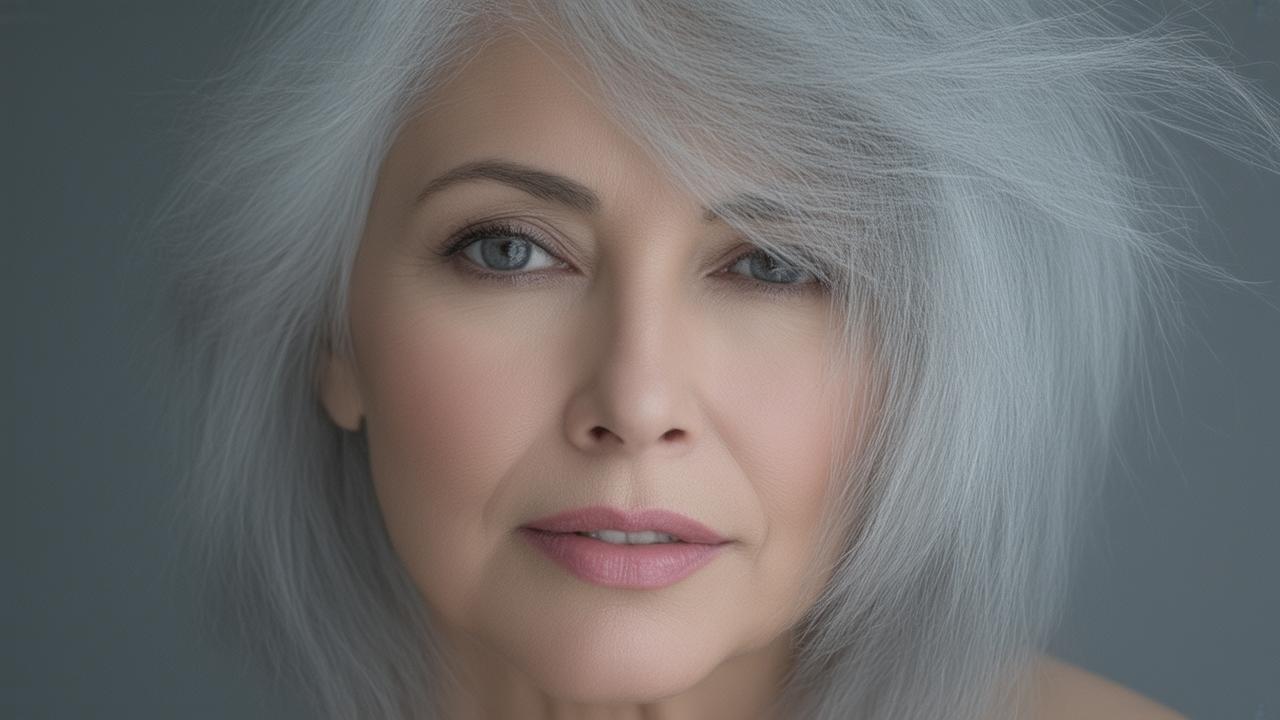
The woman in the mirror is not quite the same one who walked into the salon an hour ago. Her eyes are curious, searching. The cape still clings to her shoulders, a soft swish of black fabric, and bits of hair dust her collarbones like pale confetti. The stylist lifts a strand near her temple and lets it fall, slow-motion, back into place. Under the warm salon lights, there’s no harsh line between brown and silver, no telltale band of grow-out. Instead, it all seems to dissolve into itself—chestnut, mushroom, soft pearl gray—like watercolor spreading on wet paper.
“So this is… what did you call it?” she asks, leaning closer to the mirror.
“Melting,” the stylist says. “Color melting. It’s what comes after balayage when you’re ready to stop pretending your gray hair doesn’t exist.”
She laughs, but there’s a quiet exhale of relief in it. For the first time in a long time, she doesn’t feel like she’s in a battle with her hair. It just looks like… her. Only softer, easier. Almost like the gray never mattered at all.
The Era of Balayage—and Why It Started to Feel Like Work
Balayage once arrived like a revolution. Gone were the days of stripy foils and high-contrast highlights that grew out like a barcode. With its painterly sweeps of color and sun-kissed, lived-in results, balayage felt natural, effortless, even romantic. For years it owned the mood boards: beachy brunettes, California blondes, low-maintenance blondish brunettes who could go months between salon visits.
But then another revolution arrived—this time not from a product or a trend, but from biology. The first wiry silver hair at the part line. A cluster of pearly strands near the temples. The slow, inevitable scatter of gray, like the earliest stars in a barely darkened sky.
Balayage could play defense for a while. Lightly painted pieces helped blur the contrast between dark roots and scattered white hairs. For some, it still does. But for many, something started to feel… off. Balayage was designed to mimic the sun, not camouflage an entirely new pigment pattern sprouting from the scalp. The graceful, lazy grow-out became less graceful when stark grays popped through the artfully painted ribbons of caramel and honey. Instead of low-maintenance, the whole situation began to feel like a constant catch-up game.
And then there was the emotional piece. To keep balayage looking “perfect,” you had to keep erasing the very thing your body was clearly, calmly doing: aging. Changing. Evolving. There’s a particular kind of exhaustion that comes from constantly trying to outsmart your own reflection.
Some people responded by going all in: frequent root touch-ups, glosses, toners, a calendar of color appointments that read like a second job. Others swung to the opposite extreme, letting the gray grow in all at once and living through that long, uneven, half-and-half phase that feels like walking around with your own visible progress bar.
Somewhere between those two extremes—total camouflage and total surrender—another option emerged. Not a trend with glittering before-and-after photos, but a quiet recalibration: blending instead of hiding, melting instead of masking.
What “Melting” Really Is (and What It Isn’t)
Color melting is a technique, but it’s also a shift in attitude. If balayage was about mimicking sun and surf, melting is about making transition invisible. It doesn’t ask your hair to be one thing or another—fully colored or fully gray. Instead, it lets the two coexist so gracefully that your eye stops insisting on categorizing them.
Technically speaking, melting is the seamless transition between multiple shades—usually three or more—applied in such a way that you can’t see where one ends and the next begins. Think of it as a gradient rather than stripes: root color (which might even be your natural gray), a soft mid-tone, and brighter or deeper ends, all blurred into one another. No horizontal lines, no blocky regrowth, no harsh demarcation when the next inch of natural hair appears.
Where balayage often highlights select pieces of hair, leaving others entirely untouched, melting tends to involve more of the head, strategically. It doesn’t have to mean heavy coverage, but it does mean intentional overlapping tones rather than isolated ribbons of color. It’s more mist than brushstroke—less about light vs. dark and more about the spaces between.
And here’s the key when gray enters the chat: melting doesn’t fight the gray. It acknowledges it. Your stylist looks at your natural pattern—the clusters near the temples, the sprinkling on top, the lower density at the nape—and builds a color story that uses those silvers as part of the palette, not an enemy to be defeated.
From Battle to Blend
If you’ve ever stared at your regrowth and thought, “If only this didn’t look so harsh,” melting is the answer to that thought. It’s less “covering” and more “softening the contrast.” Hair that once felt like a battlefield—dark vs. white, dyed vs. natural—suddenly becomes a field of micro-shifts, tiny tone changes that let your eye glide instead of snag.
The magic is not that melting makes gray invisible. It’s that it makes gray unimportant. Forgettable, in the best sense of the word. People will see your hair color, not your gray hair.
Inside the Salon: What Melting Actually Feels Like
The experience of getting a melt done has its own rhythm. The cape, the consultation, the slightly too-bright lights overhead—it’s familiar. But the conversation is different. Instead of “What color do you want to be?” it’s often “How much of your natural do you want to see?” and “What do you want maintenance to feel like?”
Your stylist studies more than just your roots. They look at your skin tone in daylight vs. indoor light. The density of gray on different parts of your head. How your hair falls, how it curls or straightens, where it naturally separates. They’ll often choose a root shade that softly echoes your natural base—maybe a smudged mushroom brown or a dark ash blonde—then build in intermediary tones that echo your existing grays: smoky latte, cool beige, soft pearl. The ends might drift lighter or stay close to your base, depending on whether you’re craving dimension or subtlety.
Processing time smells faintly of developer and toner, a muddle of salon fragrances and the low murmur of other conversations. When your hair is finally rinsed—warm water rushing over your scalp like a small private waterfall—there’s a sense that something has been lifted, rather than simply coated.
Then comes the mirror moment. Hair blown dry, soft light catching on the new landscape of color. If balayage used to make you say, “I love my highlights,” melting more often makes you say, “My hair looks… really healthy,” or, “I don’t notice the gray anymore.” It feels less like a costume and more like an edited version of your own story.
A Quick Look: Balayage vs. Melting for Grays
Here’s a simple comparison to understand how melting shifts the experience when gray hair becomes part of your life:
| Aspect | Balayage | Melting |
|---|---|---|
| Goal | Sun-kissed, highlighted contrast | Seamless transition & gray blending |
| Gray Hair Approach | Often tries to hide or distract | Integrates gray into the color story |
| Grow-Out Line | Can become obvious as grays increase | Soft, blurred, less noticeable |
| Maintenance Feel | More frequent adjustments with heavy gray | Longer stretches between visits |
| Best For | Those with minimal gray or chasing brightness | Those wanting to soften, not erase, their gray |
The Strange Freedom of Letting Gray Be “Forgotten”
There’s a moment, usually a few weeks after a melt, when the real payoff shows up. The fresh-from-the-salon polish has mellowed. Your natural roots have inched forward. You’re in the bathroom, maybe half-dressed, hair piled in a towel. You catch a glimpse of yourself and brace for that familiar jolt: the sharp contrast, the unmistakable band of growth. Except… it doesn’t come.
Instead, your roots slide quietly into the rest of your hair. You see a little sparkle near the crown, a soft halo of lighter strands by your forehead, but nothing screams “new gray.” It just looks like dimension. Like texture. Like variation the way bark has variations, or river stones, or the inside of a seashell.
This is what people mean when they say melting makes gray hair forgettable. It doesn’t vanish. Your hair hasn’t time-traveled back ten years. But it has stepped out of the spotlight. Other things take center stage: the health of your hair, the way the shades complement your eyes, the overall harmony of the color with your skin. Gray becomes background noise—present, but not demanding attention.
There’s a psychological shift inside that, subtle but powerful. The feeling that you’re no longer in an arms race with your regrowth. The sense that you can book your next color appointment because you want a refresh, not because you’re desperate to hide what’s showing. The relief of not holding your breath every time you lean into a mirror in harsh morning light.
Goodbye Balayage, Hello… Ease
Saying goodbye to balayage isn’t about denouncing it. For many, it was the stepping stone to something gentler: an understanding that hair color can be soft and dimensional without pretending aging doesn’t exist. But if balayage was the era of sun-kissed illusion, melting might quietly mark the beginning of something else—an era of coexistence.
You can still love warmth or coolness, depth or brightness. You can still be brunette, blonde, or somewhere deliciously in between. The difference is in the way the gray is invited to sit at the table instead of being shoved out of the room. The way the mirror begins to feel like an ally again.
Is Melting for Everyone? Listening to Your Hair (and Your Calendar)
Not every head of hair—or every lifestyle—wants the same thing. Some people feel most like themselves with strong, solid color and crisp coverage. Others dream of full, natural silver and the clean slate of stopping color altogether. Melting lives in the expansive space between those poles.
➡️ Forget Burj Khalifa and Shanghai Tower: Saudi Arabia now readies a bold 1km-tall skyscraper
➡️ Doctors under fire as they warn seniors with joint pain to avoid swimming and Pilates and choose this unexpected activity instead
➡️ According to psychologists, the simple act of greeting unfamiliar dogs in the street is strongly linked to surprising and highly specific personality traits that reveal more about you than you think
➡️ Every autumn, gardeners make the same mistake with their leaves
➡️ France ships 500-tonne nuclear ‘colossus’ to power the UK’s new generation III reactor at Hinkley Point C
➡️ NASA will say goodbye to the International Space Station in 2030 and welcome commercial space stations
➡️ Psychology teams identify three recurring color preferences linked with fragile self-confidence
If you’re wondering whether it’s for you, you might start by asking a few quiet questions:
- Do I feel exhausted trying to keep my grays covered?
- Am I curious what a softer version of my natural color could look like?
- Do I want my hair appointments to feel less urgent and more optional?
- Could I be okay with seeing some gray, as long as it doesn’t dominate?
If the answers lean toward yes, melting can be a bridge. It can carry you from solid-color dependency to a place where you could, someday, be almost entirely natural, and no one would ever know when the “real” gray started.
It’s also kind to your calendar. Because the technique is built around blending and harmony, regrowth is naturally more forgiving. Instead of frantically booking a root touch-up every three or four weeks, you might find yourself stretching to eight, ten, even twelve weeks between color sessions. In between, a simple gloss or toner can refresh the tone without restructuring the whole look.
Talking to Your Stylist About Melting
You don’t have to walk into your salon and brandish the word “melting” like a secret password. What matters is describing how you want your hair to feel and behave:
- “I want my gray to blend in so that grow-out doesn’t feel stressful.”
- “I’d like a soft, diffused root and more seamless transitions between shades.”
- “I don’t mind seeing some gray; I just don’t want any harsh lines.”
- “Can you use my natural gray as part of the dimension, instead of fully covering it?”
A good colorist will understand the language of blending, smudging, and diffusing. They may use glazes, lowlights, softly shadowed roots, and multiple toners to create the effect. The terminology can vary, but the intention is the same: to stop fighting what grows and instead design around it.
Living With Melted Color: Care, Texture, and the Quiet Joy of Enough
Once you’ve stepped into this world of blended ease, maintenance becomes less about strict rules and more about gentle support. Color-safe shampoos, nourishing conditioners, and periodic masks help keep your mid-lengths and ends glossy without over-stripping your grays, which can be naturally drier or more fragile.
Heat styling takes on a new tone, too. When your color story is all about softness and gradient, hair that retains a hint of its natural movement often looks even more beautiful. Loose waves show off the subtle shifts in tone. Curls catch the light on silver threads that now read as intentional sparkle, not something to hide. Even straight hair benefits: the sleek sheet of color looks richer, more nuanced, less like a single block and more like finely woven fabric.
Over time, something else may happen—a kind of quiet recalibration of what “enough” looks like. Your relationship to perfection loosens. A few extra gray strands at the front become an accent, not an emergency. You learn to trust that your next appointment will refine, not rescue, your hair.
Goodbye, then, to balayage as the only answer to modern color. Not with bitterness, but with gratitude for what it taught us: that hair doesn’t have to be rigid or high-maintenance to be beautiful. And hello to melting—the technique that doesn’t ask you to abandon your gray or your love of color, but lets them share space in the most disarming way.
The woman in the mirror tilts her head one last time, watching the light slide over her newly melted hair. “It just looks like me,” she says finally, surprised by how much she likes that sentence. The stylist smiles, unclips the cape, and tiny flecks of old color fall to the floor, swept quietly away with everything she no longer needs to carry.
FAQ: Melting and Gray Hair
Does melting completely hide gray hair?
No. Melting is about blending rather than erasing. Your gray becomes part of a soft gradient of shades, so it’s far less noticeable, but not fully covered the way solid root color would be.
How often do I need to touch up a melted color?
Most people can go 8–12 weeks between appointments, depending on how fast their hair grows and how much contrast exists between their natural shade and the melted tones.
Can melting work if I already have a lot of gray?
Yes. In fact, melting is especially beautiful on high-gray-density hair, because your natural silver can be used to create luminous highlights and soft transitions instead of fighting them with strong, opaque dyes.
Will melting damage my hair more than balayage?
Not necessarily. Because melting often focuses on toners, lowlights, and strategic blending rather than heavy bleaching, it can be gentler than traditional highlight-heavy balayage. The exact impact depends on your starting color and the products used.
Can I switch from solid root color to melting?
Absolutely. Many people use melting as a transitional strategy to move away from frequent root touch-ups. Your stylist may need a couple of sessions to break up the solid color and introduce softer gradients, but the result is usually a far more forgiving grow-out.
Is melting only for brunettes?
No. Melting works on blondes, redheads, brunettes, and everything in between. The key is choosing tones that harmonize with your natural base and gray pattern, whether that means cool, ashy blends or warmer, golden transitions.
What should I ask my stylist if I’m interested in melting?
Tell them you want soft, blended color that integrates your gray, minimizes harsh regrowth lines, and stretches the time between appointments. Bring photos that show subtle gradients rather than strong highlights, and be honest about how much gray you’re comfortable seeing.





