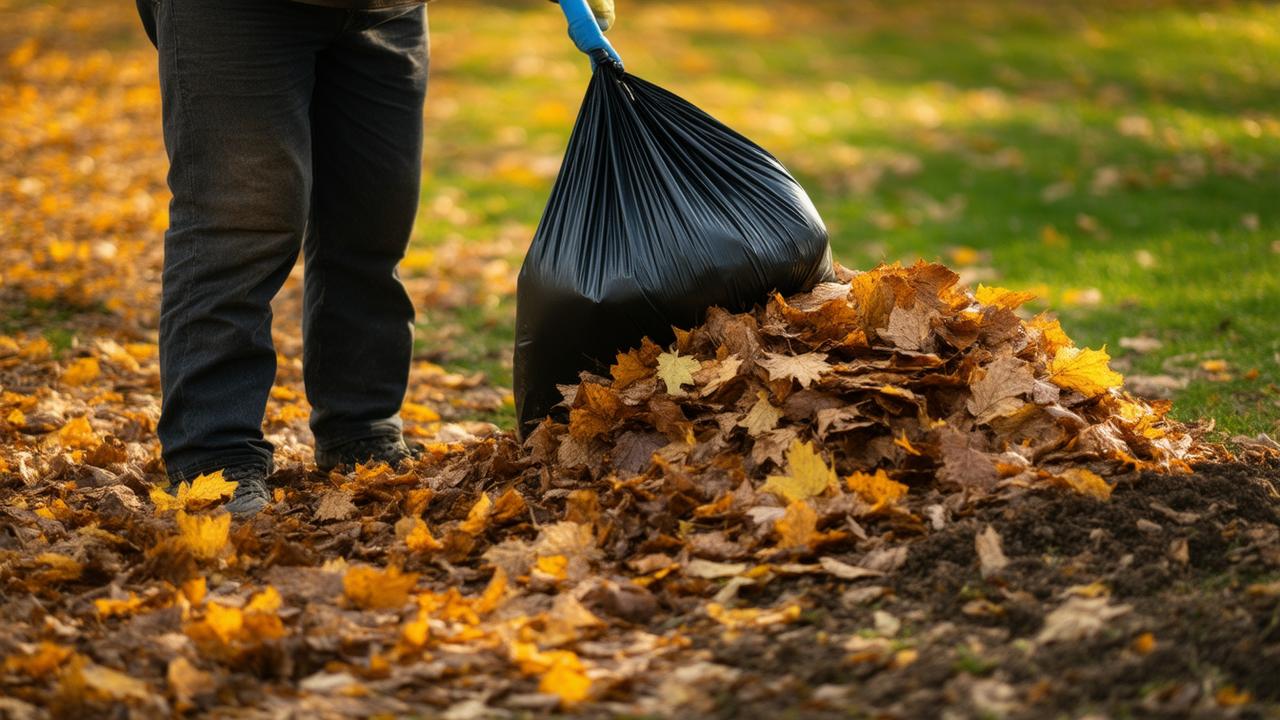
The first cold night slid in quietly, the way real change always does. By morning, the maple at the end of the yard had given up half its leaves, and the lawn looked like someone had shaken out a giant quilt of gold and rust and crimson. You could smell it in the air—that faint, sweet rot of the year exhaling. A neighbor’s rake scraped the sidewalk in that familiar autumn rhythm: pull, drag, gather, bag. Somewhere, a gas leaf blower whined into life, chasing every last leaf into a corner as if they were intruders that had overstayed their welcome.
Every autumn, the same ritual plays out on street after street. We stuff leaves into crinkly plastic bags, drag them to the curb, and feel oddly virtuous for “cleaning up.” The yard looks tidy, the edges are sharp again, the grass is visible. But in our quest for neatness, we’re quietly dismantling one of the most important seasonal gifts nature offers us—for free.
The Annual Leaf Panic
There’s a moment every fall when the leaves shift from “pretty” to “problem.” At first, they’re something to marvel at out the window, a living painting that changes by the hour. Then, after a storm or a gusty night, they’re suddenly “yard work.” They’re “clogging the gutters,” “smothering the grass,” “making a mess.”
So the panic begins. We haul out rakes, tarps, leaf blowers, collection bins. Lawns are scraped nearly bare. Garden beds are brushed clean as if something dangerous might happen if a single oak leaf dares to linger under the hydrangeas. There’s a low-level anxiety that if we don’t clear every inch, we’re failing as responsible homeowners.
But step back for a moment and look at the forest. Nobody rakes there. Nobody runs a blower between the trunks of old beeches. Nobody bags up leaves in tidy plastic shrouds. Yet somehow, the forest doesn’t die of suffocation. The trees get bigger. The soil deepens. Life below the surface gets richer. The forest functions because of those leaves, not in spite of them.
The mistake gardeners make every autumn is simple and widespread: we treat fallen leaves as trash instead of treasure. We see a problem where nature has handed us a complete system. The leaves are both the blanket and the pantry for everything that lives in the soil—and for more creatures than most of us realize.
What’s Hiding in a Leaf Pile
Pick up a handful of damp leaves from the corner of a quiet, un-raked yard and really notice them. The top layer is crisp and colorful. Underneath, they’re darker, softer, almost leathery. Go deeper and you’ll find them half-decayed, dissolving into a fine, crumbly humus that smells like earth after rain. This is not “yard waste.” This is a slow-motion miracle.
In that layered pile lives an entire hidden neighborhood. Overwintering butterflies tuck themselves into curled leaves, their chrysalises disguised as bits of bark and debris. Fireflies—those childhood summer stars—spend most of their lives as larvae in the leaf litter, hunting, waiting, depending on that moist, protected layer to survive until next summer’s warm evenings.
Native bees nest in hollow stems and in the loose soil beneath the leaves. Ladybugs cluster in sheltered pockets. Countless moths, beetles, spiders, and microscopic decomposers use that “mess” as their winter shelter, their nursery, their pantry. When we strip the ground bare every fall, we’re not just removing leaves. We’re throwing out entire generations of beneficial insects and the food chain they support.
And then there are the birds. The ones that show up in your yard in early spring, flicking through the beds and borders, aren’t just admiring your plant choices. They’re looking for food—larvae, pupae, insects—all the tiny lives that survived the winter in the leaf litter. A “clean” bed is a silent bed. An untidy one is a breakfast buffet.
The Leaf–Soil Conversation
Beyond shelter and habitat, leaves are constantly holding a quiet conversation with the soil. As they break down, they feed it. Nutrients that the tree pulled up through its roots all summer long are returned to the ground in a soft, steady rain. Calcium, magnesium, trace minerals—things we’re often told to buy in bags or bottles—are all contained in that autumn fall.
Left in place on garden beds (or moved there thoughtfully), leaves become a living mulch. They moderate soil temperature, protect plant roots from freeze–thaw cycles, and conserve moisture. Worms pull shredded pieces down into their tunnels, mixing them into the soil structure. Fungi thread their way through the layers, transforming leaf tissue into long-term organic matter, deepening the soil’s capacity to hold water and support life.
When we drag those leaves to the curb, we don’t just lose potential mulch and compost. We break the loop. The yard becomes dependent on us to replace what we just removed—with purchased fertilizers, bark mulch, and soil amendments that attempt to mimic what the leaves would have done on their own.
But What About the Lawn?
This is usually where the protest rises: “If I leave the leaves, my grass will die.” The truth is more nuanced—and more generous. Yes, a thick, unbroken mat of large leaves left all winter on a manicured lawn can cause problems. It can block light, trap too much moisture, and encourage fungal issues. Grass, especially the pampered kind we tend, likes to breathe.
But that doesn’t mean your only options are “bag everything” or “let it smother.” The middle ground is where the magic happens. Instead of seeing leaves as an enemy of the lawn, think of them as raw material to be redirected.
| Leaf Situation | Simple Action | Benefit |
|---|---|---|
| Light, scattered leaves on lawn | Run mower over them to shred in place | Feeds lawn, no smothering |
| Moderate layer of leaves | Rake or blow onto garden beds | Free mulch and habitat |
| Very thick, wet mats of big leaves | Shred, then use for compost or beds | Prevents smothering, speeds breakdown |
| Leaves in pathways or hardscape | Sweep into nearby beds instead of bagging | Less waste, more soil cover |
A light layer of leaves can actually help your lawn, especially if you run a mulching mower over them. The pieces sift down between the blades of grass, break down over winter, and return nutrients to the soil. Studies have shown that lawns mulched with shredded leaves can be just as healthy—if not healthier—than lawns kept obsessively clean.
The thick, ankle-deep drifts? Those are perfect for elsewhere. Rake them into rings around trees and shrubs, spread them in vegetable or perennial beds, or pile them into a corner to become a slow, cold compost heap. The key isn’t removal; it’s relocation.
The Garden Beds Are Begging You to Be Messy
If there’s anywhere in your yard that wants to be “messy” in autumn, it’s your garden beds. That bare, brown soil we often see in late fall and early spring is not a natural state. In wild landscapes, soil is almost never left naked. It’s covered with leaves, fallen stems, moss, or other plant litter that buffers the living world beneath.
Your perennials, shrubs, and young trees benefit enormously from a leaf cover. Think of it as tucking them in for winter. Spread a generous, fluffy layer over the roots, leaving a bit of breathing room around the crowns of delicate plants. Those leaves will insulate against temperature swings, reduce weed growth, and invite in the microbial and insect life that keeps soil thriving.
It might feel a little rebellious to resist the urge to clip everything down and haul everything away. But that’s because we’ve been taught that “good gardening” looks like control. The quiet truth, seen in any thriving woodland, is that good gardening often looks like letting go of some of that control—just enough to let the system work.
➡️ Goodbye balayage : “melting,” the technique that makes gray hair forgettable
➡️ Forget Burj Khalifa and Shanghai Tower: Saudi Arabia now readies a bold 1km-tall skyscraper
➡️ Doctors under fire as they warn seniors with joint pain to avoid swimming and Pilates and choose this unexpected activity instead
➡️ According to psychologists, the simple act of greeting unfamiliar dogs in the street is strongly linked to surprising and highly specific personality traits that reveal more about you than you think
➡️ France ships 500-tonne nuclear ‘colossus’ to power the UK’s new generation III reactor at Hinkley Point C
➡️ NASA will say goodbye to the International Space Station in 2030 and welcome commercial space stations
➡️ Psychology teams identify three recurring color preferences linked with fragile self-confidence
Where the Real Work Happens (And It’s Not in Your Trash Bags)
Stand at the curb on a typical suburban street in November and look at the enormous bags of leaves lining the edge like a strange, papery wall. All that organic matter, all those nutrients, all that potential habitat, sealed up and sent away. It’s like watching people box up their pantry and put it out for collection, only to go to the store and buy food replacements the next day.
The real work of the garden, the deep work, happens in quiet, mostly invisible ways. It happens as a slow crumble of leaf edges under January snow. It happens in the soft sounds of worms tugging shreds of leaf into tunnels. It happens in the fungi exchanging resources with plant roots, fueled by the carbon in those fallen leaves.
When you let more leaves stay on-site—on lawns in shredded form, on beds in soft drifts, in corners as leaf piles—you’re not “being lazy.” You’re collaborating with a system billions of years in the making. You’re inviting back the parts of the year that most gardening magazines edit out between glossy photos: the off-season, the quiet season, the time when the garden looks asleep but is actually busy rearranging itself below your feet.
A Different Kind of Autumn Ritual
This doesn’t mean putting away your rake forever. It just means changing the story. Instead of the annual leaf purge, imagine a different autumn ritual. You walk the yard slowly on a crisp afternoon, breath puffing in front of you. You notice where the leaves are piling too thick on the lawn and where the garden beds look bare and exposed. You listen for the soft rustle of life underfoot.
You rake, but you rake with intention—moving leaves from where they’re a problem to where they’re a gift. You mow, but maybe you set the mower to mulch and make a couple of lazy passes instead of chasing every last leaf to the driveway. You leave that quiet, leaf-filled corner under the big tree untouched, knowing that somewhere inside it, a swallowtail chrysalis is dreaming of next summer.
By spring, the garden will answer back. The soil will feel richer under your fingers. The beds will hold moisture longer between rains. Birds will spend more time probing the ground. You might spot a few more fireflies in June, winking over the lawn at dusk. All because, one autumn, you decided not to make the same mistake as the year before.
Frequently Asked Questions
Will leaving leaves in my yard kill my grass?
Very thick, unbroken mats of leaves can damage grass, especially if they stay wet all winter. However, a light layer that’s been shredded with a mower usually benefits the lawn by feeding the soil and breaking down over time. The key is to mulch or relocate heavy accumulations rather than bagging everything.
Are leaves safe to use as mulch in flower beds?
Yes. Leaves make excellent natural mulch. Spread them in a loose layer over your beds, avoiding thick, compacted piles directly on top of plant crowns. Over time, they’ll insulate roots, suppress weeds, and improve soil structure as they decompose.
What about pests and diseases in leaf litter?
Most leaves are safe to keep and use on-site. If you know a particular plant had a serious fungal disease (like rose black spot or certain fruit tree diseases), you can compost those leaves separately at higher temperatures or dispose of them. For the majority of your garden, leaf litter supports beneficial life far more than it encourages problems.
Is it okay to leave leaves in vegetable gardens?
Yes, with a bit of care. After the growing season, you can add a layer of leaves to your vegetable beds to protect and feed the soil over winter. In spring, either rake excess leaves aside or lightly work partially decomposed ones into the top layer of soil before planting.
What if my town requires leaf collection?
If local rules or pickup schedules push you toward bagging, keep as many leaves as you reasonably can on your property—on beds, around trees, or in a dedicated leaf pile. Use municipal collection as a last resort, not the default, and remember: even shifting a portion of your leaves into your own garden makes a real difference for soil and wildlife.





