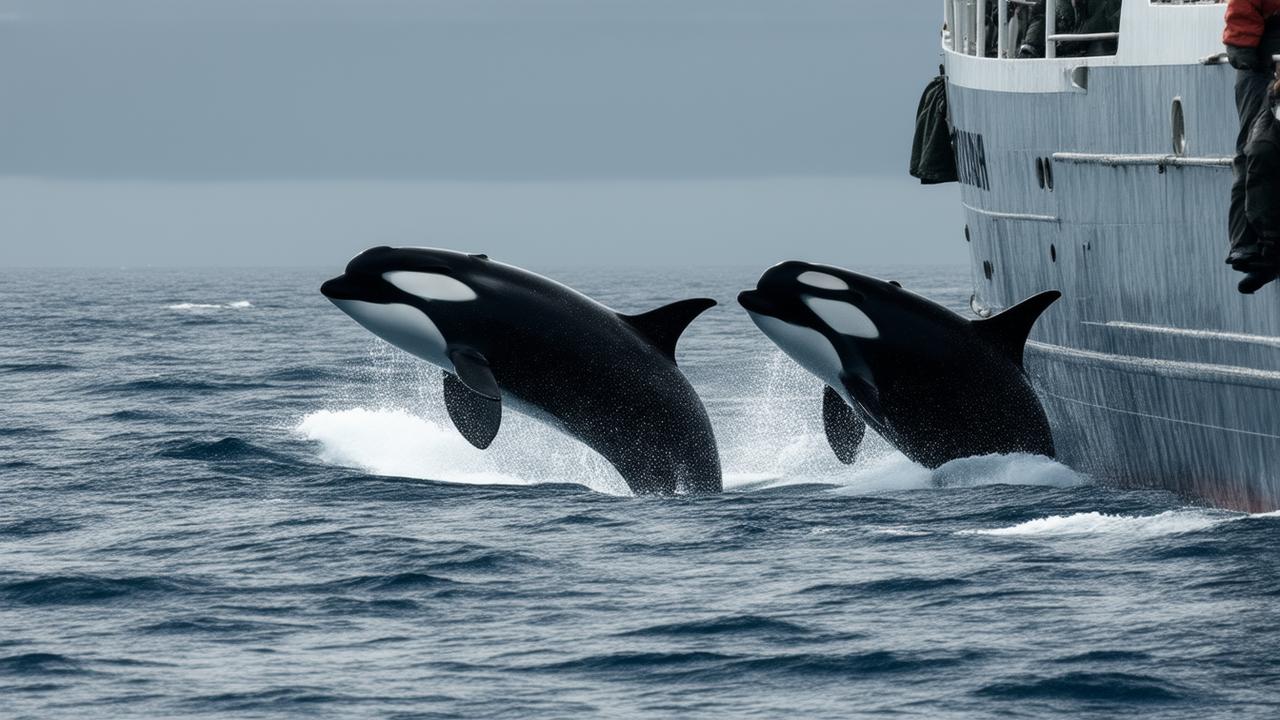
The first time the hull shuddered, the captain thought they had hit a submerged log. Just a dull, heavy thud beneath the waterline, followed by a strange, scraping vibration that hummed through the metal like a nervous heartbeat. The second impact, harder and more precise, left no room for doubt. Somewhere in the deep, something was not just bumping the vessel—it was aiming for it.
By the time the crew of the small sailing yacht rushed to the stern, the North Atlantic evening had turned slate gray, and the wind carried that faint, metallic tang of distant rain. The water behind them boiled with white patches and dark, slicing fins. There, almost unnervingly close, a group of orcas moved like coordinated shadows—circling, diving, rising again. One angled its massive head, nudged the rudder with the calm confidence of a creature that knew exactly what it was doing.
High above, gulls screamed and wheeled. The ocean rolled on as it always had, indifferent and ancient. But down below, beneath the hulls of sailboats, cargo ships, and fishing trawlers, something had shifted in the habits of the ocean’s top predator. And in recent months, the North Atlantic has been on quiet alert.
An Ocean That Suddenly Feels Smaller
The North Atlantic has always been a place of thresholds—between continents, between climates, between the known and the unknowable. But for the captains who have been navigating these waters for decades, something has changed. Not in the color of the sea, not in the shape of the storms, but in the feeling of being watched.
In reports filed from Portugal to the Strait of Gibraltar, from the coasts of Spain stretching up toward the Bay of Biscay and farther north, a pattern has emerged: orcas approaching vessels—particularly smaller commercial and recreational boats—and deliberately striking the rudders. The accounts share uncanny similarities. A sudden appearance of fins. A slow, circling movement. Then, the contact: a push, a ram, a twist of powerful jaws against the mechanical heart of the ship’s steering.
These are not random collisions; experts increasingly describe them as purposeful interactions. Some even go further, calling them “coordinated attacks,” the phrase heavy with implication. And while scientists hesitate to use language that hints at intent, the experiences at sea have shaken even the most seasoned mariners.
Imagine standing at the helm of a working fishing boat or a delivery yacht: the air heavy with salt, engine vibrating underfoot, horizon a clean, broad arc. Then your steering wheel goes slack. The boat yaws uncontrollably. Behind you, black-and-white forms glide through the water with unnerving grace. You are no longer in charge; something else has taken control of the script.
The Strange Intelligence of the Rudder Strikes
Orcas—often called killer whales, though they belong to the dolphin family—have long captured the human imagination with their intelligence. They teach each other hunting techniques, pass down dialects of vocalizations like cultural heirlooms, and adapt to new opportunities with startling speed. But what’s unfolding in the North Atlantic feels different. It feels personal.
Again and again, skippers report the same behavior: orcas honing in on the rudder, as though understanding it is the key to immobilizing the vessel. They ignore other parts of the hull, avoiding the deadly spinning propellers with almost surgical precision. Some nudge and bump, almost playfully. Others hit hard enough to splinter wood or warp metal.
The ocean may be vast, but patterns like this echo loudly. Researchers and marine biologists from Europe’s coastal nations have begun pooling data and testimonies to try to decode what’s happening. And as they listen, log, and analyze, one conclusion keeps rising to the surface: this is not random, and it is spreading among specific orca groups like a trend.
A Behavior That Feels Like a Story Spreading
Some scientists describe the phenomenon as a “fad”—a kind of orca meme passing through social groups. Orcas are known for this sort of behavioral contagion. In one population, individuals once carried dead salmon on their heads for weeks, as if wearing macabre hats. Another group learned to surf the wakes of big ships, turning industrial maritime traffic into their own leisure waves.
What makes the rudder-targeting unusual is the risk and impact. Disabling a ship is not harmless fun. It can leave a vessel adrift, send emergency signals flying, and even—if the sea turns rough—threaten human lives. And yet, from the orcas’ perspective, it may be something else entirely: a learned response, a reaction to a trauma, or simply a novel, stimulating interaction with a powerful new object in their environment.
Revenge, Curiosity, or Something In Between?
As soon as the first incidents began to circulate in the news and sailing communities, a familiar human story stepped forward: revenge. The idea is almost irresistible. Somewhere along the line, perhaps, an orca was injured by a boat—struck by a hull or sliced by a propeller—and began associating vessels with pain. That orca then started striking rudders, teaching others to do the same. A culture of retaliation born in the dark submarine corridors of memory.
It’s a compelling narrative, cinematic and primal. But like many good stories, it may not be entirely true. Evidence for a single “traumatized matriarch” leading a coordinated campaign is thin. Orca societies are complex, yes, but also practical. Attacking ships does not deliver food, and it burns energy.
Other hypotheses are less dramatic but no less fascinating. Perhaps the orcas are simply experimenting. For an animal whose life is spent in a three-dimensional, ever-shifting landscape of pressure, sound, and motion, a ship’s rudder is an irresistible anomaly: a moving, vibrating structure that sends shockwaves through the water whenever a human hand turns a wheel. An interactive toy on a scale only an ocean could provide.
There is also the possibility that this behavior is rooted in play. Many apex predators, especially those with advanced cognition, engage in play that would terrify smaller creatures sharing their space. Wolves practicing pack takedowns, lion cubs ambushing each other, young sharks investigating anything that splashes. For orcas, “play” might simply look like coordinated, high-energy experiments on the largest objects in their universe—our ships.
The Human Cost and the Quiet Fear
Whatever their motivation, the consequences ripple outward into human reality. Insurance claims rise as rudders snap. Shipping companies adjust routes, adding fuel costs and transit time to avoid hotspots. Smaller charter operators and fishermen, already pinched by changing quotas and shifting fish stocks, must now calculate the risk of an orca encounter into their margins.
On deck, the emotion is something more primal than economics. Fear, yes, but mixed with awe—an ancient unease that comes from realizing that we are not the only ones capable of planning, testing, learning. That somewhere underneath our boats, there is a mind watching us, reacting to us, perhaps even anticipating our moves.
Reading the Water: Where It’s Happening and How Often
The incidents are clustered, not random. Reports most commonly emerge from waters off the Iberian Peninsula, where a specific group of orcas, sometimes called the “Iberian subpopulation,” passes seasonally. Over time, their behavior seems to have spread along their migratory paths, tracing invisible routes through the shipping lanes.
Maritime agencies and research groups have begun turning fragmented stories into structured data. While exact figures shift as new incidents are logged, a broad picture is starting to form: these encounters are still rare on the scale of global shipping—but frequent enough to demand careful attention.
| Region | Typical Vessel Type Involved | Most Common Impact |
|---|---|---|
| Off Iberian Peninsula | Sailing yachts, small commercial boats | Rudder damage, temporary loss of steering |
| Gibraltar & Strait approaches | Cargo vessels, trawlers, charter boats | Rudder impacts, repeated circling behavior |
| Northern routes toward Bay of Biscay | Mixed commercial and recreational traffic | Approaches without contact, close passes |
For now, most large commercial ships can withstand a curious or persistent orca. Their rudders are thick, engineered to handle the force of a rough sea, not just the push of an animal. But smaller vessels—the working backbone of many coastal economies—do not have that luxury. A broken rudder on a six-meter swell is more than an inconvenience; it is a distress call waiting to happen.
Guidelines from Above, Uncertainty Below
In response, maritime authorities have started issuing advisories: if approached by orcas, slow your vessel. Avoid sharp course changes. Stay calm. Cut the engine if safe to do so. Do not attempt to fend them off physically or with weapons. The message is both pragmatic and quietly humbling—treat the orcas like a weather system you cannot fight, only endure.
➡️ France suffers a €3.2 billion blow as a last-minute reversal kills a major Rafale fighter jet deal
➡️ Neither boiled nor raw : the best way to cook broccoli for maximum antioxidant vitamins
➡️ France turns its back on the US and drops €1.1 billion on a European detection “monster” with 550 km reach
➡️ Day will turn to night during the longest total solar eclipse of the century occurring across regions
➡️ No more duvets in 2026? The chic, comfy and practical alternative taking over French homes
➡️ Seniors behind the wheel: will licenses be pulled automatically after 70 from ?
➡️ Goodbye kitchen cabinets: the cheaper new trend that won’t warp, swell, or go mouldy over time
But from the orcas’ point of view, these countermeasures may simply become part of the ongoing experiment. Slow down, and you make the rudder easier to reach. Cut the engine, and you change the acoustic signature of the ship, perhaps altering what initially drew them in.
What Happens When Apex Minds Meet Industrial Seas?
The deeper story hiding in these encounters is not one of attack versus defense, but of two powerful forces colliding: the industrial scale of human movement, and the cognitive complexity of a marine apex predator. For centuries, humans moved largely unaware of the personal worlds of the animals beneath their keels. Now, those worlds are pushing back into view.
In a warming climate, fish stocks shift, ocean noise increases, and shipping lanes grow busier. Orcas, whose survival depends on sharp perception and flexible behavior, are adapting in real time. Their experiments with rudders might be a fragment of a larger adjustment: a re-mapping of what in their environment can be hunted, played with, learned from, or challenged.
A Relationship Still Being Written
On a quiet night watch, far from land, it’s easy to feel that the ocean is empty. The dark swallows the last of the shoreline glow, and the ship becomes a small, fragile island of light. But below that thin skin of hull plating is a layered world of sound and movement we barely understand. Orcas live in it as intimately as we live in our cities.
Each encounter with a ship’s rudder is a sentence added to a story that both species are writing—one that blends fear, fascination, danger, and possibility. Are the orcas lashing out at a world closing in around them, or are they simply investigating the newest and loudest actors on their underwater stage? We do not yet know. But we are no longer the only ones writing the script.
For now, captains will continue to scan the swells, listening not just for storm warnings on the radio but for the soft exhale of a whale surfacing nearby. Researchers will keep tracing the invisible lines of culture within orca pods, listening to their calls and watching their choices. And somewhere in the North Atlantic twilight, a fin will cut the water behind a ship, and a powerful, deliberate body will glide toward a rudder, curious as ever, rewriting the rules of how we share the sea.
Frequently Asked Questions
Are orcas really attacking commercial ships on purpose?
Evidence suggests that orcas are intentionally targeting specific parts of ships—mainly rudders—rather than colliding by accident. Whether this is “attack” or intense curiosity and play is still debated, but the behavior appears coordinated and learned within certain orca groups.
How dangerous are these encounters for people on board?
Most encounters have not resulted in human injuries, but they can be serious. Damaging or destroying a rudder can leave a vessel without steering, which is especially dangerous in rough seas, busy shipping lanes, or near rocky coasts.
Why do orcas focus on the rudder instead of other parts of the ship?
The rudder moves and vibrates in the water, making it a highly noticeable and dynamic object. Orcas may recognize it as the key control point for the vessel’s direction, or they may simply find the movement and resistance interesting to push, bite, or twist.
Is this behavior spreading to other orca populations?
So far, the rudder-targeting behavior has been mainly documented in a specific North Atlantic group, particularly around the Iberian Peninsula and nearby waters. There is no strong evidence yet that distant populations, such as those in the Pacific Northwest, are adopting the same habit.
What should captains do if orcas approach their ships?
Current guidance typically recommends slowing down, avoiding sudden course changes, and, when safe, reducing engine noise. Crews are advised not to attempt to strike or scare the orcas, as this risks escalation and harm to both animals and people.
Are orcas protected, even if they damage vessels?
In most countries bordering the North Atlantic, orcas are protected marine mammals. Laws usually prohibit harming them, even in response to property damage. This places extra importance on prevention, careful navigation, and following official guidelines during encounters.
What does this phenomenon tell us about orca intelligence?
These incidents reinforce what scientists already suspect: orcas are capable of complex learning, cultural transmission, and flexible problem-solving. Their focus on rudders, and the apparent spread of this behavior, highlights their ability to share and refine new “ideas” within their social groups.





