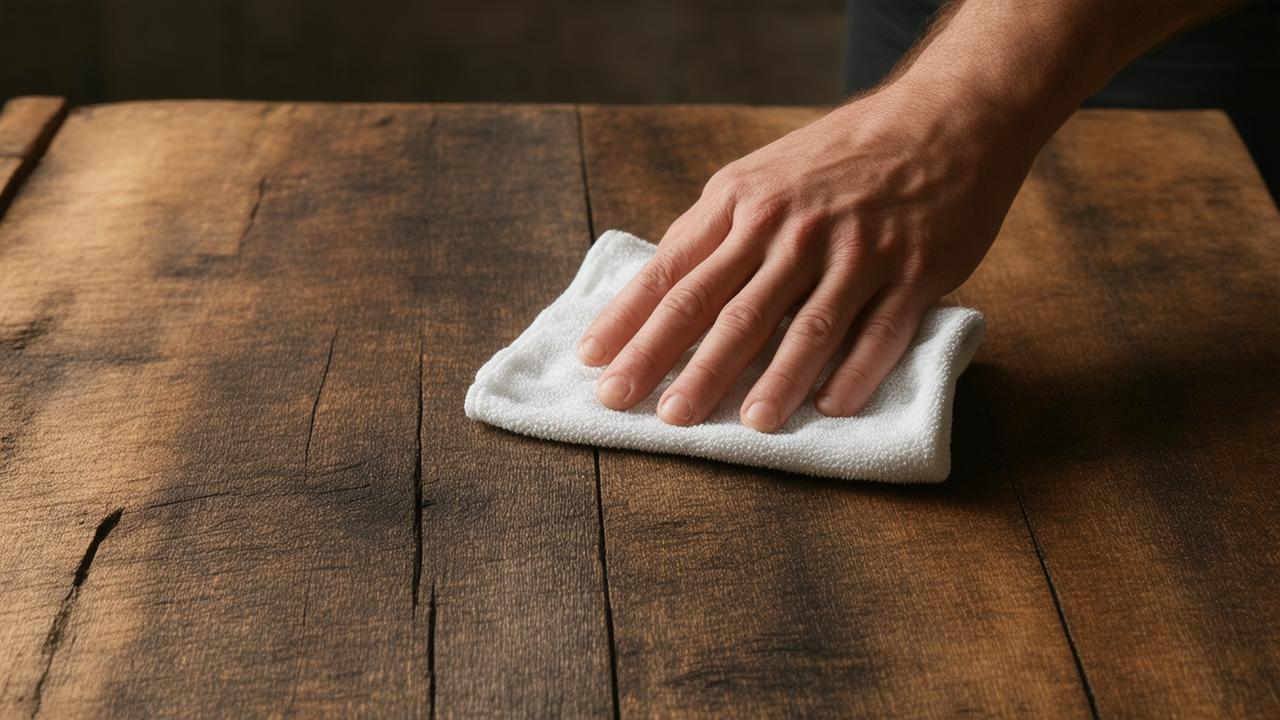
The first thing I noticed was the sound. A soft, whispering squeak as the cloth moved across the wood, like a finger drawn through wet sand. Sunlight slanted through the window, catching on the dull, scratched surface of an old oak table, the kind that had seen a thousand dinners and a thousand little indignities—water rings, scuffs, chipped corners, and the faint shadow of a long-faded candle burn. Yet under that tired finish, there was still a glow waiting. You could feel it more than see it at first, a quiet promise that the wood wasn’t done telling its story.
The Secret in the Bowl: A Simple Mix with Surprising Power
For years, that oak table had been pushed against a wall, covered in mail and mismatched mugs and the slow drift of everyday clutter. The family who owned it told me they’d thought about getting it refinished professionally, then thought about getting rid of it entirely. But a local restoration expert, the kind of person who can read a piece of wood like a diary, insisted they try one last thing before they gave up.
On the kitchen counter, she set out a small ceramic bowl and three simple ingredients most people already have at home. No harsh solvents. No industrial polish filled with fumes and mystery chemicals. Just a gentle, homemade solution that—if you asked her—has saved more old tables and sideboards than she could count.
She poured in warm water first, the steam fogging faintly in the cool air. Then a small measure of white vinegar, sharp and clean, the scent rising instantly and cutting through the stale dust. Finally, a modest ribbon of mild liquid dish soap, translucent and slick, swirling into the mix like a slow-moving current. She stirred it with a spoon until it turned cloudy and soft, the kind of everyday magic that looks like nothing and does everything.
“People think wood is fragile,” she said quietly, picking up a folded microfiber cloth. “But really, it’s resilient. It just needs the right kind of kindness.”
Why Microfiber Matters More Than You Think
The cloth she used was nothing glamorous. No embroidered edges, no brand name screaming from the tag. Just a plain square of microfiber—soft, dense, and just a little clingy, the way it pulled at the skin when you ran your fingers along it. There’s a practical reason experts keep reaching for these cloths when dealing with tired wood: they’re gentle where they should be, and surprisingly fierce where it counts.
Unlike a rough towel or paper towel, microfiber doesn’t grind grit and dust into the surface. Instead, those tiny fibers grab hold of the particles and trap them, like a forest of invisible branches collecting stray leaves in a windstorm. When soaked in the warm, soapy-vinegar solution, the cloth becomes a kind of healing tool—reaching into the old wax, the grease from a thousand fingertips, the cloudy film of years, and coaxing it loose.
The expert dipped her cloth into the bowl, then wrung it out slowly. Water streamed back in a steady, silvery line, leaving the cloth damp but not dripping. That balance matters. Too wet, and you risk swelling the wood, especially on older pieces with delicate veneers. Too dry, and you just rearrange the dust instead of lifting it away. She pressed the cloth lightly between her fingers, testing it the way a baker might test dough.
Then she began to work.
The First Pass: When the Wood Starts to Wake Up
The old oak table looked almost gray in the morning light, its tired finish scattered with pale scratches. As the cloth moved across it in long, even strokes, the room filled with the simple, clean smell of vinegar and soap, a scent oddly comforting, like a freshly mopped floor in an old house. The solution loosened years of grime, invisible and yet suddenly very present as the cloth began to darken.
What surprised the family watching wasn’t the speed—that was almost slow—but the transformation. After just a few passes, a faint, warm tone started to show through, as if the wood had taken a deep breath. The grain, once muted, began to stand out in delicate lines. Swirls and knots that had long disappeared beneath haze and fingerprints reappeared, quiet but insistent, like familiar faces in an old photograph.
“You’re not stripping it,” the expert explained, turning the cloth to a clean side. “You’re respecting what’s already here. This isn’t about erasing history. It’s about letting it shine again.”
She worked in sections, always following the direction of the grain, never pushing against it. Each pass was steady and patient, almost meditative. As she finished one patch, she’d buff it lightly with a dry microfiber cloth, coaxing out a soft gleam that reflected the window’s light in gentle, hazy curves. There was no high-gloss, factory-perfect glare—just a natural, low, confident sheen that felt honest.
| Step | What You Need | What to Do |
|---|---|---|
| 1. Prepare Solution | Warm water, white vinegar, mild dish soap, small bowl | Mix mostly warm water with a splash of vinegar and a small drop of soap. Stir until cloudy, not foamy. |
| 2. Wet the Cloth | Clean microfiber cloth | Soak the cloth, then wring it out until just damp—no dripping. |
| 3. Clean in Sections | Damp microfiber cloth | Wipe gently along the grain, working on small areas so the surface never stays very wet. |
| 4. Dry and Buff | Dry microfiber cloth | Immediately buff each cleaned section to lift residue and reveal the natural sheen. |
| 5. Optional Nourish | Wood oil or conditioner | Once fully dry, apply a small amount of oil if the wood looks thirsty or dull. |
A Near-New Finish Without Erasing the Past
Halfway through, it became hard to remember how flat and exhausted the table had looked just an hour earlier. The wood now caught the light in soft ripples, the surface reflecting enough brightness to feel fresh, yet still carrying the fine lines and shadows that told its story. That’s the beauty of this kind of restoration: it doesn’t pretend the piece is brand new. It simply makes it feel newly alive.
The expert knelt to inspect a particularly stubborn water ring—a pale ghost of some long-ago glass left sweating on the surface in summer. She pressed the damp cloth over it, letting the warmth and mild acidity gently work at the stain. Slow circles. A pause. Another pass. The ring didn’t vanish entirely, but it faded, like a memory finally allowed to soften at the edges.
“Perfection is overrated,” she said, standing up, wiping her hands on the dry cloth. “What you want is presence. When you look at a piece and it feels ready to be part of your life again, that’s enough.”
By the time she finished, the table looked almost new to anyone who’d only just walked into the kitchen. The grain had depth again—dark lines, honeyed swirls, and the subtle shimmer of old-growth oak catching every angle of the afternoon light. The finish wasn’t glossy, but it was confident, as though the wood had squared its shoulders after a long slouch.
Listening to the Wood: When to Go Gentle, When to Go Further
Of course, not every piece responds the same way. Restoration experts talk about wood the way naturalists talk about landscapes—each with its own history, its own scars, its own thresholds. Some antiques carry delicate shellac or old varnish that needs a lighter touch. Others, coated in modern polyurethane, simply need a deep clean and a little polish. The microfiber-and-solution method works best as a first conversation with the piece, a way of asking, “What do you need?”
If the wood brightens, if the surface smooths under your fingers and the grain wakes up under the light, you know you’ve hit the right note. Sometimes, after cleaning, a thin application of a good-quality wood oil or conditioner can be the next step—nothing heavy, just enough to feed the surface, restore some richness, and guard against future dryness.
But the experts are cautious about going straight for sanding or stripping. Those are last-resort measures, the equivalent of re-plowing a meadow instead of carefully pulling the weeds. Once you remove a finish entirely, you erase not only dirt and damage but also the soft patina that comes from decades of touch and time. The humble solution in the bowl, paired with that hardworking microfiber cloth, offers something gentler: renewal instead of replacement.
“People think they need to start over,” one restorer told me. “Most of the time, they just need to start paying attention.”
Bringing Old Furniture Back Into Daily Life
The transformation isn’t only visual. There’s a subtle emotional shift that happens when a neglected piece of furniture comes back into use. The family who owned the oak table had grown used to treating it like a surface, not a presence—something to stack things on, not gather around. But after the restoration, they moved it back to the center of the room. Someone set a vase of cut branches on it, tender green tips stretching toward the ceiling. Someone else ran a hand along the edge, testing the smoothness, tracing the grain as if learning a new map.
➡️ France suffers a €3.2 billion blow as a last-minute reversal kills a major Rafale fighter jet deal
➡️ Neither boiled nor raw : the best way to cook broccoli for maximum antioxidant vitamins
➡️ France turns its back on the US and drops €1.1 billion on a European detection “monster” with 550 km reach
➡️ Day will turn to night during the longest total solar eclipse of the century occurring across regions
➡️ No more duvets in 2026? The chic, comfy and practical alternative taking over French homes
➡️ Seniors behind the wheel: will licenses be pulled automatically after 70 from ?
➡️ Goodbye kitchen cabinets: the cheaper new trend that won’t warp, swell, or go mouldy over time
Suddenly, the table invited things: shared meals, scattered homework, winter puzzles, quiet cups of coffee on slow mornings. Not because it looked perfect, but because it looked cared for. The light that skimmed across it in late afternoon found something to hold onto now, something alive.
That’s what this simple practice offers, beyond clean wood and revived finishes. It offers an excuse to pause and reconnect—with the objects that have traveled silently beside us through the years, holding our routines the way old trees hold the memory of seasons. When you soak that microfiber cloth in its warm, faintly tangy solution and start to work in calm, deliberate strokes, you are doing more than cleaning. You are telling the furniture, and maybe yourself: you still matter here.
FAQ
What exactly is the homemade solution restoration experts recommend?
Most experts use a simple mix of warm water as the base, a small splash of white vinegar, and a tiny amount of mild dish soap. The water provides gentle moisture, the vinegar helps cut through old residue and grease, and the soap loosens dirt. It should look slightly cloudy, not overly soapy or foamy.
Will this method work on all types of wooden furniture?
It works well on most finished wooden pieces—tables, chairs, dressers, sideboards—especially those with standard varnish or polyurethane finishes. For antiques with fragile or unknown finishes, it’s wise to test a very small, hidden area first and use an extra-light touch.
Can vinegar damage wood finishes?
Used straight and in large amounts, vinegar can be too harsh. But in a heavily diluted mix with water and just a drop of soap, applied with a damp (not wet) microfiber cloth and wiped dry promptly, it is generally safe and effective for breaking down grime without stripping the finish.
How often should I clean wooden furniture this way?
For pieces you use daily, a deep clean with this method every few months is usually enough. In between, you can simply dust with a dry microfiber cloth. Over-cleaning with moisture isn’t helpful; balance and moderation keep the wood healthiest.
Do I still need furniture polish or oil afterward?
Not always. Many pieces look revived with cleaning alone. But if the wood appears dry, dull, or “thirsty” after it’s completely dry, a small amount of quality wood oil or conditioner can restore luster and protection. Always apply lightly and buff thoroughly.
Is microfiber really that important, or can I use any cloth?
Microfiber is strongly preferred because of its structure. It traps dust and grit instead of dragging it across the surface, which helps prevent scratching and gives a deeper clean. A regular cotton rag can work in a pinch, but it won’t be as effective or as gentle.
Will this remove deep scratches or dents?
No. The solution and cloth can’t erase structural damage; they focus on surface buildup, haze, and light marks. Deep scratches, gouges, or worn-through finishes may require more advanced restoration—filling, sanding, or refinishing. But you may be surprised how many “flaws” fade once the surface is truly clean.
Is this method safe for veneer furniture?
Yes, as long as you keep the cloth only damp and never let standing water sit on the surface. Veneer can swell or lift if it gets too wet, so work quickly in small sections and dry immediately with a second cloth. The gentle, low-moisture approach is key.
How long should I wait before placing items back on the furniture?
Once you’ve wiped and buffed the surface dry, let it rest for at least an hour before placing heavier objects back on top. If you’ve applied any oil or conditioner afterward, follow its instructions, usually allowing several hours for full absorption and curing.
Can this technique help with cloudy or hazy finishes?
Yes, often it can. Cloudiness is frequently caused by layers of old polish, grease, and dust. The warm, diluted vinegar-and-soap solution, lifted with microfiber, can clear away much of that haze and reveal the original sheen, bringing the finish back to something very close to its old, near-new glow.





