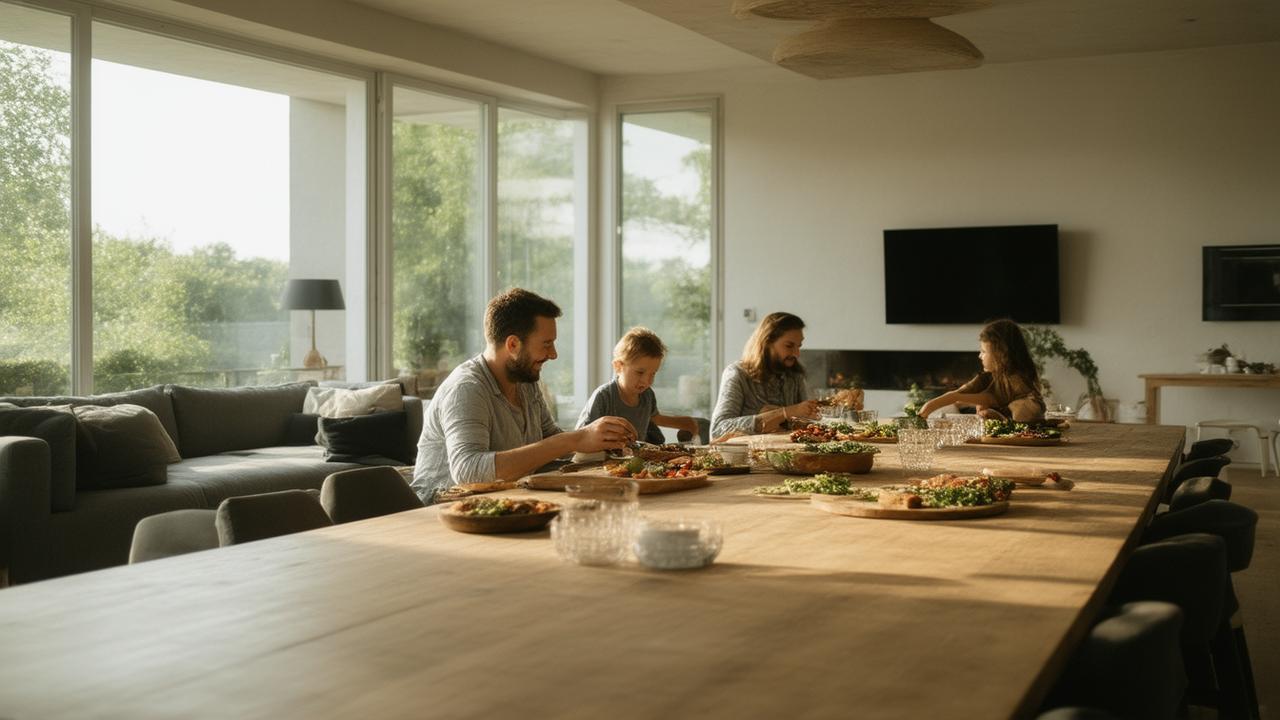
The first time I realized the French were quietly rebelling against the classic “living-dining room,” I was standing in a Paris apartment that didn’t seem to know where its sofa ended and its kitchen began. There was no formal dining table, no stiff arrangement of chairs waiting for Sunday roasts. Instead, a long wooden counter was scattered with crumbs and glasses, a pot of something fragrant simmered on the stove, and friends leaned, perched, and lounged in a kind of gentle, happy chaos. Someone was stirring a sauce with one hand and topping up a glass with the other. A child ran through with a piece of baguette like a tiny baton. Nobody seemed to miss the old living-dining room at all.
The Slow Goodbye to the Formal Living-Dining Room
For decades, the standard French apartment followed a script: an entrance corridor, a salon (living room) opening onto a salle à manger (dining room), and then, tucked away at the back, the kitchen. The salon and salle à manger were for receiving, for neatness, for a certain kind of social theater. The kitchen was where the mess lived. Doors, walls, thresholds – each room had its role, and you moved between them almost ceremonially.
Today, that script is quietly being rewritten. Ask an estate agent in Lyon or Nantes what buyers want, and they’ll say it outright: “Une grande pièce de vie.” Not a living room. Not a dining room. A single, flowing, social space where life happens – cooking, working, eating, talking, napping, everything. The old living-dining duo, once the pride of the bourgeois interior, is losing ground to a more relaxed, more porous, and frankly, more human way of inhabiting space.
Walk into newly renovated homes from Bordeaux to Strasbourg, and you’ll see a pattern: walls knocked down, corridors absorbed, kitchens opened up. The “pièce de vie” has become both stage and backstage, intimate and public at once. And this shift isn’t just aesthetic; it’s social, emotional, and profoundly tied to how the French are choosing to spend time together.
From Showroom to Shared Life: Why the Change Feels So Good
There’s a particular memory that keeps coming up when you ask people about the old living-dining format. It’s the feeling of being separated. The host, often the one who loves cooking most, exiled in the kitchen while everyone else sits in the salon chatting with a glass of wine. Laughter rises and falls like a tide from the other room; you hear the punchline but miss the story. For many French households, that split has started to feel out of step with how they want to live.
Modern French hosting is less about perfect table settings and more about shared moments: someone chopping herbs while another tastes the sauce, friends leaning on countertops, kids sprawled on a rug nearby. The shift toward one big social space reflects a deeper desire to be together in the making of the meal, not just the eating of it.
Technology has played its quiet part. Laptops move from sofa to kitchen island without ceremony. Streaming replaces scheduled TV, freeing the room layout from the tyranny of the television set. And then there was the pandemic, when homes turned into offices, classrooms, and cafés all at once, forcing many families to reconsider what “shared space” could mean. Walls, once seen as markers of comfort and privacy, started to feel more like barriers.
The New Heart of the Home: Kitchen-Living Hybrids
So what’s replacing the living-dining duo? In a word: everything. Or, more precisely, spaces that can be everything at once. The French pièce de vie is often a kitchen-living hybrid, but that doesn’t quite capture its mood. It’s less about blending two rooms and more about creating a landscape of social micro-zones.
Picture this: at one end, a generous kitchen with open shelves and a deep sink, the kind that invites you to roll up your sleeves. A long island sits in the middle, surrounded by mismatched stools, always just a little cluttered with mail, fruit, and a forgotten magazine. A step away, a warm, soft area opens up: an inviting sofa, perhaps a low bookshelf doubling as a room divider, a coffee table marked by years of wine glasses and coffee cups.
The dining “area” is no longer a stiff table at the center of the universe, but a flexible corner: a big farmhouse table that doubles as homework station, office space, and holiday banquet hall; or even a round bistro table nestled near a window, where breakfast for two and impromptu apéros happen with equal ease. The lines between activities blur, and that’s exactly the point.
Instead of having a room for dining, another for relaxing, and another for cooking, French households are stitching all of those gestures together into a single, ongoing, shared routine. It feels less “organized” on paper. But in daily life, it feels deeply, instinctively sociable.
How the New French Social Room Actually Works
Behind this evolution is a subtle choreography of furniture, light, and sound. While the old model imposed roles on rooms, the new one allows spaces to shift character throughout the day. Morning light falls on the kitchen island turned breakfast bar; midday finds it transformed into a laptop station or a crafts zone; evening draws chairs around it for shared cooking, then, a moment later, shared eating.
Instead of doors, the French are using texture and height to define soft boundaries. A small step up to a raised platform, a change from tiled kitchen floors to warm wooden boards near the sofa, a pendant light low over the dining table – all of these tiny cues say, without words: here, we talk; here, we cook; here, we rest. Yet nobody needs to pass through a doorway to move between them. The flow is continuous.
Sound has changed, too. Where once the clang of pots and the hiss of the stove were politely hidden away, they now form part of the soundtrack of gatherings. Music plays from a speaker that follows you from counter to couch. The clink of plates is no longer backstage noise but part of the shared moment. Children’s voices blend into conversations instead of being confined to a separate “playroom.”
Old Habits, New Layouts: The French Way of Making It Theirs
Of course, this is still France, a country with strong traditions around meals and hospitality. The switch to an open, fluid pièce de vie doesn’t mean abandoning those rituals; it means reshaping them. The Sunday lunch remains sacred in many households, but it now unfolds in a space where guests can help set the table without feeling they’ve crossed into “the kitchen,” where someone can top up the wine while checking the gratin without excusing themselves from the conversation.
The old distinction between “everyday” and “formal” is softening. Many families keep a beautiful table – perhaps inherited from grandparents – but it lives right in the main social area, used daily rather than kept pristine for visitors. Crystal glasses might share a shelf with mismatched mugs and children’s drawings taped to the wall. The message embedded in the furniture is clear: life is happening here all the time, not waiting politely in a closed room.
Some homes, especially in older Haussmann buildings, are adapting without tearing down every wall. Large double doors between kitchen and former dining room are left open almost permanently, turning two rooms into one visual universe. Others use sliding glass panels or half-walls to keep cooking smells somewhat contained while preserving the sense of togetherness. The exact shape varies, but the intention is the same: fewer barriers, more shared moments.
Why This Feels Especially French – And What It Says About Us
France has long romanticized the table as a place of democracy – a place where ideas are argued, jokes spar, and time stretches. The shift away from a dedicated “living-dining” combo toward a more fluid, sociable space doesn’t erase that mythology; it extends it. Now, the debate about politics might begin while chopping shallots and continue while stirring the pot, then drift to the sofa along with the coffee cups.
Guests are no longer expected to sit stiffly in the salon, fingers carefully balanced around a cup, waiting to be served. Increasingly, they’re invited into the center of things – to slice bread, to stir, to taste from the pan. The act of hospitality moves away from performance toward participation. “Make yourself at home” isn’t just a polite formula; it’s suddenly very literal.
➡️ Goodbye kitchen cabinets : the cheaper new trend that doesn’t warp or go mouldy
➡️ Hairstyles after 60: forget old-fashioned looks, as professional hairstylists say this haircut is the most youthful
➡️ If your dog gives you its paw, it’s not to play or say hello : animal experts explain the reasons
➡️ Starlink Unveils Mobile Satellite Internet: No Setup, No New Phone Needed
➡️ Pour half a glass of this common kitchen liquid—no vinegar or baking soda—to clear a slow drain automatically
➡️ A Popular Hair Washing Habit Gradually Weakens Hair After Midlife
➡️ How many showers per week are truly optimal for healthy aging? Experts challenge conventional wisdom
There’s something quietly radical in this. In many ways, the new French social room dissolves the old separation of roles: host and guest, worker and relaxer, adult and child. Everyone shares the same ground, the same air, the same smells of garlic and butter and coffee. The home becomes less a backdrop to social life and more a living participant in it.
A Quick Look at the Shift in French Homes
While the change is more cultural than statistical, certain patterns are emerging in renovations and new builds across France. Here’s a simplified snapshot:
| Feature | Traditional Living-Dining | New Sociable Pièce de Vie |
|---|---|---|
| Room layout | Separate living, dining, and closed kitchen | Open or semi-open kitchen-living-dining blend |
| Social focus | Conversation mainly at the table or in salon | Conversation flows from stove to sofa to table |
| Role of kitchen | Service and preparation, often hidden | Central, visible, shared activity zone |
| Use of space | Formal vs. everyday rooms clearly divided | One main space used flexibly all day long |
| Atmosphere | More ceremonial, “proper,” sometimes stiff | Informal, participative, lived-in |
Designing Your Own Sociable Space, the French Way
You don’t need to live in Paris with high ceilings and moldings to embrace this trend. The essence of the new French social room is not square meters, but attitude. It starts with a simple question: how do you want people to feel in your home – including you?
Think of the center of gravity. In many French homes, that center is shifting from the sofa or the TV to the table or the island. If you cook, eat, talk, and work in the same space, let your furniture show it. A solid table you love, good lighting, stools that invite lingering, a sofa you can sink into – these are not decorative extras; they’re tools for building togetherness.
Don’t shy away from visible life. Open shelves with everyday plates, herbs on the counter, a basket of toys in the corner – all of it signals that this is a place for being, not just looking. Instead of trying to hide the kitchen, consider how to make it beautiful in its reality: a well-placed rail for hanging pots, a wooden board that lives permanently on the counter, a lamp that casts warm light over evening cooking.
If knocking down walls isn’t an option, borrow tricks from small French apartments: leave doors open by default, use glass partitions or interior windows, align the dining table and sofa to face each other instead of the TV, and cluster lighting into zones so the room feels layered rather than flat. The aim is always the same: make it easy for people to be together, doing different things, without feeling separated.
FAQ
Why are French households moving away from the classic living-dining room?
Many French households find the traditional layout too formal and too divided. People want to talk, cook, eat, and relax in the same space instead of being split between a salon, a dining room, and a closed kitchen. The newer layouts feel more natural, more social, and better suited to modern life.
What exactly is a “pièce de vie”?
“Pièce de vie” literally means “living space” and usually refers to one large, multi-use room that combines kitchen, dining, and living areas. It’s the beating heart of the home, where everyday life unfolds from morning coffee to late-night conversations.
Is this trend only for new builds, or can older homes adapt too?
Older homes are absolutely part of the shift. Many French apartments and houses are being renovated to open up kitchens, widen doorways, or link rooms visually with glass or sliding doors. Even without major construction, keeping doors open, rearranging furniture, and rethinking lighting can recreate the feeling of a shared, sociable space.
Doesn’t an open social room create more mess and noise?
It can, but many people are embracing that as part of real life rather than something to hide. Good storage, a few closed cupboards, and smart materials help manage visual clutter. As for noise, rugs, curtains, bookshelves, and soft furnishings absorb sound while still keeping everyone connected.
How can I make my own home feel more like these new French social spaces?
Start by identifying where you naturally gather now – the table, the counter, the sofa – and strengthen that spot with better seating and lighting. Pull the dining area closer to the kitchen, move the sofa so it faces people rather than the TV, and keep what you use daily within reach instead of hidden away. Above all, design the room for conversation and shared activity, not just for how it looks in photos.





