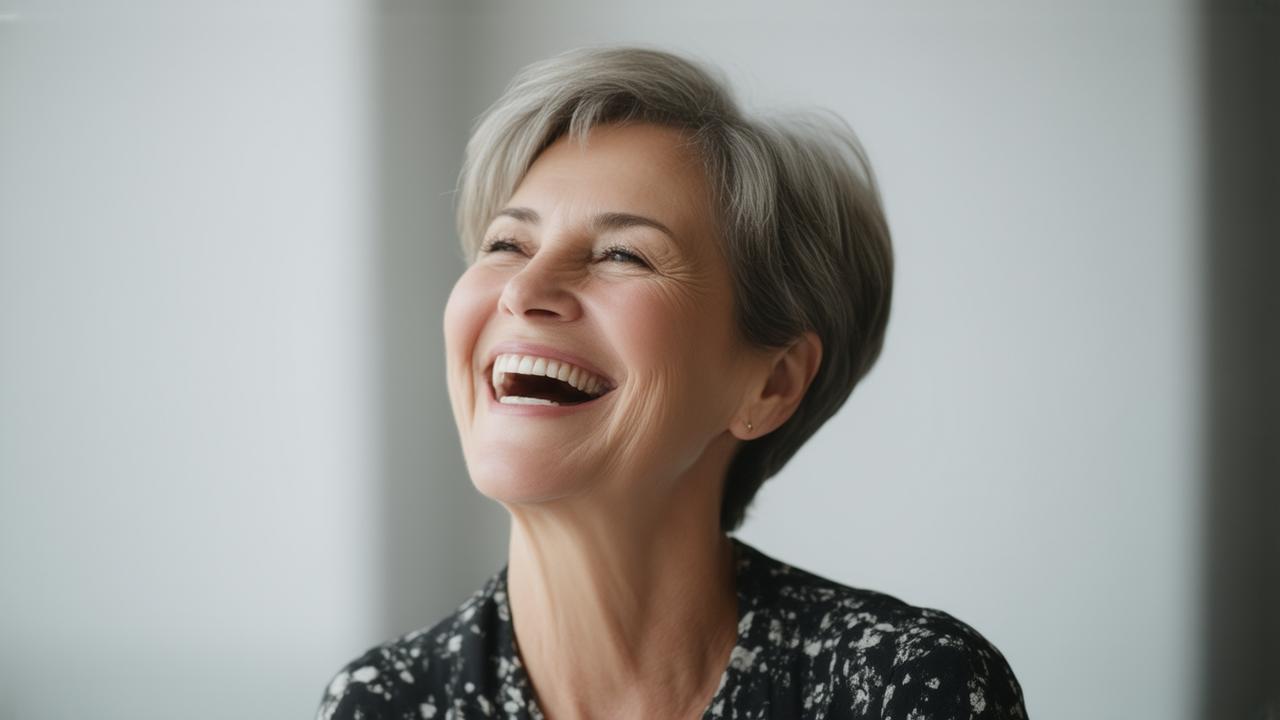
The woman in the salon chair looks like she has already decided something long before she walked in. Her hands rest calmly on the black cape, but her eyes are alive with a kind of quiet rebellion. Sixty-eight, she tells the stylist. “I’m ready to stop looking like the ‘grandmother’ everyone expects,” she laughs, the word sounding almost like a costume she’s tired of wearing. The stylist smiles, comb in hand. “Perfect,” she says. “Because we’re about to make you look like you again.” Scissors flash in the light, a soft rain of silver and blonde falls to the floor, and you can almost feel it—years of playing safe slipping away with every snip.
Why “Age-Appropriate” Hair Is Old News
Ask a group of professional hairstylists what they dread hearing most, and many will tell you it’s this phrase: “What’s appropriate for my age?” Not because they don’t care about how you feel at sixty or seventy—but because “appropriate” is often code for “small,” “neutral,” “invisible.” Somewhere along the way, the world decided that turning sixty meant stepping quietly into beige cardigans and tiny perms, as if joy and edge were only allowed in younger decades.
But hairstylists who work with women over sixty will tell you a different story. They talk about clients who walk in whispering and walk out laughing; about women who arrive with photos of their mothers’ haircuts and leave with something that looks like them, not a family heirloom. They talk about how the most youthful haircut isn’t actually about chasing trends—it’s about movement, softness, and personality.
“Hair after sixty is like a second language,” one stylist in her fifties told me. “The rules you followed at thirty don’t apply anymore. Your texture has changed, your lifestyle has changed, and honestly, your tolerance for nonsense has changed too. Your haircut should keep up.”
Forget the phrase “for your age.” The better question is: What makes you feel awake again when you look in the mirror?
The Most Youthful Haircut Stylists Keep Recommending
Across salons, cities, and time zones, a clear favorite keeps rising to the surface whenever stylists talk about youthful hair after sixty: some version of a modern, softly layered bob. Not the stiff helmet of the early 90s, not the razor-sharp, severe editor bob (unless you adore it)—but a bob that moves, breathes, and bends with your natural texture.
Think of it as the “living bob”: just grazing the jawline or skimming the collarbone, shaped with gentle layers that soften around the face. It doesn’t sit on your head; it dances. It can be worn sleek one day, tousled and airy the next. It works with waves, with curls, with fine hair, with coarse hair—because it’s not a one-size-fits-all template. It’s a framework your stylist customizes to your life.
Hairstylists love this cut for a reason. The length is short enough to lift and open the face, yet long enough to feel feminine and versatile. The layers add movement and fullness without creating that “over-done” look that can age you faster than any wrinkle. And when paired with soft, face-framing pieces—sometimes called curtain layers or invisible layers—it does something quietly magical: it pulls the eye upward and gently blurs hard edges.
It’s not about hiding your age. It’s about shifting the focus—from “How old am I?” to “How alive do I feel?”
The Bob That Moves With You
The most youthful version of this cut rarely looks “fixed.” Picture this: you step out into a light breeze, and instead of your hair staying glued in place, it sways. When you tuck it behind one ear, a few strands fall forward, framing your cheekbones. When you run your fingers through it, it resettles easily without protest.
Modern bobs for women over sixty are built around that sense of natural ease. They might have:
- Soft layers that start around the cheek or jaw to lift the face.
- Texture at the ends instead of blunt, heavy lines.
- A part that isn’t rigidly straight but slightly off-center or softly side-swept.
- Enough length to curl, wave, or smooth depending on your mood.
The effect is subtle, but powerful. A layered bob with movement keeps the eye traveling, instead of landing on droopiness or fine lines. It frames your features the way good lighting does in a photograph—not changing who you are, just revealing the best angles.
Letting Go of the “Old-Fashioned” Look
If you grew up watching your mother or grandmother go to the salon every week for tight roller sets and stiff spray, you may still carry an invisible script about what aging hair should look like. Maybe a short, tightly curled crop that barely moves. Maybe a very conservative, polished style that never dares stray from its assigned place.
But stylists will tell you: the very things we used to consider “proper” for older women are often the first to make you look older than you feel. Overly structured sets. Harsh, dark, blocky colors. Short cuts with hard, straight lines and no softness. These don’t celebrate the face; they box it in.
One stylist described it this way: “Old-fashioned hair is hair that looks like it’s afraid of being touched.” Youthful hair, at any age, invites touch—even if the only fingers running through it are your own as you make coffee in the morning. A modern bob, cut with gentle layers, doesn’t resist life. It moves with it.
This doesn’t mean everyone has to go short. It means letting go of the idea that you must shrink your presence because of your birth year. The most refreshing thing you can do for your look after sixty is to choose a haircut that belongs to you now, not to the expectations handed down from another era.
How to Talk to Your Stylist So You Don’t Get “Matronly” Hair
The magic of this youthful bob really begins in the conversation, not the scissors. When you sit down in that salon chair, you’re not just asking for a haircut—you’re asking to be seen as who you are now, not who people think a sixty-something woman should be.
Before your appointment, pause and notice how you want to feel when you leave:
- Do you want to feel lighter? More polished? More playful?
- Do you want something low-maintenance or are you happy to style a bit?
- Do you like your hair to skim your neck, your jaw, or your collarbone?
Then, bring this language into your conversation with your stylist. Phrases like:
- “I want a modern, soft bob with movement, not something stiff or old-fashioned.”
- “Please add gentle layers around my face to lift it, but nothing choppy or spiky.”
- “I’d like my hair to look effortless, like it can air-dry and still look good.”
Ask your stylist where your length should hit to be most flattering. For many faces over sixty, just below the chin to mid-neck is a sweet spot—not so short that it feels severe, not so long that gravity takes over. Once you’re aligned on how you want to feel and what you absolutely want to avoid (the dreaded “helmet hair,” for instance), you give them permission to design the cut around your bone structure and hair texture.
| Hair Goal | What to Ask For | What to Avoid |
|---|---|---|
| Looking more youthful | Soft, layered bob with face-framing pieces | Heavy, one-length cuts with no movement |
| More volume | Subtle internal layering, light texturizing at the ends | Over-thinning, chunky layers, excessive razoring |
| Low maintenance | Length that works with your natural texture, easy air-dry shape | Styles that require daily heat tools and complex products |
| Softness around the face | Long, blended fringe or curtain bangs | Short, blunt, heavy bangs cut straight across |
Color, Texture, and the Secret Power of Soft Edges
A haircut doesn’t exist in isolation; it lives alongside your color and texture. That modern bob looks especially fresh when the hair color is softened, too—not necessarily lighter, but less harsh. Ultra-dark, flat shades can cast shadows that emphasize lines and hollows. Stylists often suggest gentle highlights, lowlights, or embracing your natural silver with dimension added through tone and shine.
Imagine soft, smoky grey blended with delicate pearl highlights. Or a warm silver with whispers of beige blonde weaving through. On a textured, layered bob, this kind of color catches the light, making your hair look like it’s glowing rather than simply “dyed.”
Texture matters as well. If your strands have become finer over the years, a lightweight mousse or volumizing spray at the roots can keep your bob buoyant without crunch. If your hair has turned wiry or coarser, a smoothing cream or a drop of serum through the ends can make your layers look intentional instead of frizzy.
Soft edges—both in cut and in color—are the quiet secret. Hard lines drag the eye downward; soft, textured ends and diffused color encourage the gaze to wander. That wandering is what most people register as “youthful,” even if they can’t put a finger on why.
Styling Rituals That Feel Like Self-Respect, Not Hard Work
You don’t need a drawer full of tools and bottles to make this haircut work. In fact, the right bob should need surprisingly little. The goal is not to turn your bathroom into a backstage dressing room; it’s to create a tiny, sustainable ritual that feels like taking yourself seriously—in the gentlest way.
➡️ Inheritance: the new law coming into force in February that changes everything for descendants
➡️ Better than air freshener: the taxi method to keep the car interior always fresh
➡️ At a blistering 603 km/h, this new maglev officially becomes the fastest train ever built
➡️ After the February New Moon, this planetary alignment will ease the year-end for this zodiac sign
➡️ The forgotten soak that restores cast iron pans to a smooth, black finish
➡️ Officials issue warning after spotting first-of-its-kind sight in place it doesn’t belong urging immediate action
➡️ Goodbye kitchen cabinets : the cheaper new trend that doesn’t warp or go mouldy
Many stylists recommend a simple routine like this:
- Towel-dry your hair gently so it’s damp, not dripping.
- Apply a light styling product: volumizing spray at the roots if you’re fine-haired, smoothing cream through the ends if your hair is coarse or wavy.
- Blow-dry with your head slightly tilted, using your fingers to lift at the roots and encourage movement.
- At the end, use a round brush just for the front pieces, curling them slightly away from your face for that open, lifted look.
If you prefer to air-dry, ask your stylist to cut your bob to fall nicely with your natural texture. A good cut will “self-style” more than you think. You might add a scrunch of curl cream, a bit of sea-salt spray for lived-in waves, or simply smooth the top with your palms.
This daily touch, this few minutes of presence with your own reflection, has its own quiet power. You’re not fighting your hair. You’re collaborating with it.
Owning Your Reflection After Sixty
Back in the salon, the woman in the chair is almost unrecognizable from the one who walked in—not because she looks younger in the conventional sense, but because she looks present. Her new bob skims just below her jaw, silver and ash and a hint of soft beige catching the light. The layers around her face sweep gently back, revealing high cheekbones that were there all along.
“I look like me,” she says quietly, almost surprised. Then: “I didn’t realize how much I’d been disappearing behind my hair.”
That is the quiet revolution of a good, modern haircut after sixty. Not pretending you’re thirty again. Not erasing the map of your life from your face. Just choosing a shape that says: I am still here, and I am not finished taking up space.
A softly layered bob—the most-loved “youthful” cut according to so many professional hairstylists—isn’t magic. But it is an invitation: to movement instead of rigidity, to ease instead of effort, to visibility instead of retreat. When you step out of the salon with hair that swings when you turn your head, you’re sending a message, quietly and clearly:
I get to decide what sixty looks like on me.
FAQ: Hairstyles After 60
What is the most youthful haircut for women over 60?
Most professional stylists point to a modern, softly layered bob as the most youthful option. It adds movement, frames the face, and can be tailored to different textures and lifestyles, making it feel fresh rather than old-fashioned.
Does short hair always make you look older or younger?
Length alone doesn’t determine agefulness—shape and texture do. Very short cuts with hard lines can look severe, but soft, layered short styles can look incredibly modern and youthful. The key is movement and softness, not just how much you cut off.
Can I keep my hair long after 60 and still look youthful?
Yes, as long as it has shape and health. If you love longer hair, ask for gentle layers and face-framing pieces to prevent it from dragging your features down. Regular trims and conditioning are essential so that longer hair looks intentional, not neglected.
Should I go fully grey before getting a new haircut?
No. You can update your cut at any stage. In fact, a modern cut often makes transitioning to grey feel more stylish and deliberate. Your stylist can blend your color or add dimension so the shift looks soft rather than stark.
How often should I get my bob trimmed to keep it looking good?
Most bobs look their best with trims every 6–8 weeks. This keeps the shape clean, the ends healthy, and the layers working in your favor, without letting the style grow out into something shapeless.
What if my hair is thinning—will a bob still work for me?
Yes, and it’s often a great choice. A well-cut bob with subtle layers can make fine or thinning hair appear fuller. Avoid heavy, blunt ends or over-thinning the hair; instead, ask for light internal layering that supports volume.
Do I need a lot of products and tools to style a youthful bob?
No. A simple routine—like a lightweight styling product and a basic blow-dry or air-dry—can be enough if the cut is right. The goal is for your hair to work with minimal effort, not to require a complicated daily styling process.





