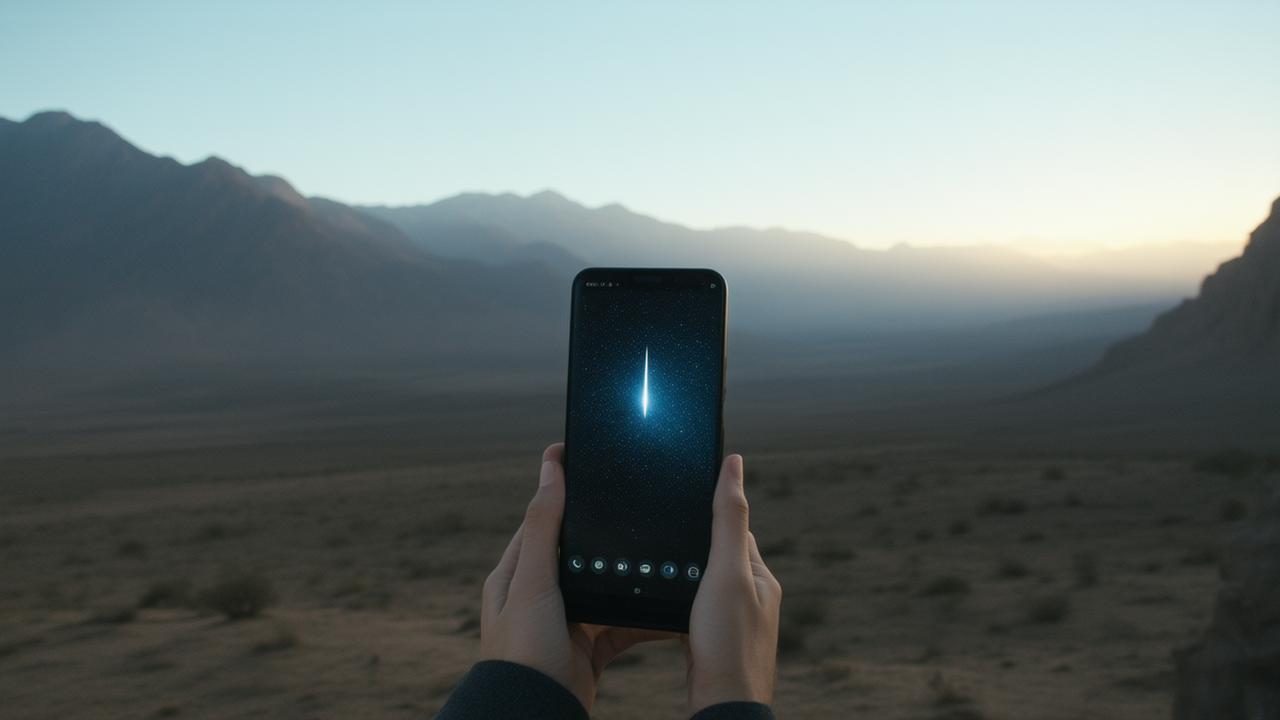
You notice it first on the edge of nowhere—where the last bar of cell signal quietly slips away, and the world turns into one long, beautiful dead zone. Maybe you’re driving a dirt road that doesn’t show up on any app, or pitching a tent miles beyond the last cabin light, or staring through a train window at plains that just keep unfolding. This has always been the trade: the wilder the place, the lonelier your phone. Then one crisp evening, out there in the middle of that blank space, your phone buzzes. A message. Then another. No towers for miles, yet the internet is suddenly humming softly in your hand.
When the Sky Becomes the Cell Tower
That’s the quiet revolution Starlink has been teasing for years, now clicking into place: mobile satellite internet that works directly with your existing phone—no dish balanced on a cooler, no tripod facing some specific slice of sky, no mysterious router blinking in a tent. Just your phone and the sky above it.
There’s a certain magic in the idea, even if you know the tech behind it is anything but mystical. Imagine standing in the middle of a desert where the air trembles in waves of heat and the horizon looks like an illusion, and yet you’ve got enough signal to video call a friend. Or being deep in a forest where the canopy closes overhead like a living cathedral, the nearest town a long hike away, and still being able to send your exact GPS coordinates to someone who needs to know you’re safe.
We’ve grown used to an unwritten rule of modern life: the map is never entirely accurate once you leave the grids and the highways. That empty “No Service” label might as well read: “You’re on your own from here.” Starlink’s new mobile satellite service is basically erasing that sentence.
The Feeling of Connection Without the Fuss
Turning Dead Zones into Quietly Connected Places
It’s one thing to say “global coverage,” another to feel it.
Picture this: You’re on a night train rumbling through an unfamiliar country. Outside, a smear of dark forest and faraway lights. The overhead speakers are murmuring in a language you only half understand. Historically, this is the kind of place where you download everything you might need while you still have service near cities—maps, translations, playlists—and then surrender to offline mode as soon as the land opens up.
Now, you glance at your phone and it just…works. Messages send. Maps keep updating the little blue dot as it glides over long stretches of countryside that have never had a cell tower. Back home, someone sends you a photo. You reply with one taken from the train window: stars faint above, your reflection in the glass, the blur of a place you’ll likely never see again except like this.
There’s a subtle but powerful emotional shift happening here. Remote no longer means disconnected. The world feels a little less fragmented, the blank patches on the coverage map a little less ominous.
How It Works Without You Having to Care How It Works
No New Phone. No White Box on a Stick.
Underneath all the poetry and possibility, there’s hardware and math: a swarm of low-orbit satellites gliding just high enough above Earth to talk to your phone with less delay and more reliability than the old, lumbering satellites of the past. But what matters day-to-day is not the orbital mechanics—it’s what you’re not required to do.
You don’t need to:
- Buy a special “satellite phone” with chunky antennas and outdated screens.
- Bolt a dish to your roof or clamp one to your truck bed.
- Spend an afternoon pointing hardware toward some exact area of the sky like you’re dialing in a telescope.
Instead, you keep the phone that’s already in your pocket. When you wander out of reach of cell towers, the phone gradually lets the satellites take over in the background. No awkward switching, no fumbling with cables, no fiddling through setup menus.
It’s like roaming, but the network you’re roaming onto is stitched across the sky instead of built into the ground.
A Quick Look at What Changes—and What Doesn’t
Think of this new service as a quiet upgrade layered onto the way you already use your phone. Your apps don’t suddenly become “satellite apps.” You still open your messages the same way, scroll your feeds the same way, send your location the same way. The only thing that changes is that the invisible line between “connected” and “offline” shifts further and further out.
| Experience | Traditional Coverage | With Starlink Mobile Satellite |
|---|---|---|
| Road trips through remote regions | Long stretches of “No Service” | Persistent signal from orbit |
| Backcountry hiking & camping | GPS only, no messaging or maps refresh | Ability to message, share location, refresh maps |
| Ocean crossings & offshore trips | Special equipment needed, limited access | Phone becomes your lifeline at sea |
| Everyday life on the fringes | Patchy, unreliable signal | More stable connectivity where towers are scarce |
From a user’s perspective, it’s almost disappointingly simple. You’re not invited into a new ecosystem; you’re just allowed to stay online in places that used to shrug you off.
Why This Matters for People Who Live on the Edge of the Map
Beyond Convenience: Safety, Stories, and Staying
For anyone whose life happens mostly inside cities, this might feel like a nice-to-have—a way to keep your feed from going dark on that once-a-year camping trip. But for people who live and work at the edges of the network, the difference runs deeper.
Think of ranchers whose land sprawls out beyond any tower’s reach, who have been juggling radios and patchy coverage for years. Or small coastal communities whose only link to the larger world has long been weather-dependent, expensive, and unreliable. Or seasonal workers who move with migrating fish, wildlife, or crops, always slightly beyond the reach of normal infrastructure.
For them, having internet that follows them wherever they go isn’t a novelty. It’s weather forecasts that actually load in time. It’s medical advice that doesn’t require a drive into town. It’s kids in remote homes doing video lessons instead of downloading worksheets once a week at a café.
There’s also something more subtle unfolding: the stories of these places can now be told from within, in real time. The person on the fishing boat, on the fire line, on the glacier, or in the desert can share what they’re seeing while they’re still seeing it. Not as a delayed upload when they get back to civilization, but as a living, flickering exchange.
The Emotional Weight of Never Really Being “Offline”
Freedom, Responsibility, and the Last Quiet Corners
Of course, not everyone will cheer the idea of a world where even the loneliest ridge has reception. For many, going off-grid has always been an act of intention: the phone goes into airplane mode, dropped to the bottom of a pack or glove box like a stone. The silence, the emptiness, the break from constant notification is part of the appeal.
➡️ Inheritance: the new law coming into force in February that changes everything for descendants
➡️ Better than air freshener: the taxi method to keep the car interior always fresh
➡️ At a blistering 603 km/h, this new maglev officially becomes the fastest train ever built
➡️ After the February New Moon, this planetary alignment will ease the year-end for this zodiac sign
➡️ The forgotten soak that restores cast iron pans to a smooth, black finish
➡️ Officials issue warning after spotting first-of-its-kind sight in place it doesn’t belong urging immediate action
➡️ Goodbye kitchen cabinets : the cheaper new trend that doesn’t warp or go mouldy
Starlink’s mobile satellite service doesn’t erase that possibility, but it does change the default setting. You’ll have to choose your disconnection rather than accept it as a given. You can still swipe into airplane mode, still power down entirely, still hike into a valley where you’d never dream of opening a messaging app. The difference is that now, if you twist an ankle, lose your way in sudden fog, or find yourself watching a storm roll in with a knot in your stomach, you can reverse that choice in an instant.
There’s a new responsibility woven into this convenience: to know our own boundaries. To decide when to invite the world in and when to let it wait. The technology opens a door that used to be locked by geography. We’re the ones who’ll decide how often to step through it.
From Experimental to Everyday
When Sci‑Fi Quietly Turns into Infrastructure
It wasn’t long ago that the idea of a personal satellite network sounded like something reserved for governments and space agencies. A sky full of cooperating satellites, handing off connections as smoothly as your phone hops between towers, was the stuff of concept art and cautious speculation.
Now, it’s quietly showing up in the most ordinary places: the back seats of family cars on summer road trips; the pockets of field researchers who no longer have to lug heavy satellite gear; the cabins tucked at the end of long, rutted roads. Not as a premium, exotic toy, but as the invisible background hum of daily life.
You might first notice it not when you’re in danger or when you’re testing it on purpose, but in some small, mundane moment. Standing by a remote lake as the sun slips behind a ridge, you send a photo to someone far away. A reply lands almost instantly: “Where are you?”
And you smile, glancing up at a sky laced with unseen paths of data, and answer: “Middle of nowhere. Sort of.”
Questions People Are Already Asking
Does this really work with my existing phone?
The key idea behind Starlink’s mobile satellite internet is compatibility with modern smartphones. The goal is for your current device—assuming it meets certain basic technical standards—to connect without you needing to buy a separate satellite handset. Over time, more phones and carriers are expected to support this seamlessly.
Will I need to install any equipment or apps?
You won’t need to set up a dish, mount hardware on your roof, or carry specialized terminals just to get basic connectivity. In many cases, your phone will switch over in the background when normal networks fade. Any required software-side support is typically handled at the carrier and system level, not by you fiddling with gear in the field.
Is this meant for emergencies only, or everyday use?
While emergency use is one of the most powerful benefits—especially for people in remote places—the design aims at everyday connectivity as well. Messaging, basic browsing, map updates, and essential apps are prime candidates, with performance evolving as the network grows and matures.
What about speed and latency compared to regular cell service?
Satellite connections, even low-orbit ones, tend to feel a bit different than a strong city cell signal. Latency can be slightly higher, and speeds depend on coverage, load, and your location. The emphasis is less on replacing the fastest urban fiber-backed networks and more on making sure you’re not dropped entirely when you leave them behind.
Can I still truly disconnect if the sky always has coverage?
Absolutely. This technology gives you the option to stay connected, but it doesn’t force your phone to stay awake. Airplane mode still works. Turning your phone off still works. The difference now is that your solitude is a choice, not a condition imposed by the absence of infrastructure. In moments when you need or want to be reachable—somewhere far past the last tower—you can be.





