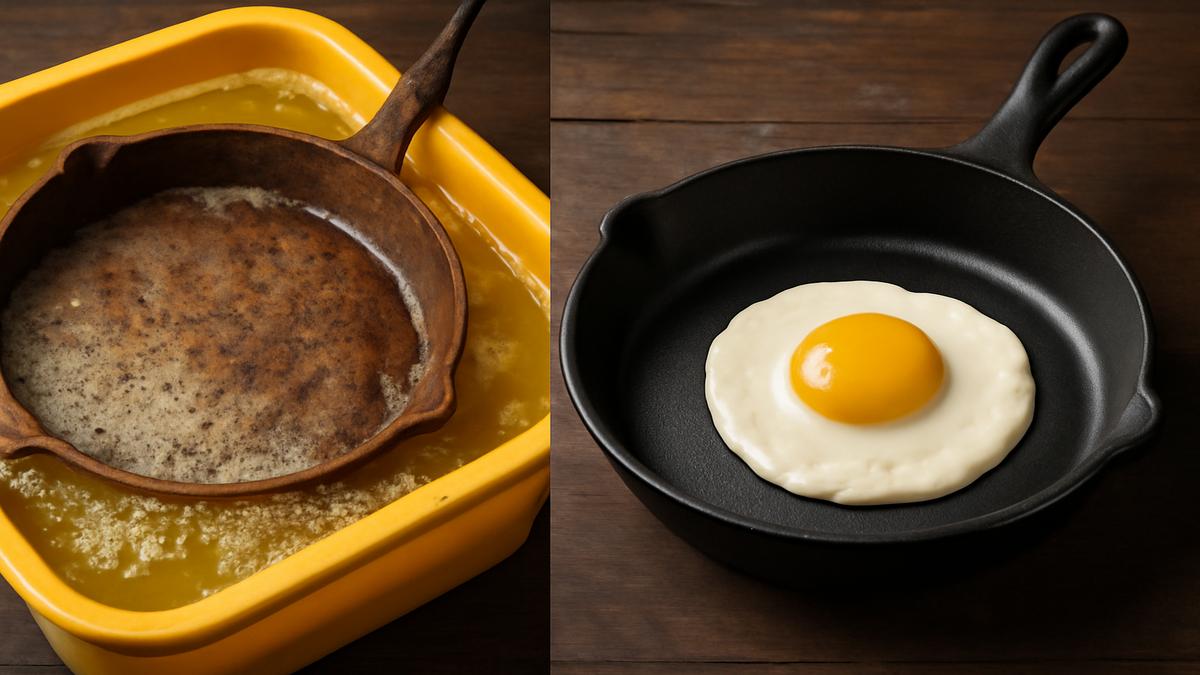
The pan arrived in a cardboard box still dusted with someone else’s kitchen. A stranger’s fond of grease clung to the sides, and a thin crust of rust freckled the handle like old moss on a stone. You could almost smell its past lives—bacon mornings, cornbread nights, maybe a campfire stew or two. Most people would have glanced at it once and tossed it back into the thrift-store bin. But if you’ve ever cooked on true, velvety cast iron, you know better. You recognize that dull, flaking skillet for what it is: a sleeping animal that only needs the right kind of waking.
The Ghosts Hiding in a Rusty Skillet
Cast iron has a way of making time visible. Each scratch, each rusty bloom, every bit of baked-on mystery gunk is a record of every flame it’s met, every careless soak in a sink of soapy water, every night abandoned with a little too much tomato sauce crusted to the sides. When you lift a neglected cast iron pan from a yard-sale card table or out of the back of your own cupboard, you can feel the weight of those choices in your palm.
Most advice about resurrection hovers somewhere between the brutal and the tedious. There’s the steel-wool-scrub-until-your-knuckles-ache method. There’s the drill with a wire wheel that sends black dust floating like storm clouds around your garage. There are chemical oven cleaners and heavy-duty lye baths that sound more like industrial processes than something you’d want near your dinner.
But then there is the quiet method—the forgotten soak—that asks you to do almost nothing. The method that lets water, time, and a pinch of ordinary household alchemy peel away decades of neglect while you go about your life. No buzzing tools. No caustic fumes. Just a pot, some warm water, a simple additive, and patience.
The first time you try it, you might feel almost suspicious. It seems too simple to be real. Yet there’s a deep, almost old-world satisfaction in watching a ruined pan slowly return to a smooth, black finish with a process so gentle it feels more like restoration than repair.
The Forgotten Soak: A Gentle Undoing
Ask old-timers at country flea markets, blacksmithing shows, or under the shade tents at antique fairs, and one phrase comes up again and again: “Just soak it.” Not in soap. Not in vinegar. Not in anything fancy and scented in pastel bottles. Just water helped along by a small scoop of washing soda—sodium carbonate—or, if you have a more adventurous streak and the right setup, a quiet bath with a low-voltage charger and a washing soda solution. This is the forgotten soak: an old, almost whispered practice that slowly, gently unhooks rust from iron and loosens the old, flaking layers of seasoning.
At its simplest, the method is this: you give rust and residue a more appealing place to go than your pan. Washing soda—stronger than baking soda, but still a staple in old laundry routines—raises the alkalinity of the water and helps dissolve fats and food residues clinging to the metal. In an electrolysis setup, that same washing soda solution becomes the medium through which rust migrates off the pan and onto a scrap piece of sacrificial steel. But even without the wires and charger, a long, patient soak in hot water and washing soda can work small wonders.
It’s a strange kind of restoration—less like scraping barnacles from a ship hull and more like letting snow melt from a branch. You’re not attacking the pan; you’re simply giving neglect a way out.
How the Soak Actually Works
Washing soda water is slippery in your hands, almost silky. That texture hints at what it’s doing: saponifying oils, breaking down stubborn, baked-on grease that clings to nooks in the casting. In a simple soak, this means the water can creep into the tiny spaces between rust, old seasoning, and bare metal. Food residue swells and softens, and the cling of rust loosens its grip.
If you choose to add a basic electrolysis setup—an optional layer, but beloved by collectors—the process becomes almost uncanny. With a cheap battery charger, a plastic tub, a few tablespoons of washing soda, and a sacrificial scrap of steel hooked to the positive lead, the current slowly persuades rust to migrate away from your pan. The pan itself, attached to the negative lead, begins to shed its orange-brown armor. Over hours and sometimes overnight, the water deepens into an inky broth while the pan beneath it is quietly reborn.
Whether you lean into electricity or stick to the simpler path, the through-line is the same: give it time. The forgotten soak doesn’t reward urgency. It rewards trust.
From Filthy to Satin: A Slow Reveal
There is a moment, when you lift the pan from its bath, that feels almost ceremonial. The air meets the wet metal; the smell of mineral water and faint iron rises up. What looked like solid, caked-on blackness now rubs off with a plastic scraper or a stiff brush, sloughing away in soft, curled ribbons. Rust that once seemed permanent wipes away in muddy streaks.
You might stand at the sink with warm water running, brushing and rinsing, brushing and rinsing, feeling the roughness give way to a faint, uniform gray. That gray is raw iron, freshly unveiled, like a river stone pulled from the silt. It doesn’t look like the glossy black pan of your dreams—yet. It looks matte and vulnerable, every grain and casting swirl visible, ready for whatever story you’re about to write on it.
There is something deeply tactile about this stage. Your fingers trace the inside surface, feel for lingering bumps or scabs of residue. Any stubborn bits often surrender after another short return to the soak. The pan is no longer an artifact of someone else’s neglect; it is a blank page.
As you dry it—quickly, thoroughly, maybe even in a low oven or over a burner to chase away every last hint of moisture—you can almost hear it sigh. This is the moment to move from undoing to creating, from stripping back its history to crafting its future.
Why This Old Trick Faded Away
Like many simple, effective methods, the washing-soda soak slipped quietly out of common knowledge when modern conveniences barged into the kitchen. Nonstick pans promised slick surfaces without the ritual. Stainless steel stepped in with its gleam and its indifference to dishwashers and soap. Cast iron—solid, heavy, stubborn—was left behind by anyone who didn’t feel like courting it.
At the same time, what remained of cast iron lore got compressed into quick tips: “Use salt to scrub!” “Never use soap!” “Just bake on oil!” Many of those fragments help, but they live in the world of maintenance. They don’t speak to the pan that is already beyond a light scrub.
The forgotten soak belongs to another era, when people understood that some things weren’t supposed to bend to rush or pressure. You didn’t blast old wood with sanders when sanding blocks would do. You didn’t strip an heirloom rocking chair with harsh chemicals when sunlight, time, and a little elbow grease could breathe it back. You didn’t toss an iron skillet just because the surface had gone wild with rust.
Today, as more people rediscover cast iron at thrift shops and online auctions, the soak is being quietly revived: in shared photos of before-and-after pans, in tucked-away forums, in slow, patient workshops where someone stands over a gray tub of cloudy water and explains that what you mostly need is waiting.
The Fine Line Between Ruin and Renewal
There’s a kind of intimacy that comes from bringing a pan back from the edge. As you start to season the bare metal again, you enter into a pact with it. You’re not just making it usable; you’re deciding what sort of relationship you want to have with this everyday piece of iron.
The first layers of seasoning after the soak feel almost fragile. A thin sheen of oil—flaxseed, canola, grapeseed, or just a clean, neutral fat—wiped nearly invisible, then baked on in a hot oven until it polymerizes into a hard, black film. Not puddled. Not sticky. Just enough to stain the gray a faint, smoky bronze. Over several rounds, that bronze darkens into the deep black familiar to anyone who’s inherited a truly old pan.
The transformation is sensual. The surface, once chalky and gray under your fingers, begins to feel like satin—dry, smooth, with the faintest whisper of drag. The smell of hot oil drifts through your kitchen, not unpleasant but insistent, as if the pan is breathing something out and taking something in at the same time. It is becoming itself again.
Somewhere in this process comes the first test: a fried egg, a slice of cornbread, a handful of potatoes. There’s a quiet thrill in watching food slide across a pan that—just days ago—looked doomed. Each success adds another microscopic layer to the seasoning. Each careful cook, each respectful wipe-down afterward, gently underscores the work the soak began.
Choosing When to Soak and When to Walk Away
Not every pan that crosses your path is a candidate for redemption. The forgotten soak is powerful, but it is not magic. Deep cracks, severe warping, or pitting that looks like a lunar landscape can mean a pan is more story than tool. Run your fingers inside and outside the pan after you’ve stripped it; if the casting is thin in spots or the bottom rocks badly on a flat surface, you may have found something better suited to hanging as decoration than searing steak.
But you’d be surprised how often a pan that looks utterly desolate is only a soak away from resurrection. What looks like catastrophic rust is often just surface bloom. What appears as thick, impenetrable black tar often turns out to be old cooking oil layered unevenly, ready to slough off the moment you let the water, washing soda, and time do their work.
This is one of the quiet lessons of the forgotten soak: restraint. You learn not to attack every problem with aggressive force. You learn to pause, to let chemistry and patience handle what brute strength can’t do without leaving scratches behind.
The Pleasure of Slow Tools in a Fast World
To restore a cast iron pan this way is not just to rescue an object. It’s to take a small stand against the constant hum of replacement that defines so much of modern life. We are trained to get rid of things the moment they show their age: chipped enamel, dull knives, pans that don’t shine in marketing photos. In that world, a rusty cast iron skillet is almost a dare.
The soak answers that dare with refusal. No, this doesn’t go to the landfill. No, this doesn’t get replaced with cheap, thin metal that warps at the first blast of heat. Instead, you roll up your sleeves—metaphorically or literally—and make space for a process that happens on its own timeline.
➡️ Light will disappear for minutes experts warn an extraordinary solar eclipse is officially approaching
➡️ How a single houseplant in the bedroom can increase deep sleep phases by 37%, according to a NASA study
➡️ Cut after 40: here are the 5 “least flattering” bob haircuts, according to this professional hairdresser
➡️ He hid an AirTag in his sneakers before donating them: and traced them to a market stall
➡️ After 250 years, a lost explorer’s ship has been found perfectly preserved off Australia’s coast : a time capsule from another era
➡️ Boiling lemon peel, cinnamon and ginger : why people recommend it and what it’s really for
➡️ Day will slowly turn to night as the longest total solar eclipse of the century passes across several regions, creating a rare and spectacular event that scientists say will captivate millions for hours
There’s a quiet rhythm to it. Fill the tub. Dissolve the washing soda. Lower the pan into the cloudy warmth. Walk away. Come back hours later. Brush. Rinse. Check. Sometimes repeat. Season. Use. Care. Over time, what began as a project becomes part of the way you move through your kitchen: slower, more attentive, more willing to invest time instead of money.
And the reward is tangible. A revived cast iron pan does not just perform. It participates. It holds heat with an almost living steadiness. It browns onions the way you remember from childhood kitchens. It crisps the edges of cornbread into texture that modern nonstick can’t quite mimic. It remembers, in its own mute way, the hands that have cared for it.
A Simple Reference for the Soak
For all its almost mythic reputation among collectors, the forgotten soak can be summarized in a few calm steps. This simple table keeps the heart of the process close at hand:
| Stage | What You Do | What You Notice |
|---|---|---|
| Prepare the bath | Fill a plastic tub or deep sink with hot water and dissolve washing soda until the water feels slick. | Water turns slightly cloudy; the surface feels silky between your fingers. |
| Soak the pan | Submerge the cast iron completely, avoiding contact with dissimilar metals; let it sit for several hours or overnight. | Rust dulls and softens; old seasoning starts to look patchy or swollen. |
| Brush and rinse | Use a stiff brush or plastic scraper to remove loosened residue; rinse under warm water. | Black flakes and rusty slurry wash away; bare gray metal begins to emerge. |
| Dry and warm | Thoroughly dry with a towel, then place on low heat or in a warm oven to drive off hidden moisture. | Surface shifts from wet shine to soft matte; no beads of water remain. |
| Re-season | Apply a whisper-thin coat of oil, wipe nearly dry, and bake at high heat; repeat several times. | Color deepens from pale gray to brown to rich black; surface grows smoother and more resilient. |
Living with Cast Iron After the Soak
Restoration is only the prologue. The real story begins on an ordinary evening when you reach for that once-rusty pan without thinking. Maybe you’re browning butter for a skillet cookie, or searing late-summer vegetables, or letting chicken thighs sink into a shallow pool of sizzling fat. The pan responds like it’s been waiting for this all along.
You’ve probably heard the rules: dry thoroughly, avoid soaking, oil lightly after washing, don’t store it in a damp cabinet. Those rituals don’t feel like rules anymore, though. They feel like the minimal courtesies owed to something that has already proven its willingness to endure.
As months slide by, you may notice the surface shifting, almost imperceptibly, becoming darker, more uniform, a little more forgiving every time something hits its heat. A piece of fish that once clung stubbornly now releases with a gentle nudge of the spatula. An egg glides, leaving only a faint, golden trace. With each success, the pan’s new finish earns its right to be called seasoned.
In time, your resurrected skillet may outlive most things in your kitchen. The nonstick pans will scratch and peel. The glass will chip. Gadgets will pass through, exciting and then abandoned. But the iron—patient, heavy, seasoned by a forgotten soak and your steady hand—will just keep saying yes to flame and food, year after year.
That’s the quiet beauty of this old method. It doesn’t just restore metal. It restores a kind of relationship: between you and the thing you cook with, between labor and time, between what we throw away and what still has stories to tell.
FAQ
Is washing soda the same as baking soda?
No. Washing soda (sodium carbonate) is stronger and more alkaline than baking soda (sodium bicarbonate). They look similar, but washing soda is better at cutting through heavy grease and aiding rust removal. Always read the box to be sure you have the right one.
Will the soak damage my cast iron pan?
Used correctly, a washing-soda soak will not harm sound cast iron. It removes rust and old seasoning, revealing the raw metal. Serious damage usually comes from prior abuse—deep pitting, cracks, or warping—not from the soak itself.
How long should I soak the pan?
For a simple washing-soda bath, many pans respond well to several hours to overnight. Very neglected pieces may need a second round. Check periodically; when rust and residue loosen easily under a brush, the soak has done its job.
Can I skip the electrolysis and just soak?
Yes. Electrolysis speeds rust removal and is especially useful for heavy corrosion, but a straightforward washing-soda soak alone can handle many neglected pans. It’s quieter, simpler, and requires no electrical setup.
Do I have to strip all the old seasoning?
If the existing seasoning is mostly intact, smooth, and not flaking, you may not need a full strip. The forgotten soak is most valuable when the surface is badly rusted, sticky, uneven, or chipping. In those cases, starting from bare metal produces a more reliable, durable finish.
What oil should I use for re-seasoning after the soak?
Any clean, neutral oil with a reasonably high smoke point works: canola, grapeseed, sunflower, or even plain vegetable oil. The key is applying a whisper-thin layer and baking it until fully polymerized, rather than letting oil pool and turn sticky.
How do I keep the pan from rusting again?
Dry it thoroughly after every wash—on the stove or in a warm oven—and wipe on a thin film of oil while it’s still slightly warm. Avoid leaving it in a damp sink or stacked under wet cookware. Regular use and light maintenance are the best rust prevention.
Can I use this method on other cast iron pieces?
Yes. Dutch ovens, griddles, waffle irons, and even old cast iron trivets can benefit from the same washing-soda soak, as long as they are solid cast iron without attached wooden or highly decorative parts that might be damaged by the bath.





