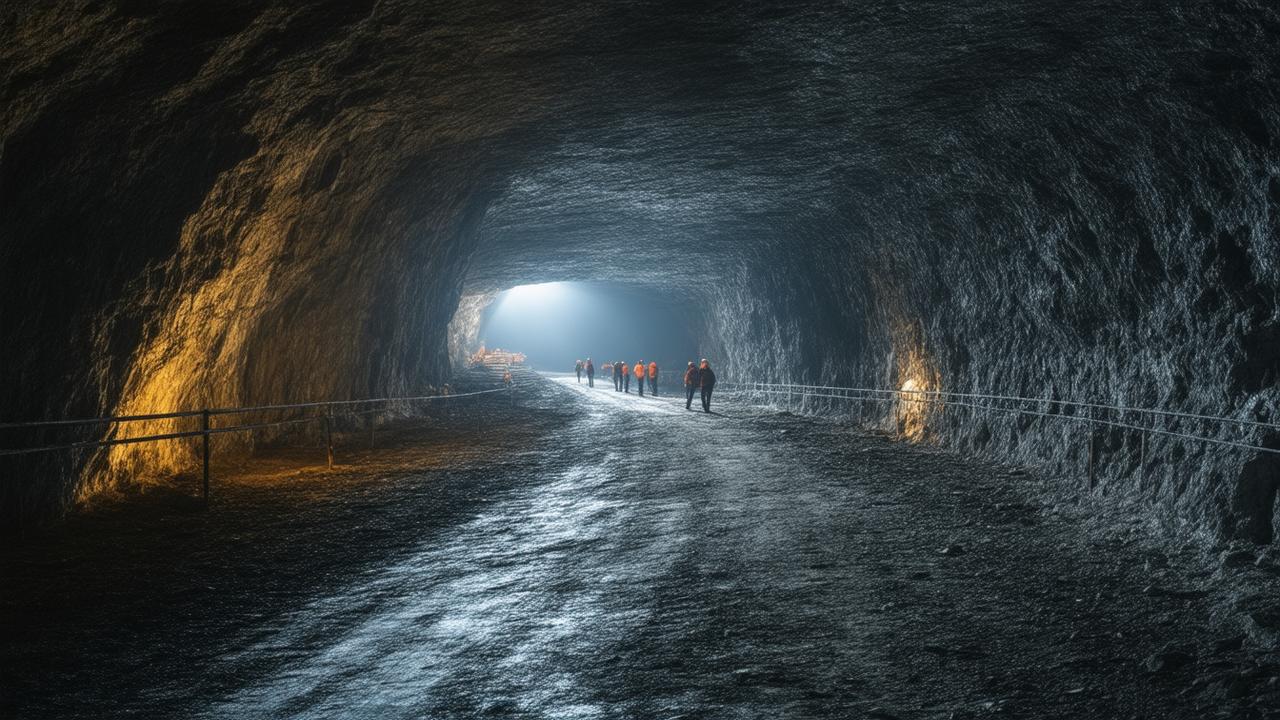
The first time you feel a Swiss tunnel swallow you whole, it’s a little like stepping out of one world and sliding quietly into another. One moment there are church steeples, cowbells, and the distant hiss of skis carving snow; the next, the light narrows, the mountains close in, and your train begins to hum through the heart of solid rock. The air seems to change. Voices fall away. Time softens into rhythm and echo. It feels, strangely, like entering the hidden subconscious of a country that has spent nearly three decades chiseling its ambitions into the bedrock beneath its own feet.
The Mountain That Became a Doorway
Imagine standing in front of an Alpine wall of stone—sheer, immaculate, apparently eternal. The kind of mountain face that looks like it has never yielded to anyone or anything. Now imagine that inside that same mountain lies a perfectly lit, climate-controlled corridor wide enough to swallow high-speed trains, service vehicles, emergency crews, and a small city’s worth of technology. In Switzerland, this isn’t imagination; it’s daily commute.
Over the last 30 years, the Swiss have taken a landscape famous for its verticality and quietly folded it inward. They have transformed it into a three-dimensional jigsaw of tunnels: rail tunnels, road tunnels, emergency shafts, ventilation galleries, maintenance ducts. If you could peel away the soil and grass and villages and ski lifts from the surface, much of the country would look like a hollowed-out honeycomb of intent.
It didn’t happen by accident. Back in the 1990s, Switzerland stared down the barrel of its own geography. The Alps, lovely and lucrative, were also a choke point for Europe’s trade. Trucks were grinding through valleys, choking them with exhaust, threatening fragile ecosystems, and rattling villages built centuries before the idea of 40-ton freight lorries. The country faced a question: How do you remain a crossroads of a continent without sacrificing the mountains that define you?
The answer, stubbornly and surgically, was to go underneath.
The Nearly Invisible Megacity Below
If a city is defined by its infrastructure—its arteries, utilities, energy lines, and movement—then what lies beneath Switzerland qualifies as a kind of invisible metropolis. Not one with cafés or plazas, but with tunnels as boulevards, emergency shafts as side streets, cable ducts as alleyways, cross-passages as pedestrian shortcuts. It’s a megastructure you can’t see from the sky, but that moves thousands of people and millions of tons of goods every single day.
The numbers tell part of the story. The Gotthard Base Tunnel alone stretches 57 kilometers under the Alps, making it the longest railway tunnel in the world. Add in the Lötschberg Base Tunnel, the older Gotthard road tunnel, the Ceneri Base Tunnel, and dozens of smaller links, access portals, and service tubes, and you begin to see a pattern. Piece by blasting piece, engineers have created an underworld of concrete and steel that rivals the complexity—and scale—of large cities above ground.
What’s striking is how deliberately un-spectacular it all looks from outside. There are no skyscrapers here, no grand sweeping bridges. Just modest portals in quiet valleys, where trains slip into round black mouths in the rock and disappear as simply as if they’d taken a left turn down the street. The spectacle is framed not for the eye, but for the imagination.
And for the body. Sit on a train as it dives into one of these tunnels, and you feel it: the faint pressure shift in your ears, the sudden smoothness of movement, the way landscape becomes idea instead of scenery. You are no longer crossing the Alps; you are moving beneath them, following a line that ignores peaks and passes and weather as if the mountain had agreed to step politely aside.
Carving Time out of Stone
On the surface, this looks like a story about rock and machinery. But underneath—quite literally—it’s a story about time. About how long it takes to carve a path through something that seems immovable, and how much time you win back, minute by minute, for every passenger and shipment that passes through.
Here is a simple way to picture it when you’re scrolling on your phone, trying to imagine the scale of a project that’s mostly hidden. Think of each major Swiss base tunnel as a kind of underground highway of time savings:
| Tunnel | Approx. Length | Opened | Key Benefit |
|---|---|---|---|
| Gotthard Base Tunnel | 57 km | 2016 | Cuts north–south travel time and shifts freight from road to rail. |
| Lötschberg Base Tunnel | 34.6 km | 2007 | Speeds up journeys between northern and southern Switzerland. |
| Ceneri Base Tunnel | 15.4 km | 2020 | Completes a flat, fast rail corridor through the Alps. |
Each of these tubes undercuts old, winding mountain routes that once bit into schedules and patience in equal measure. Every minute shaved off is multiplied across thousands of daily riders, across freight schedules, across years. The tunnels don’t just connect places; they compress distances we once accepted as inevitable.
But that compression came in slow motion. Drilling through rock at depths of up to 2,300 meters below the surface demanded patience measured in years, even decades. Teams bored forward under temperatures that could approach 40 degrees Celsius, in air that had to be constantly circulated and cleaned. Sometimes they met hard, unyielding granite; sometimes weak rock filled with water, which collapsed and surged like buried seas. Progress could mean just a few meters a day.
It’s strange to realize that the sleek, quiet sensation of your train gliding through a tunnel is the final act of a story written in dust, detonations, and uncertain waiting.
Listening to the Heartbeat of the Underground
If you could stand in the middle of one of these tunnels with everything turned off—no trains, no fans, no maintenance vehicles—you’d discover that the underground is never truly silent. There’s a soft drip somewhere in the dark, a creak in the lining, the distant subsonic murmur of the Earth settling and breathing. The engineers who built this world have listened to those noises for years, sensors streaming data, alarms waiting to shriek at the slightest irregularity.
Building underground in Switzerland is a conversation with geology. Each layer of stone speaks a different dialect: compact gneiss, brittle slate, crumbly sediment. Tunnel-boring machines—those monstrous rotating mouths of steel—don’t simply chew through; they feel their way forward, guided by geologists, surveyors, and a web of instruments that tremble at the slightest shift.
Workers grew accustomed to days when the rock cooperated, when everything aligned and the machine advanced with satisfying regularity. And then there were days when the mountain pushed back—when water burst through unseen fissures, or unstable rock suddenly swelled, pressing against the freshly built lining, reminding the builders that this was not empty space they were claiming but an intimate rearrangement of the Earth’s own architecture.
To tunnel is to insist, but also to negotiate. Every meter gained is a handshake, part force, part understanding.
What It Feels Like to Live Above an Underground Empire
Most Swiss people do not wake up thinking: Beneath my morning coffee, there’s an entire parallel universe of tunnels. They simply live with its benefits. The freight that used to roar along valley roads now slips along quiet rails under their feet. The tourist who used to arrive exhausted after slow, winding mountain crossings now steps off a train that treated the Alps as a horizontal line rather than a jagged obstacle.
Still, if you live in Switzerland long enough, the underground begins to seep into your sense of place. You learn that there is always a shorter, straighter way hidden under the surface. The country’s famous punctuality gains another dimension: when your infrastructure is shielded from weather, landslides, and snowstorms, the schedule hardens into a promise. Trains disappear into mountain mouths in winter blizzards and emerge on the other side with almost theatrical indifference to the chaos above.
There’s a quiet psychological shift that comes with this. The Alps, once an imposing barrier, become something more like a roof: admired, defended, but no longer feared as a wall between “here” and “there.” When the mountain can be crossed in a single, smooth, well-lit span, it shrinks—not in grandeur, but in tyranny.
And yet, the tunnels do not diminish the landscape. Paradoxically, they protect it. By drawing heavy traffic underground, Switzerland has preserved valleys and passes as spaces for people, animals, and climate-sensitive ecosystems. Instead of freight convoys, you get hikers. Instead of diesel noise, you get cowbells and the river’s hiss. The underground city allows the above-ground villages to stay, in a sense, more village-like.
➡️ Psychology says people who let others go first in line when they seem rushed display these 6 situational awareness traits that most people are too self-focused to develop
➡️ Boiling rosemary is a simple home tip I learned from my grandmother, and it can completely transform the atmosphere of your home
➡️ New ban hitting wood burners announced as fireplace rules changed
➡️ Soon a driving licence withdrawal for senior motorists after a certain age a necessary safety measure or a shocking discrimination against retirees
➡️ Day will turn into night: the longest solar eclipse of the century is already scheduled and its extraordinary duration is astonishing scientists
➡️ No vinegar or baking soda needed : the trick to cleaning your car seats and removing the toughest stains
➡️ Add just two drops to your mop bucket and your home will smell amazing for days no vinegar, no lemon needed
Why Go to Such Lengths? The Ethics of a Hidden Network
Digging for almost thirty years through some of Europe’s hardest rock is not the path of least resistance. It is the path of long arguments, referendums, taxes, and construction schedules that extend beyond political careers. So why did Switzerland choose this way?
Part of the answer lies in its political culture. Big projects in Switzerland are not imposed from above; they’re voted on. The New Rail Link through the Alps, the grand scheme that underpins much of this underground infrastructure, was endorsed at the ballot box. People agreed—narrowly at times—to invest in something they knew would take generations to fully realize. In an age obsessed with quarterly results and instant wins, that in itself feels almost radical.
Another part of the answer is ethical. The tunnels are not merely about getting there faster; they are about getting there differently. By carving flat, efficient rail routes through the mountains, Switzerland can take heavy trucks off hairpin mountain roads and load their containers onto trains instead. The underground becomes a tool for reducing emissions, noise, and risk. It’s not perfect, but it’s pointed in a particular direction: toward a future where mobility and mountain can coexist without one devouring the other.
There is also a deeper, quieter motivation that surfaces when you talk to the people who planned and built these tunnels: the almost old-fashioned pride of making something that will outlast you. Tunnels are centuries-long statements. They will still be there, probably still humming with trains and maintenance lights, long after today’s headlines and arguments have faded. In choosing tunnels, Switzerland is betting that connection, once carved in rock, is worth keeping.
Standing at the Portal Between Worlds
Visit one of the great tunnel portals on an ordinary day—not an opening ceremony, not a press event, just a working Tuesday. The scene is almost modest. The mountain slopes rise, green or snow-dusted, depending on the season. There’s a rail line, a scattering of technical buildings, maybe a handful of workers in orange vests, a fenced-off entrance where the tunnel begins. No drama.
Then a train arrives, brakes sighing, doors hissing. People climb aboard: commuters with earbuds, tourists with backpacks, a parent juggling a stroller, a student half-asleep behind their glasses. The signal flicks. The train rolls forward and disappears into the darkness, swallowed with an ease that belies the 30 years of cutting and measuring and blasting that made this exact moment possible.
Watching it go, you become aware of the double life of this landscape. Above, a postcard: peaks, forests, villages, clouds. Below, a lattice of intention and engineering, humming like a hidden nerve network. One world framed for the eye, the other for the flow of bodies, goods, and time.
By carving tunnels through solid rock for nearly three decades, Switzerland has built more than a transport system. It has constructed an invisible city of motion beneath its mountains—a place where the future is not shouted from rooftops, but whispered patiently into stone. Step into a Swiss tunnel and you are stepping into that whisper, carried forward at 200 kilometers an hour, through the heart of a country that chose to go under its problems rather than around them.
Frequently Asked Questions
Why did Switzerland invest so heavily in tunnels instead of expanding road networks over the Alps?
Switzerland chose tunnels to protect its Alpine environment, reduce road congestion and accidents, and shift freight from trucks to cleaner, more efficient rail. Tunnels also provide faster, flatter routes that are less affected by weather, improving reliability for both passengers and freight.
How long did it take to build the Gotthard Base Tunnel?
Planning and construction for the Gotthard Base Tunnel stretched over roughly two decades. Actual excavation took many years due to complex geology, safety requirements, and the need to build not just the main tubes, but also cross-passages, service shafts, and emergency infrastructure.
Are these tunnels safe during emergencies?
Yes. Modern Swiss base tunnels are designed with extensive safety systems: parallel tubes connected by cross-passages, emergency exits, ventilation and smoke extraction systems, refuge areas, and constant monitoring. Regular drills prepare staff to respond to fires, breakdowns, or medical emergencies.
Do the tunnels affect the stability of the mountains above?
The tunnels are carefully engineered to minimize impact on the surrounding rock. Detailed geological studies are done before and during excavation, and the tunnels are lined and reinforced to handle natural stresses. Monitoring systems track movement and pressure, allowing for adjustments if needed.
Can ordinary travelers actually feel a difference when using these base tunnels?
They can. Journeys are noticeably shorter and smoother compared to old mountain routes, with fewer curves and gradients. Travelers often experience a quiet, consistent ride, with weather and surface conditions having little impact once the train is inside the tunnel.





