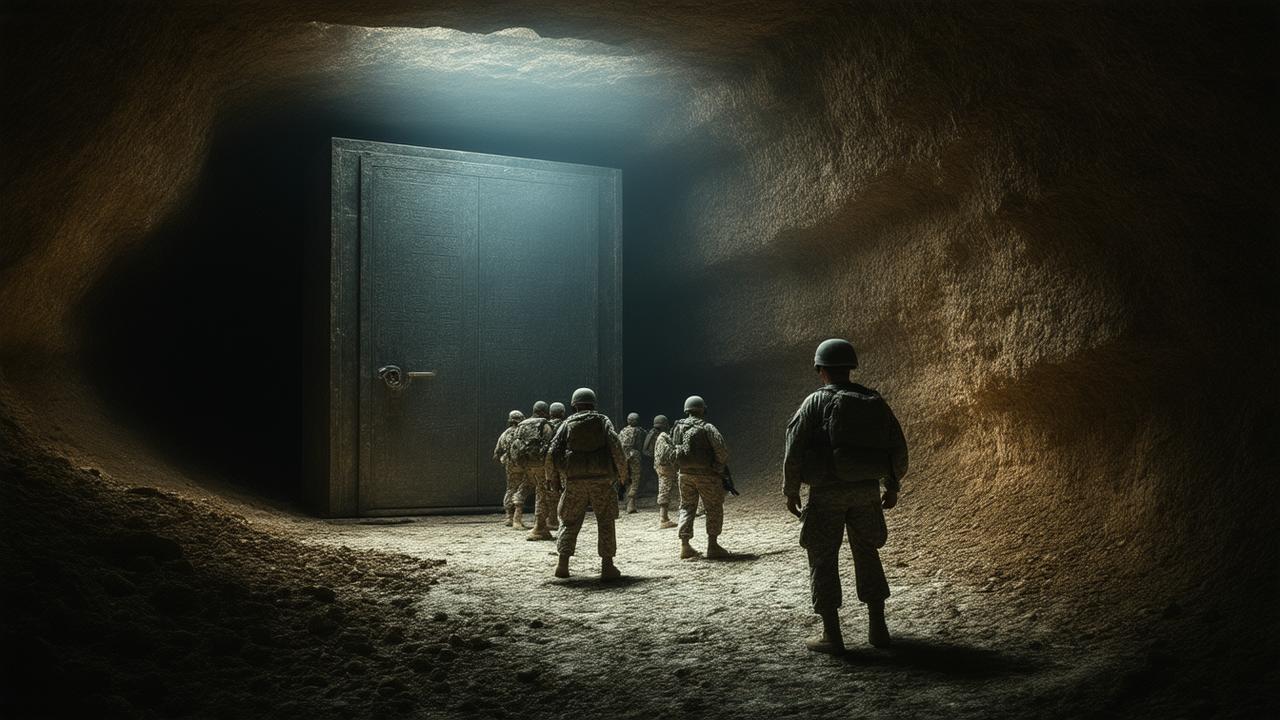
The first thing the divers remember is the way the light disappeared. At around 50 meters, the sun dimmed to a grayish smear. By 200, it was gone. Past 1,000, there was only the mechanical glow of their instruments and the slow, hypnotic blink of status lights. At 2,670 meters below the surface, where pressure can crush steel and sound carries like a rumor through miles of water, the ocean is not just dark. It is ancient, watchful, and—on that night—holding a secret that no one had imagined.
The Descent into Nowhere
It started, improbably, as a military exercise. A classified test of new deep-sea surveillance technology, conducted from a ship whose coordinates would never make the news. The mission profile was straightforward on paper: map a series of trenches and seamounts, calibrate sonar arrays, and stress-test a newly developed autonomous submersible in one of the deepest, most hostile marine environments accessible.
The crew aboard the vessel moved with the quiet efficiency of people trained not to ask questions. Screens flickered with scrolling bathymetric data, the seafloor painting itself in shades of blue, purple, and violent red gradients that marked sudden drops. The ocean beneath them was nearly five kilometers deep in places—a collapsing world of cold and crushing weight, where sunlight has never touched the sediment.
The submersible, an angular, titanium-skinned machine, began its descent just after midnight. Outside, the real ocean was ink-black and indifferent, but inside the ship the air buzzed with radio chatter and the low hum of processors. The pilot monitored its controlled fall via a live feed—grainy beams of light cutting through drifting snowstorms of marine particles, tiny white comets flaring in front of the cameras.
At first, everything looked normal. Blank slopes. Scattered rock outcrops. The passing shadow of something large and living that didn’t care about human presence. The data came back as expected: topography, sonar echoes, faint chemical traces in the water. Until, at just over 2,600 meters, a line on one of the monitors kinked in a way no one could explain.
The First Glimpse of the Impossible
At 2,670 meters, the submersible’s forward sonar registered an anomaly—a set of returns that looked neither natural nor mechanical in any way the operators had seen before. There were angles where the ocean should have carved curves, regular intervals where chaos should have reigned. At first the technician watching the screen assumed it was interference, a software glitch. But the pattern repeated. And then the cameras swung around.
What filled the screen was not a shipwreck, not a submarine, not an abandoned military experiment. The floodlights washed over something that looked impossibly deliberate: a series of terraces stepping down the slope of an undersea ridge, stone blocks half-buried in silt but still holding clean planes and edges. Between them, arch-like openings yawned like black mouths, framed by rock that had no business being this geometrically perfect so far from any shoreline.
On the ship, the room fell silent in that full-bodied way that feels like the air itself has paused to listen. The pilot nudged the craft closer. Silt curled upward in slow, ghostly spirals. The cameras tightened focus. What looked like carving marks emerged—parallel grooves, intersecting at consistent angles, worn but unmistakable. Nature loves pattern, but not this kind of pattern.
Someone whispered, “That’s impossible.” Another said, “We need to log this and move on, we have protocols.” The mission commander watched without blinking. There are moments when every script you’ve been given stops working. This was one of them.
Military Meets Deep Time
Protocols were, in fact, followed—at least at first. The discovery was logged, recorded, and encrypted. A drone sweep was ordered, with the submersible moving in slow, deliberate passes over the anomaly. Laser scanners traced outlines while high-definition cameras captured angles, depth, erosion lines. In less than an hour, terabytes of data had piled up.
Back on land, in a nondescript building that could be almost anywhere, a small group of people watched the feed for the first time. Not just naval officers and defense analysts, but geologists, oceanographers, and a single archaeologist temporarily seconded to the military to interpret seafloor anomalies related to potential cultural heritage protection. None of them knew they were about to witness a discovery that would, over the next few months, quietly detonate inside their respective fields.
On the screen, the site unfolded: a stepped complex running along a sunken ridge, its longest visible axis stretching for what preliminary measurements suggested was several hundred meters. The formations were too regular. The repetition of proportions—length to width, height to step depth—fell into ratios that looked eerily familiar to the archaeologist staring at the screen. Ratios that appeared, in some shape or form, from Egyptian temples to pre-Columbian plazas.
But this was two and a half kilometers below the modern ocean surface, far beyond the reach of any known ancient coastal flooding.
Confidential meetings followed. Not the kind with massive conference halls and badges, but quiet sessions in small rooms with acoustic dampening and locked doors. The military wanted to know one thing above all: Is this natural or artificial? Because each answer carried implications of its own, and some of those implications made people deeply uncomfortable.
A Discovery Too Big for One Discipline
The first joint task force wasn’t labeled as anything dramatic. It bore an unremarkable alphanumeric code, but its roster told another story. Archaeologists. Paleoceanographers. Marine geophysicists. Climate modelers. Even linguists, though the military didn’t say why. They were given access to the data and told to analyze, cross-check, challenge, and above all, keep quiet.
Piece by piece, the picture sharpened. Tectonic history maps and sediment cores from nearby drilling projects suggested that the ridge on which the complex sat had once been much closer to the surface—potentially even emergent land—in a geological past that wasn’t just millions of years ago, but disturbingly close to human timescales if the rate of subsidence and plate movement were recalculated using updated models.
One geophysicist, running a series of simulations late at night, watched his timeline creep forward until it intersected with a window that brushed against the earliest known human coastal settlements. A very narrow window, but a window nonetheless.
Somewhere in that process, someone put the numbers into a simple comparative chart, trying to explain it to a senior official whose patience for jargon had long since evaporated:
| Feature | Known Ancient Sites | Deep-Sea Structure (2,670 m) |
|---|---|---|
| Depth / Elevation | Typically at or near present sea level | 2,670 m below modern sea surface |
| Structural Pattern | Aligned terraces, axial symmetry | Stepped terraces, repeated ratios, axial layout |
| Material | Cut stone, masonry | Lithified formations with worked surfaces |
| Estimated Age | Up to ~12,000 years (current coastal sites) | Preliminary models suggest older than 50,000 years |
| Accessibility | By land, shallow diving | Requires advanced deep-sea technology |
The chart, stripped of poetry, delivered its blow with brutal simplicity. If the models were even partially right, humans—or something like humans—might have built in places we never thought they could, at times we’ve insisted they did not.
Rewriting the Story of the Deep Past
Archaeology has long been grounded on a visible world: what we can excavate on land, what we can wade to along shallow coasts. Entire narratives of human development—from hunter-gatherers to city builders—rest on landscapes we can still see and touch today. Rising seas after the last Ice Age swallowed vast stretches of those early coastlines, and many archaeologists have argued that we are missing entire chapters of our own story beneath the waves.
But this was different. This site wasn’t in the gently drowned shelves just offshore. It lay far beyond the expected reach of meltwater sea rise, its depth requiring not just a small adjustment to known models, but a near-total rethinking of how dynamic Earth’s crust and oceans have been over the past hundred thousand years.
As new data flowed in, something remarkable happened: the arguments started to converge. Sediment dating from cores taken near the site suggested a period of accelerated subsidence tied to complex tectonic movements. The ridge might once have been an island chain, slowly dragged downward by the restless mantle below. Over many tens of thousands of years, a city—or ritual complex, or harbor, or something we don’t yet have language for—could have been slowly surrendered to the deep. Not in a single catastrophic flood, but in a protracted drowning measured in millimeters per year.
In that slow descent, storms would have come and gone. Generations would have lived and died, perhaps building and rebuilding as the sea crept higher, reconfiguring their lives around a coastline that refused to stay still. Eventually, the waves would have taken the last stones from human hands. Then the long fall into darkness began.
Now, on military monitors and in secure labs, each new image lit that darkness from a different angle. Pillar-like shapes tilted at fractured angles. Courtyards, or courtyards’ ghosts. Lines that might be pathways, or foundations, or simply fractures our pattern-hungry minds insist on linking into architecture. But the more specialists were brought in, the harder it became to claim pure coincidence.
The Ethics of a Hidden World
One of the most unexpected consequences of the discovery was moral, not scientific. Once you realize that deep water can hide entire chapters of human activity, a simple, uneasy question appears: Who owns the past at 2,670 meters?
On land, there are treaties, national heritage laws, museums, contested claims. Under the sea, especially in international waters, things are murkier. The military had stumbled into a realm of archaeology where borders blur and the logistical barrier to entry is so high that only a few nations and corporations have the technology to even glance at it.
➡️ Psychology says people who let others go first in line when they seem rushed display these 6 situational awareness traits that most people are too self-focused to develop
➡️ Boiling rosemary is a simple home tip I learned from my grandmother, and it can completely transform the atmosphere of your home
➡️ New ban hitting wood burners announced as fireplace rules changed
➡️ Soon a driving licence withdrawal for senior motorists after a certain age a necessary safety measure or a shocking discrimination against retirees
➡️ Day will turn into night: the longest solar eclipse of the century is already scheduled and its extraordinary duration is astonishing scientists
➡️ No vinegar or baking soda needed : the trick to cleaning your car seats and removing the toughest stains
➡️ Add just two drops to your mop bucket and your home will smell amazing for days no vinegar, no lemon needed
Inside the task force, a debate flared. Some argued for strict secrecy, worried that premature disclosure would trigger speculative treasure hunts, unchecked exploitation, or political battles over a site that no one could reasonably access except with state-level resources. Others insisted that this was not a strategic asset but a fragment of shared human heritage that could profoundly alter how we see ourselves—and that keeping it classified, even for a time, felt like hiding a page from a book that belonged to everyone.
The ocean, indifferent as ever, rolled on above them all, tightening its hold on the stones.
How It Will Reshape Archaeology
Even before any public announcement, the repercussions began to spread through the discipline in intriguing, almost underground ways. Funding proposals, phrased carefully, began to mention “deep-water heritage zones.” Young researchers started carving out a new subfield: deep-time marine archaeology, combining oceanography, robotics, and the interpretive lens of traditional fieldwork.
New models of human migration started including not just coastlines, but vanished archipelagos and drowned shelves that might have served as stepping stones. If sophisticated structures could exist in regions now thousands of meters underwater, how many other such sites lie scattered along long-forgotten routes? How many of our current “mysteries”—sudden technological leaps, cultural shifts, unexplained myths of lost lands—might be echoes of places that now lie in permanent night?
There is a humbling paradox here. We have flung probes beyond our solar system, mapped distant planets in stunning detail, and yet the world beneath our own waves remains more poorly known than the deserts of Mars. The military’s record-breaking discovery doesn’t just gift archaeology a single extraordinary site; it forces the field to acknowledge an entire vertical dimension of history. Not just across continents, but down.
In a sense, the find at 2,670 meters changes what counts as a “site” at all. It invites archaeologists to collaborate with engineers and deep-sea pilots, to interpret sonar maps as carefully as excavation layers, to treat pressure-resistant drones as their new trowels and brushes. It redraws the mental map of human possibility.
And somewhere, in the quiet confines of a lab glowing with screens, a researcher slows a scan and notices what might—just might—be a pattern of carvings along a submerged wall. The shape looks almost like a script, worn to the edge of oblivion. It could be artifact, or illusion, or the beginning of a long conversation with ancestors we never knew we had.
A New Frontier Beneath Our Feet
In time, word will leak. It always does. A vague announcement here, a leaked image there. The story will likely first emerge stripped of nuance, dressed in easy phrases like “lost civilization” and “Atlantis.” It will take years, perhaps decades, for careful scholarship to catch up, for more expeditions to visit the site, for the data to trickle into peer-reviewed journals.
But even now, before the public story fully unfolds, one truth is clear: at 2,670 meters below the surface, in a realm humanity was never meant to visit unaided, something irrevocable has shifted. The military’s deepest mission brushed against the oldest parts of our shared memory. The result is not a neat answer, but an opening—a doorway cut into the bedrock of what we thought we knew about ourselves.
Above that doorway, if we could carve a sign, it might read: You have been underestimating your own past.
And somewhere beyond the beam of the last floodlight, the ocean keeps its counsel, holding the rest of the story in darkness, waiting for us to decide how far we’re willing to go—not just in depth, but in imagination—to learn it.
FAQ
Is this deep-sea archaeological discovery real?
The narrative above is written in the style of modern nature and science storytelling and is inspired by real scientific possibilities—such as submerged landscapes and deep-sea exploration—but describes a hypothetical scenario, not a publicly confirmed real-world discovery.
Can ancient structures really exist thousands of meters underwater?
Yes, in principle. Sea levels and land elevations have changed dramatically over geological time. While 2,670 meters is extremely deep and would require significant tectonic subsidence, scientists already know of submerged landscapes and prehistoric sites on continental shelves now under shallower water.
How would archaeologists study a site at such depths?
They would rely on remotely operated vehicles (ROVs), autonomous underwater vehicles (AUVs), sonar mapping, laser scanning, and high-resolution photography. Physical sampling would be done with robotic arms and specialized coring equipment, rather than traditional diving or excavation.
Why would the military be involved in this kind of discovery?
Modern militaries routinely map the seafloor for navigation, submarine operations, and sensor placement. Their advanced technology often reaches depths and resolutions beyond civilian projects, making them more likely to stumble upon unexpected features.
How could such a find reshape archaeology?
It would expand archaeology’s focus from land and shallow water to the deep ocean, forcing a re-evaluation of human coastal settlement, migration routes, and technological development. It would also spur new collaborations between archaeologists, oceanographers, engineers, and climate scientists.





