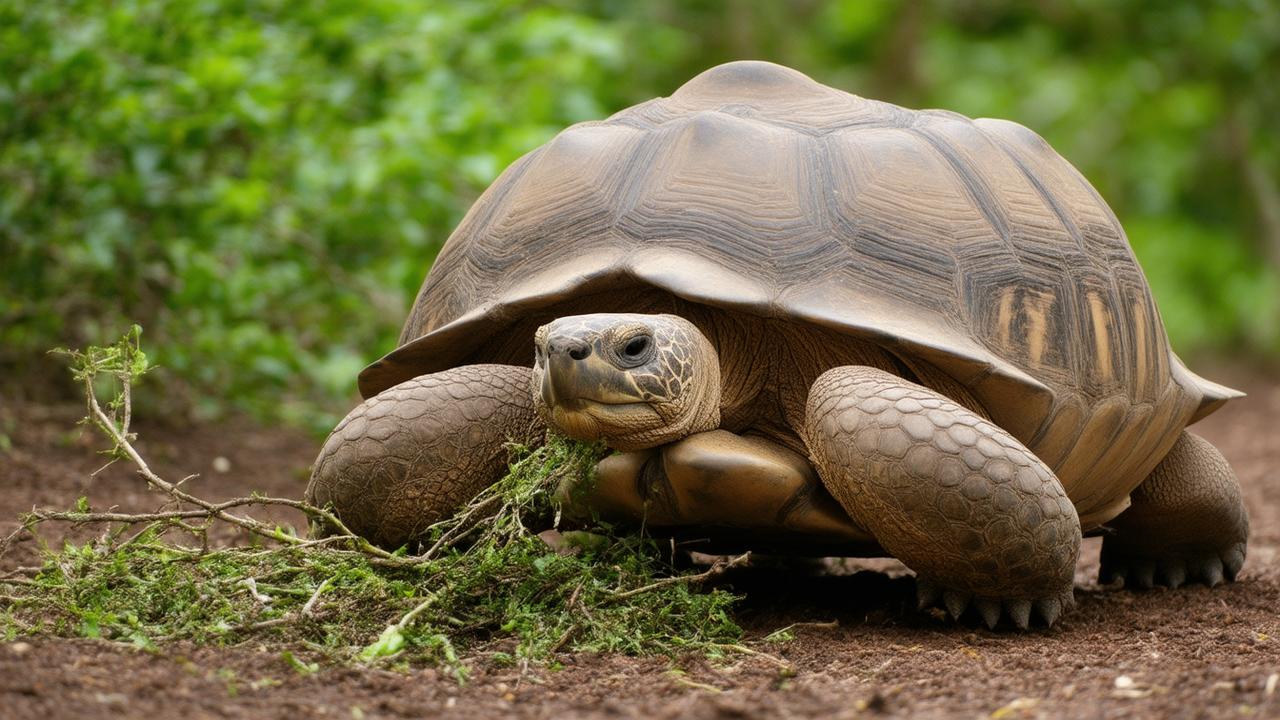
The first thing you notice is the sound. Not a roar or a chorus, but a steady, deliberate crunching—like someone slowly breaking celery stalks under a heavy boot. All around you, in the shimmering heat of a Galápagos afternoon, shells the size of overturned bathtubs move through the brush with unexpected determination. A tortoise jaw closes around a woody shrub stem; a few seconds later, what had once defied the wind is reduced to snapped twigs and drifting leaves. Seeds scatter into the soil. Dust rises. Life, very quietly, begins again.
A Lost Engine of the Islands
For most of human memory, the Galápagos giant tortoise has existed in our imagination as a symbol: of slow time, of evolutionary wonder, of patient survival. But for the islands themselves, tortoises were never symbols. They were engines.
Centuries ago, tens of thousands of giant tortoises roamed these volcanic landscapes. They trampled saplings, churned soil, opened paths, and carried seeds in their guts, redistributing future forests one mouthful at a time. Their movements carved the shape of plant communities, shaped where birds could nest and hunt, and even influenced how water pooled and seeped through the ground.
Then came whalers, pirates, colonists. Tortoises were stacked alive in ship holds as living meat reserves—easy to catch, easy to keep, easy to eat. Some populations vanished entirely. Others shrank to a ghostly fraction of their former numbers. As the shells disappeared, something else faded too: the invisible choreography of ecological processes they had held together for millennia.
On Santa Fe and other islands, shrubs thickened into nearly impenetrable thickets. Grasses and seedlings that once thrived under a more open canopy struggled in the shade. Seeds fell, but did not travel far. It was as if someone had turned off a slow, grinding, essential machine—and the landscape quietly seized up.
When the Giants Come Home
Now, step into that same Galápagos light today, and the machine is starting to hum again.
More than 1,500 giant tortoises have been brought back to key islands—part of one of the most ambitious rewilding efforts on Earth. These are not abstract numbers in a research paper. They are individuals with chipped scutes, mud-caked shells, and the faint earthy smell of sun-baked reptile skin, fanning out from release pens into territories that have not seen such heavy footsteps in generations.
On Santa Fe, where tortoises had vanished, conservationists introduced a related species from another island as ecological stand-ins, carefully selected to play similar roles. At first, the tortoises hesitated, pushing gently at unfamiliar shrubs, swinging their heads as if testing the air. Then instinct took over. They walked. They grazed. They knocked things down.
Every day they spend tearing into shrubs and walking across the land is a day that history bends back on itself. A landscape that had grown tight and tangled begins to open. Paths appear where before there was only thorn. Seedlings of native trees, once smothered in shade, catch bursts of light. In their slow, stubborn way, the tortoises are restarting processes that evolution tuned over millions of years—and that human exploitation nearly snapped in two.
Eating, Walking, and Quietly Rebuilding an Ecosystem
To watch a tortoise eat is to realize how deceptively simple restoration can look. No high-tech tools, no gleaming machinery—just a jaw, a beak, a neck stretching out with glacial patience. A tortoise grabs a woody shrub, leans its weight into the stem, and rips. Repeat that action a few thousand times across a year, across an island, across a decade, and the land becomes something different.
The tortoises are blunt instruments and precise engineers all at once. Their feeding habits push back against invasive or overabundant shrubs, thinning the vegetation and letting sunlight penetrate. That light wakes up buried seeds, stimulates grasses and herbs, and makes room for native saplings that need open space to grow. Where shrubs are torn down, the wind moves differently; rain strikes the soil with a new angle; small animals find new routes to travel.
But the real magic happens on the move. Each tortoise is a slow-moving seed dispersal machine. Fruits and seeds pass through their guts, bathed in digestive juices that often help break down seed coats and increase germination success. Hours or days later, in a different patch of the island, those seeds emerge in a neat package: a small pile of nutrient-rich fertilizer, dropped precisely where new plants now have a better chance to take hold.
Over time, these tiny, plopped-down islands of fertility string together into corridors of new growth. Tree species that had become fragmented across the landscape start to connect again. Genetic diversity flows more freely. The forest, shrubland, and grassland communities begin to reorganize around this renewed movement of plant life, orchestrated—slowly, silently—by animals that can’t even outrun a human walking briskly.
| Tortoise Action | Immediate Effect | Long-Term Ecological Impact |
|---|---|---|
| Grazing on shrubs | Reduces dense woody cover | Opens space for native grasses and seedlings to thrive |
| Trampling vegetation | Creates paths and bare-soil patches | Enhances habitat diversity and micro-sites for germination |
| Seed dispersal via droppings | Moves seeds away from parent plants | Increases plant genetic mixing and range expansion |
| Digging shallow hollows | Disturbs and aerates soil | Improves soil structure and water infiltration |
| Congregating at water or shade | Creates localized high-traffic zones | Generates nutrient “hotspots” and unique plant communities |
Rebooting Broken Ecological Processes
If you imagine an ecosystem as a series of loops—nutrients cycling, seeds traveling, predators and prey balancing each other—then the loss of a major species tears those loops open. Things still move, but not in circuits. Energy leaks out. Feedbacks fail. Processes break.
Tortoises don’t just eat and walk. They close loops.
By hauling nutrients from one part of the island to another in their bodies, they connect otherwise isolated patches of fertility. By thinning some plant species and favoring others, they rearrange the competitive playing field, preventing a few aggressive shrubs from locking entire landscapes into stasis. Their presence encourages a shifting mosaic of habitats—dense here, open there, damp in one depression, exposed and sun-blasted on the next slope.
These structural changes ripple outward. Ground-nesting birds find more open ground with sightlines that make it harder for predators to sneak up. Insects track the changing plant communities, bringing pollination services with them. Lizards and small mammals follow the new patterns of cover and open space, seeking food and refuge in a terrain subtly re-sculpted by thousands of tortoise decisions about where to take the next bite.
Even fire regimes can shift. Where dense, dry shrubs once formed continuous fuel, tortoise browsing may fragment that fuel into patches. In a warming, drying world, anything that breaks up flammable continuity can reduce the intensity or frequency of fire, giving native species a crucial edge.
None of this happens overnight. But stand on a hill where tortoises have been absent for a century, and then again ten years after they return, and the difference creeps up on you: the height and texture of the plants, the way the wind carries fewer seeds from this valley and more from that ravine, the sense that the place is not fixed, but is once again in motion.
The Human Hands Behind the Shells
Behind every tortoise now roaming freely, there is a human story as well—a convergence of scientific planning, logistical stubbornness, and quiet, repetitive care. Eggs collected from remnant populations are incubated in controlled conditions. Tiny tortoises—small enough to cradle in both hands—start their lives not under a prickly pear’s shade, but beneath heat lamps and the watchful eyes of staff who know each animal’s growth curves and shell patterns.
For years, they are protected from the threats that their ancestors never had to face at scale: introduced rats and cats, invasive ants, pigs, dogs, goats. Only once they reach a size that gives them a decent chance against this altered world are they loaded into crates, carried by boat, then by backpack or stretcher over rough lava landscapes to release sites. The moment the crate door is lifted, gravity and instinct take over. The tortoise steps out, blinks in the glare, and rejoins an ancient conversation with the land.
Conservationists track them with tags and sometimes GPS units, following their routes through the brush. Data maps fill with slow-moving dots that trace seasonal migrations between higher, lusher slopes and drier lowlands. Field teams return to the same plots year after year, measuring seedlings, shrubs, ground cover, and soil. The numbers tell a story the eye begins to see: more native plants, fewer suffocating thickets, a greater variety of habitat niches.
➡️ Psychology says people who let others go first in line when they seem rushed display these 6 situational awareness traits that most people are too self-focused to develop
➡️ Boiling rosemary is a simple home tip I learned from my grandmother, and it can completely transform the atmosphere of your home
➡️ New ban hitting wood burners announced as fireplace rules changed
➡️ Soon a driving licence withdrawal for senior motorists after a certain age a necessary safety measure or a shocking discrimination against retirees
➡️ Day will turn into night: the longest solar eclipse of the century is already scheduled and its extraordinary duration is astonishing scientists
➡️ No vinegar or baking soda needed : the trick to cleaning your car seats and removing the toughest stains
➡️ Add just two drops to your mop bucket and your home will smell amazing for days no vinegar, no lemon needed
It is not neat, and it is not perfect. Some years, drought bites deeply, and even the tortoises struggle. Some invasive species push back harder than expected. But the overall direction is clear: with each shell added to the landscape, the islands regain a piece of their original self.
What It Means to Restore a Giant
There is something humbling about realizing that one of the most powerful tools we have for healing damaged islands is a reptile that moves at the speed of erosion. In a time of climate urgency and technological fixes, the idea that “slowness” can be a restoration strategy feels almost radical.
Reintroducing more than 1,500 giant tortoises is not just a victory for one charismatic species. It is a statement about how ecosystems actually work. They do not respond only to fences, to spreadsheets, to laws written on distant desks. They respond to physical presence—to bodies that move, eat, excrete, and die in particular ways, in particular places, over time spans that stretch beyond human careers.
In the Galápagos, the return of these giants challenges a more subtle assumption, too: that conservation is only about stopping loss. Here, something else is happening. We are not just putting a brake on decline; we are pressing a reset button, asking the land to remember an older script written by the footsteps and bite marks of enormous, long-lived reptiles.
Listen again to that celery-crunching sound on the slope above you. Each bite is both an ending and a beginning—this shrub losing its branches, that seed getting its chance, this path opening, that thicket thinning. It is the sound of an ecosystem remembering that it knows how to change.
In a century, if we are wise and persistent, a traveler may walk across a Galápagos island and see tortoises almost as Darwin did: common, unavoidable, part of the scenery. Not a miracle, not a project, not a headline, but a quiet, living background to everything else that happens there. Birds will nest where shells have flattened the grass; trees will grow where seeds once rode inside reptilian bellies. And the loops—nutrients, seeds, life—will be closed again.
Frequently Asked Questions
Why were giant tortoises reintroduced to some Galápagos islands?
Giant tortoises were reintroduced because they are key ecosystem engineers. Their grazing, trampling, and seed dispersal help control dense shrubs, promote native plant regeneration, and restart ecological processes that broke down when tortoise populations collapsed due to historical overhunting and habitat change.
How do tortoises help plants besides eating and dispersing seeds?
By opening up thick vegetation, tortoises let more light reach the ground, which benefits grasses and seedlings. Their movement and shallow digging aerate the soil, improve water infiltration, and create small disturbance patches where certain plants can germinate more easily.
Are the reintroduced tortoises the same species that originally lived on each island?
In some cases, yes, but not always. On islands where the original tortoise species is extinct, conservationists have introduced closely related species with similar body shape and feeding behavior to fill the same ecological role, after careful scientific assessment and planning.
How many tortoises have been brought back so far?
More than 1,500 giant tortoises have been released across key Galápagos islands as part of long-term breeding and restoration programs. Many more are still being raised in captive facilities and will be added over time.
How long will it take for the ecosystems to fully recover?
Full recovery will likely take decades, possibly longer. Tortoises are long-lived and slow to reproduce, and ecological processes respond gradually. However, positive changes in vegetation structure, seed dispersal, and habitat diversity are already being recorded within years of reintroduction.
Do the tortoises face new threats today?
Yes. Although hunting has been largely stopped, introduced predators, invasive plants, disease, and climate extremes all pose risks. Ongoing management—eradication of invasive species, habitat protection, and careful monitoring—is essential to ensure that tortoise populations and the ecosystems they support continue to recover.
Why are giant tortoises considered “ecosystem engineers”?
They are called ecosystem engineers because their physical presence and behavior actively reshape the environment. Through grazing, trampling, and seed dispersal, they alter plant communities, soil conditions, and habitat structure in ways that affect many other species and ecological processes.





