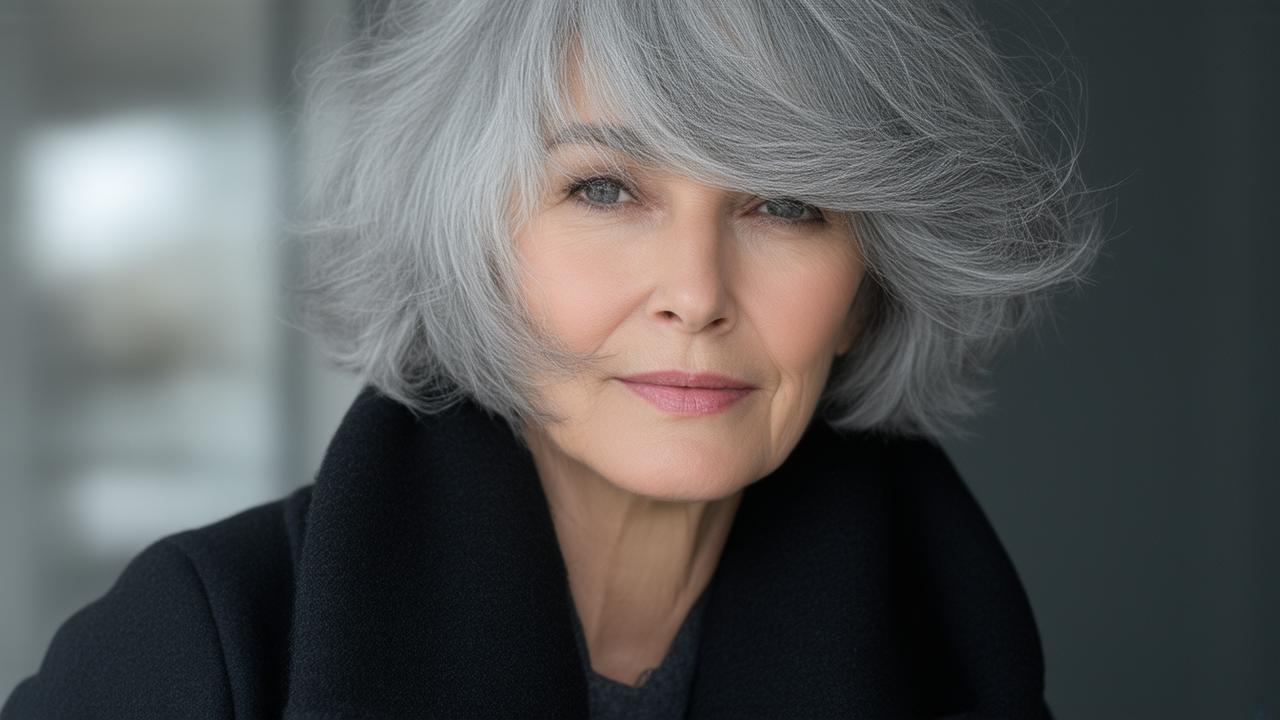
The first thing you notice is the shimmer. Not the flat, one-tone gloss of a salon dye, but the soft, shifting play of light over strands that are not quite grey, not quite brown, not quite anything you can name. On the train, a woman in her fifties lifts her head, and for a second the carriage seems to pause with you. Her hair looks like it caught dawn in it—silver woven with caramel, a hint of rose warmth toward the ends. No obvious roots, no harsh demarcation, no telltale chemical shine. Just this alive, dimensional color that makes her look… rested. Younger, but also somehow more herself.
The New Grey-Covering Secret You’re Starting to See Everywhere
For decades, covering grey hair meant one of two things: the chemical smell of ammonia in a salon chair, or a box of color balanced on your bathroom sink, promising “perfect coverage” and a youthful you in thirty minutes. The script was predictable: color, look fresh; wait three or four weeks; watch a sharp white line appear; repeat. Underneath the layers of brown, black, or blonde, your real hair color—along with your patience—slowly disappeared.
But something is shifting. Walk through any café on a weekday morning and you’ll spot it: hair with movement and nuance, greys softened rather than obliterated, faces that look relaxed instead of overworked. People are quietly saying goodbye to traditional hair dyes and embracing a new trend that both covers grey and, paradoxically, looks more natural and often more youthful than the uniform color we used to chase.
This isn’t the dramatic “go full silver overnight” movement (though that has its own devoted following). This is a gentler revolution: low-tox, low-maintenance, and high on dimension. It’s about speaking more kindly to your hair—and it’s turning out to be one of the most flattering age-defying tricks around.
Why Classic Hair Dye Started to Feel Wrong
Ask around and the reasons people are turning away from standard dyes come tumbling out like confessions.
There’s the ritual fatigue: booking a three-hour appointment every few weeks; texting your stylist in a panic because your roots decided to appear the week before a big event; the endless cycle of touch-ups that never quite end. There’s the sensory side too—eyes stinging from fumes, that unmistakable chemical scent following you out of the salon and into your pillowcase.
Then there’s what happens to the hair itself. After years of permanent coloring, strands often feel a little defeated: porous, dry, brittle at the ends. Color that was once rich and nuanced begins to look flat, especially on darker shades that need more processing. Ironically, the more we try to look effortlessly youthful, the more obvious the effort becomes.
People also started reading ingredient lists. Words like “ammonia,” “PPD,” and “resorcinol” stopped sounding abstract and started feeling personal. Stories spread of sensitive scalps flaring up, of people developing allergies seemingly overnight. The idea of painting aggressive chemicals onto our heads every month suddenly felt… off.
And quietly, another thing dawned on many of us: that hard line of regrowth. The grow-out demarcation, especially on dark dyed hair with light natural roots, doesn’t exist in nature. It is the visual equivalent of shouting, “I dye my hair!” every time you tuck it behind your ear.
The Gentle Takeover: Blends, Glosses, and Botanical Color
Into this moment of fatigue stepped a different approach—less about fighting time, more about softening it. Instead of coating every strand in one opaque shade, the new grey-covering trend focuses on blending, veiling, and enhancing.
1. The Rise of Grey Blending
Grey blending is exactly what it sounds like: working with your natural greys instead of against them. Stylists weave in highlights, lowlights, and mid-tones that mimic what the sun might have done if it were also a colorist. The goal is to diffuse the contrast between your greys and your base color so that new growth doesn’t scream for attention.
Imagine a dark brunette with scattered silver at the temples. Instead of dyeing everything a single dark chocolate brown, a colorist might add warm, medium-brown pieces, some soft caramel ribbons, and a translucent glaze over the greys. The result? Hair that looks layered with light, like a photograph taken at golden hour. As it grows, there’s no hard root line—just a soft shift in tone that still feels intentional.
2. Glosses and Glazes: Sheer, Not Shouting
Another hero of this new movement is the hair gloss or glaze. These are low-commitment, semi-permanent formulas—often ammonia-free—that add tone and insane shine without locking you into a strict regrowth cycle.
Think of a gloss as the Instagram filter of hair color. It sits on the outside of the strand, blurring uneven tones, cooling down brassiness, or warming up washed-out ends. For grey coverage, glosses can slightly tint silver strands so they blend more harmoniously with the rest of your hair, without erasing them entirely. The effect is extremely flattering: light-catching, youthful, and soft around the face.
3. Botanical and Mineral-Based Color
Then there’s the move toward plant-powered and mineral-enhanced hues. Henna and indigo have been around for centuries, but new formulations combine botanical extracts, oils, and gentler pigments to create softer, more modern results. Some salon brands offer hybrid systems—mixes of plant-based color with minimal synthetic additives—to reduce harshness while still achieving believable tones.
These options don’t always behave like traditional dyes—coverage can be more translucent, and the palette slightly different—but that’s becoming part of their appeal. They stain the hair rather than blasting open the cuticle, creating a wash of color that can camouflage greys while keeping hair’s texture and movement intact.
4. Strategic Dimension as a Youthful Illusion
Here’s the twist: many people are discovering that less color looks more youthful. Flat, single-process dye can create a helmet effect that emphasizes lines and shadows in the face. In contrast, dimensional color—where greys are softened, not smothered—adds visual “air” around the features. Lighter pieces around the face bounce light onto the skin, and the slight shimmer of silver strands can function like built-in highlighter.
It’s not about pretending you don’t have greys. It’s about arranging them in a way that flatters you. The result feels less like a mask and more like turning up the contrast on your real self.
Real People, Real Hair: How the Switch Actually Feels
Everyone’s hair story is personal, but when you listen to people who’ve traded full-on dye for this new approach, certain themes repeat.
There’s the relief of reclaiming time. Instead of monthly emergency root appointments, they’re stretching salon visits to eight, ten, even twelve weeks. Some shift from full services to occasional glosses and partial highlights. Their calendars feel lighter, and so do their heads.
There’s the physical difference. Hair often begins to feel like hair again—less straw, more silk. Without constant high-level processing, curls spring back; waves remember their pattern; fine hair gains a bit of resilience. Blow-drying takes less effort because the strands aren’t as parched.
And then, there’s the mirror moment. The first weeks can be disorienting. You may catch glimpses of silver at your temples or a new, warmer tone framing your face and think, Is this really me? But as the color softens into itself, many people describe a sense of rightness. Their hair does not look like it belongs to a younger stranger; it looks like an upgraded version of their present self—rested, bright, and believable.
| Approach | How It Treats Greys | Maintenance |
|---|---|---|
| Traditional Permanent Dye | Covers completely, one solid shade | High – frequent root touch-ups |
| Grey Blending | Softens and mixes greys with highlights/lowlights | Medium – flexible grow-out |
| Gloss/Glaze | Veils greys with translucent tone and shine | Low to medium – fades gently |
| Botanical/Hybrid Color | Stains and softens greys, often semi-opaque | Medium – depends on formula |
Looking Younger Without Pretending to Be Younger
There’s an interesting paradox at the heart of this trend: the less you try to erase your age, the younger you can end up looking.
When we fully eradicate grey, we also remove natural variation—the kind that hair has at every age. Children’s hair is rarely a single flat color; it has halos of lighter strands, sun-touched pieces, deeper shadows at the nape. By reintroducing that nuance, even around the presence of some grey, we recreate a quality that reads subconsciously as youthful vitality rather than manufactured youth.
➡️ Psychology says people who let others go first in line when they seem rushed display these 6 situational awareness traits that most people are too self-focused to develop
➡️ Boiling rosemary is a simple home tip I learned from my grandmother, and it can completely transform the atmosphere of your home
➡️ New ban hitting wood burners announced as fireplace rules changed
➡️ Soon a driving licence withdrawal for senior motorists after a certain age a necessary safety measure or a shocking discrimination against retirees
➡️ Day will turn into night: the longest solar eclipse of the century is already scheduled and its extraordinary duration is astonishing scientists
➡️ No vinegar or baking soda needed : the trick to cleaning your car seats and removing the toughest stains
➡️ Add just two drops to your mop bucket and your home will smell amazing for days no vinegar, no lemon needed
Colorists are increasingly thinking like portrait artists. They place lighter tones around the eyes and cheekbones to lift; they keep the crown slightly deeper for dimension; they may allow some intentional silver to shine through at the temples, which can look elegant rather than aging when balanced by warmth elsewhere. Instead of chasing the color you had at nineteen, they’re designing a palette that complements your skin as it is now.
The psychological shift matters too. There is a specific kind of tension in always “fixing” your regrowth, like you’re chasing a version of yourself that keeps slipping out of reach. When the expectation shifts from flawless coverage to flattering blending, something inside relaxes. You’re no longer late for an invisible deadline every time your roots appear; they’re simply part of a slower, intentional evolution.
How to Start Saying Goodbye to Traditional Dyes
If your fingers are already twitching for the appointment app, it can be tempting to overhaul everything at once. But the gentlest, most successful transitions tend to happen in stages—especially if you’ve been coloring for years.
Begin with a conversation. When you book, look for words like “grey blending,” “low-maintenance color,” “lived-in color,” or “dimensional coverage.” Bring photos—not just of colors you love, but of grow-out patterns that look tolerable to you. Explain how often you’re realistically willing to visit the salon, and whether you’re open to keeping some grey visible.
Your stylist might suggest:
- Adding highlights and lowlights into your current shade to break up the solid line of regrowth.
- Switching from permanent root color to demi- or semi-permanent formulas.
- Using clear or tinted glosses to boost shine and softly blur greys in between bigger appointments.
- Gradually lightening your overall color so future greys contrast less dramatically.
At home, be kind to your hair as it shifts. Hydrating masks, gentle sulfate-free shampoos, and light oils or serums become your allies. The healthier your hair’s texture, the better any approach to grey coverage will look, because shine and movement are half the illusion of youth.
Most of all, give yourself time. Hair grows about a centimeter a month; identity sometimes moves more slowly. Some days you may miss the dense, predictable shade you once had. But notice the small wins: the way your hair glows in evening light now, the freedom of skipping an appointment you would once have felt desperate to keep, the quiet pride in catching sight of yourself and thinking, Yes—that looks like me.
FAQs: The New Grey-Covering Trend
Does grey blending really make you look younger?
Often, yes. By introducing dimension, lightness around the face, and a softer transition between colors, grey blending can lift your features and add vibrancy. It looks less artificial than a flat dye, which many people find more youthful overall.
Will I still see my grey hairs with this approach?
Usually, you’ll see some greys, but they’re softened and integrated rather than standing out in stark contrast. Think of them as part of the overall texture instead of isolated strands shouting for attention.
Is this trend only for women?
Not at all. Many men are discovering that subtle blending, lowlights, or a soft glaze over salt-and-pepper hair can look polished and youthful without the obvious “just dyed” effect.
Can I try this at home, or do I need a professional?
You can experiment with gentle glosses at home, but for true grey blending and dimensional color, a skilled colorist makes a big difference. They can read your natural tones and place color strategically in ways that are hard to replicate yourself.
How long does it take to transition from full dye to this new style?
It depends on your starting point and your comfort level. Some people see a visible shift after one or two appointments; for others, a gradual transition over six months to a year feels more manageable. The key is moving in stages that feel emotionally and practically sustainable.
Is this approach healthier for my hair?
Generally, yes. Using fewer aggressive chemicals, spacing out appointments, and relying more on semi-permanent tones and glosses usually leads to less damage. Over time, hair often becomes softer, shinier, and more resilient.
What if I decide I miss my old, fully colored look?
You can always adjust your strategy. The beauty of this trend is its flexibility—you can dial coverage up or down over time. Saying goodbye to traditional hair dye doesn’t have to be an all-or-nothing statement; it can simply be an ongoing conversation between you, your hair, and the person you are becoming.





