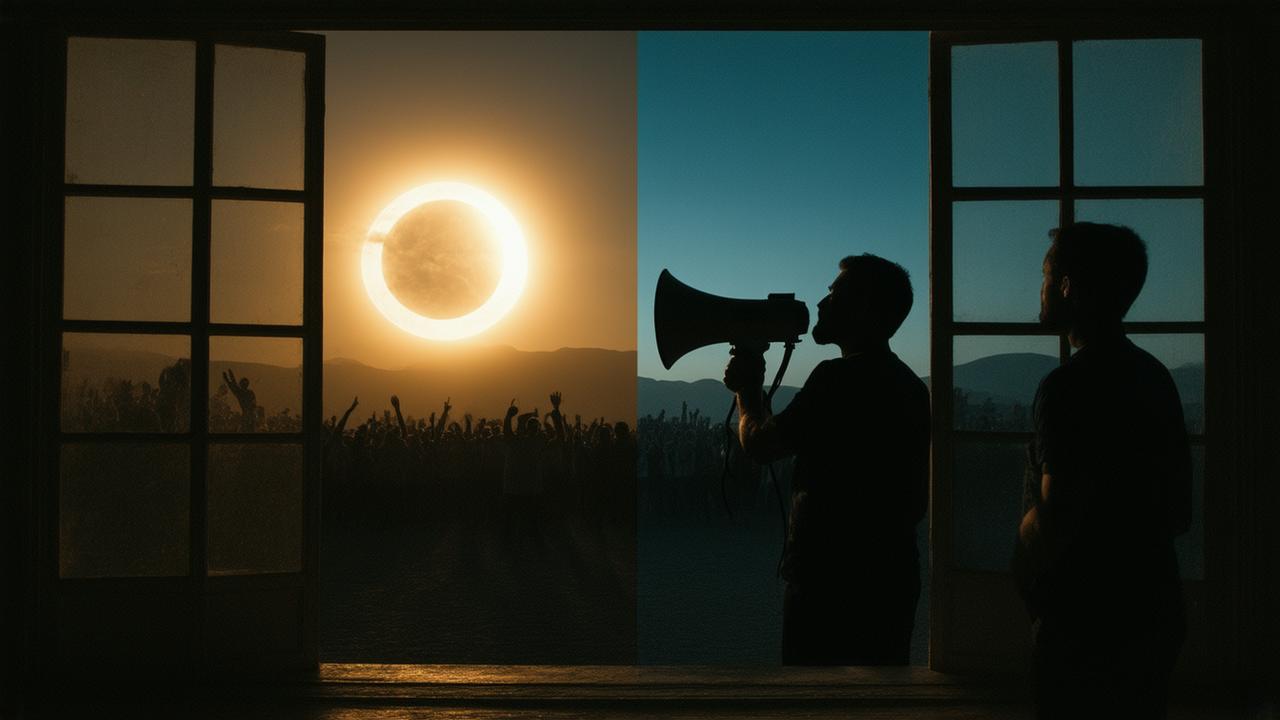
The first time I saw the path of the coming eclipse mapped on a glowing screen, the line looked impossibly thin—like a stroke of ink across the face of the Earth. A shadow, no wider than a hundred miles or so, that will race across continents and oceans, turning day to night in a slow, eerie sweep. Scientists call it a total solar eclipse. Preachers call it a sign. On street corners and late-night livestreams, others whisper the word “omen.” But the shadow, indifferent to all of us, is still coming.
When the Sun Blinks
In the weeks leading up to it, the world begins to hum with a familiar but intensified anticipation. You can feel it in the grocery store line, where people talk about eclipse glasses the way they once talked about toilet paper and hand sanitizer. You can hear it in the nervous undercurrent behind casual jokes: “So, is this the end of the world, or what?”
Somewhere in a bright, humming observatory, a solar physicist is staring at a model of the Sun’s corona, meticulously color-coded and alive on a computer screen. To her, this isn’t doomsday—it’s opportunity. A chance to watch the star we live by reveal its hidden layers, as the Moon glides between Earth and Sun, blocking almost all of that brutal white light and leaving only the fragile halo: the corona, pale and ghostlike and usually invisible.
To see a total solar eclipse is to watch the familiar rules of daytime quietly break. The light doesn’t just dim; it changes character. Shadows sharpen, air cools, birds fall strangely silent. The blue of the sky deepens into something that isn’t quite afternoon and isn’t quite evening—an uncanny twilight that descends out of order.
And this one—this eclipse—has been anointed with a special distinction: the longest of the century, a drawn-out breath in which the Sun will vanish for minutes that feel like hours. Long enough for scientific instruments to gather a wealth of data. Long enough for believers to search the darkened sky for meaning. Long enough for the prophets of doom to say, “There. Do you see?”
The Shadow’s Path: A Moving Line on a Living Planet
The eclipse won’t cover the entire Earth in darkness—only a narrow path where the Moon’s shadow, the umbra, touches down and sweeps across the planet. People beyond that ribbon will see a partial eclipse: the Sun bitten into, like a luminous cookie with a crescent gone. But inside the path of totality, the world will change in a way that photographs never fully capture.
Imagine standing in a crowded field, or on a rooftop, or at the edge of a small town’s main street. The day has been bright, maybe even unremarkable. People check their phones, adjust homemade pinhole viewers, press the edges of eclipse glasses against their cheeks. Children fidget, teenagers take selfies, adults pretend not to be nervous.
Then, slowly, the light begins to fade—not as if a cloud has passed over the Sun, but as if someone has dialed down the color of the world. The temperature drops, a thin fresh chill slipping under your shirt. Someone says, “Is it starting?” Someone else shushes them, as if they’re in a theater.
The Sun becomes a star with a bite taken out of it, then reduced to a shrinking arc, then to a final bright bead. The landscape looks washed out, like a film set at the wrong exposure. And then there’s that moment that makes hearts stop—the diamond ring effect. A last brilliant flare at the edge of the Moon and then, suddenly, impossibly, darkness.
Believers Under a Darkened Sky
Long before anyone understood orbital mechanics, eclipses were the sky’s loudest way of getting attention. Ancient texts describe them as dragons devouring the Sun, as heavenly battles, as warnings sent to kings and empires. It’s not hard to imagine why. You don’t need an education to feel the sharp edge of wrongness when the Sun, the unblinking eye of day, suddenly closes.
Today, not everyone sees the coming eclipse as a mere curiosity or scientific event. In hushed prayer rooms and thunderous megachurches, in candlelit temples and spare community halls, people are already preparing. Some will gather to pray for protection. Others will fast. A few small groups will retreat together to the countryside, seeking isolation from what they believe the darkened sky may herald.
Prophetic voices online are louder than ever. A charismatic preacher in a crisp suit stands beneath a projected image of the eclipse path, tracing it with his finger across a digital map. He talks about patterns, about celestial signs mentioned in scripture. “When the Sun goes dark in the middle of the day,” he declares, “we must pay attention.” To him and to his followers, the timing, the length, the very geometry of the eclipse feel like a stitched-together message.
But not all believers are afraid. For many, the eclipse is a moment of awe, not terror. A reminder that creation is larger and more intricate than any daily worry. Parents will take their children outside and say, “Look up. Remember how this feels. This is one of those days you’ll talk about when you’re old.” For them, the shadow is not a threat, but a rare invitation to feel small in a way that is strangely comforting.
How Science Sees the Same Darkness
In laboratories and control rooms, scientists talk about the same event with entirely different language. For them, eclipses are not warnings—they are windows. A total solar eclipse offers a natural coronagraph: the Moon neatly blocks the brilliant solar disc, leaving the fainter outer atmosphere visible.
Telescopes will be shipped, hauled, and carefully assembled along the path of totality, forming a loose chain of sky-watching stations. As the shadow moves, one set of instruments hands the Sun off to the next, like a relay race of data collection.
They will study the temperature and structure of the corona, hunting for clues about why it is so much hotter than the Sun’s surface. They will watch the dance of magnetic loops that can unleash solar storms—storms that can rattle satellites, disrupt power grids, and paint auroras across polar skies.
Even the darkness itself is data. Scientists will track how quickly animals respond—the confused choruses of crickets, the sudden roosting of birds, the shifting behavior of farm animals. Temperature sensors will log the falling degrees. Atmospheric researchers will study how the brief night changes air currents and turbulence. To them, the eclipse is not a verdict on humanity. It is a rare, coordinated natural experiment where the universe briefly adjusts a single, massive variable: sunlight.
Doomsday Prophets in the Era of Livestreams
Yet science shares the stage—sometimes unwillingly—with voices tuned to an entirely different frequency. If you spend any time in the back alleys of the internet, the eclipse is already a star in thousands of videos, threads, and whispered predictions. The thumbnails show red skies, cracked Earth, blazing comets, and round eyes full of dread.
A man in a dim room speaks into a grainy camera about secret observatories and hidden government warnings. A woman on a mountaintop claims that her dreams have been filled with two suns, then none. Another says the pattern of eclipses over certain nations spells out a message of judgment, if only you map the paths just right.
These prophets gather their citations not from peer-reviewed journals but from mosaics of biblical verses, numerology, historical coincidences, and gut-deep conviction. For their followers, the length of this eclipse—the longest of the century—is not a quirk of orbital geometry. It is emphasis. Boldface. Underlining from the heavens.
On social media, countdown timers to the “End” tick alongside timers that simply count down to “Totality.” The two clocks are indistinguishable at a glance. The same celestial moment is being framed as cosmic theater, sacred sign, and existential threat—all at once.
A Planet Watching Itself Darken
In the middle of these competing interpretations stands everyone else—the vast, quiet majority who simply want to see something they’ve never seen before. Families plan road trips into the path of totality, booking out small-town motels long before the owners realize what’s coming. Schools order bulk packs of eclipse glasses. Amateur astronomers dust off telescopes and carefully affix solar filters.
➡️ Psychology says people who let others go first in line when they seem rushed display these 6 situational awareness traits that most people are too self-focused to develop
➡️ Boiling rosemary is a simple home tip I learned from my grandmother, and it can completely transform the atmosphere of your home
➡️ New ban hitting wood burners announced as fireplace rules changed
➡️ Soon a driving licence withdrawal for senior motorists after a certain age a necessary safety measure or a shocking discrimination against retirees
➡️ Day will turn into night: the longest solar eclipse of the century is already scheduled and its extraordinary duration is astonishing scientists
➡️ No vinegar or baking soda needed : the trick to cleaning your car seats and removing the toughest stains
➡️ Add just two drops to your mop bucket and your home will smell amazing for days no vinegar, no lemon needed
On the morning of the eclipse, satellites will watch from orbit as the Moon’s shadow slides across the Earth like a bruise, a circular blot of night surrounded by a softer penumbra. Airlines may adjust flight paths just so passengers can glimpse the strangeness from above the clouds.
Down on the ground, there will be picnics and watch parties, quiet moments on lonely hillsides, crowded city rooftops, and solitary figures on apartment balconies craning their necks. A billion tiny human stories, all briefly aligned with the same darkened Sun.
| Group | What They See | What It Means to Them |
|---|---|---|
| Scientists | A rare natural experiment and a clear view of the solar corona | Data, discovery, better models of our star and space weather |
| Believers | A powerful sign written across the sky | A call to reflect, pray, repent, or marvel at creation |
| Doomsday Prophets | Confirmation of long-held warnings and visions | Evidence that the end—or a great upheaval—is near |
| Everyday Skywatchers | Day turning to night in a way they’ll never forget | A once-in-a-lifetime memory, a story to pass down |
Between Fear and Wonder
When the longest eclipse of the century arrives, the shadow won’t ask us what we believe. It will move in perfect obedience to the quiet clockwork of gravity, just as it has for billions of years. The Moon, a gray, airless stone, will drift into the exact position required to block the star that gives us warmth and weather and life.
Yet for us, watching from this thin film of atmosphere and water, the moment will refuse to be merely technical. Standing beneath that brief false night, it is hard not to feel that something is looking back, or speaking, or at least inviting us to pay attention.
We live in an age that measures everything and understands more about the cosmos than any humans before us. And still, a simple shadow can sync the pulse of a planet—can silence conversations, raise goosebumps, and make the most rational among us suck in a breath at the first sight of the corona’s pale fire.
Perhaps that is the quiet gift of this eclipse. Not doom. Not even data. But the rare experience of planetary agreement: for a handful of minutes, billions of people aware of the same event, the same strangeness, the same shared sky. Scientists with their instruments, believers with their scriptures, prophets with their signs, and children with smudged eclipse glasses, all staring up at the same dark Sun.
And then, as suddenly as it began, the light will return. The first bead of sunlight will burst around the Moon’s edge, another diamond ring, another gasp. Day will rush back in a rising tide of color and warmth. Birds will resume their songs, cars will start moving, phone signals will fill the air again with everyday chatter.
The world will not end that day. Most likely, no governments will fall, no secret switches will be thrown. But something quiet may have shifted: a memory laid down, a perspective nudged, a question opened. For a moment, we will have watched our world step into its own shadow and then out again—and remembered, however briefly, that our typical days are balanced on the thin edge of a very particular light.
Frequently Asked Questions
Is a total solar eclipse dangerous to watch?
Yes, looking directly at the Sun is always dangerous, including during most of a solar eclipse. The only safe time to look without protection is during the brief phase of totality, when the Sun is completely covered by the Moon. Before and after totality, you must use certified eclipse glasses or properly filtered equipment to protect your eyes.
Why is this eclipse called the longest of the century?
Eclipse duration depends on the precise distances and alignment of the Sun, Moon, and Earth. During this particular event, the Moon will be relatively close to Earth and will cover the Sun’s disc very centrally, allowing totality to last longer than in typical eclipses. When experts compare all total eclipses within this century, this one stands out with the longest period of totality.
Does a solar eclipse have any proven effect on human behavior?
There is no scientific evidence that eclipses directly alter human behavior or emotions. However, the experience can be emotionally powerful. People may feel fear, awe, or excitement simply because the event is so visually and psychologically striking. Any changes in mood are usually due to perception and context, not a physical effect of the eclipse.
What do scientists hope to learn from such a long eclipse?
The extended duration of totality gives scientists more time to study the Sun’s corona, magnetic fields, and solar winds. They can gather higher-quality data on temperature, structure, and dynamics in the corona and observe how solar activity might affect Earth’s upper atmosphere. A longer eclipse acts like an extended laboratory session in space weather research.
Are eclipses really signs of doom or end-times events?
From a scientific perspective, eclipses are predictable, natural events that follow well-understood orbital mechanics. They do not cause disasters or dictate human fate. However, many spiritual and religious traditions interpret unusual celestial events symbolically. Whether an eclipse is seen as a sign or simply a spectacular alignment depends entirely on personal belief, not on physical evidence.





