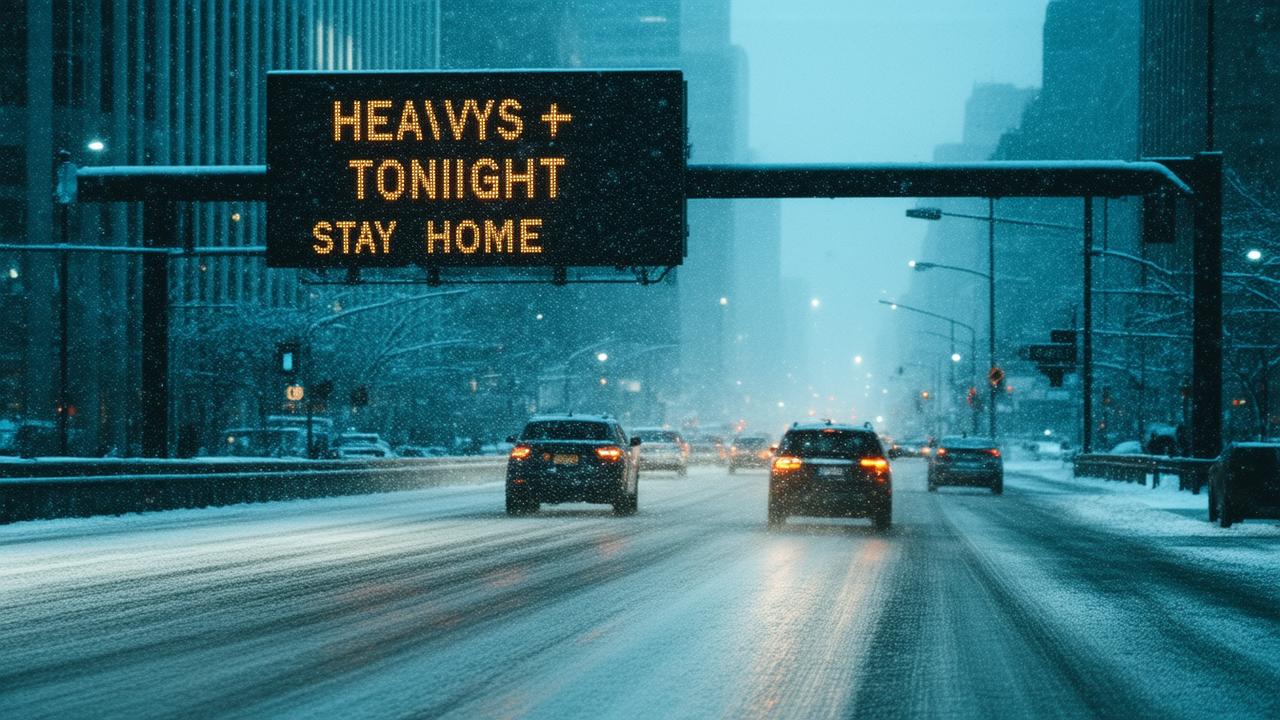
The first flakes arrive almost shyly, drifting past the streetlights like bits of ash from some distant, quiet fire. It’s just after dusk when you notice them, pressed against the cold window, watching the soft white specks hesitate in the air before settling on windshields, porches, and the dark shoulders of parked cars. For a moment, it’s beautiful in that uncomplicated way winter can be—before the noise, before the alerts, before the tension that now curls around every storm forecast.
The Calm Before the Hazard
Inside, the television hums with the familiar cadence of a weather alert. A red bar crawls along the bottom of the screen: Heavy snow expected to begin tonight. Travel strongly discouraged. Stay off the roads if possible. The meteorologist’s voice is steady, practiced. This isn’t the first storm of the season, but something about this one feels heavier—literally and otherwise.
Outside, the town still pretends everything is ordinary. A delivery van rattles down the road; its taillights smear into streaks of red in the swirling air. The grocery store parking lot glows white and yellow under floodlights as people hustle carts through the biting wind, stocking up on milk, bread, coffee, and a little extra chocolate, just in case.
Your phone buzzes with a new notification. It’s the city’s alert system: Plows will be deployed tonight. Non-essential travel is discouraged after 10 p.m. Please remain at home if you can do so safely. A few seconds later, a different message arrives—this time from your workplace: Our operations will continue as scheduled tomorrow. Employees are expected to report unless notified otherwise.
Two messages, two realities. Stay home. Come in. Be safe. Be productive. Somewhere in the space between those instructions, the snow keeps falling—faster now, the flakes thickening into a curtain that begins to erase the edges of the world.
The First Signs of Commitment
You zip your coat and step outside. The cold hits instantly, sharp enough to make you inhale. Snow collects along the driveway like spilled flour, fine and powdery still, whispering under your boots. The air smells clean and metallic, the way it does right before a storm decides it’s serious. There’s a low hum in the distance—the early sound of a snowplow making its first exploratory pass down the main road.
Across the street, a neighbor wrestles a snow shovel out of the garage, leaning it by the door as if preparing for a long negotiation. Next door, someone is loading bags of rock salt into a plastic bin. The neighborhood has slipped into storm mode: porch lights glowing, vehicles backed into driveways for quick exits, wiper blades raised in defiant little arms.
You look down the block, imagining what the next twelve hours will do to it. The map in your head fills with drifts—where the wind will pile the snow higher than your knees, where the plow will leave a frozen wall at the end of each driveway, where the sidewalks will become delicate trenches by morning.
Inside again, you check the forecast on your laptop. Numbers line up like a quiet threat: six inches. Ten inches. Maybe more in some pockets, if the band of heavy snow stalls. The radar animation plays in loops—blue swirling into darker blue, edging toward purple. The storm is no longer hypothetical; it has shape and momentum.
Work, Warnings, and the Weight of Expectations
On your kitchen table, your phone is a small, glowing tug-of-war. An email from your boss, sent to the entire team, hangs in your inbox. It’s polite but firm, the kind of message that tries to sound understanding and decisive at once: the company’s priority is “business continuity,” and while safety is “important,” operations will remain normal “for the time being.” Please plan to arrive on time.
Moments later, social media fills with screenshots of the same city alert you received. Friends share photos of their cars already brushed with white. Someone posts a blurry image of a highway sign flashing: WINTER STORM WARNING – AVOID TRAVEL TONIGHT. In the comments beneath, everyone is arguing with invisible opponents.
“If the authorities say stay home, why is my job acting like tomorrow is just another Tuesday?” one person writes.
“Because companies pretend weather is an inconvenience, not a hazard,” another replies.
The tension is familiar. You’ve felt it before in other storms, other crises. There is a particular modern dissonance in being told, in one breath, that conditions are dangerous enough to warrant emergency alerts, while in the next breath being reminded that quarterly targets don’t pause for snowflakes.
The truth is that the roads don’t care what any email says. Slush will still layer over black ice. Visibility will still shrink to a gray tunnel. The snow won’t negotiate with deadlines or meetings.
The Streetlights and the Silent City
Night comes quickly, folding the town into a dim, muffled bowl. The storm finds its rhythm. Snow doesn’t just fall now; it drives. It moves sideways across porches, rides the wind down alleyways, stacks up in corners like it’s been planning this all along.
You stand at your front window and watch as the world recedes. The streetlights become islands of hazy yellow, each surrounded by a cone of white chaos. The outlines of cars soften into rounded shapes, as if they’re being slowly erased and redrawn in a gentler language.
Somewhere nearby, a siren wails—a thin, distant sound, quickly swallowed by the storm. Perhaps it’s a firetruck working its way carefully through the slick roads, or an ambulance trying to thread through the growing drifts. The urgency of that sound clashes with the stillness inside your home, where the only disruptions are the soft thuds of snow hitting the window and the low hum of the heater.
You imagine the highways now: long ribbons of black and white, lit only by the occasional beam of headlights, each driver a small, moving risk. You picture a nurse on the night shift, timing her departure between the worst bands of snowfall; a grocery stocker preparing to spend the night at the store; a plow driver sipping lukewarm coffee from a thermos at 3 a.m., eyes burning from staring into the same swirling patterns for hours.
The forecast had used the word “heavy,” but it feels inadequate. It’s not just the snow that grows heavy tonight; it’s the choices that come with it.
Numbers, Risks, and the Hidden Story of the Road
Storms like this turn into narratives everyone participates in, whether they want to or not. The next day’s conversations will circle around inches of accumulation, commute times, and the sickly thrill of “You should’ve seen the roads.” But within those stories are quieter details that rarely make it past the surface.
Consider the layering effect—how one small decision multiplies risk across an entire landscape. Each time someone chooses to drive, another variable is added to a system already straining under snow and ice. For authorities, the request to “please stay home” isn’t about control; it’s about math. Fewer cars mean fewer accidents. Fewer accidents mean ambulances can move faster. Plows can clear routes without weaving around stalled vehicles abandoned in whiteouts.
Businesses, on the other hand, juggle entirely different numbers: missed appointments, canceled deliveries, payroll, lost revenue. For them, staying open isn’t always callous—it can be survival. But in the friction between necessity and caution, it’s the ordinary worker who ends up caught in the crosswind.
In your own mind, the questions stack up like drifts at the door:
- Is my presence tomorrow really essential?
- What happens if I call in and they don’t understand?
- What happens if I go in and the roads are worse than predicted?
Outside, the storm doesn’t pause for your calculations. It just keeps laying down its white arguments layer by layer, erasing the lines on the road as easily as chalk under a hard rain.
A Night Measured in Inches and Quiet Decisions
By midnight, the world has been reduced to a palette of whites and grays. The house creaks occasionally as gusts of wind press against the siding. In the dim kitchen light, you stand over your phone and compose a message to your manager:
“If the roads are as bad as predicted, I may not be able to come in safely. I’ll keep you posted in the morning.”
Your finger hovers before you hit send. It feels strangely rebellious to state the obvious: that your safety matters as much as your output. In this era of remote logins and endless connectivity, the idea of risking a spinout on an unplowed road to sit in a fluorescent-lit office seems almost archaic, yet here we are—still negotiating with weather, still bargaining with risk.
The snow on your front steps has passed your ankles now. A neighbor’s car is barely recognizable under a thick, smooth layer that glows faintly in the porchlight. Somewhere down the street, the rhythmic scrape of a shovel breaks the hush. In this strange, muffled world, the smallest sounds feel magnified: the chink of metal on concrete, the crunch of boots packing down fresh snow.
You think of the people who have no choice tomorrow—emergency workers, utility crews, caregivers, bus drivers, the ones whose roles are as essential as they are underappreciated. For them, the landscape of risk has always been non-negotiable. The storm is simply another shift.
Morning: The World Rewritten in White
When you wake, daylight has turned the storm into a softer version of itself. The sky is a pale, almost luminous gray, and the air carries that serious quiet that only follows a heavy night of snow. You push aside the curtain and look out on a world remade.
The cars along the street resemble sleeping animals, mounded and still. The sidewalk is a rumor under at least a foot of white. Tree branches bow under the weight, each twig outlined in delicate frosting. The usual shapes of your neighborhood are still there, but softened, their hard lines erased or blurred into rounded edges.
➡️ Engineers confirm construction is underway on an ambitious underwater rail line designed to link entire continents through a deep-sea tunnel
➡️ No vinegar, no wax: the simple home trick that makes hardwood floors shine like new
➡️ Spraying vinegar at your front door: what it does and why people swear by it
➡️ If you still remember these 10 everyday moments from decades ago, your memory is sharper than most people in their 70s
➡️ Greenland declares an emergency after researchers spot orcas breaching dangerously close to melting ice shelves
➡️ If you have old keys at home, you may be sitting on a hidden treasure without even realizing it ‘here’s why’
➡️ Not Crosswords or Chess: The Best Memory-Boosting Activity for Over-65s
The plows have been by, carving deep furrows along the roadway, leaving high ridges of compacted, grayish snow at the end of each driveway—sturdy barricades that stand between every parked car and the street. The sky spits a few last, lazy flakes, as if the storm is signing its name in small print.
Your phone lights up with new messages. The city: Travel remains hazardous. Non-essential travel discouraged until conditions improve. Your workplace: Office opening at normal time. Please allow extra time for your commute.
“Please allow extra time,” as if time is something you can shovel. As if minutes could be thrown like rock salt across an icy hill.
You set the phone down and watch as your neighbor steps outside, shovel in hand, surveying the challenge in front of him. It will take him at least an hour to clear a narrow escape path. Every movement will be deliberate: lift, toss, breathe, repeat. You can feel the weight of that labor in your own shoulders, the numbness that will creep into fingers and toes, the way the damp chill will slip through coat seams and glove cuffs.
Choosing Caution in a Culture That Hurries
You pour coffee and stand by the window, feeling the heat of the mug in your hands while your mind tries to sort priorities that can’t be measured on the same scale. Productivity on one side, safety on the other. Sharp tires on slick curves. A timecard versus a tow truck. You imagine the headlines that could appear tomorrow if the wrong combination of choices collides in an intersection somewhere you’ll never see.
In the quiet of your kitchen, away from the buzz of emails and alerts, the answer feels clearer than any traffic report: the storm is not something to beat; it’s something to respect.
Snowstorms have always been reminders of scale. They pause our carefully scheduled lives and ask us, not gently, to reconsider our certainty. A few hours of weather can humble an entire region—shutting down highways, rerouting flights, silencing commerce. Underneath our belief in constant motion, there is the simple truth that nature does not read our calendars.
You send another message, this one shorter and steadier than the draft from last night:
“Roads here are still hazardous. I won’t be driving in this morning. I’ll work from home and stay available.”
There’s a small, private relief in pressing send. It’s not a grand gesture, not a revolution, but it is a choice in favor of caution in a culture that too often mistakes recklessness for dedication.
Outside, your breath clouds the air as you step out with your own shovel, the first bite of cold instantly prickling your cheeks. The snow squeaks under your boots, that soft, compressed sound that only comes with deep, dry cold. Each shovelful arcs in a glittering spray, catching what little light the sky offers. There’s work to be done, yes—but it’s on your terms, in your own driveway, in the quiet aftermath of a storm that has already said more about our priorities than any memo or press release could.
Reading Between the Flakes
By midday, the town will begin to stir more confidently. Tire tracks will etch new, dark lines down the streets. The first brave (or pressured) commuters will creep their way to offices and stores. Plows will keep circling, pushing back the boundaries of passable roads foot by foot.
But even as the day reasserts itself, the memory of the night’s warnings will linger. The tension between what we are told is dangerous and what we are told is required will not melt as quickly as the snow on a salted sidewalk.
Heavy snowstorms are more than weather events. They are moments that expose the fault lines in how we live—how we weigh safety against profit, how we decide whose time and risk matter most, how we interpret words like “essential” when the sky turns white and the roads vanish beneath our wheels.
As you look out over the bright, blinding blanket that now covers everything, you can’t help but think: maybe the real challenge isn’t the snow at all. Maybe it’s learning to listen when the world, in all its drifting, silent insistence, is telling us to slow down.
| Aspect | Authorities’ Guidance | Typical Business Response |
|---|---|---|
| Travel | Discourage non-essential driving; stay home if possible. | Encourage employees to report as usual, sometimes with “extra commute time.” |
| Priority | Public safety, reduced accidents, emergency access. | Continuity of operations, minimizing disruption and loss. |
| Timeframe | Focus on the most hazardous period of the storm. | Focus on scheduled shifts, appointments, and deadlines. |
| Risk Assumption | Assumes fewer vehicles equals fewer emergencies. | Assumes individuals will “manage” risk on their own. |
| Desired Outcome | Keep people safe and roads clear for essential services. | Maintain normalcy and productivity despite the storm. |
FAQ: Navigating Heavy Snow When Messages Conflict
What should I do if authorities say stay home but my employer wants me at work?
Start by honestly assessing road conditions where you are, not just near your workplace. If travel is clearly hazardous, communicate that directly and calmly. Offer alternatives such as working from home, shifting your hours, or postponing non-urgent tasks. Document road warnings from local authorities for your own records, and prioritize your safety—no job is worth a serious injury on the road.
How can I prepare if I absolutely must drive during a heavy snowstorm?
If driving is unavoidable, leave far earlier than usual, reduce your speed dramatically, and increase your following distance. Clear all snow and ice from your vehicle, including the roof and lights. Keep an emergency kit in your car—blanket, water, snacks, phone charger, flashlight, and a small shovel. Stick to main roads that are more likely to be plowed and salted.
Why do authorities and businesses often give conflicting advice during storms?
Authorities focus on public safety and emergency response; fewer cars on the road means fewer accidents and faster access for ambulances and plows. Businesses focus on continuity, customer expectations, and financial stability. The goals aren’t always aligned, which is why individuals often receive mixed messages and must make personal risk assessments.
What makes heavy snow so dangerous compared to light snow?
Heavy snow can rapidly reduce visibility, hide ice beneath a soft layer of powder, and overwhelm plow schedules. Accumulation can happen faster than roads can be cleared, while wind can create deep drifts and whiteout conditions. The sheer volume of snow also leads to more stranded vehicles, blocked intersections, and slower emergency responses.
How can communities reduce risk during major snow events?
Communities can coordinate by heeding travel advisories, checking on vulnerable neighbors, staying off roads to give plows room to work, and supporting remote or flexible work where possible. Clear communication from local officials and employers, combined with individual caution and preparation, creates a buffer of safety that no single plow or policy can provide alone.





