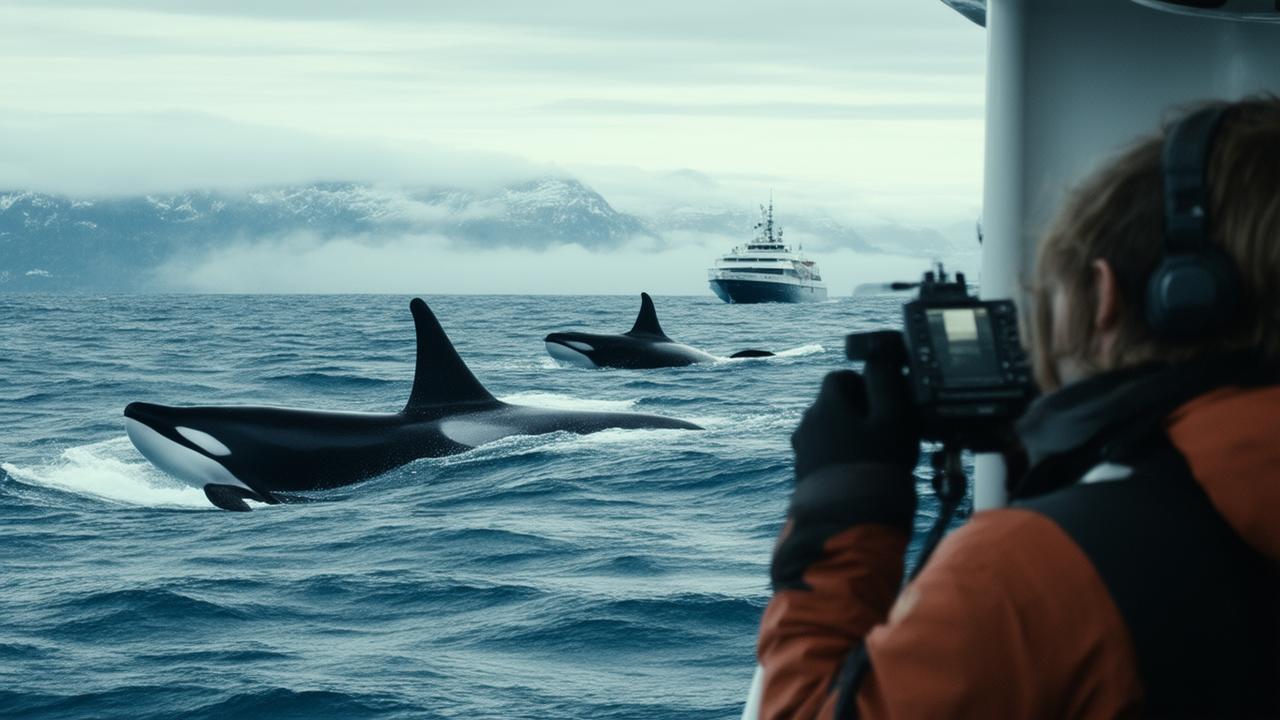
The first time the orca appeared, the sea was flat as glass. The research boat drifted in a rare pocket of quiet, engine idling low, air thick with salt and the faint diesel tang that clings to metal. Then—like a breath exhaled from the ocean itself—a black dorsal fin sliced the surface. Someone whispered, someone else raised a camera, and for a brief, aching moment it felt like the old stories: humans and whales sharing a wary but distant peace.
Then the orca turned.
Not in the lazy, looping arc of a curious animal, but with purpose—straight toward the boat’s rudder. The first impact was a blunt, shocking thud. The vessel shivered. A second hit followed, more deliberate. The scientists on board exchanged glances that were equal parts awe and dread. It looked less like a mistake and more like intent.
“They’re learning,” one of the biologists murmured, half to himself. “And they’re angry.”
A Troubling Pattern in the Open Sea
For years, orcas were the charismatic giants of nature documentaries and conservation campaigns: apex predators, tightly bonded families, haunting calls echoing through cold blue depths. Lately, however, a different story has been surfacing—one in which these whales are not simply observed from afar, but are making their presence aggressively, and repeatedly, felt.
Reports have been piling up from sailors, fishers, and scientists along coastlines where orcas are common. Rudders snapped clean off. Fiberglass hulls dented and scraped. Boats spun helplessly as engines whined and props bit uselessly into empty water. The encounters are not random. They are focused, repetitive, and alarmingly coordinated.
Marine biologists tracking these events are careful with their words. “Aggression” is a loaded term when applied to wild animals; no one wants to paint orcas as villains in a human drama. But the pattern is there, and it’s impossible to ignore. What’s emerging, they say, is something deeply unsettling: learned behavior, passed from whale to whale, that centers humans not as distant observers—but as targets.
The Science Behind “Learned Aggression”
Orcas, or killer whales, are not fish but large, intelligent dolphins. Their brains are complex; their societies, intricate. They teach each other hunting techniques, vocal dialects, even play behaviors that differ from one family group to another. Cultural transmission—learning through observation and social bonds—is a cornerstone of orca life.
Now, some researchers worry that this same cultural engine is driving a new, more dangerous trend. When orcas repeatedly interact with boats in ways that damage those vessels—and visibly control how humans move—the behavior doesn’t stay confined to a single curious individual. Others join in. Younger whales watch. Soon, it becomes a group activity.
There are stories of older females initiating the contact, with juveniles trailing close behind, mimicking the strikes on a vessel’s rudder. The idea that a matriarch might be teaching her pod not how to hunt fish, but how to disable human craft, is as fascinating as it is chilling.
What the Encounters Actually Look Like
On paper, an “orca-boat interaction” sounds sterile and clinical. On the water, it is anything but. Sailors speak of a sudden, eerie silence just before the first hit, as conversation dies away and all attention narrows to that black fin, that ripple, that surge of white water under the transom.
Rudders, it turns out, make a satisfying target. They’re relatively exposed, and they matter. Break a rudder and you rob the vessel of its control. The whales may not know the engineering logic behind it, but they appear to understand the outcome.
Here’s a simplified snapshot of what crews and scientists are reporting:
| Aspect | Common Observations |
|---|---|
| Primary target | Boat rudders and stern gear rather than hulls or sides |
| Number of orcas | Often 2–6 animals, with at least one older individual present |
| Behavior style | Repeated bumps, rams, or biting of the rudder; circling the boat; apparent coordination |
| Duration | From a few minutes to over an hour in some cases |
| Human response | Killing engines, staying quiet, calling for help, or attempting to deter the whales (often unsuccessfully) |
The sea in these moments becomes strangely intimate. You can hear the exhale of orca blowholes, harsh and hollow like someone knocking inside the ocean. You can feel the vibration of the impacts travel up through your legs. The line between observer and participant dissolves. You are no longer just on the water; you are in a conversation with something powerful, and not entirely pleased with your presence.
Why Are Orcas Doing This?
Ask ten scientists and you’ll get a careful chorus of hypotheses, not a single tidy answer. But several themes keep surfacing—threads that, woven together, tell a broader story about stress, memory, and the weight of human activity on the sea.
One possibility is simple: a negative experience. Perhaps a collision with a vessel that injured a whale or her calf. Perhaps entanglement with fishing gear trailing from a boat. For an animal with a long memory and a brain wired for social learning, a traumatic encounter may not fade quietly into the background.
Another theory, not mutually exclusive, is environmental frustration. Many orca populations are struggling with dwindling prey, increasing noise pollution, and busy shipping lanes that fracture their acoustic world. The ocean has become louder, harsher, more crowded. When your life depends on sound—on hearing the faint flutter of fish or the distant call of a pod mate—constant mechanical roar is not just an inconvenience. It is an assault.
In that context, targeting boats may be more than random aggression. It might be protest, or play that has curdled into something harder. A way of exerting control in a sea where so much has been taken out of their hands—or fins.
Humans Refuse to Change Course
Even as reports grow more frequent, human behavior changes slowly, if at all. Shipping routes still cut directly through orca habitats. Speed restrictions, where they exist, are often lightly enforced or limited to narrow windows. Recreational boaters crowd close for photos. Whale-watching tours promise “up-close encounters” as if intimacy with wildness were a guaranteed feature, not a fragile privilege.
Marine biologists and conservationists have spent years asking for quieter seas: slower ships, rerouted traffic, protected corridors where whales can communicate without the constant grind of propellers. Yet the economic logic of global trade and coastal tourism runs deep. To many, whales are scenery, not stakeholders.
The irony is hard to miss. We complain about orca “attacks” while refusing to acknowledge the daily onslaught of human noise, metal, and waste in their world. We call it aggression when a whale strikes a rudder, but shrug when sonar drills across an entire feeding ground or when another container ship barrels through a migration route.
Living With a Super-Intelligent Neighbor
What’s unfolding off our coasts is less a horror story and more a relationship crisis. Orcas are not invaders; they are long-time residents of these waters, sculpted by ice ages and tides, their social maps older than our ports and marinas. We are the newcomers who arrived with powerful engines and sharp hulls, reshaping the acoustic and physical landscape in a single, loud century.
To share space with a mind like an orca’s is to accept that you are being observed, assessed, and remembered. These animals recognize individual voices, ships, even patterns of behavior. They adapt quickly. When we demonstrate that boats mean danger, competition, or disturbance, we should not be surprised when some whales begin to push back.
There is also the uncomfortable possibility that we are watching a kind of cultural experiment among orcas: a new tradition, born of tension with humans, spreading through their pods the way new songs or hunting techniques do. If that’s true, then this isn’t a fad that will vanish next season. It is a story we’re writing together, whether we like it or not.
➡️ Engineers confirm construction is underway on an ambitious underwater rail line designed to link entire continents through a deep-sea tunnel
➡️ No vinegar, no wax: the simple home trick that makes hardwood floors shine like new
➡️ Spraying vinegar at your front door: what it does and why people swear by it
➡️ If you still remember these 10 everyday moments from decades ago, your memory is sharper than most people in their 70s
➡️ Greenland declares an emergency after researchers spot orcas breaching dangerously close to melting ice shelves
➡️ If you have old keys at home, you may be sitting on a hidden treasure without even realizing it ‘here’s why’
➡️ Not Crosswords or Chess: The Best Memory-Boosting Activity for Over-65s
What Could Changing Course Look Like?
Changing course, in this case, is not just a metaphor. It is literal. It means asking hard questions about where and how we move through the sea, and whether we can live with small inconveniences for the sake of a shared ocean.
Some of the ideas on the table are practical and immediate: reducing vessel speeds in known orca corridors; establishing no-go or low-traffic zones during key feeding and breeding seasons; designing quieter propellers and hull shapes that cut down on underwater noise. For smaller boats, it may mean learning protocols for encounters: cutting engines early, avoiding chasing or flanking whales, and giving them room to maneuver without feeling cornered.
There is also a cultural dimension. We need new stories about what it means to meet an orca. Less “thrill of the chase,” more “guest in someone else’s home.” The sea is not an empty stage for our adventures but a layered neighborhood of lives and languages we’re only beginning to understand.
The technology exists; the science is clear enough. What’s missing is will. As long as speed, profit, and convenience outrun caution, the pressure on orcas will continue to mount. And so, perhaps, will their experiments in resistance.
A Future Decided Between Waves
On a gray afternoon, a small sailboat limps back to port, its rudder a twisted ruin. The crew is shaken but unhurt. As they tie off, they talk in low voices about the orcas—how close they were, how deliberate it all felt. Part of them is angry. Another part is quietly, uncomfortably, impressed.
Far offshore, the whales move on. Maybe an older female leads, her fin tall and scarred, juveniles following in her wake. Perhaps they are silent. Perhaps they chatter, clicks and whistles ricocheting through the deep. Somewhere in that layered soundscape, something has changed: a new behavior, a shared memory, a way of understanding boats.
We like to imagine the ocean as a blank blue expanse, its inhabitants following ancient, unchanging scripts while we skim across the surface, detached. But the orcas are telling us, in the only language they have, that they are paying attention—that they notice the shapes of our vessels, the patterns of our movement, the relentless noise we pour into their world.
The question is not whether they will adapt. They already are. The question is whether we will. Whether we can slow down, reroute, redesign, and relearn our place in this shared, shifting seascape before the relationship tips further into conflict.
For now, every fin that breaks the surface is both a wonder and a warning. In the heave of the swell and the echo of that hollow exhale, you can almost hear it: a patient, intelligent presence, asking—again and again—if we are finally ready to change course.
Frequently Asked Questions
Are orcas really attacking boats on purpose?
Evidence suggests that many recent interactions are deliberate rather than accidental. Orcas repeatedly target specific parts of vessels, especially rudders, and sometimes display coordinated behavior within their group. While we can’t know their exact motives, these actions go beyond simple curiosity.
Is this behavior spreading among different groups of orcas?
In some regions, similar patterns are being observed among related pods, particularly where older individuals and juveniles are seen together during boat interactions. This points toward cultural transmission—whales learning from each other and passing on the behavior.
Are humans in serious danger from these encounters?
Most incidents damage boats but do not result in direct harm to people. However, disabling a rudder or damaging a hull far from shore can create dangerous situations for crews. The risk is less about being attacked outright and more about losing control of a vessel in open water.
Why don’t we just keep orcas away from shipping lanes?
Orcas use large, overlapping home ranges that often coincide with major shipping routes and busy coastal waters. We cannot simply move the whales. Instead, scientists advocate for changing how and where we operate vessels—through rerouting, speed limits, and protected corridors—to reduce conflict.
What can individual boaters do to reduce negative encounters?
Boat operators can slow down in known orca areas, avoid approaching or surrounding whales, keep engines in neutral when animals are near, and follow local guidelines for marine mammal distances. Reporting encounters to research groups or authorities also helps scientists track patterns and propose better protections.





