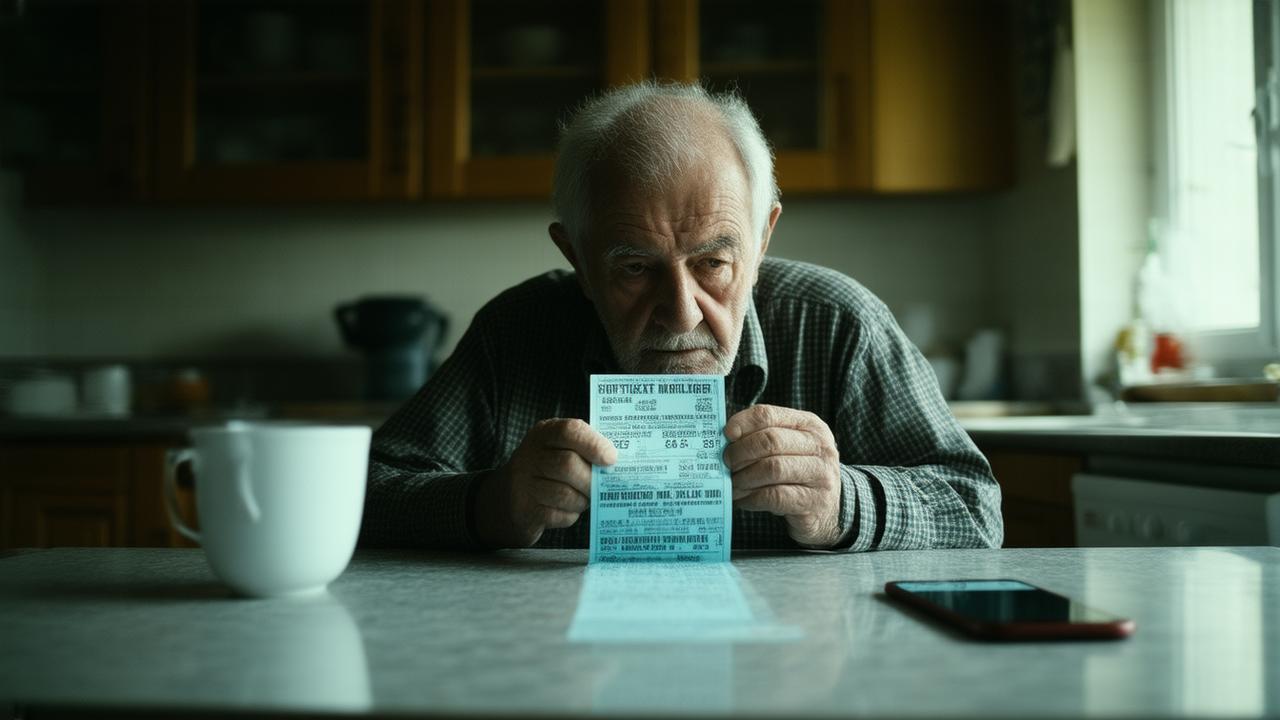
The day the money arrived, the sea outside Hans Keller’s kitchen window looked like split gemstones—sunlight glancing off winter waves, gulls wheeling and complaining in the bright February air. His kettle whistled, the old enamel one with the chipped spout, and for a few delicious seconds the only thing on his mind was whether he’d remembered to buy more tea. Then the phone on the table vibrated. A soft, ordinary little buzz that, in another life, he might have ignored.
It was a notification from an app he barely remembered downloading.
The Morning the World Tilted
Hans had never been the kind of man who believed in sudden fortune. At 72, he trusted the slow mathematics of years worked, pensions earned, and the careful stretching of euros. He had spent four decades as a tram driver in a small coastal city—same route, same creaking seat, same gentle nods to familiar faces. His life, like the rails he once followed every day, ran straight and predictable.
The lottery had entered his world the way technology often did—with mild suspicion and a hesitant shrug. A younger neighbor had helped him install the national lottery app months earlier. “You don’t need to stand in those horrid queues anymore, Hans,” she’d said, thumbs flying over his phone. “It’s easier. Safer, even.” The words “easier” and “safer” had stayed with him like a promise.
He’d played, on and off, more out of habit than hope. A few euros here and there. Nothing extravagant. Each time, the app flashed its bright colors and cheerful tones, then sank back into silence. Lose, lose, lose. He barely noticed. The world stayed the same size.
Then came that morning.
The notification was simple, almost shy: “You have an important update regarding your ticket.” His thumb hovered. Outside, a gust of wind rattled the window frame. He opened the app.
The numbers were displayed with a kind of digital reverence, lit up in a celebratory halo of confetti and animated sparkles: his numbers. Every single one. A bright banner unfurled across the top of the screen—“CONGRATULATIONS! JACKPOT WON: €71,500,000.”
Nothing in the kitchen moved. Hans stared at the digits, the commas, the impossible zeros. The kettle shrieked on the stove. The gulls shrieked outside. His heart did something strange, like missing a step on a familiar staircase. He turned off the gas without looking and sat down at the little pine table where he’d eaten every breakfast for twenty years.
He read the amount again. Out loud this time, his voice rough and unsure. Seventy-one point five million. The sound of it seemed to float in the air, foreign and heavy.
The app chimed again. “Your prize has been credited to your lottery account.” Then another line: “For withdrawals and security, please verify your identity and connect your banking app.”
Later, when journalists would ask what he felt in that exact moment, he’d say, “Like the horizon had suddenly moved closer, and I could walk to it if I wanted.” But that morning, in the small kitchen that smelled of tea and old wood, he mostly felt his hands shake.
A Week of Millionaire Air
The first 24 hours passed in a blur of numbers and disbelief. Family members arrived—some summoned, some mysteriously well-informed. The living room filled with overlapping voices, urgent questions, and that peculiar mix of joy and anxiety that large sums of money always invite.
They spoke of practical things first. Pay off the mortgage on his daughter’s flat. Fix his grandson’s car. Replace the aging boiler that groaned every January. But then, like plants turning toward the sun, their imaginations stretched further.
A house by the lake. A little sailboat, perhaps. Donations to the animal shelter down the road. A trip, at last, to the Norwegian fjords he’d spent half his life talking about but never seen. He almost tasted the cold, clean air up there; imagined the mountains rising like ancient guardians over black water, the kind of silence that remakes a person.
The lottery company called to confirm his identity. He shuffled to his bedroom to dig out old documents, the dull beige weight of his passport, the carefully folded pension statements. Everything was in order. The voice on the phone was warm and professional. Yes, the amount was correct. Yes, it had been processed. Yes, he should install the official banking app to make transfers easier and more secure.
Secure. There was that word again.
His niece, tech-savvy and impatient, helped him set things up. She downloaded the recommended banking app, linked it to his lottery account, and walked him through the screens. “See, Uncle Hans? All digital now. You’re basically a modern millionaire.” He chuckled, but his fingers fumbled slightly over the unfamiliar icons.
For a few days, he lived in that strange, weightless space between the life he’d known and the one he was about to enter. He walked differently, shoulders back, lungs filling more deeply. Food tasted brighter. The sea outside seemed to glimmer with new permission. He began making lists.
He wrote down everyone he wanted to help, in careful blue ink on a yellow legal pad. He added small luxuries for himself, almost shyly: a new pair of shoes without worn heels; a better mattress; good binoculars for watching birds on the marshes. It pleased him that with seventy-one and a half million, the first things he thought of were still modest and earth-bound.
His old friends at the café teased him. “Don’t forget the little people when you buy your island, Hans.” He laughed with them, but later, alone with the quiet hum of the fridge, he promised himself he wouldn’t forget anyone. Money, he thought, was finally just a tool for making life softer, kinder, more spacious—for him, and for the people he loved.
The App That Opened Every Door—and Then One More
The bank app quickly became the new center of gravity in his pocket. Each time he opened it, the screen bloomed with numbers so large they didn’t quite seem real. He tested small transfers: €200 to his daughter, then €500 to his grandson. Each time the money arrived swiftly, neatly, as if the digital world had smoothed out all the rough edges of reality.
The app made everything feel frictionless. Need to move ten thousand here? A few taps. Thinking of setting aside a generous donation there? Slide, confirm, done. The language of it was soothing, wrapped in blues and whites, soft fonts and reassuring icons. “Secure transfer.” “Protected login.” “We’ve got you covered.”
Still, a thin thread of unease fluttered through him when the app suggested enabling “enhanced access.” A popup explained it in small, neat lines: connecting additional services, allowing “trusted financial partners” to offer him better investment options, simplifying “large-amount transactions.” It came with glowing checkmarks and the promise that “millions of satisfied users” had already done the same.
When the next screen asked for permission to “temporarily increase transfer limits for your convenience,” his thumb wavered. But then he thought of the house his daughter wanted to see that weekend, the speed with which he’d need to move money if she decided on it, the subtle way she’d hovered over the property listing on her phone.
Convenience. Security. Protection. These words repeated like a spell.
He tapped “Accept.”
That night, the sea wind rose, flinging salt against his windows. The streetlights cast wavering nets of yellow on the pavement. Hans slept lightly, waking often, his dreams crowded with half-built houses and unfinished journeys.
Far away, on a server he would never see, someone else’s night was just beginning.
The Quiet, Invisible Disappearance
The theft did not come with sirens or broken glass. No doors were kicked in; no masked strangers appeared in security footage. It was a crime that moved like shadow, like mist across a field, leaving nothing but a faint chill behind.
It began with a second app—one that looked and behaved so much like his banking app that even a trained eye would have needed to squint. It had arrived as an “update,” a prompt that appeared at the edge of his screen while he was reading messages from his daughter. “Critical security improvement,” it said. “Strongly recommended.” The icon looked identical. The fonts were the same. The promise—safety—was familiar.
He tapped “Install” without thinking, eager to get back to the flow of conversation about school fees and mortgage calculations.
By the following afternoon, in the soft, ordinary hour when he usually took his walk along the seawall, the attackers had everything they needed. They’d waited, patient and invisible, for him to open his fake app and attempt a “routine check.” They watched as he entered his login details. They intercepted the confirmation text that buzzed gently in his palm, the code he typed in without suspicion.
Somewhere, perhaps, a progress bar filled silently on a computer screen.
Then, in less time than it takes to make a cup of tea, the numbers in his account began to thin.
A transfer here, smoothly executed. A conversion there, slipping across borders faster than any plane ticket. The digital trail wound its way through countries whose names Hans might have visited only in an atlas: shell accounts, ghost companies, cryptocurrency tumbling through opaque addresses like coins in a waterfall.
On his phone, nothing screamed. No alarm sounded. His screen looked calm, peaceful, unchanged.
It wasn’t until the next morning, when he opened the app to check if a promised transfer to his daughter had cleared, that the horizon inside his chest collapsed.
The balance stared back at him, impossibly small. A few scattered thousands. Numbers that looked, once again, like something belonging to him.
His first thought was that there had been a glitch. He looked for the missing millions like misplaced keys. He blinked hard and refreshed the page. The app turned its little circle of loading light, polite and efficient. Then the same modest balance reappeared, indifferent as a stone.
➡️ Engineers confirm construction is underway on an ambitious underwater rail line designed to link entire continents through a deep-sea tunnel
➡️ No vinegar, no wax: the simple home trick that makes hardwood floors shine like new
➡️ Spraying vinegar at your front door: what it does and why people swear by it
➡️ If you still remember these 10 everyday moments from decades ago, your memory is sharper than most people in their 70s
➡️ Greenland declares an emergency after researchers spot orcas breaching dangerously close to melting ice shelves
➡️ If you have old keys at home, you may be sitting on a hidden treasure without even realizing it ‘here’s why’
➡️ Not Crosswords or Chess: The Best Memory-Boosting Activity for Over-65s
His hand went cold around the phone. The kitchen clock ticked too loudly. Outside, a gull screamed, the sound knifing through the morning calm.
The Week After the Miracle
The calls to the bank were long and full of holds—loops of peaceful music and recorded reassurances about “high call volumes.” Eventually, a human voice came on the line. Then another, higher up. Then someone from the lottery office. Then a man from the cybercrime unit whose voice was steady and almost apologetic.
“Mr. Keller,” the investigator said, “you were targeted by a very sophisticated phishing attack. The app you installed… it wasn’t from your bank.”
The words hit him like cold water. Phishing. It sounded almost playful, like something you might do on a sunny afternoon by the lake. But in his reality, it had teeth.
The investigator explained, gently, that the scammers had exploited a gap between his bank app and the lottery platform, slipping into that tiny seam where human habit and digital trust met. They spoke of “fraudulent overlays,” “malicious permissions,” and “credential harvesting.” The vocabulary fluttered around him like the pages of a manual written in a language he didn’t quite speak.
He sat at his little pine table, listening as his brief, dazzling future as a multi-millionaire was reclassified as “an incident.”
When he asked, voice shaking, how much could be recovered, there was a long pause. “We’re doing everything we can,” the officer said. “But a significant amount has already moved through multiple channels. It may be very difficult…” His voice trailed off.
By the end of the week, the figure had solidified into something that tasted like metal in Hans’s mouth: almost everything. Roughly €71.5 million gone, dissolved into the circuitry of a world he would never see.
Neighbors who had spoken easily of new beginnings now lowered their voices when he passed. Some still came by with coffee and sympathy; others, uncertain of what to say, stayed away. His family pressed forward, trying to be brave on his behalf. His daughter said money was just numbers, but he could see the unspoken calculations behind her eyes—schools, apartments, debts she’d mentally erased and now had to sketch back in.
The tabloids found him, inevitably. The headline writers had a field day:
| Day | Event | Account Balance (Approx.) |
|---|---|---|
| Day 1 | Jackpot confirmed in lottery app | €71,500,000 |
| Day 2 | Banking app linked and tested | €71,498,800 |
| Day 3 | “Security update” app installed | €71,497,600 |
| Day 4 | Multiple unauthorized transfers | €2,300,000 |
| Day 5 | Fraud discovered and reported | €12,400 (frozen) |
He saw his own story reduced to a line or two beneath oversized lettering: “RETIREMENT DREAM TURNS NIGHTMARE,” “LOTTERY WINNER LOSES IT ALL TO APP SCAM.” People read it on buses, in waiting rooms, over their lunch sandwiches. A cautionary tale, consumed and folded away.
What We Trust When We Tap
In the quiet weeks that followed, after the reporters stopped calling and the investigators moved on to other cases, Hans settled back into his old routines with the stunned care of someone stepping onto thin ice. He returned to the morning walks along the seawall, to the café with its chipped mugs, to his small, steady pension.
But something in the world felt permanently altered—not just for him, but somehow for all of us who live with glass rectangles in our pockets, who trust invisible systems with the most intimate parts of our lives.
The app icons on his phone, once bright and friendly, now felt like doors he didn’t fully understand. Each tap was a tiny act of faith in designers he’d never meet, servers he’d never see, protocols he’d never grasp. He couldn’t shake the sense that he’d stumbled, briefly, into a parallel digital wilderness—one where predators moved without sound, and the usual signs of danger were nowhere to be found.
We like to think that risk makes itself known. That danger has a smell, a shadow, a particular kind of silence that warns us. But the risk that found Hans did not growl at the edge of the campfire. It arrived dressed as protection and safety, speaking the gentle language of updates and improvements.
He still carries his phone. He still uses apps—though fewer now, each one installed with a ritual of suspicion. His bank has given him a physical token for verification, a small device that beeps and flashes, a little anchor of plastic and numbers. It feels strangely comforting, like an old key in a world of automatic doors.
Sometimes, standing by the sea, he thinks of the brief week when the horizon looked close enough to touch. He remembers how money, in its sudden avalanche, seemed to rearrange gravity. Then he looks at the waves, endless, repeating, indifferent to gains and losses.
The gulls still wheel and complain over the water. The air still smells of salt and diesel and distant rain. The world, he realizes, did not owe him that miracle, nor did it particularly care how quickly it was taken back. What remains, stubborn and real, is this: the warmth of his daughter’s hand in his, the way his grandson laughs at his old tram stories, the steam rising from a chipped mug of tea in a kitchen that has seen him through both smaller joys and quieter sorrows.
His name will live on a little while longer in those archived articles about “the man who lost €71.5 million to an app.” But the truer story, perhaps, is not just about a windfall and a theft. It is about the fragile threads of trust that bind us to the invisible systems we use every day—and how, in an age of digital abundance and digital danger, the simplest acts of care, skepticism, and slowness might be the most valuable currencies we have left.
Frequently Asked Questions
How did the retiree lose €71.5 million through an app?
He installed what appeared to be a legitimate “security update” for his banking app. In reality, it was a sophisticated phishing app that captured his login details and confirmation codes. Once the attackers had this information, they initiated large, rapid transfers from his lottery-linked account, moving the money through multiple channels before the fraud was discovered.
Could the bank or lottery have prevented this?
Both institutions had standard security measures in place, but the criminals exploited the user’s trust and a realistic-looking fake app. While banks and lotteries can improve detection systems and user education, such scams often hinge on moments of human vulnerability—tapping “Accept” on something that looks legitimate, especially after being told often that apps are “safe” and “easy.”
Was any of the money recovered?
In this kind of cross-border digital theft, only a small fraction is typically recovered. By the time authorities trace the transfers, funds have usually passed through several accounts and conversion services. In the story, just a tiny amount was frozen; the vast majority had effectively vanished into complex financial channels.
What mistakes did the retiree make, from a security point of view?
He trusted an update prompt without verifying its source, entered sensitive login details into a fraudulent app, and had recently increased his transfer limits and access permissions. None of these actions were malicious or “careless” on their own—they were the same kinds of things millions of people do every day. But together, they created a perfect opening for the attackers.
How can people protect themselves from similar app-based scams?
Only install banking or lottery apps from official app stores and verified developers; avoid clicking update links from texts or pop-ups. Double-check the exact name and publisher of any financial app. Be skeptical of unexpected prompts to “increase limits” or “enhance access.” Use multi-factor authentication that doesn’t rely solely on SMS codes, and contact your bank directly if anything in an app feels unusual or rushed.





