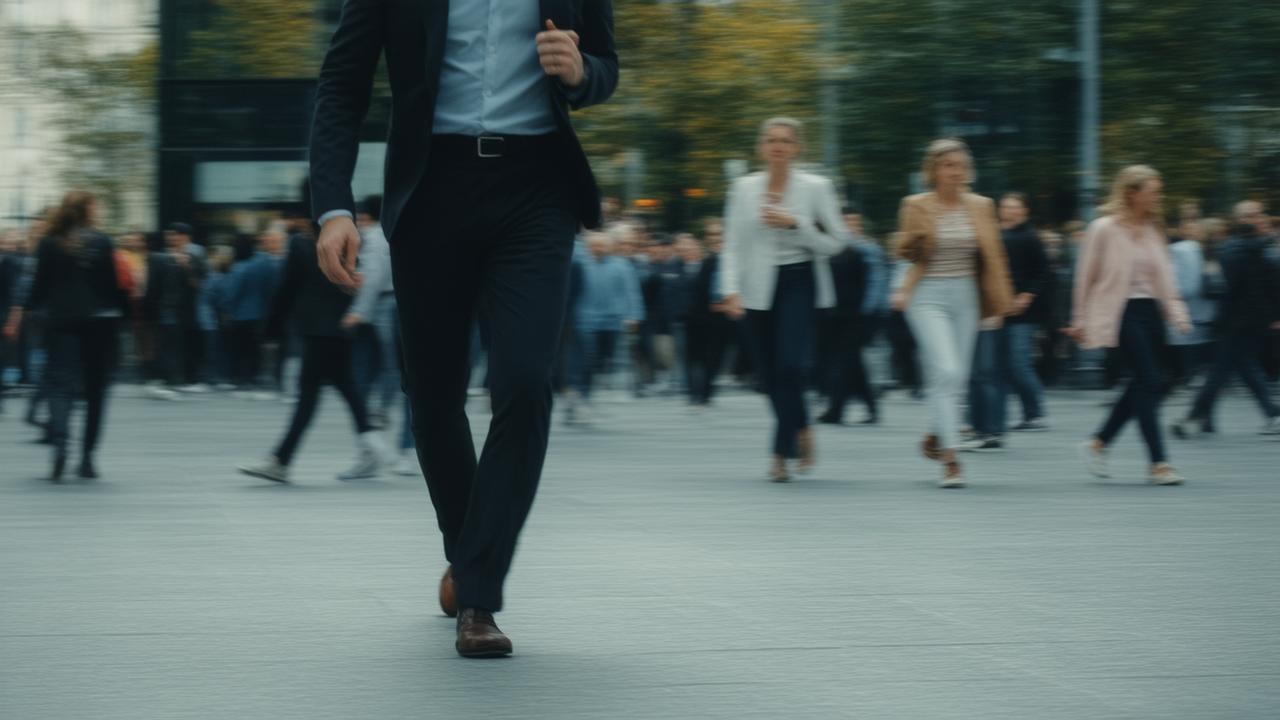
The first thing you notice about him is the speed. Not a frantic rush, not the flustered scramble of someone late, but a kind of effortless urgency. His steps land with a quiet certainty, coat swinging behind him, eyes already fixed on the next corner. At the crosswalk, he’s not impatient, just poised. When the light turns, he moves first. And, for a brief moment, as you stand there with your coffee cooling in your hand, you wonder: what is he walking toward that you aren’t?
The Subtle Language of Footsteps
We rarely think of walking as a language, but behavioral scientists do. To them, a sidewalk is like a living spreadsheet of human data. They watch how people move: the ones who drift, who dawdle, who zigzag between messages on their phones. And then there are the fast walkers—those purposeful, unhesitating strides cutting through the crowd like a sharpened thought.
In study after study, researchers have noticed a pattern: people who naturally walk faster than average often score higher on measures of cognitive sharpness, tend to be more professionally successful, and even show signs of better long-term health. It’s not that the speed of your steps magically turns you into a genius or a CEO. It’s that walking speed, it seems, is a clue—a window into how your brain, your body, and your ambitions quietly sync up.
Imagine an overhead view of a busy city street at noon. Zoom out: the people look like dots in motion. But to a behavioral scientist, those dots aren’t random. The ones moving briskly, weaving efficiently, adjusting speed and direction without collision, reveal something else: mental agility, planning, a strong internal clock that says, without words, “I know where I’m going, and I’m already on my way.”
The Science of Stride: Why Pace Reveals the Mind
Hidden beneath our casual stroll is a complex collaboration between brain and body. Every step is a negotiation—balancing, predicting, reacting. When someone walks faster, especially with a steady, organized pace, it often reflects more than strong legs. It reflects a brain working like a well-tuned engine.
Researchers have found that walking speed can be a surprisingly powerful proxy for what’s happening upstairs. People with quicker, more consistent gaits often have faster processing speeds: they handle information quickly, make decisions faster, and navigate complex environments more smoothly. The brain is constantly calculating distances, reading micro-expressions, judging gaps between cars, sensing shifts in the crowd—and doing it all in real time.
It doesn’t stop at intellect. Behavioral studies suggest that fast walkers tend to have stronger executive function—that orchestral conductor in the brain that handles planning, focus, and self-control. These are the same skills that show up in careers and creative pursuits: the ability to prioritize, to move from intention to action, to keep momentum when others get stuck at the curb.
And then there’s the body. A brisk natural pace often signals robust cardiovascular health, efficient lungs, good muscle function, and a nervous system that’s firing smoothly. It’s as if the body and mind are co-signing the same message: “We’re ready. Let’s go.”
Walking Speed as a Quiet Life Indicator
The fascinating part is how consistently walking pace lines up with broader life outcomes. When researchers crunch the numbers across communities, a pattern emerges: faster walkers are more likely to report higher job satisfaction, stronger feelings of control over their lives, and a sense that they are moving toward something meaningful, not just moving around.
They tend to show up slightly earlier to meetings, respond a bit quicker to opportunities, and manage their time in ways that compound over the years. A few extra things done today, a few doors knocked on that others never quite reached. It’s not that fast walkers are magically lucky; it’s that their pace reflects a deeper orientation toward time and opportunity.
| Walking Style | Typical Traits Observed | Long-Term Tendencies |
|---|---|---|
| Brisk, purposeful pace | Focused, time-aware, decisive | Higher career engagement, better health markers |
| Average, variable pace | Moderate planning, reactive rather than proactive | Typical outcomes, mixed energy and focus |
| Consistently slow stroll | Laid-back or distracted; sometimes low energy | Higher risk of disengagement, possible health concerns |
This isn’t destiny in table form. Life is too wild and complicated for that. But it does hint at something quietly powerful: how you move through the world physically can reflect how you move through it mentally and emotionally.
Fast Walkers, Fast Minds? Unpacking “Success”
Of course, the word “successful” is slippery. It can mean a corner office or a quiet cabin, a bank account full of numbers or a heart full of peace. When behavioral scientists say fast walkers tend to be “more successful,” they usually mean something more measurable: higher incomes, more promotions, more completed degrees, stronger performance reviews.
Here’s one way to picture it. Think of your day as a long corridor lined with doors—tiny chances: a conversation you might start, an idea you might chase, a risk you might take. Fast walkers are literally and metaphorically moving through that corridor more decisively. They get to more doors sooner. They knock more often. Not every door opens, but over months and years, the compounding effect of that motion adds up.
Fast walking, in this sense, is like a physical reflection of an inner stance toward life: “I don’t have forever. I’d better move.” That doesn’t mean rushing blindly. It means respecting time as something alive and limited, not an endless backdrop. Their stride says, “The next step matters.”
And yet, success isn’t only speed. Slow, deliberate work can yield masterpieces. Quiet, reflective lives can be deeply fulfilled. The trap is to confuse slowness with depth, and speed with shallowness. The reality is subtler. Many of the people moving fastest on foot are also the ones who can slow their minds when it counts—shifting gear like a well-practiced runner who knows exactly when to push and when to breathe.
The Shadow Side of Pace
There is a caution here. The world already worships hurry. Not every fast walker is flourishing; some are simply stressed. Their rapid pace can be a symptom of anxiety rather than clarity. They rush because they are running behind on a life they didn’t choose, not moving forward in one they did.
That’s why context matters. A grounded brisk pace—eyes up, shoulders relaxed, steps steady—is different from the frantic, hunched, bag-swinging dash. Behavioral science can see patterns, but it can’t always read the private story behind each pair of shoes.
Can You “Train” Your Way to a Brisker Brain?
If walking speed and cognitive sharpness are linked, the obvious question sneaks in: can you change one by changing the other? If you simply start walking faster, will you become sharper, more successful, more focused?
Science is cautious here. Walking briskly won’t replace thoughtful learning, courageous decisions, or honest self-reflection. But movement does shape the mind. Regular brisk walking is one of the simplest and most reliable habits for boosting brain health. It increases blood flow, supports the growth of new neural connections, and improves mood. Over time, this can sharpen attention and memory, making it easier to engage fully with work and life.
There’s also the subtle psychological effect. When you choose to walk with a little more purpose, you send yourself a quiet message: “My time matters. Where I’m going matters.” That small act of intentionality can spill into other choices. You might guard your focus a bit more carefully, say no more often, show up more fully to the tasks you’ve chosen.
➡️ Day will turn to night: the century’s longest solar eclipse now has an official date
➡️ Fishermen report sharks biting their anchor lines just moments after orcas surrounded their boat in a tense marine encounter
➡️ By carving tunnels through solid rock for nearly 30 years, Switzerland has built an underground infrastructure larger than many cities above ground
➡️ Few people know it, but France is the only country in Europe capable of building fighter jet engines with such precision, thanks to the DGA
➡️ China once again makes construction history with a 22.13-kilometer highway tunnel, setting a new world record
➡️ At 2,670 meters below the surface, the military makes a record?breaking discovery that will reshape archaeology
➡️ Day will briefly turn to night as astronomers officially confirm the date of the longest solar eclipse of the century, set to create a breathtaking spectacle across multiple regions
Experiment with this: on your next walk—to the store, to the bus stop, around your block—deliberately increase your pace. Not to the point of strain, just enough that you feel alert. Notice what happens to your thoughts. Do they sharpen slightly? Do you feel more awake to your surroundings, more tuned into your own presence in the scene?
Tuning Your Pace to Your Purpose
Fast walking doesn’t need to become a new performance metric. It’s more like a gentle dial you can adjust depending on what the moment calls for. Heading into a challenging meeting? A brisk five-minute walk beforehand can clear the mental fog. Returning home after a heavy day? A slower, grounding walk might be the wiser choice.
Success, in any meaningful sense, isn’t about walking fast all the time. It’s about moving at the pace that aligns with your intentions—and being able to shift that pace deliberately, instead of being dragged by inertia or stress.
The Sidewalk Mirror: What Your Pace Might Be Telling You
Next time you find yourself out in the world—on a city block, a park path, a quiet country road—pay attention to the cadence of your steps. Not to judge, but to listen. Imagine your walking speed as a mirror, reflecting something about how you’re moving through your life.
Do you drift, often late, often apologizing? Your feet might be staging a small protest against a life that doesn’t quite feel like yours. Do you rush, shoulders tight, eyes barely meeting anyone else’s? Your body might be bearing the weight of expectations that never let you rest.
Or perhaps you notice something else: that when you walk a little faster, you feel a little more alive. Your breath deepens, your senses wake up, your mind clears. Suddenly, the day doesn’t feel like something happening to you. It feels like something you’re walking into, step by deliberate step.
Behavioral scientists can give us graphs and probabilities and cautious words like “tend to” and “correlate with.” But there’s another layer that belongs to you alone: how it feels from the inside when you choose your pace with awareness.
Somewhere between the slow shuffle and the frantic sprint lies a stride that feels like truth: a pace that says, “I’m here, I’m going somewhere, and I’m doing it on purpose.” Whether or not the studies ever capture that, you’ll feel it in your bones, in the rolling rhythm of heel-to-toe, in the quiet confidence of moving just a little faster toward the life you actually want.
FAQ
Does walking faster automatically mean I’m more intelligent?
No. Walking speed doesn’t determine intelligence. It’s a rough indicator that often correlates with cognitive sharpness and overall health, but many other factors—education, curiosity, environment, and effort—play a far bigger role in intelligence.
If I start walking faster, will I become more successful?
Simply speeding up your steps won’t guarantee success. However, walking briskly can improve your health, energy, and mental clarity, which may support better decisions, productivity, and follow-through over time.
What is considered a “fast” walking pace?
In many studies, a brisk pace is often around 5–6 km/h (about 3–4 mph) or enough to slightly raise your heart rate and breathing, while still allowing you to speak in short sentences.
Can walking slowly ever be a good thing?
Yes. Slow walking can be deeply restorative and reflective. The key is whether your slower pace is a conscious choice for rest or reflection, or an unintentional sign of low energy, stress, or poor health.
How can I safely increase my walking pace?
Start with your usual route and gradually quicken your steps for short intervals. Keep your posture upright, eyes forward, and arms gently swinging. If you have health concerns, check with a healthcare professional before making big changes to your activity level.





