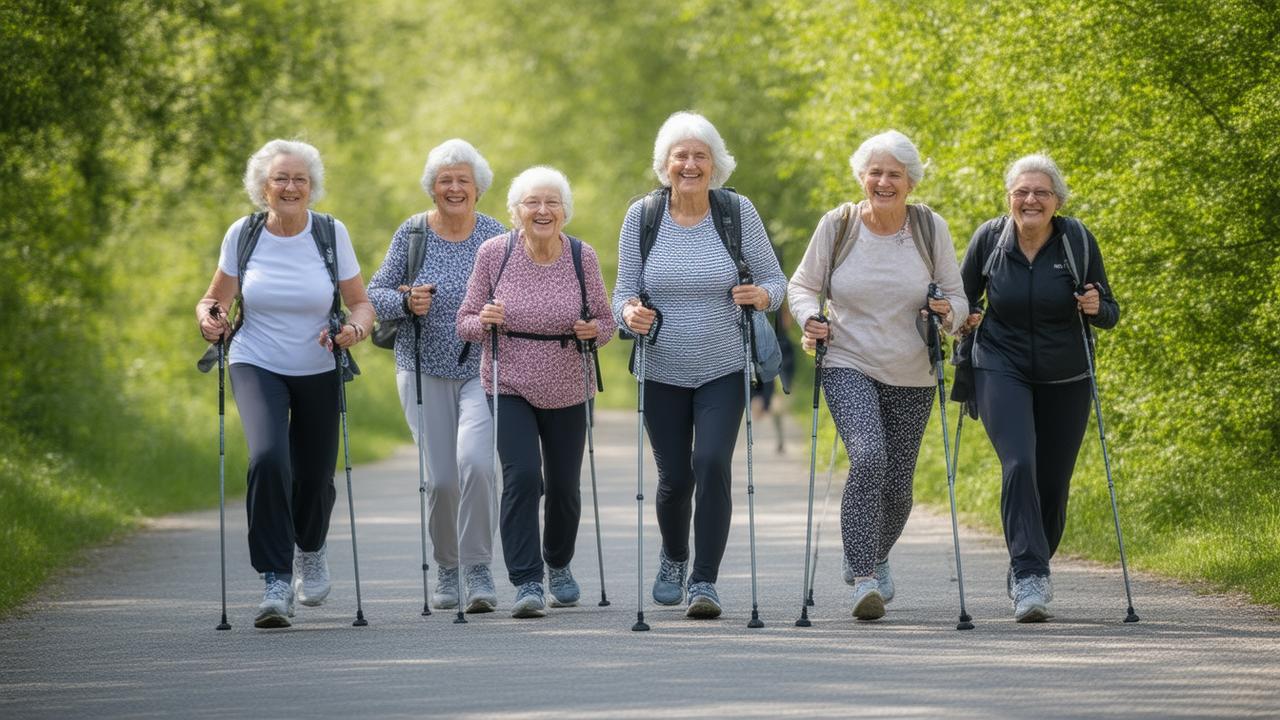
The first thing you notice is the sound. A soft, rhythmic crunch of gravel under slow, careful feet. It’s early morning in the park, the air still cool, holding the last whispers of night. Sunlight is just beginning to spill through the trees, turning the edges of the leaves a translucent green. On a winding path near the duck pond, a small group of people—gray hair, sun hats, bright windbreakers—are moving in quiet unison. Their arms swing gently, their gaze focused, their steps deliberate but unhurried. No one is rushing. No one is gasping for breath. Yet there is something deeply intentional in the way they walk, as if each step has a purpose.
Why Experts Are Pointing to Walking, Not the Pool
When people hit their mid-60s and beyond, the usual advice rolls in like a predictable tide: “Take up swimming, it’s gentle on the joints,” or “Try Pilates for your core and flexibility.” These are both excellent activities, and for many, they’re life-changing. But a growing number of geriatricians, physiotherapists, and movement specialists are quietly agreeing on something surprisingly simple: for most people over 65 with joint problems, purposeful, regular walking—not just casual strolling—is often the best all-around activity.
Not a power walk that leaves you breathless. Not a punishing hike. Just a consistent, well-paced, joint-conscious walk, tailored to your body and done with more intention than you might expect.
“Walking is the closest thing we have to a built-in prescription,” one physiotherapist told me. “It’s what the human body is wired for. For older adults with arthritis, stiff knees, or tender hips, the right kind of walking can actually nourish those joints rather than wear them down.”
The paradox is hard to ignore. The same motion that many fear will “grind down” cartilage can, when done correctly, help lubricate joints, strengthen muscles that support them, and reduce stiffness. Movement sends nutrient-rich fluid washing through the joint spaces like a gentle tide. Stay still too long, and that tide retreats.
The Walk That’s Different From Just “Getting Your Steps In”
There’s walking as an afterthought—pacing the house, wandering the supermarket aisles—and then there is walking as a practiced activity. Experts are talking about the latter.
Think of it as a walking practice, not simply exercise. This kind of walking asks you to show up regularly and pay attention: to posture, to pace, to how your joints feel today versus yesterday. It’s less about chasing 10,000 steps and more about building a relationship with your own movement.
Imagine this: you start on a flat, familiar path. Your shoes are supportive but flexible, hugging your feet without pinching. You stand tall—not rigid, but relaxed—letting your shoulders drop away from your ears. Your gaze lifts to the horizon instead of scanning the ground directly in front of your toes. You take smaller steps than you might have in your 40s, but they’re efficient, smooth, and surprisingly powerful. Each heel lands gently, then rolls through to the toes. There is no jarring, no stomping, just an even rhythm.
This is not “just walking.” It’s joint-wise walking: an intentional, adaptable practice that can be scaled up or down depending on your pain levels, your balance, and your confidence on any given day.
Why Not Simply Swim Or Do Pilates?
Swimming is wonderful for joint relief; the buoyancy removes pressure from the knees and hips. Pilates builds impressive core strength and helps with posture. But they both come with barriers that many older adults quietly bump into.
For swimming, you need access to a pool, the confidence to move in water, and often the willingness to appear in a swimsuit in public. For Pilates, there’s usually a studio, a schedule, an instructor, a new vocabulary of movements—and sometimes, intimidating equipment. These can all be overcome, of course, but they’re hurdles.
Walking, on the other hand, is already stitched into daily life. No membership, no locker rooms, no mats. Step outside your front door, and you have a ready-made training ground. That simplicity can mean the difference between doing something once a week and doing it most days of the year.
The Hidden Power Of Gentle, Consistent Walking
The science behind why experts are so fond of walking for people over 65 with joint issues reads like a wish list.
Joint lubrication: Synovial fluid—your joints’ natural “grease”—moves better when you move. A regular walking routine encourages circulation of this fluid, which can ease that morning stiffness that makes getting out of bed feel like a minor negotiation.
Muscle support: Surrounding muscles act like scaffolding for your joints. Stronger quadriceps, hamstrings, calves, and glutes can absorb forces that would otherwise land directly on your knees and hips. Each walk is a quiet strength session, especially when you maintain good form.
Balance and fall prevention: Walking challenges the systems that keep you upright—vision, inner ear, proprioception (your sense of where your body is in space). Over time, that can translate into fewer stumbles, fewer near-falls, and more confident movement in crowded shops or uneven sidewalks.
Bone health: Unlike swimming, walking is weight-bearing. That gentle pressure through your skeleton signals your bones to maintain density—an important buffer against osteoporosis and fractures.
Mood and cognition: People underestimate the mental side. Repeated studies show walking improves mood, sleep, and cognitive sharpness. There’s something almost alchemical about a slow, steady walk outdoors: the brain seems to breathe more deeply too.
Designing A Joint-Friendly Walking Routine
The magic is not in heroic distances; it’s in the rhythm of showing up. Many experts suggest starting smaller than you think you “should” and letting your body earn the right to do more.
Picture a simple, realistic plan for someone just starting out at 68 with creaky knees:
- Week 1–2: 10–15 minutes, 5 days a week, on flat, even ground.
- Week 3–4: 15–20 minutes, still 5 days a week, with one day including a very gentle incline.
- Beyond: Gradually build to 25–30 minutes most days, with rest days or lighter days as needed.
The pace should allow you to talk in full sentences—what professionals call “conversational pace.” Breathing a bit deeper is fine; gasping is not the goal.
Here’s a simple snapshot of how a typical week might look for someone with joint sensitivity:
| Day | Walking Time | Terrain | Intensity |
|---|---|---|---|
| Monday | 15 minutes | Flat pavement or park path | Easy, conversational |
| Tuesday | 20 minutes | Flat with short gentle incline | Lightly challenging |
| Wednesday | 10–15 minutes | Very even, familiar route | Recovery, very easy |
| Thursday | 20 minutes | Flat, with a few turns | Steady, moderate |
| Friday | 15 minutes | Flat, shaded path | Easy |
| Saturday | Optional 10–15 minutes | Choice: indoors or outdoors | Listen to body |
| Sunday | Rest or gentle 5–10 minutes | Very easy, even surface | Restorative |
Listening To Your Joints As You Move
The real teacher on any walk is not your fitness tracker; it’s your joints. They have a language, and learning to interpret it can change everything.
➡️ Day will turn to night: the century’s longest solar eclipse now has an official date
➡️ Fishermen report sharks biting their anchor lines just moments after orcas surrounded their boat in a tense marine encounter
➡️ By carving tunnels through solid rock for nearly 30 years, Switzerland has built an underground infrastructure larger than many cities above ground
➡️ Few people know it, but France is the only country in Europe capable of building fighter jet engines with such precision, thanks to the DGA
➡️ China once again makes construction history with a 22.13-kilometer highway tunnel, setting a new world record
➡️ At 2,670 meters below the surface, the military makes a record?breaking discovery that will reshape archaeology
➡️ Day will briefly turn to night as astronomers officially confirm the date of the longest solar eclipse of the century, set to create a breathtaking spectacle across multiple regions
A dull, mild ache in the first few minutes that fades as you warm up? Often acceptable, even expected in those with arthritis. A sharper, stabbing pain that worsens the longer you walk, especially if it lingers for hours afterward? That’s your cue to back off, shorten your route, or slow your pace next time.
Experts often talk about the “24-hour rule”: if joint pain significantly flares and stays worse for more than a day after a walk, the last session was likely too much. Adjust and try again with less intensity or time. Walking, in this sense, becomes a gentle negotiation with your own body, not a battle of willpower.
Small Tweaks That Protect Your Knees And Hips
There are simple adjustments that can make walking more comfortable for older joints:
- Footwear first: Supportive shoes with cushioning and a slight rocker sole can reduce impact on knees. Replace worn-out shoes; flattened cushioning can sneak up on you.
- Shorter steps: Over-striding—letting your foot land far in front of your body—can increase stress on the joints. Shorter, quicker steps are often kinder.
- Use poles if needed: Light trekking poles or a cane (used correctly) can offload some pressure and improve balance on uneven ground.
- Choose your surface: Packed dirt paths, rubberized tracks, or smooth park trails are gentler than hard concrete sidewalks.
These tweaks might seem minor, but for a 70-year-old knee that has walked tens of thousands of miles already, they can be the difference between “I can’t keep doing this” and “I feel better after I walk than before.”
More Than Exercise: Walking As A Daily Ritual
Somewhere along that park path, between the quiet hum of distant traffic and the splash of ducks in the pond, walking shifts from “workout” to ritual. That’s where it becomes sustainable.
There’s the neighbor you nod to every Tuesday, the dog that always pulls toward your direction, the bench that has become your unofficial halfway marker. There’s the way your shoulders drop a few minutes in, the way the day’s worries seem to spread out and thin like mist in the morning sun.
For people over 65, especially those navigating pain, stiffness, and the creeping fear of losing independence, this ritual matters just as much as the biomechanics. Walking offers something powerfully symbolic: each step is proof that you are still moving under your own power, still inhabiting your life with agency.
Swimming lanes and Pilates studios absolutely have their place. But walking has a special kind of democracy. It belongs to anyone with a pair of shoes and a bit of space. On good days, your walk might be longer, your pace a little peppier. On bad days, it might be the quiet shuffle to the corner and back. Both count. Both send the same message to your joints and your brain: “We are still in this together.”
And that group in the park? The ones in bright jackets, trading stories as they move? Many of them started as people who weren’t sure they could still walk comfortably. Now, they return to the path the way one returns to an old friend—knowing that, step by small step, this simple act is keeping their world just a little bit larger.
FAQs
Is walking really better than swimming or Pilates for joint problems?
Not universally better, but often more practical and sustainable. Walking is weight-bearing (good for bones), easily accessible, and can be finely adjusted to your pain and energy levels. Swimming and Pilates are excellent too, but they require more resources, confidence, or instruction. Many experts see walking as the baseline activity to build everything else upon.
How much should I walk if I have arthritis?
Start small: even 5–10 minutes a day can help. Gradually increase to 20–30 minutes on most days, as tolerated. The key is consistency and listening to your joints. If your pain spikes and stays worse for more than 24 hours after a walk, scale back time or intensity.
Won’t walking wear out my knees faster?
Research suggests that, for most people with mild to moderate osteoarthritis, controlled walking does not speed up joint damage. In fact, it may reduce pain and stiffness by improving muscle support and joint lubrication. Always talk with your healthcare provider if you have severe arthritis, recent injury, or major deformity in the joint.
What if I have balance issues or I’m afraid of falling?
Start in the safest environment you can: indoors in a hallway, along a railing, or in a flat, familiar park with benches. Consider walking poles or a cane for added support. A physiotherapist can assess your balance and recommend specific exercises or devices to help you walk more safely.
Is it still helpful if I break my walks into short sessions?
Yes. Three 10-minute walks offer similar benefits to one 30-minute walk, and short, frequent outings can be easier on sensitive joints. You might do a morning loop around the block, a midday stroll down the street, and an evening walk to catch the sunset. They all add up—for your joints, your heart, and your mood.





