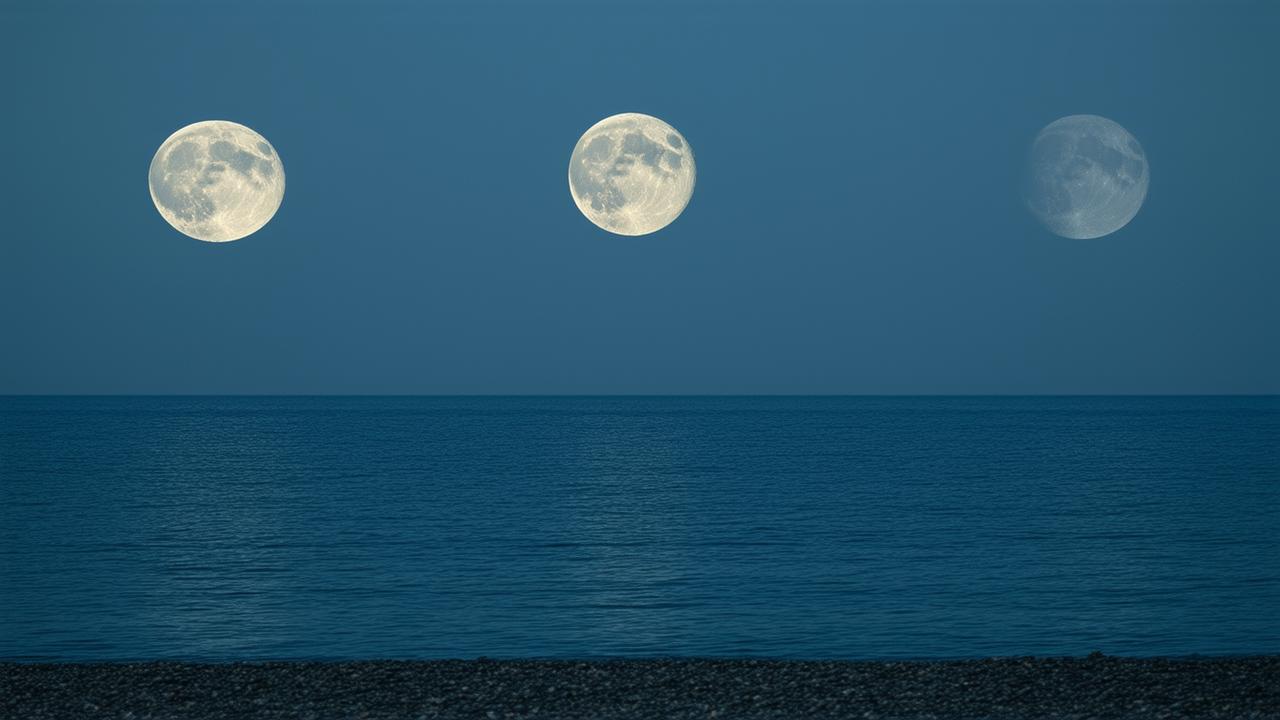
The tide smells different at four in the morning. It’s quieter, too. The waves breathe instead of crash, rolling in and out with the unhurried rhythm of something that has been practicing for billions of years. Stand on a dark shore at that hour and you might notice it: the soft crunch of shells underfoot, the chill of the wet sand seeping through your soles, the metallic tang of salt on your tongue. Above you hangs the Moon, pale and patient, tugging at the ocean as it has done since long before there were names for oceans or for moons. What you cannot see, what no one can see, is that the Moon is slowly slipping away. Each faint, silent centimeter of distance is changing the length of our days and the strength of our tides, rewriting the choreography of Earth and ocean in a way so subtle we almost miss it.
The Slow Goodbye in the Night Sky
Imagine a dance that has lasted 4.5 billion years. Not a frantic spin across the floor, but a long, steady waltz: Earth turning, oceans rising and falling, the Moon gliding in its orbit. Now imagine that, in this dance, one partner is very gradually stepping back. No flinging doors, no slammed exits, just a slow, almost tender retreat.
Every year, the Moon moves about 3.8 centimeters farther from Earth—roughly the rate at which your fingernails grow. Astronomers know this not because they guessed, but because they measure laser pulses bouncing off reflective panels left on the lunar surface by Apollo astronauts. The beams go out, hit the Moon, and return a tiny fraction of a second later, bearing a time stamp as precise as a heartbeat on a monitor. That delay is growing. The Moon is leaving.
This isn’t a sudden breakup. It’s a consequence of gravity and friction, of energy exchanged between rock and sea and sky. As Earth spins, its oceans bulge toward the Moon’s pull. But Earth rotates faster than the Moon orbits, so those bulges are dragged slightly ahead of the Moon’s position. Like a parent pulling a child’s sled from in front, those displaced bulges tug forward on the Moon, giving it extra energy. In return, Earth’s rotation gives up a sliver of its speed. The result is a quiet trade: we get longer days, the Moon gets a wider orbit.
The Lengthening of Daylight
Time itself is changing under your feet, and you probably didn’t notice. Not time in the abstract sense of aging and seasons, but literal, measurable days. The spin of Earth is slowing, the planet dragging its feet as if reluctant to complete each turn.
Right now, the effect is small. Tidal friction—the rubbing of water against seafloor, of crust against mantle—adds roughly 1.7 milliseconds to the length of each day every century. It’s the sort of number that feels negligible, like a single grain of sand tossed onto a beach. Yet stretch that sand-grain over millions and billions of years, and the beach looks very different.
Geologists read this history in stone. Ancient corals and shell-bearing creatures built their skeletons in daily and seasonal bands, like trees laying down rings. Fossils show that about 400 million years ago, there were roughly 400 days in a year. Not because Earth went faster around the Sun, but because the days themselves were shorter—just over 21.8 hours each. Farther back still, the newborn Earth might have spun through a day in as little as six hours.
When you stand outside at dusk and feel the light fade, you are inhabiting a moment in a very long, very slow story. Our 24-hour day is not a fixed design; it’s a phase. Future beings, watching their own sunsets long after humans are gone, may live under 25-hour days and never think to ask why.
When the Ocean Listens to the Moon
Walk along a rocky shore at low tide and the world opens up. Pools brim with anemones and starfish; crabs skitter between stones; knotted ropes of seaweed slump over exposed rocks like uncombed hair. All of this is staged by the Moon, whose gravity is strong enough to drag the oceans into great planetary inhalations and exhalations.
The Moon creates two bulges of water on opposite sides of Earth: one facing it directly, one on the far side, where water is left “behind” as Earth and Moon whir around a common center of mass. As our planet rotates through these bulges, coastlines rise into high tide and sink into low. It’s a rhythm so reliable that fish spawn with it, seabirds time their feeding to it, and humans schedule harbor entries and beach days around its swings.
But this, too, is changing. As the Moon drifts away, its gravitational pull on our oceans weakens. Over unimaginably long stretches of time, tides will become more modest. The dramatic range between high and low water that shapes many coastal ecosystems will slowly flatten.
To visualize this steady retreat and its subtle consequences, consider a simplified picture of the Moon’s changing distance and Earth’s day length over enormous spans of time:
| Epoch | Approx. Moon–Earth Distance | Length of One Day on Earth | Tidal Strength (Relative) |
|---|---|---|---|
| Early Earth (over 4 billion years ago) | Much closer than today | Possibly ~6–10 hours | Far stronger than today |
| ~400 million years ago | Closer than today | ~21–22 hours | Stronger than today |
| Present day | ~384,400 km | ~24 hours | Defined as 1× (current) |
| Far future (hundreds of millions of years) | Tens of thousands of km farther | >24 hours | Gradually weaker than today |
The story in the table is rough, but the trend is clear: as the Moon steps back, tides whisper instead of shout. Intertidal zones—the thin, critical strip of life between high and low tide—will shift and shrink. The choreography of feeding, spawning, migration, and nesting will be gently, then significantly, rewritten.
The Planet That Learns to Breathe Differently
Stand near an estuary at dawn and listen. You may hear the clucking of wading birds, the faint slap of fish at the surface, the soft fizz of tiny bubbles bursting where river meets sea. Estuaries, deltas, mangrove forests—their very existence leans hard on the difference between low and high tide. Here, the weakening of the Moon’s pull is more than a technical curiosity; it’s a deep ecological rewrite, stretched so slowly across time that each generation might never notice the difference.
Life uses tides like a clock. Horseshoe crabs haul themselves ashore to lay eggs when the tide runs highest, giving their young the best chance to avoid predation. Some reef fish release clouds of eggs in sync with particular phases of the Moon, timing hatching with the currents that will carry larvae to safer nurseries. Sea turtles pick nesting moments when tide and moonlight favor their long, exhausted climbs up the sand.
Now, think of these rhythms as music that is imperceptibly slowing down. Not by much over the span of a lifetime, or many lifetimes—but over millions of years, the tempo changes. Tidal ranges withdraw, the extremes of flooding and baring of the shore become less dramatic. Channels silt in differently. Marshes either drown more easily under storms, without strong flushing tides to pull sediments away, or they dry in new patterns where water no longer reaches as far.
It’s a strange thought: long after human influence has reshaped coasts with seawalls and carbon emissions, the Moon will still be editing the outlines of our shorelines in its own patient way. The planet has always been a moving target—continents sliding, climates shifting, oceans rising and falling. The Moon’s slow retreat is just one more layer of motion, one that has been operating silently in the background since before the first cell pulsed with life.
A Future of Still Waters and Long Evenings
Project yourself into an impossible future, billions of years from now. The Sun will have brightened and swelled, Earth’s oceans may have largely boiled away, and life as we know it will almost certainly be gone. Somewhere in that unimaginable era, the Moon will be much farther away—and the spin of Earth much slower.
Long before that ultimate endgame, something else will likely occur: tidal locking. This is the point where Earth’s rotation slows enough that the same side of the planet constantly faces the Moon, just as the same side of the Moon always faces us now. The day, at least in theory, would become the same length as the Moon’s orbital period. The daily rise-and-fall of tides as we know them would largely vanish, replaced by more static swells.
➡️ Psychology says people who let others go first in line when they seem rushed display these 6 situational awareness traits that most people are too self-focused to develop
➡️ Boiling rosemary is a simple home tip I learned from my grandmother, and it can completely transform the atmosphere of your home
➡️ New ban hitting wood burners announced as fireplace rules changed
➡️ Soon a driving licence withdrawal for senior motorists after a certain age a necessary safety measure or a shocking discrimination against retirees
➡️ Day will turn into night: the longest solar eclipse of the century is already scheduled and its extraordinary duration is astonishing scientists
➡️ No vinegar or baking soda needed : the trick to cleaning your car seats and removing the toughest stains
➡️ Add just two drops to your mop bucket and your home will smell amazing for days no vinegar, no lemon needed
This distant scenario is complicated by the fact that the Sun, too, raises tides—just weaker ones. As the Moon moves away and its grip slackens, solar tides will matter more. The dance becomes a three-body story: Earth’s spin, the Moon’s drift, the Sun’s growing glare. There will still be tides, but they’ll be gentler, driven more by the Sun’s insistent hand.
From a human vantage point, all this is more philosophy than prediction. We won’t be here to see those almost-still waters or those extra-long twilights. But knowing that the system is changing, even now, shifts something in the way we look up on a clear night. The Moon is not a fixed lantern pinned to the sky; it’s a companion on a diverging path, moving so gradually that only our most precise tools reveal its escape.
Your Life in a Moving Universe
It’s easy to hold an illusion that the big things are stable. Mountains feel immovable, coasts solid, the Moon a faithful constant. Our everyday experience is thick with repetition: sunrise and sunset, tide in and tide out, calendars that promise another June after this one is gone. Yet beneath that reassuring cycle is an unhurried drift. Plates inch past one another. Climates mellow and then lurch. The Moon pulls away; the days lengthen; the tides soften.
On a very personal scale, none of this alters how you’ll catch the bus tomorrow, or when your coffee cools, or when your favorite beach reveals its tide pools each afternoon. The extra milliseconds in today’s length are swallowed by the noise of daily life. But there’s a particular kind of perspective, almost a comfort, in realizing that you are living in the middle of a grand, glacially slow transition.
The long, pale light of evening that you enjoy after work exists because Earth once spun faster and is now decelerating. The regular, breathing tides that spread foam across the sand are a collaboration between a spinning planet and a receding Moon. You are not simply standing on Earth; you are part of this great, grinding, fluid process, as much in motion as the Moon itself.
Next time you find yourself under a clear sky, look up and find that familiar, cratered face. Think of lasers pinging off its surface, timing its retreat in fractions of a nanosecond. Think of fossil corals, silently recording shorter days hundreds of millions of years ago. Think of the animals and coastlines of the far future, adjusting in small, almost invisible ways to the gentler tides of a more distant Moon. Then listen, if you can, to the soft rush of blood in your own ears. The universe moves slowly, but it moves through you, too.
Frequently Asked Questions
Is the Moon really moving away from Earth?
Yes. Measurements from laser ranging experiments show that the Moon is receding from Earth at about 3.8 centimeters per year. This is caused by tidal interactions between Earth’s rotating oceans and the Moon’s gravity.
How does the Moon’s retreat make our days longer?
As tides drag against the seafloor and Earth’s crust, they create friction that slows Earth’s rotation slightly. When Earth spins more slowly, each full rotation takes longer—so the length of a day increases, by roughly 1.7 milliseconds per century.
Will we ever notice the change in day length?
Not directly in a human lifetime. The change is far too small to sense without precise instruments. Over hundreds of millions of years, however, the cumulative effect becomes large, transforming 22-hour days into 24-hour days, and eventually longer.
Are tides getting weaker right now?
The Moon’s gradual retreat does weaken its gravitational influence, but over human and even civilization timescales, the change is negligible compared with other factors such as local geography, storm patterns, and sea-level changes.
Could Earth and Moon ever stop changing like this?
In theory, the Earth–Moon system could reach a tidal equilibrium in which Earth becomes tidally locked to the Moon, and the main tidal interactions slow dramatically. In practice, the evolving Sun and other cosmic factors will likely alter the system long before a perfect equilibrium is reached.





