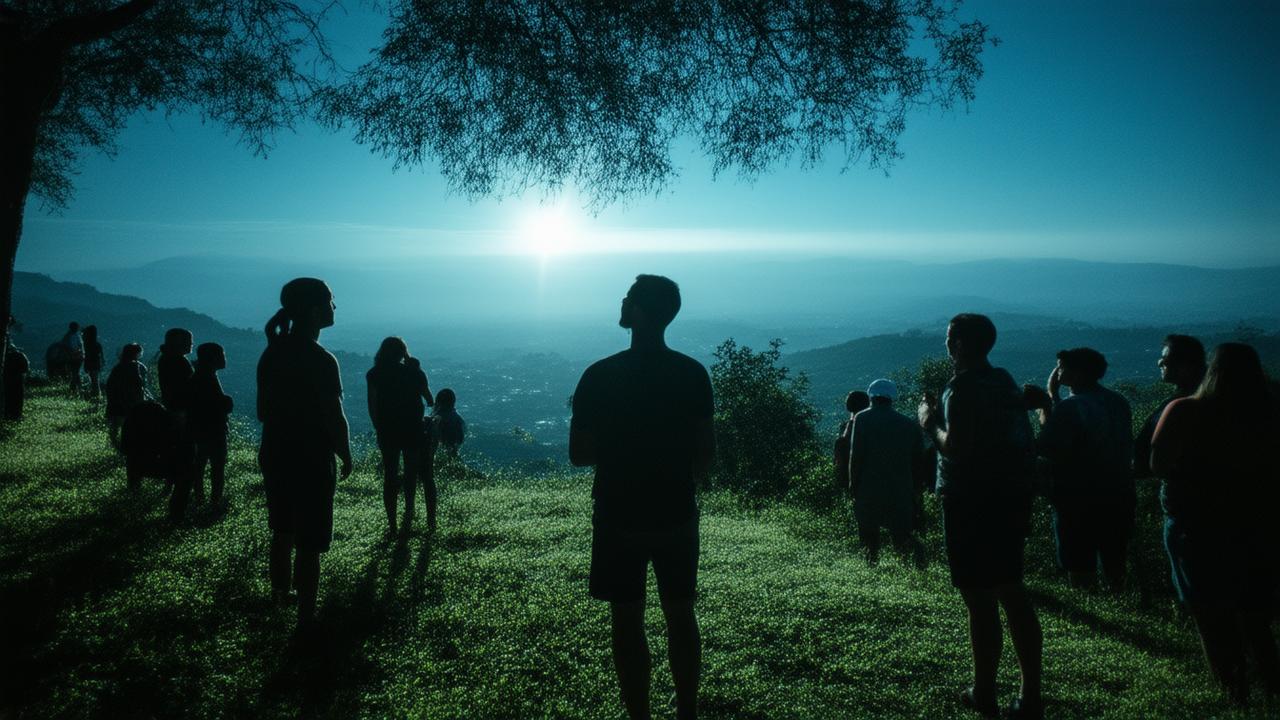
On an ordinary afternoon not so far from now, someone will be standing in a familiar field, or on a crowded city rooftop, or on the deck of a boat rolling gently at sea, and they will notice something is wrong with the light. The world will look slightly washed out, as if seen through old glass. Colors will flatten. Birds will hesitate mid-song. Shadows will sharpen to a strange, knife-edge clarity. And then, quite suddenly, day will begin to leak away, and the longest total solar eclipse of the century will turn the sky into an astonished, breath-held twilight.
The Slow Dimming: How an Eclipse Sneaks Up on You
Total solar eclipses don’t arrive like storms. There is no crash of thunder, no heralding drumroll. Instead, they slip quietly into the day, polite and methodical. The Moon, small and unassuming from Earth, begins to move across the Sun’s face, taking the first careful bite out of its dazzling disk. For a while, it’s easy to miss — one too-bright circle with a subtle notch, still fierce enough that you must not look at it with bare eyes.
But as the minutes pass, the change in light becomes undeniable. You might notice it on a white wall first, or in the way a familiar street looks oddly drained of warmth. Colors lose their summer fat. Reds and greens thin toward gray. The world feels as if someone has dialed down the saturation on reality. The air cools, not dramatically, but perceptibly enough that you might cross your arms without thinking, or feel a hint of goosebumps.
On the ground beneath trees, crescent-shaped patches of Sun slip through gaps in the leaves, spraying thousands of tiny half-moons across sidewalks, parked cars, and outstretched hands. It’s as though the planet itself is trying to show you what’s happening in the sky, painting living diagrams in scattered light. The mood shifts. People speak more quietly, as if entering a cathedral.
The Longest Shadow: Why This Eclipse Matters
Total solar eclipses are rare for any one place. Years, decades, or even generations can pass between them. But this one is different for another reason: it will bring the longest stretch of totality in an entire century. For a sliver of Earth, the Moon’s shadow will linger just a bit longer than usual, giving humans, animals, and instruments more time in the unearthly, midday night than anyone alive has ever experienced before.
Totality — that fragile interval when the Moon fully covers the Sun — usually lasts only a couple of minutes. Long enough to gasp, to fumble with a camera, to shout something wild and inarticulate. Long enough to forget, almost instantly, every scientific fact you ever knew about astronomy. But when totality stretches past three, four, even five minutes, something changes. The brief spectacle becomes a sustained experience, a kind of shared, global meditation on darkness and light.
The path of this eclipse will curve across Earth in a narrow band, a corridor barely a couple hundred kilometers wide but thousands long. Inside this track, the Sun will vanish entirely; just outside, it will remain a blindingly bright crescent. The difference between those two experiences — separated by such a small distance — will be the difference between day turning to night and day simply looking a little strange.
The Science of a Perfect Lineup
Totality requires cosmic precision. The Sun is about 400 times larger than the Moon, but also about 400 times farther away. By an extraordinary coincidence, that means both appear nearly the same size from Earth’s surface. When everything lines up — Sun, Moon, and Earth in a straight line — the Moon can slip perfectly over the Sun’s disk, like a coin covering a distant spotlight.
Because both orbits are slightly tilted and elliptical, not every new Moon produces an eclipse, and not every eclipse is total. Sometimes the Moon is just a little too far away, too small in apparent size, and the Sun’s outer ring burns around it in an annular, “ring of fire” event. For this century’s longest total eclipse, the geometry will be extravagantly kind: the Moon will be close, its shadow tight and dark, its motion across our face of the Sun timed to yield a long, luxurious span of totality.
When Day Becomes Night: Sights, Sounds, and Silence
Ask seasoned eclipse chasers about the moment of totality, and they’ll often pause, search for words, and then laugh softly, defeated. Language rusts in the presence of this experience. But we can try.
In the final minutes before totality, the light takes on a peculiar, metallic quality. Shadows go sharp as etched lines. The Sun shrinks to a glittering crescent that feels more like an artifact than a star. Somewhere, a dog begins to whine. Birds spiral toward their roosts, confused by the rushing twilight. Streetlights may flicker on. The wind shifts as the falling temperature ripples across the landscape like a slow-motion wave.
Then comes the last bead of sunlight, the “diamond ring” effect: a single searing point of light hanging on the Moon’s edge before vanishing. In that instant, the world exhales — and darkness falls. Not the blackness of midnight, but a deep, saturated twilight, as if sunset had dropped straight down from the sky rather than sliding across the horizon.
Overhead, the Sun is gone. In its place is a black, circular hole where the sky has been punctured, wreathed in the spectral white fire of the solar corona. Streamers of plasma, usually lost in the Sun’s glare, radiate outward in delicate, ghostly tendrils. Around the horizon, a 360-degree “sunset” encircles you, glowing orange and pink in every direction at once. Planets wink into view: Venus, brilliant and defiant; Jupiter, calmer and more reserved. Stars that normally belong to late evening appear right in the middle of the day.
For the longest total eclipse of the century, this will not be a fleeting glimpse. The world will live in this suspended moment for long, extended minutes. There is time to notice the temperature has dropped more than you expected; to hear the sudden quiet, or the distant, irrepressible cheering of people along the path. There is time to look up, look around, and look inward — to actually feel the weight of standing on a tiny planet, briefly plunged into the Moon’s traveling shadow.
How It Feels to Witness a Century’s Eclipse
Even if you know every number — the exact duration of totality, the speed of the Moon’s shadow across Earth, the angle of solar corona streamers — there is something primitive and unshielded about watching the Sun vanish from the sky. For tens of thousands of years, humans feared eclipses, weaving them into stories of devouring dragons, angry gods, and omens of upheaval. Those old instincts hum beneath our modern understanding, surfacing as an unnameable tension in the chest when daylight falters.
People often cry, or laugh unexpectedly. Some go silent, not out of politeness, but because their thoughts simply… stop. In the long totality of this eclipse, that sensation may deepen into something else: a feeling of rare, shared astonishment. Along the path of the shadow, millions of strangers who will never meet each other will all look up at the same darkened Sun and, for a handful of minutes, carry the same wordless realization: we live on a world that can be plunged into cosmic night in the middle of the day, and then gently returned.
Chasing the Shadow: Preparation, Safety, and Wonder
To experience totality, you must be within the narrow central path of the eclipse. A few dozen kilometers off to either side, and the Sun will remain a blazing crescent, too bright to look at directly. Partial eclipses are beautiful in their own way, but they do not bring true darkness, the ring of sunset on every horizon, or the revelation of the corona. For the longest total solar eclipse of the century, many will travel — by plane, train, car, or even hiking boots — to stand in that shadow’s highway.
There is a practical side to preparing. Certified eclipse glasses or solar viewers are essential for every phase except totality itself, when the Sun is completely covered. Ordinary sunglasses are not safe; neither are improvised filters. During the partial phases, the Sun is still radiating enough light to damage your eyes, even though it seems dimmer. Only when totality arrives, and the Sun’s bright disk is entirely hidden, can you remove your protective eyewear and look at that otherworldly black circle in safety.
➡️ France suffers a €3.2 billion blow as a last-minute reversal kills a major Rafale fighter jet deal
➡️ Neither boiled nor raw : the best way to cook broccoli for maximum antioxidant vitamins
➡️ France turns its back on the US and drops €1.1 billion on a European detection “monster” with 550 km reach
➡️ Day will turn to night during the longest total solar eclipse of the century occurring across regions
➡️ No more duvets in 2026? The chic, comfy and practical alternative taking over French homes
➡️ Seniors behind the wheel: will licenses be pulled automatically after 70 from ?
➡️ Goodbye kitchen cabinets: the cheaper new trend that won’t warp, swell, or go mouldy over time
For many, the anticipation becomes its own quiet adventure: mapping the path, checking climate normals for odds of clear skies, choosing a field or hill or roadside vantage point that feels right. Others will discover the eclipse almost by accident, surprised by the odd light, the sudden chilly breeze, the murmuring excitement of those who know what is happening. In both cases, the same cosmic event will roll overhead, impartial and precise, ignoring the fences and borders below.
A Simple Guide to the Experience
Here is a compact way to imagine how the hours of this eclipse might unfold if you are within the path of totality:
| Approximate Time | What You See | What You Might Feel |
|---|---|---|
| T–90 to T–60 minutes | First bite of the Moon on the Sun; still bright daylight. | Curiosity, a sense of unreality as nothing much seems different yet. |
| T–60 to T–20 minutes | Sun becomes a shrinking crescent, crescents appear on the ground through leaves. | Noticeable cooling, colors flattening, rising excitement. |
| T–20 to T–2 minutes | Light turns strange and sharp; environment enters deep twilight. | Unease mixed with awe; animals behave oddly, people grow quiet. |
| Totality (T to T+several minutes) | Sun fully covered; corona visible; stars and planets appear. | Overwhelming wonder, emotional release, time feels suspended. |
| T+several to T+60 minutes | Light returns in reverse; crescent Sun grows, day reasserts itself. | Relief, exhilaration, a bittersweet wish to see it all again. |
After the Shadow Passes
Just as quietly as it arrived, the Moon’s shadow will move on. The sky will brighten from west to east. Birds will venture into song again, tentatively at first, then with growing confidence. People will slip eclipse glasses back over their eyes for the departing partial phases or pack away tripods and notebooks. The strange chill will lift. Within an hour or so, if you didn’t know better, you might believe nothing unusual had happened at all.
But in pockets along the path of totality, the memory will hang on. There will be stories: of the child who clung to a parent’s hand and whispered, “Is the Sun okay?” Of the scientist who had waited an entire career for those extended minutes of data and then cried anyway. Of the farmer who stepped out from between rows of crops and, for once, looked not at the soil but above the horizon, into a sky stolen briefly by the Moon.
Long after the Sun has reclaimed its ordinary brilliance, the eclipse will live on in small, private ways. In a sketch in a notebook. In data curves charting the drop in temperature and the reactions of migrating birds. In a phone’s gallery filled with pictures that never quite capture how it truly felt. And in a simple, indelible memory: for the span of the longest total solar eclipse of the century, you stood on a spinning world while day turned honestly, completely, movingly into night — and then gave the light back.
Frequently Asked Questions
Is it safe to look at a total solar eclipse?
It is only safe to look at the eclipse with the naked eye during the period of totality, when the Sun is completely covered by the Moon. At all other times, including partial phases before and after, you must use certified eclipse glasses or a proper solar viewer. Ordinary sunglasses, smoked glass, or exposed film are not safe.
Why is this eclipse the longest of the century?
This eclipse benefits from especially favorable geometry: the Moon will be relatively close to Earth, appearing slightly larger in the sky, and the alignment of the orbits allows the Moon’s central shadow to sweep a longer path across Earth. Those factors combine to produce an unusually long duration of totality compared with other eclipses this century.
Will everyone on Earth see totality?
No. Only people located within the narrow path of totality will see the Sun fully covered. Those outside the path may see a partial eclipse, where the Moon takes a bite out of the Sun but never hides it completely. Weather, time of day, and your exact location all influence what you will experience.
Do animals really react to eclipses?
Yes. Many animals respond to the sudden change in light and temperature. Birds may head toward roosts, insects might start their evening choruses, and farm animals can appear restless or move as if night has arrived. Their behavior tends to return to normal as daylight comes back.
How often do total solar eclipses happen?
Total solar eclipses occur somewhere on Earth roughly every 18 months, but any single location on the planet may wait many decades or even centuries between events. The rarity of seeing totality from where you stand is part of what makes each one so prized — and why this century’s longest eclipse feels like an invitation not to be missed.





